Question types

Nutrition in Animals question types

112 questions across 9 question groups — pick any mix to generate a Science paper with step-by-step answer keys.

112
Questions
9
Question groups
5
Question types
Sample Questions

Nutrition in Animals questions

One sample from each question group in this chapter. Select any group above to see the full set with answer keys.

Q 1MCQ (1 Marks)1 Mark
The finger-like outgrowths of Amoeba helps to ingest food. However, the finger-like outgrowths of human intestine helps to
  • A
    digest the fatty food substances
  • B
    make the food soluble
  • absorb the digested food
  • D
    absorb the undigested food

Answer: C.

View full solution
Q 2MCQ (1 Marks)1 Mark
Choose the correct order of terms that describes the process of nutrition in ruminants
  • Swallowing → Partial digestion → Chewing of cud → Complete digestion
  • B
    Chewing of cud→ Swallowing → Partial digestion → Complete digestion
  • C
    Chewing of cud→ Swallowing → Mixing with digestive juices → Digestion
  • D
    Swallowing → Chewing and mixing → Partial digestion → Complete digestion

Answer: A.

View full solution
Q 3MCQ (1 Marks)1 Mark
Read carefully the terms given below. Which of the following set is the correct combination of organs that do not carry out any digestive functions?
  • Oesophagus, Large intestine, Rectum
  • B
    Buccal cavity, Oesophagus, Rectum
  • C
    Buccal cavity, Oesophagus, Large intestine
  • D
    Small intestine, Large intestine, Rectum

Answer: A.

View full solution
Q 5MCQ (1 Marks)1 Mark
Which of the following pair of teeth differ in structure, but are similar in function?
  • A
    Canines and incisors
  • Molars and premolars
  • C
    Incisors and molars
  • D
    Premolars and canines

Answer: B.

View full solution
The following questions consist of two statements.
Assertion (A) and Reason (R). Answer the following questions by selecting the appropriate option given below.
Assertion (A) Boiled and chewed rice does not give blue-black colour with iodine solution.
Reason (R) Boiled and chewed rice contains starch.
  • A
    Both A and R are true and R is the correct explanation of A
  • B
    Both A and R are true, but R is not the correct explanation of A
  • A is true, but R is false
  • D
    A is false, but R is true

Answer: C.

View full solution
The following questions consist of two statements.
Assertion (A) and Reason (R). Answer the following questions by selecting the appropriate option given below.
Assertion (A) Human beings cannot digest cellulose.
Reason (R) Humans do not have cellulose digesting bacteria.
  • Both A and R are true and R is the correct explanation of A
  • B
    Both A and R are true, but R is not the correct explanation of A
  • C
    A is true, but R is false
  • D
    A is false, but R is true

Answer: A.

View full solution
The following questions consist of two statements.
Assertion (A) and Reason (R). Answer the following questions by selecting the appropriate option given below.
Assertion (A) Pancreas secrete bile juice.
Reason (R) Liver is the largest gland in our body.
  • A
    Both A and R are true and R is the correct explanation of A
  • B
    Both A and R are true, but R is not the correct explanation of A
  • C
    A is true, but R is false
  • A is false, but R is true

Answer: D.

View full solution
The following questions consist of two statements.
Assertion (A) and Reason (R). Answer the following questions by selecting the appropriate option given below.
Assertion (A) The inner lining of stomach is protected from the effect of hydrochloric acid.
Reason (R) The inner lining of the stomach secrete mucus.
  • Both A and R are true and R is the correct explanation of A
  • B
    Both A and R are true, but R is not the correct explanation of A
  • C
    A is true, but R is false
  • D
    A is false, but R is true

Answer: A.

View full solution
The following questions consist of two statements.
Assertion (A) and Reason (R). Answer the following questions by selecting the appropriate option given below.
Assertion (A) Bread taste sour when chewed for some time.
Reason (R) Bread contains starch.
  • A
    Both A and R are true and R is the correct explanation of A
  • B
    Both A and R are true, but R is not the correct explanation of A
  • C
    A is true, but R is false
  • A is false, but R is true

Answer: D.

View full solution
Name the parts of the alimentary canal where
(a) water gets absorbed from undigested food
(b) digested food gets absorbed
(c) taste of the food is perceived
(d) bile juice is produced
View full solution
You were blindfolded and asked to identify the drinks provided in two different glasses. You could identify drink A as lime juice and B as bitter gourd juice. How could you do it inspite of being blindfolded?
View full solution
Ruminants such as cows and buffaloes swallow their food hurriedly and store it in a part of the stomach called rumen. The cellulose of the food is digested here by the action of certain bacteria, which are not present in humans. Later their partially digested food is returned to the buccal cavity of the animals in small lumps and animals chew it to complete the process of digestion. This process is called rumination.
View full solution
Boojho and Paheli were eating their food hurriedly so that they could go out and play during the recess. Suddenly, Boojho started coughing violently. Think of the reasons, why he was coughing and discuss with your friends?
View full solution
Choose the odd one out from each group and given reasons.
(i) Liver, salivary gland, starch, gall bladder
(ii) Stomach, liver, pancreas, salivary gland
(iii) Tongue, absorption, taste, swallow
(iv) Oesophagus, small intestine, large Intestine, rectum
View full solution
Q 313 Marks Question3 Marks
A person met with an accident while driving. After examination, the doctor told him that since he got a fracture in the wrist, operation would be required. After the operation, the patient was put on a glucose drip and was not given food for a few hours.
(i) Why was the patient not given food directly?
(ii) How does the glucose help the patient recover?
View full solution
Q 323 Marks Question3 Marks
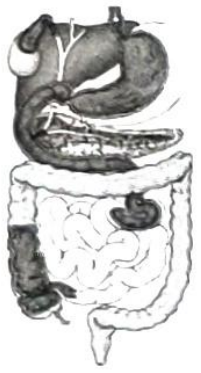
Label the following parts of given figure and name them.
Image
(a) The largest gland in our body.
(b) The organ where protein digestion starts.
(c) The organ that releases digestive juice into the small intestine.
(d) The organ where bile juice gets stored.
View full solution
Q 333 Marks Question3 Marks
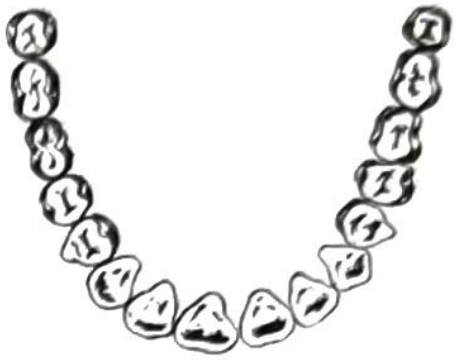
Label the given figure as directed below in A to D and give the name of each type of teeth.
(a) The cutting and biting teeth as A
(b) The piercing and tearing teeth as B
(c) The grinding and chewing teeth as C
(d) The grinding teeth present only in adult as D
Image
View full solution
Q 343 Marks Question3 Marks
Jaya returned from school and found that her grandmother was scolding their maid Rani, as she did not come the day before. The maid told that her son was passing watery stools frequently that's why she did not come. Jaya's mother who was listening the discussion came to them and told Rani not to come for coming 3-4 days. She also suggested to give her son a solution of sugar and salt in (boiled and cooled) water, many times a day for fast recovery. Jaya was surprised. She rushed to her mother and asked the scientific reason for it. Her mother smiled and explained her the importance of this solution.
(i) Name the term used to describe the condition in which a person passes out watery stools.
(ii) Name the solution of sugar and salt in water. Why is it given to a person suffering from this condition?
View full solution
Q 353 Marks Question3 Marks
Little Rishi (a student of class VI) was watching his favourite cartoon serial on television, while eating lunch. Suddenly he started getting hiccups. His elder brother Shubham, who was sitting near by him, gave him a glass of water and suggested not to eat too fast in a hurry. Little Rishi got confused as he had heard that 'hichki' comes when someone remembers.
He asked his father. His father smiled and explained him that it is only a myth. He also explained him the proper scientific reason behind it.
(i) What is hiccup?
(ii) Why do we get hiccup?
View full solution
Match the Column I with Column II.
Column I
(Animals)
Column II
(Mode of feeding)
A. Butterfly1. Bitting and chewing
B. Ant2. Swallowing
C. Mosquito3. Siphoning
D. Snake4. Sucking
View full solution
Column IColumn II
A. Salivary gland1. Bile juice secretion
B. Stomach2. Storage of undigested food
C. Liver3. Saliva secretion
D. Rectum4. Acid release
 5. Digestion is completed
View full solution
Match the Column I with Column II.
Column IColumn II
A. Amoeba1. Release of faeces
B. Incisors2. Cud chewing animals
C. Ruminant3. Pseudopodia
D. Anus4. Cutting and biting
View full solution

Generate a Nutrition in Animals paper free

Pick question groups from the list above, set marks and difficulty, and export a branded PDF with step-by-step answer keys. First 3 chapters free — no signup.

Download App