Questions

3 Marks Question

Take a timed test

11 questions · self-marked practice — reveal the answer and mark yourself.

Question 13 Marks
A person met with an accident while driving. After examination, the doctor told him that since he got a fracture in the wrist, operation would be required. After the operation, the patient was put on a glucose drip and was not given food for a few hours.
(i) Why was the patient not given food directly?
(ii) How does the glucose help the patient recover?
Answer
(i) The patient was not given food directly because after an operation the digestive system needs rest, and the patient may not be able to digest food properly.
(ii) Glucose provides instant energy as it is directly absorbed into the blood, helping the patient recover strength and heal faster.
View full question & answer
Question 23 Marks
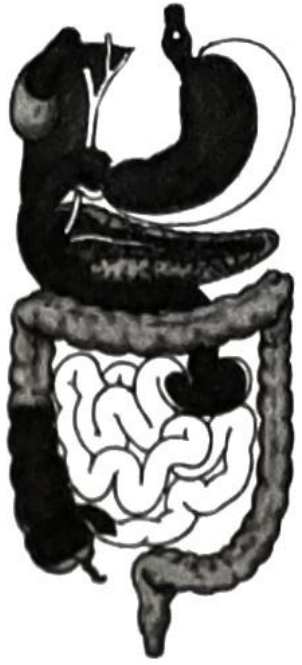
Label the following parts of given figure and name them.
Image
(a) The largest gland in our body.
(b) The organ where protein digestion starts.
(c) The organ that releases digestive juice into the small intestine.
(d) The organ where bile juice gets stored.
View full question & answer
Question 33 Marks
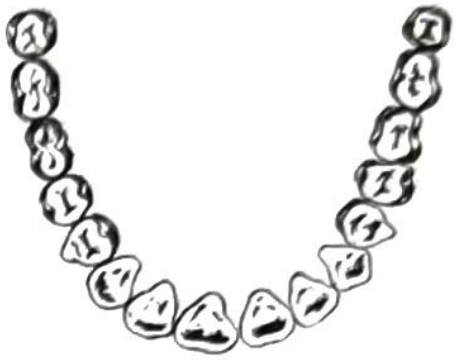
Label the given figure as directed below in A to D and give the name of each type of teeth.
(a) The cutting and biting teeth as A
(b) The piercing and tearing teeth as B
(c) The grinding and chewing teeth as C
(d) The grinding teeth present only in adult as D
Image
View full question & answer
Question 43 Marks
Jaya returned from school and found that her grandmother was scolding their maid Rani, as she did not come the day before. The maid told that her son was passing watery stools frequently that's why she did not come. Jaya's mother who was listening the discussion came to them and told Rani not to come for coming 3-4 days. She also suggested to give her son a solution of sugar and salt in (boiled and cooled) water, many times a day for fast recovery. Jaya was surprised. She rushed to her mother and asked the scientific reason for it. Her mother smiled and explained her the importance of this solution.
(i) Name the term used to describe the condition in which a person passes out watery stools.
(ii) Name the solution of sugar and salt in water. Why is it given to a person suffering from this condition?
Answer
(i) The condition in which a person passes watery stools is called diarrhoea.
(ii) The solution of sugar and salt in water is called Oral Rehydration Solution (ORS).
It is given to a person suffering from diarrhoea because it replaces the lost water and salts, preventing dehydration and helping in fast recovery.
View full question & answer
Question 53 Marks
Little Rishi (a student of class VI) was watching his favourite cartoon serial on television, while eating lunch. Suddenly he started getting hiccups. His elder brother Shubham, who was sitting near by him, gave him a glass of water and suggested not to eat too fast in a hurry. Little Rishi got confused as he had heard that 'hichki' comes when someone remembers.
He asked his father. His father smiled and explained him that it is only a myth. He also explained him the proper scientific reason behind it.
(i) What is hiccup?
(ii) Why do we get hiccup?
Answer
(i) Hiccup is a sudden, involuntary contraction of the diaphragm muscle, followed by the quick closing of the vocal cords, producing the "hic" sound.
(ii) We get hiccups when the diaphragm gets irritated, often due to eating too fast, overeating, drinking very cold or hot water, or swallowing air.
View full question & answer
Question 63 Marks
Define oral rehydration solution and when is it given to the patient? How can you prepare ORS at home?
Answer
Oral rehydration solution is the solution of sugar and salt in a particular ratio in the clean water. When a person passes out watery stools frequently, the disease is called diarrhoea. In this condition there is a loss of water and salt from the body of a person.
This is called dehydration, which may be fatal if not cured at proper time. In order to prevent dehydration, the person or patient should be given ORS. It makes up the loss of water and salts in the body and sugar provides energy which helps in the recovery of disease. It should be given to a patient suffering from diarrhoea at a regular interval.
At home the ORS can be prepared by dissolving a teaspoonful of sugar and pinch of salt in a glass of clean water. The water used for preparing ORS should be first boiled and then cooled so that all the microorganisms or harmful bacteria may be killed.
View full question & answer
Question 73 Marks
Ruminants such as cows and buffaloes swallow their food hurriedly and then sit restfully and chew their food. Give reason.
Answer
Ruminants such as cows and buffaloes swallow their food hurriedly and store it in a part of the stomach called rumen. The cellulose of the food is digested here by the action of certain bacteria, which are not present in humans. Later their partially digested food is returned to the buccal cavity of the animals in small lumps and animals chew it to complete the process of digestion. This process is called rumination.
View full question & answer
Question 83 Marks
Write the difference between milk teeth and permanent teeth.
Answer
The difference between milk teeth and permanent teeth are as follows
Milk teethPermanent teeth
They grow during infancy. i.e. when one is small baby.They grow at the age of 6-8 years.
They are also called as temporary teeth because these are lost at the age of 6-8 years.They do not fall until old age or due to some dental disease.
They can be replaced by permanent teeth.If these teeth fall down, no new teeth arise on their place.
View full question & answer
Question 93 Marks
Mention the different steps of nutrition in animals.
Answer
The various processes that are involved in the nutrition are as follows
(i) Ingestion The process by which food is taken into the body of an organism is called ingestion.
(ii) Digestion The process by which the food containing large insoluble substances is broken down into small water soluble substances is called digestion. There are two methods of digesting food, i.e., physical method (including chewing and grinding of food in mouth) and chemical method (addition of digestive juices to the food by the body itself).
(iii) Absorption The process by which the digested food passes through the intestinal wall into blood stream is called absorption.
(iv) Assimilation The process by which the absorbed food is taken in by body cells and used for energy, growth and repair is called assimilation.
(v) Egestion The process by which the undigested food material is removed from the body is called egestion.
View full question & answer
Question 103 Marks
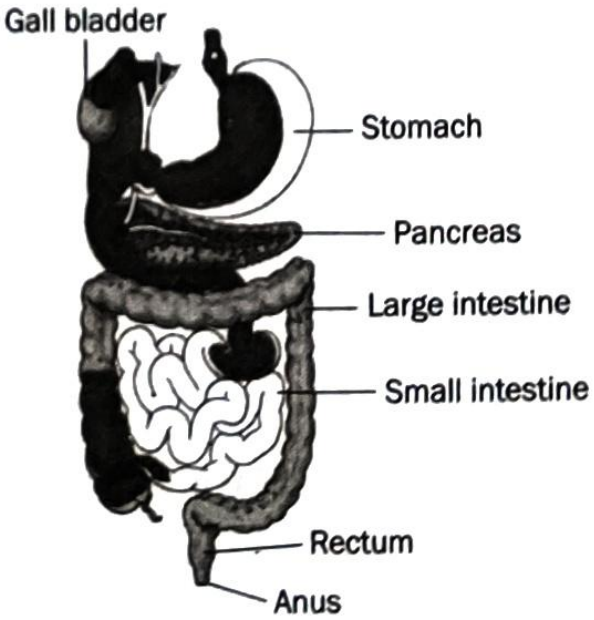
Label the given figure of the digestive system.
Image
Answer
The digestive system is composed of following parts
Image
View full question & answer
Question 113 Marks
Write the name of the mode of nutrition in the following organisms.
(i) Butterfly
(ii) Snail
(iii) Frogs
(iv) Snake
(v) Ant
Answer
The mode of nutrition in the given organisms is :
(i) Butterfly - Sucking
(ii) Snail - Scraping
(iii) Frog - Swallowing
(iv) Snake - Swallowing
(v) Ant - Chewing
View full question & answer