Questions

1 Marks Question

Take a timed test

21 questions · self-marked practice — reveal the answer and mark yourself.
Question 11 Mark
Coconut is a large and heavy fruit. How is it adapted for dispersal by water?
Answer
Coconut fruit has fibrous outer coat, which helps it to float in water.
View full question & answer
Question 21 Mark
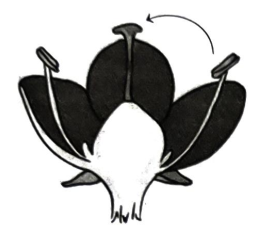
Which type of pollination does the given figure indicate?
Image
Answer
The given figure shows self-pollination, as the pollen grains from anther of flower are transferred to the stigma of the same flower.
View full question & answer
Question 31 Mark
Pick the odd one out from the following on the basis of mode of reproduction and give reason for it, Sugarcane, Potato, Rice, Rose.
Answer
The odd one out is rice.
In the above given pairs, rice reproduces by sexual reproduction but sugarcane, potato and rose reproduce vegetatively.
View full question & answer
Question 41 Mark
Fungus, moss and fern reproduce by a common method of asexual reproduction. Name the method.
Answer
Fungus, moss and fern reproduce by the common method of spore formation which is a type of asexual reproduction.
View full question & answer
Question 51 Mark
Boojho had the following parts of a rose plant-a leaf, roots, a branch, a flower, a bud and pollen grains. Which of them can be used to grow a new rose plant?
Answer
Branch can be used to grow a new rose plant. As, rose reproduces by vegetative propagation. i.e. stem cutting method.
View full question & answer
Question 61 Mark
Boojho wants to know why flowers are generally so colourful and fragrant? Is it to attract insects?
Answer
Flowers are colourful and fragrant to attract insects which help in pollination.
View full question & answer
Question 71 Mark
Paheli thought that new plants always grow from seeds. But, she has never seen the seeds of sugarcane, potato and rose. She wants to know how these plants reproduce?
Answer
Sugarcane, potato and rose can be reproduced using stem or buds of the parent plants.
View full question & answer
Question 81 Mark
What is the name of scars present on potato tuber?
Answer
The scars present on a potato tuber are called eyes.
View full question & answer
Question 91 Mark
The process of fertilisation in plants occurs in which part?
Answer
The process of fertilisation in plants occurs in the ovule.
View full question & answer
Question 101 Mark
Fruit is the ripened ovary of a flower. Explain.
Answer
After fertilisation, the ovary of a flower develops and becomes a fruit with seeds present inside.
View full question & answer
Question 111 Mark
In which part of flower does fertilisation occur?
Answer
Ovary is the part where fertilisation occur, i.e. male and female gametes fuse together.
View full question & answer
Question 121 Mark
Pollen grains are present inside anthers for long time yet they do not die. Why?
Answer
Pollen grains have a tough protective coat which prevents them from drying up.
View full question & answer
Question 131 Mark
Give one difference between unisexual and bisexual flower.
Answer
Unisexual flowers are those which contain either male or female reproductive part and bisexual flower has both reproductive parts (i.e. male and female) on the same flower.
View full question & answer
Question 141 Mark
Write the male and female reproductive parts present on the flowers.
Answer
The male reproductive part is stamen and the female reproductive part is pistil.
View full question & answer
Question 151 Mark
Name the spore producing bodies in fern.
Answer
Sori is a yellow-brown cluster of structure that produces spores. They are usually found on the lower surface of the leaves of ferns.
View full question & answer
Question 161 Mark
Mention the mode of reproduction in the following organisms.
(i) Spirogyra
(ii) Yeast
(iii) Money plants
Answer
(i) Spirogyra - Fragmentation
(ii) Yeast - Budding
(iii) Money plant - Vegetative propagation (stem cutting)
View full question & answer
Question 171 Mark
If the filament of Spirogyra is broken into fragments. What will you observe?
Answer
If the filament of Spirogyra is broken into fragments, then each fragment will develop into a new plant.
View full question & answer
Question 181 Mark
Name two plants where vegetative reproduction takes place by roots.
Answer
Sweet potato and Dahlia develops new plants through their roots by the process of vegetative reproduction.
View full question & answer
Question 191 Mark
Bryophyllum leaves reproduce using which mode of reproduction?
Answer
Bryophyllum leaves reproduce asexually by vegetative propagation.
View full question & answer
Question 201 Mark
Why is the process of reproduction necessary?
Answer
The process of reproduction is necessary for the perpetuation and preservation of species because it increases the number of members of species.
View full question & answer
Question 211 Mark
Formation of new, but similar individuals from parents is the characteristic feature of which process?
Answer
Formation of new, but similar individual is the characteristic feature of asexual reproduction.
View full question & answer