Question types

Reproduction in Plants question types

104 questions across 9 question groups — pick any mix to generate a Science paper with step-by-step answer keys.

104
Questions
9
Question groups
5
Question types
Sample Questions

Reproduction in Plants questions

One sample from each question group in this chapter. Select any group above to see the full set with answer keys.

Q 1MCQ (1 Marks)1 Mark
Seeds of drumstick and maple are carried to long distances by wind because they possess
  • winged seeds
  • B
    large and hairy seeds
  • C
    long and ridged fruits
  • D
    spiny seeds

Answer: A.

View full solution
Q 2MCQ (1 Marks)1 Mark
Which of the following parts of a plant take part in sexual reproduction?
(i) Flower
(ii) Seed
(iii) Fruit
(iv) Branch
Choose the correct answer given below.
  • A
    (i) and (ii)
  • (i), (ii) and (iii)
  • C
    (iii) and (iv)
  • D
    (ii), (iii) and (iv)

Answer: B.

View full solution
Q 3MCQ (1 Marks)1 Mark
Which of the following statements is/are true for sexual reproduction in plants?
(i) Plants are obtained from seeds
(ii) Two plants are always essential
(iii) Fertilisation can occur only after pollination
(iv) Only insects are agents of pollination
Choose from the options given below.
  • (i) and (iii)
  • B
    Only (i)
  • C
    (ii) and (iii)
  • D
    (i) and (iv)

Answer: A.

View full solution
Q 4MCQ (1 Marks)1 Mark
Pollination refers to the
  • A
    transfer of pollen from anther to ovary
  • B
    transfer of male gametes from anther to stigma
  • transfer of pollen from anther to stigma
  • D
    transfer of pollen from anther to ovule

Answer: C.

View full solution
Assertion (A) Seeds are dispersed to different places.
Reason (R) Drumstick and maple have winged seeds.
  • A
    Both A and R are true and R is the correct explanation of A
  • Both A and R are true, but R is not the correct explanation of A
  • C
    A is true, but R is false
  • D
    A is false, but R is true

Answer: B.

View full solution
Assertion (A) Pollen grains have a tough protective coat.
Reason (R) It protects the male gamete from adverse conditions like high temperature and low humidity.
  • Both A and R are true and R is the correct explanation of A
  • B
    Both A and R are true, but R is not the correct explanation of A
  • C
    A is true, but R is false
  • D
    A is false, but R is true

Answer: A.

View full solution
Assertion (A) Corn and papaya produce unisexual flowers.
Reason (R) Unisexual flowers contain both stamen and pistil.
  • A
    Both A and R are true and R is the correct explanation of A
  • B
    Both A and R are true, but R is not the correct explanation of A
  • A is true, but R is false
  • D
    A is false, but R is true

Answer: C.

View full solution
Assertion (A) The transfer of pollen from the anther to the stigma of a flower is called pollination.
Reason (R) Pollen grains have tough protective coat which prevents them from drying up.
  • A
    Both A and R are true and R is the correct explanation of A
  • Both A and R are true, but R is not the correct explanation of A
  • C
    A is true, but R is false
  • D
    A is false, but R is true

Answer: B.

View full solution
Assertion (A) Bryophyllum reproduces asexually through stem cutting.
Reason (R) Plants produced by vegetative propagation are exact copies of their parent plant.
  • A
    Both A and R are true and R is the correct explanation of A
  • B
    Both A and R are true, but R is not the correct explanation of A
  • C
    A is true, but R is false
  • A is false, but R is true

Answer: D.

View full solution
Boojho had the following parts of a rose plant-a leaf, roots, a branch, a flower, a bud and pollen grains. Which of them can be used to grow a new rose plant?
View full solution
When you keep food items like bread and fruits outside for a long time especially during the rainy season, you will observe a cottony growth on them.
(i) What is this growth called?
(ii) How does the growth take place?
View full solution
One morning as Paheli strolled in her garden she noticed many small plants, which were not there a week ago. She wondered, where they had come from as nobody had planted them there. Explain the reason for the growth of these plants.
View full solution
Q 313 Marks Question3 Marks
Ria went to a plant nursery with her mother. The gardener approached them and asked about their choice of plant. Ria's mother wanted a flowering plant with fragrance. Gardner showed them a plant and told them that this variety has been prepared by a method of vegetative propagation of stems. Ria grew curious and asked some questions to the gardener.
(i) What is vegetative propagation?
(ii) What is the method of producing new plants using stem?
View full solution
Q 333 Marks Question3 Marks
Ravi was sitting in a garden with his family. His younger sister came running with different types of flowers and started to name their parts. She stoped as she forgot some names and Ravi noticing this, came to help her.
His sister asked many questions related to flowers and Ravi answered her with all information he had.
(i) What is a flower? Mention its function during reproduction.
(ii) Flowers help in pollination and fertilisation. Yes/No. Give reason.
View full solution
Q 343 Marks Question3 Marks
Students of class 7th went on school trip to forest. There they observed a pond covered with a green film on surface. What can be these organisms covering the pond? Does these organisms harm the living bodies inside the pond?
View full solution
Name some fruit bearing plants. Now make a table and describe the method of seed dispersal in these fruits as well as the part which helps in the seed dispersal.
View full solution
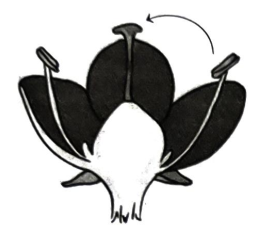
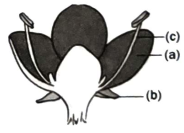
In the diagram of a bisexual flower given as figure, draw the missing part and label the parts marked (a), (b) and (c). Also label the missing part that you draw.
Image
View full solution
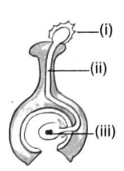
In the figure of a flower given below, label the parts whose functions are given below and give their names.
Image
(i) The part which contains pollen grains.
(ii) The part where the female gamete is formed.
(iii) The female reproductive part, where pollen grains germinate.
(iv) The colourful part of flower which attracts insects.
View full solution
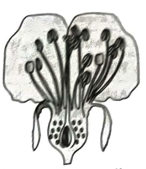
Observe the given figure and answer the following questions.
(i) Name the plant.
(ii) Which type of reproduction is seen in this plant?
(iii) Label the parts of this plant.
Image
View full solution

Generate a Reproduction in Plants paper free

Pick question groups from the list above, set marks and difficulty, and export a branded PDF with step-by-step answer keys. First 3 chapters free — no signup.

Download App