Questions

3 Marks Question

🎯

Test yourself on this topic

16 questions · timed · auto-graded

Question 13 Marks
Ria went to a plant nursery with her mother. The gardener approached them and asked about their choice of plant. Ria's mother wanted a flowering plant with fragrance. Gardner showed them a plant and told them that this variety has been prepared by a method of vegetative propagation of stems. Ria grew curious and asked some questions to the gardener.
(i) What is vegetative propagation?
(ii) What is the method of producing new plants using stem?
Answer
(i) Vegetative propagation is the formation of new plants from vegetative parts of the plant such as roots, stems and leaves. 
(ii) The stems of plants normally bear buds in the axils which can be used in a vegetative propagation to produce new plants. New plants can be obtained from the stem of an existing plant by cuttings. A small part of stem having nodes and buds is removed by making a cut with a sharp knife. The lower end of stem cutting is buried in the moist soil. After a few days the cutting develops roots. The buds grows and produces a shoot.
View full question & answer
Question 23 Marks
The transfer of pollen grains from anther to stigma of flower is termed as polination. Find out five wind pollinated flowers and list them.
Answer
List of wind pollinated flowers include
• Wheat
• Corn
• Barley
• Rice
• Rye
View full question & answer
Question 33 Marks
Ravi was sitting in a garden with his family. His younger sister came running with different types of flowers and started to name their parts. She stoped as she forgot some names and Ravi noticing this, came to help her.
His sister asked many questions related to flowers and Ravi answered her with all information he had.
(i) What is a flower? Mention its function during reproduction.
(ii) Flowers help in pollination and fertilisation. Yes/No. Give reason.
Answer
(i) Flowers are the reproductive parts of a plant. Functions of a flower are as follows.
1. It carry out sexual reproduction.
2. It forms male and female gametes.
3. It forms seeds and fruits.
(ii) Yes, flowers help in pollination and fertilisation. Flowers are essential for pollination and fertilisation because they attract pollinators have a structure that is specifically designed for pollination. These factors all work together to ensure that pollen is transferred from one flower to another which is necessary for fertilisation to occur.
View full question & answer
Question 43 Marks
Students of class 7th went on school trip to forest. There they observed a pond covered with a green film on surface. What can be these organisms covering the pond? Does these organisms harm the living bodies inside the pond?
Answer
The organisms covering the pond are algae. The massive growth of these algae form a dense layer on the surface of lake and water bodies. It makes water toxic to humans and organisms living inside the pond. It also reduces oxygen concentration in the water bodies.
View full question & answer
Question 53 Marks
Write how the following seeds are dispersed?
(I) Seeds with wings
(II) Small and light seeds
(iii) Seeds with spines/hooks
Answer
The mode of dispersal of the seeds having following properties are as follows
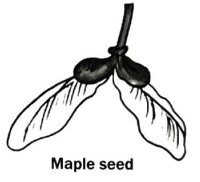
(i) Seeds with wings - like seeds of drumstick and maple are light weight and can be blown away by air. Thus, these are dispersed by wind.
(ii) Small and light seeds like of grasses are also dispersed through wind.
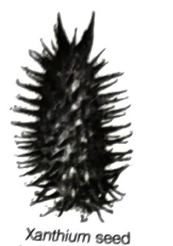
(iii) Seeds with spines/hooks seeds of Xanthium, Urena have spines and hooks on them, these hooks or spines are attached to the fur of the animal body. When animals move to other places and rub their body with tree, etc. These seeds fall from their body and get dispersed. Therefore, these are dispersed through animals.
View full question & answer
Question 63 Marks
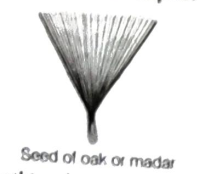
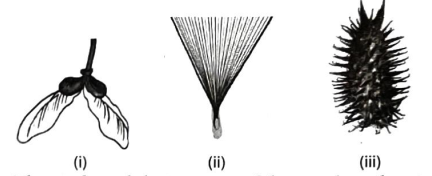
Group the seeds given in figure (i) to (iii) according to their means of dispersal.
(i) Seed dispersed by wind
(ii) Seed dispersed by water
(iii) Seed dispersed by animal
Image
Answer
The seeds and their means of dispersal can be given as follows
(i) The seed of maple is dispersed by wind. It has winged seed which are light in weight.
Image
(ii) Seed of oak or madar has hairy outgrowth which makes it lighter and can be dispersed by wind.
Image
(iii) Seed of Xanthium have numerous spines on them which gets attached to the fur of animals. Hence, these are dispersed by animals.

Image

None of the seed given in the figure is dispersed by water.
View full question & answer
Question 73 Marks
A student was given a flower. He was asked to pick the different whorls of flower by the forcep. He pulled each part of the flower and laid them on the chart paper in a sequence and named them W, X, Y, Z (from outer to inner whorl). He was unable to name them.
Help the student to name the different parts of a flower. Also help him to tell which part produces male gamete and female gametes.
Answer
The four whorls of the flower are outermost whorl 'W' is green part which is called sepal. Inside sepal the next whorl is 'X' which is coloured and attractive part of the flower called petals. The 'Y' is the inner whorl of flower called stamen. It is the male reproductive part of a flower. It consist of two parts, i.e. anther and filament. The anther contains several pollen grain which have male gamete. The whorl 'Z' is the innermost part of the flower called pistil. It is the female reproductive part of flower. It consists of three parts, i.e. stigma, style and ovary. The ovary contains ovule which produces the female gametes or egg cell.
View full question & answer
Question 83 Marks
Can animals pollinate flowers? Describe the process.
Answer
Yes, animals can pollinate flowers.
In this process, animals such as bees, butterflies, birds, or bats visit flowers to collect nectar or pollen for food.
While doing so, pollen grains from the male part (anther) stick to the body of the animal.
When the animal visits another flower, these pollen grains are transferred to the female part (stigma) of that flower.
This transfer of pollen helps in fertilization, leading to the formation of seeds and fruits, which ensures the reproduction of plants.
View full question & answer
Question 93 Marks
Differentiate between zygote and embryo.
Answer
The difference between a zygote and an embryo is as follows:
A zygote is the single-celled structure formed immediately after the fusion of male and female gametes during fertilization.
An embryo is the developing multicellular stage that forms from the zygote after repeated cell divisions.
Thus, a zygote is the initial stage, while the embryo is the later stage of development that eventually grows into a new organism.
View full question & answer
Question 103 Marks
Mention the benefits of seed dispersal.
Answer
Benefits of Seed Dispersal
Some benefits of seed dispersal are
(i) Seed dispersal avoids overcrowding of young plants around their parent plants.
(ii) It helps in preventing competition between the plants and its own seedlings for sunlight, water and minerals.
(iii) It also enables the plant to grow into new habitats for wider distribution and provides them with better chance of survival.
View full question & answer
Question 113 Marks
What is seed dispersal? What will happen if all the seeds of a plant were to fall at a same place and grow?
Answer
The process by which the seeds are scattered to different place (far and wide from their parents) is called seed dispersal. The seeds and fruits are dispersed away through various agencies like air, water and animals. Sometimes dispersal takes place by the explosion or bursting of fruits.
If all the seeds of a plant were to fall at the same place and grow, there would be a severe competition for sunlight, water, mineral and space. As a result, the survival for the plants will be difficult and the plants who survive will not grow into healthy plants.
View full question & answer
Question 123 Marks
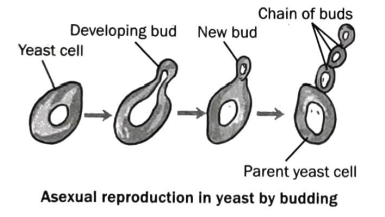
What is a bud? Which organism reproduce by budding? Give the diagrammatic representation of budding in an individual.
Answer
In this process, a small bulb-like projection called bud is formed on the parent body. The bud gradually grows in size and finally detaches itself from the parent plant. In this manner, a new individual is formed.
Yeast is a single-celled organism reproduced by the process of budding. Sometimes in yeast, another bud arises from the bud forming a chain of buds producing large number of yeast cells in short period of time.
Image
View full question & answer
Question 133 Marks
How do the plants like sugarcane, potato and rose reproduce when they cannot produce seeds?
Answer
Sugarcane and rose are propagated by stem cutting that is a method of vegetative propagation. In this, stem cutting with nodes is capable of growing into mature independent plants that are identical to their parents. Potato is an underground modified stem having bud called eyes, which sprout and develop into a new identical plant.
Thus, the plants which cannot produce seeds, can be propagated vegetatively with the help of vegetative parts such as stem, roots, buds and leaves.
View full question & answer
Question 143 Marks
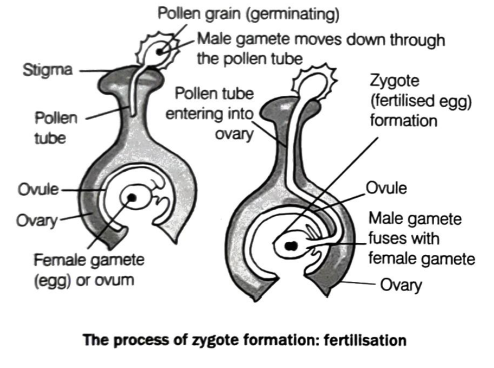
How does the process of fertilisation take place in flowers?
Answer
The process in which the male gamete fuses with female gamete to form a new cell (i.e. zygote) is called fertilisation.
The process of fertilisation in plants is as follows
(i) When the pollen is deposited on the stigma of the pistil, it begins to germinate. After some time, a long pollen tube is developed from the pollen grain which passes through the style towards the female gametes in the ovary.
(ii) The male gametes move down the pollen tube and the tube enters the ovule present inside the ovary.
(iii) The tip of pollen tube bursts and the male gamete comes out of the pollen tube. Inside the ovary, the male gametes fuse with the female gametes present in the ovule to form a fertilised egg cell which is called zygote.
(iv) The zygote develops into an embryo which is a part of a seed that develops into a new plant.
Image
View full question & answer
Question 153 Marks
Explain the differences between self-pollination and cross-pollination.
Answer
The differences between self-pollination and cross-pollination are as follows
Self-pollinationCross-pollination
Pollens are transferred to the stigma of same flower.Pollens are transferred to the stigma of different flower.
Does not require pollinating agents.Requires pollinating agents.
Occurs in papaya, corn, cucumber, etc.Common in most of flowers like rose, China rose, etc.
View full question & answer
Question 163 Marks
State the main differences between asexual and sexual reproduction.
Answer
The main differences between asexual and sexual reproduction are as follows
Asexual reproductionSexual reproduction
Only one parent is needed.Two parents, a male and a female are required.
Offspring are identical to their parents.Offspring exhibit variation with respect to their parents.
No seed is formed. Fragmentation, budding, spore formation, vegetative propagation are its different types.Seeds are formed due to the fusion of male and female gametes.
Spirogyra, yeast, moulds and potato exhibit asexual reproduction.Fruit bearing plants, like mango and China rose, reproduce sexually.
View full question & answer
3 Marks Question - Science STD 7 Questions - Vidyadip