Questions

3 Marks Question

Take a timed test

22 questions · self-marked practice — reveal the answer and mark yourself.

Question 13 Marks
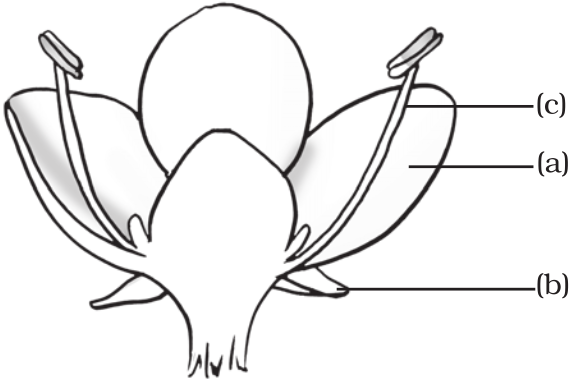
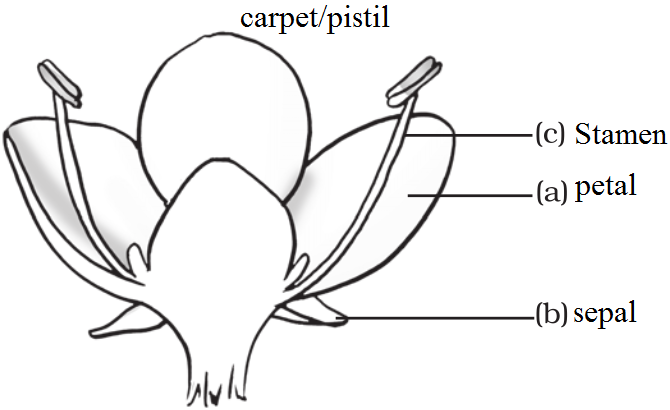
In the diagram of a bisexual flower given as Figure $12.5,$ draw the missing part and label the parts marked $(a), (b)$ and $(c).$ Also label the missing part that you draw.
Answer
The missing part along with the labelled part is as follows:
View full question & answer
Question 23 Marks
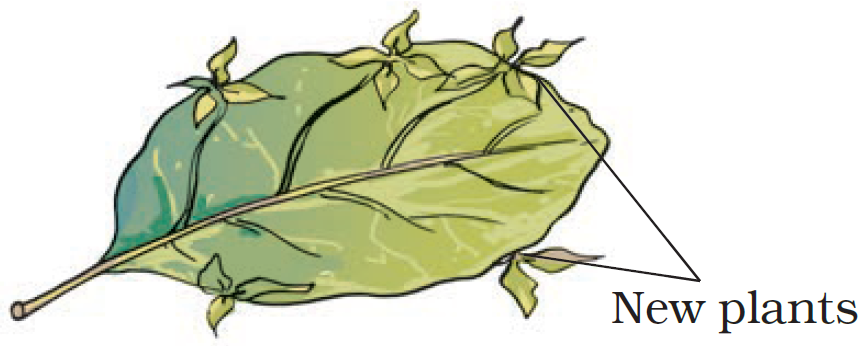
Observe the given figure?
  1. Which plant is this? Give the name of the plant.
  2. What does it shows?
  3. From where the new plants are developing?
Answer
  1. The given figure is of Bryophyllum leaf. It is also called as sprout leaf plant.
  2. It shows vegetative reproduction by leaves.
  3. The leaves of Bryophyllum develops some buds in its margin or edges which grow into new plants, when buried in the soil.
View full question & answer
Question 33 Marks
Explain what you understand by sexual reproduction.
Answer
Sexual reproduction is a process which involves production of seeds. It requires two parents. Most plants reproduce sexually with the help of flowers. The main function of a flower is to reproduce and therefore develop new seeds that can grow into new plants.
View full question & answer
Question 43 Marks
State the advantages of vegetative reproduction?
Answer
Following are the advantages of vegetative reproduction:
  1. Vegetative production allows plants to produce new plants quickly without any reproductive organs.
  2. The plants produced by this method are exact copies of the parent plant.
  3. New varieties of plants having required characteristics can be developed by this method.
View full question & answer
Question 53 Marks
How do the plants like sugarcane, potato and rose reproduce when they cannot produce seeds?
Answer
Sugarcane and rose are propagated by stem cutting that is a method of vegetative propagation, in which stem is capable of growing into a mature independent plants that are identical to their parents. Potato is an underground modified stem having bud called eyes, which sprout and develop into a new identical plant. Thus, the plants which cannot produce seeds, can be propagated vegetatively with the help of vegetative parts such as stem, roots, buds and leaves.
View full question & answer
Question 63 Marks
Mention the benefits of seed dispersal.
Answer
Benefits of Seed Dispersals:
  • Seed dispersal avoids overcrowding of young plants around their parent plants.
  • It helps in preventing competition between the plants and its own seedlings for sunlight, water and minerals.
  • One of the benefits of seed dispersal is that it enables the plant to grow into new habitats for wider distribution and provides them with better chance of survival.
View full question & answer
Question 73 Marks
What is seed dispersal? What will happen if all the seeds of a plant were to fall at a same place and grow?
Answer
Plant produces large number of seeds. When these seeds fall down they starts growing. The process by which the seeds are scattered to different place (far and wide from their parents) is called seed dispersal. The seeds and fruits are dispersed away through various agencies like air, water and animals. Sometimes dispersal takes place by the explosion or bursting of fruits. If all the seeds of a plant were to fall at the same place and grow, there will be a severe competition for sunlight, water, mineral and space. As a result, the survival for the plants will be difficult and the plants who survive will not grow into a healthy plants.
View full question & answer
Question 83 Marks
Collect some flower of different plants like papaya, rose, mustard, lady’s finger, Petunia, cucumber, corn, pea, etc. Group them under following heads.
  1. Which of these plants have unisexual flowers?
  2. Which of these plants have bisexual flower?
  3. What is the other name of unisexual and bisexual flower?
Answer
  1. Unisexual flowers are papaya, cucumber, com.
  2. Bisexual flowers are rose, mustard, lady’s finger, Petunia, pea.
  3. Unisexual flowers are also called as incomplete flower while bisexual flowers are called hermaphrodite or complete flowers.
View full question & answer
Question 93 Marks
Write how the following seeds are dispersed.
  1. Seeds with wings.
  2. Small and light seeds.
  3. Seeds with spines/ hooks.
Answer
The mode of dispersal of the seeds having following properties are as follows:
  1. Seeds with wings-like seeds of drumstick and maple become light weighted and can be blown away by air. Thus, these are dispersed by wind.
  2. Small and light seeds like seeds of grasses and cotton (having hairy growth) are also dispersed through wind.
  3. Seeds of Xanthium, Urena have spines and hooks on them, these hooks or spines are attached to the fur of the animal body. When animals move to other places and rub their body with tree, etc., these seeds fall from their body and get dispersed.. Therefore, these are dispersed through animals.
View full question & answer
Question 113 Marks
A student was given a flower. He was asked to pick the different whorls of flower by the forcep. He pulled each part of the flower and laid them on the chart paper in a sequence and named them $W, X, Y, Z$ (from outer to inner whorl). He was unable to name them. Help the student to name the different parts of a flower. Also help him to tell which part produces male gamete and female gametes.
Answer
The four whorls of the flower are outermost whorl $‘W’$ is green part which is called sepal. Inside sepal the next whorl is $X$ which is coloured and attractive part of the flower called petals. The $Y$ is the inner whorl of flower called stamen. It is the male reproductive part of flower. It consist of two parts, i.e. anther and filament. The anther contains male gametes called pollen grain. The whorl $‘Z’$ is the innermost part of the flower called pistil. It is the female reproductive part of flower. It consist of three parts, i.e. stigma, style and ovary. The ovary produces ovule which contains the female gametes or egg cell.
View full question & answer
Question 123 Marks
Describe the various ways by which seeds are dispersed.
Answer
Dispersal of seeds is the spreading of seeds across places.This dispersion of seed can take place by the following means:
  • Water: it takes place in aquatic plants and plants growing near water bodies, here seeds are dispersed through water. These seeds tend to develop a fibrous or spongy coating. The seeds float away from the parent plant. Example: coconut.
  • Wind: Some light-weighted seeds tend to float in the air and hence are dispersed by wind. Some seeds have long, feathery tails which help them to fly, like the tail of a kite. Example: Maple.
  • Animal: Seeds that are dispersed by animals have spines which help them attach to the animal bodies, hence carried to distant places. Example: urena.
View full question & answer
Question 133 Marks
Fill in the blanks with correct terms. The male and female gametes fuse to form a _____$ (a) $_____ during the process of _____$ (b) $_____. This grows into an _____$ (c) $_____ which is enclosed within a seed. After fertilisation the ovules develop into _____$ (d) $_____ and the ovary develops into a _____$ (e) $_____.
Answer
The male and female gametes fuse to form a $(a)$ during the process of zygote. $(b)$ This grows into an fertilisatio. $(c)$ embryo which is enclosed within a seed. After fertilisation the ovules develop into $(d)$​​​​​​​ seed and the ovary develops into a $(e)$​​​​​​​ fruit.
View full question & answer
Question 143 Marks
Fungus, moss and fern reproduce by a common method of asexual reproduction. Name the method.
Answer
Fungus, moss and fern reproduce by the method of spore formation, which is a type of asexual reproduction. Spores are asexual reproductive bodies produced by the parent plant, in spore cases. When the spore cases burst, the spores with hard protective layer are spread into air. On return of favourable conditions, the spores germinate and produce new plants.
View full question & answer
Question 153 Marks
Explain different types of pollination found in flowering plants.
Answer
Pollination is of two types:
  • Self-pollination: The transfer of pollen grains from the anther of a flower to the stigma of the same flower or another flower of the same plant is known as self-pollination or autogamy.
  • Cross pollination: The transfer of pollen grains of a flower to the stigma of another flower of a different plant of the same species is called cross pollination or allogamy.
View full question & answer
Question 163 Marks
Insects are called agents of pollination. How do they aid in process of pollination?
Answer
Flowers have nectars that attract insects. Insects suck these nectars as their food. When insects like bee, butterfly, etc., sit on the flower for sucking nectar, the sticky pollen grains get attached to their legs and wings. When these insects again sit on another flower, these pollen grains are transferred to the stigma of that flower from the body of the insects. In this way, insects help in pollination.
View full question & answer
Question 173 Marks
Explain the difference between self-pollination and cross - pollination.
Answer
Self-pollination Cross-pollination
It involves the transfer of pollen from the stamen to the pistil of the same flower. It involves the transfer of pollen from the stamen of one flower to the pistil of another flower of the same plant or that of a different plant of the same kind.
It occurs only in bisexual flowers. It occurs in both unisexual and bisexual flowers.
View full question & answer
Question 183 Marks
Differentiate between unisexual flower and bisexual flower$?$
Answer
S.No.
Bisexual flower
Unisexual flower
$1.$
It is also known as complete flower.
It is also known as incomplete flower.
$2.$
It contains both male and female reproductive system.
It contains either male or female reproductive system.
$3.$
E.g. Hibiscus.
E.g. Palm.
View full question & answer
Question 193 Marks
How does fertilization occur in flower? Where and how are seeds formed in plants?
Answer
When the pollen grain reaches the stigma of a flower, it starts giving rise to a pollen tube that passes through the style and reaches the ovary of the pistil. When the pollen tube reaches an ovule, it releases the male gametes. Male cells are released into the ovule for the fertilization with the female egg cell and thus the zygote is formed. After this process of fertilization, the ovary develops into fruit and ovule into seeds.
The Seed. The seed in a plant is the part that develops from the ovules after fertilization. They are enclosed in the fruit which develops from the fertilized ovary. The seeds are formed as a result of sexual reproduction and contain the young embryo which can develop into a new plant.
View full question & answer
Question 203 Marks
How does sexual reproduction take place in flowering plants?
Answer
The sexual reproduction in flowering plants involves:
  1. Pollination: Transfer of pollen grains from the anther to the stigma is called pollination. Pollen grains are transferred mainly by wind, water and insects. They are called as pollinating agents.
  2. Fertilization: The fusion of a male gamete with egg is known as fertilization. The fertilized egg is known as zygote which develops into embryo.
View full question & answer
Question 213 Marks
Explain three artificial methods of Vegetative Propagation.
Answer
  1. Cutting: Here the cuttings of the "parent" plant are removed and placed in a suitable environment so that they can grow into a whole new plant. For example rose cutting.
  2. Layering: The stem is bent down and the target region buried in the soil. The buried part of stem develops roots and is detached from the plant and develops into new plant.
  3. Grafting: In grafting a shoot or bud of a selected, desired plant (scion) is grafted onto the stock of another type of plant.
View full question & answer
Question 223 Marks
Boojho had the following parts of a rose plant - a leaf, roots, a branch, a flower, a bud and pollen grains. Which of them can be used to grow a new rose plant?
Answer
The branch can be used to grow a new rose plant, as rose reproduces through vegetative
Propagation by stem cutting method. The lower end of the stem cutting is buried in soil and the upper part having the bud is kept above the ground. The planted cutting is watered everyday.
After a few days, the cutting in soil develops roots and bud produces a shoot. In this way a branch cutting of a rose plant grows to become a new rose plant.
View full question & answer