Question
Explain the difference between self-pollination and cross - pollination.

Answer

Self-pollination Cross-pollination
It involves the transfer of pollen from the stamen to the pistil of the same flower. It involves the transfer of pollen from the stamen of one flower to the pistil of another flower of the same plant or that of a different plant of the same kind.
It occurs only in bisexual flowers. It occurs in both unisexual and bisexual flowers.

Need a full question paper?

Generate a complete, print-ready paper with questions like this in minutes — across 16+ boards, with answer keys.

Start Generating Free

Similar questions

Describe the following terms briefly.
  1. Trade winds.
  2. Wester lies.
  3. Polar winds.
Define light. Name three important properties of light.
Read the passage and answer the questions :
Rashmika noticed that the shadows of trees on her way to school were long in the morning and much shorter in the afternoon. She began to wonder why the size of the shadows changed throughout the day.
Q.1.  What causes the length of a shadow to change during the day?
(a) The shape of the object
(b) The movement of the Earth around the Sun
(c) The change in the Sun's position in the sky due to Earth's rotation
(d) The distance between the Earth and the Sun
Q.2. When would Rashmika observe the shortest shadow of a tree?
(a) Early morning$\quad$(b) Late evening
(c) Noon$\quad$$\quad$(d) Midnight
Q.3.  Which direction does a shadow point at noon in India?
(a) East$\quad$$\quad$(b) West
(c) South$\quad$$\quad$(d) North
Match the animals in Column $I$ with their mode of feeding listed in Column $II$
  Column I   Column II
  Animals   Mode of Feeding
$(a)$ House fly $(i)$ Biting and chewing
$(b)$ Cockroach $(ii)$ Suckling
$(c)$ Mosquito $(iii)$ Sponging
$(d)$ Infants $(iv)$ Sucking
Read the passage and answer the questions :
A student is conducting an experiment to observe the reaction of magnesium ribbon when it is burned in air. The student first cleans a small piece of magnesium ribbon using sandpaper and then ignites it using a flame. The ribbon burns with a dazzling white flame, and a white powdery substance is formed after the reaction. The student records these observations and continues to investigate the nature of the product formed by adding a small amount of water to the white powder.
Q.1. What is the white powder formed after burning magnesium ribbon?
(a) Magnesium sulphate
(b) Magnesium oxide
(c) Magnesium hydroxide
(d) Magnesium carbonate
Q.2. Which of the following will most likely happen after magnesium ribbon burns?
(a) The product will turn blue litmus paper red
(b) The product will turn red litmus paper blue
(c) The product will have no effect on litmus paper
(d) The product will blue litmus paper red as well as red litmus paper blue
Q.3. What is the result of adding water to magnesium oxide?
(a) It forms an acidic solution
(b) It forms a basic solution
(c) It forms a neutral solution
(d) It does not react with water
Differentiate between uniform and non-uniform motion.
A student was given a flower. He was asked to pick the different whorls of flower by the forcep. He pulled each part of the flower and laid them on the chart paper in a sequence and named them W, X, Y, Z (from outer to inner whorl). He was unable to name them.
Help the student to name the different parts of a flower. Also help him to tell which part produces male gamete and female gametes.
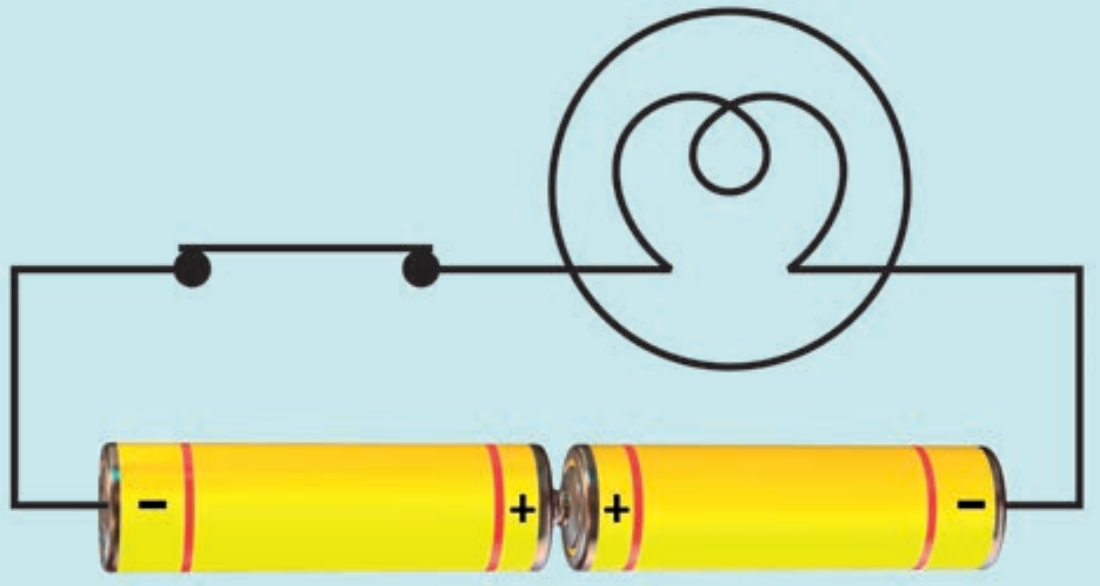
The bulb in the circuit shown in Fig. does not glow. Can you identify the problem? Make necessary changes in the circuit to make the bulb glow.
How do scientific ideas inspire innovations in other areas of life?
Why is it necessary to excrete waste products?