Question types

Respiration in Organisms question types

128 questions across 9 question groups — pick any mix to generate a Science paper with step-by-step answer keys.

128
Questions
9
Question groups
5
Question types
Sample Questions

Respiration in Organisms questions

One sample from each question group in this chapter. Select any group above to see the full set with answer keys.

Q 1MCQ (1 Marks)1 Mark
Fish breathe with the help of gills which are richly supplied with blood vessels. The gills help the fish to
  • A
    take in oxygen from air
  • take in oxygen dissolved in water
  • C
    absorb nutrients present in water
  • D
    release waste substances in water

Answer: B.

View full solution
Q 2MCQ (1 Marks)1 Mark
Breathing is a process that
(i) provides $O _2$ to the body
(ii) breaks down food to release energy
(iii) help the body to get rid of $CO _2$
(iv) produces water in the cells
Which of the following gives the correct combination of functions of breathing?
  • A
    (i) and (ii)
  • B
    (ii) and (iii)
  • (i) and (iii)
  • D
    (ii) and (iv)

Answer: C.

View full solution
Q 3MCQ (1 Marks)1 Mark
Joggers often develop cramps in calf muscles. Which of these chemicals, when produced, causes muscle cramps?
  • A
    Glucose
  • B
    Alcohol
  • Lactic acid
  • D
    Carbon dioxide

Answer: C.

View full solution
Q 4MCQ (1 Marks)1 Mark
People use different methods to get rid of nose hairs such as trimmers, waxing and many more. However, some health specialists are against the idea of removing nose hair. What likely is the concern regarding the removal of nose hairs?
  • A
    If may affect the sensitivity of the nose for odour
  • B
    The amount of inhaled oxygen will be affected
  • Germs and foreign particles will get entry inside the body easily
  • D
    It may lead to the production of mucous in excessive amounts inside the nose

Answer: C.

View full solution
Q 5MCQ (1 Marks)1 Mark
A teacher asked a student to observe inhalation. The student observed an expansion in his chest during inhalation. The teacher told the student that it is because of the movement of ribs and diaphragm. What movement is likely to be found in ribs and diaphragm of the student during inhalation?
  • A
    Diaphragm $\qquad\quad$ Ribs
    $~\quad$ Moves up$\qquad\qquad$ Moves up and inward
  • Ribs $\qquad\qquad\qquad\qquad\qquad\quad~~$ Diaphragm
    $~\quad$ Moves up and outward $\qquad\quad$Moves down
  • C
    Ribs$\qquad\qquad\qquad\qquad\qquad\qquad~~$ Diaphragm
    $~\quad$ Moves down and inward $\qquad\quad$ Moves up
  • D
    Ribs$\qquad\qquad\qquad\qquad\qquad\qquad~~$ Diaphgragm
    $~\quad$ Moves up and inward $\qquad\qquad$ Moves down

Answer: B.

View full solution
Assertion (A) Dolphins and whales keep coming to the water surface.
Reason (R) Dolphins and whales come up to water surface in the search of food.
  • A
    Both A and R are true and R is the correct explanation of A
  • B
    Both A and R are true, but R is not the correct explanation of A
  • A is true, but R is false
  • D
    A is false, but R is true

Answer: C.

View full solution
Assertion (A) We exhale only carbon dioxide.
Reason (R) Carbon dioxide turns lime water cloudy.
  • A
    Both A and R are true and R is the correct explanation of A
  • B
    Both A and R are true, but R is not the correct explanation of A
  • C
    A is true, but R is false
  • A is false, but R is true

Answer: D.

View full solution
Assertion (A) The breathing rate decreases during exercise.
Reason (R) More oxygen is needed by the muscles during exercise.
  • A
    Both A and R are true and R is the correct explanation of A
  • B
    Both A and R are true, but R is not the correct explanation of A
  • C
    A is true, but R is false
  • A is false, but R is true

Answer: D.

View full solution
Assertion (A) Yeast is an anaerobes.
Reason (R) In anaerobic respiration, glucose breaks down into carbon dioxide and water only.
  • A
    Both A and R are true and R is the correct explanation of A
  • B
    Both A and R are true, but R is not the correct explanation of A
  • A is true, but R is false
  • D
    A is false, but R is true

Answer: C.

View full solution
Assertion (A) The requirement of oxygen is more in higher animals.
Reason (R) Higher organisms need more energy.
  • Both A and R are true and R is the correct explanation of A
  • B
    Both A and R are true, but R is not the correct explanation of A
  • C
    A is true, but R is false
  • D
    A is false, but R is true

Answer: A.

View full solution
Boojho has seen in television programmes that whales and dolphins often come up to the water surface. They even release a fountain of water sometimes while moving upwards. Why do they do so?
View full solution
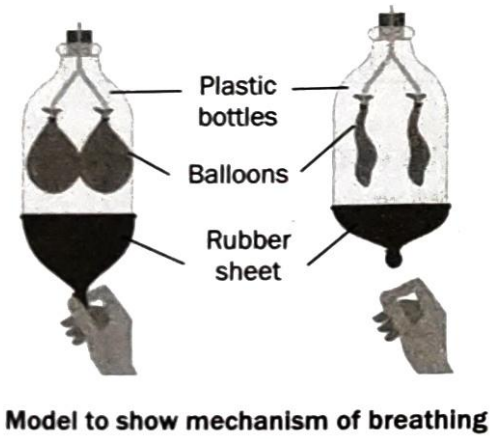
Given below is a model showing mechanism of breathing?
Image
(a) Did you see any changes in the balloons?
(b) What do the balloons in this model represent?
(c) What does the rubber sheet represent?
View full solution
Q 313 Marks Question3 Marks
A group of people were smoking cigarettes in a restaurant. The atmosphere was full of smoke. An old man sitting next to the group asked them to stop smoking while sitting in the premises or move out. They agreed to do so and promised not to repeat the mistake.
Answer the following questions.
(i) Write any three hazards of smoking.
(ii) Can smoking also affect the person who does not smoke?
View full solution
Q 323 Marks Question3 Marks
A girl was suffering from cold and was sneezing continuously. She joined her family at dinner and suddenly started sneezing without covering her nose, thus spreading particles all over the place.
On realising her mistake, said sorry and next time covered her nose.
(i) During sneezing, what are the precautionary steps to be followed?
(ii) Is sneezing a respiratory process?
View full solution
Q 333 Marks Question3 Marks
Roots of the plants get oxygen from the air present in the spaces between the soil particles. Find out how the plants living in the marshy areas respire?
View full solution
Q 343 Marks Question3 Marks
Measure the breathing rate of the members of your family. Evaluate
(i) If the breathing rate of males is the same or different from that of females.
(ii) If the breathing rate changes with age.
View full solution
Q 353 Marks Question3 Marks
Palak wants to be a great cyclist. She cycles daily for about 2 hours followed by some exercises. Today, she thought she will cycle for longer and managed it for $4^\frac{{1}}{2}$ hours. Now she is feeling cramped up and her breathing is disturbed. Her mother took her to hospital where the doctor examined and told her not to push herself more than necessary. Palak understood and promised herself to move slow and steadily.
Answer the following questions.
(i) Why did Palak have cramps in her legs?
(ii) Is breathing rate also affected after doing long hour of exercise? Why?
View full solution
Image
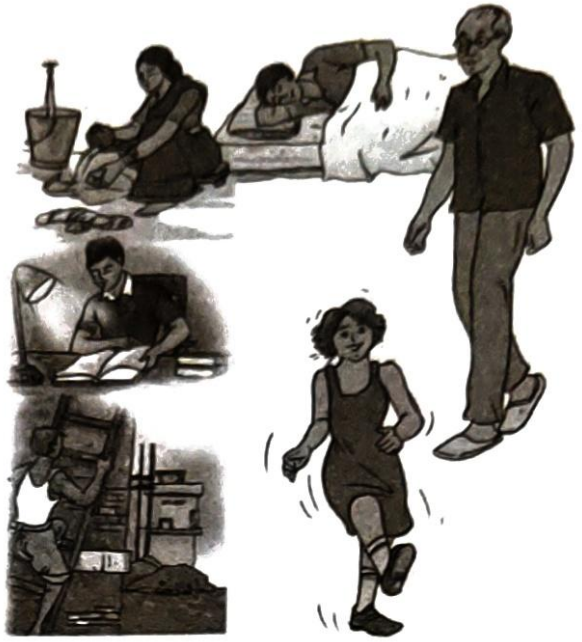
Breathing rate means the number of times a person breathes per minute. During breathing, inhalation and exhalation take place alternately. One inhalation plus one exhalation complete a single breath.
(i) Explain why the breathing rate increases during strenuous exercise?
(ii) When we exercise vigorously, the breathing rate increases and heart rate also increases. In this process, exhalation is also a very important part of exercise. Explain the importance of exhalation.
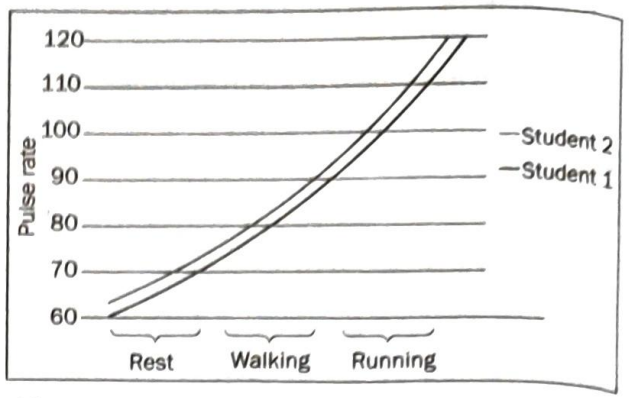
(iii) A teacher in the class assigned two students a task to compare the effect of physical activities on pulse rate. Students carried out a practical activity and collected class data. From this, they produced the graph above, which contains data at rest, brisk walking and fast running. Describe and explain the result of the investigation.
(iv) Suggest one aerobic breathing activity which can increase the capacity of lungs to take in more air.
View full solution

Generate a Respiration in Organisms paper free

Pick question groups from the list above, set marks and difficulty, and export a branded PDF with step-by-step answer keys. First 3 chapters free — no signup.

Download App