Questions

3 Marks Question

Take a timed test

15 questions · self-marked practice — reveal the answer and mark yourself.

Question 13 Marks
A group of people were smoking cigarettes in a restaurant. The atmosphere was full of smoke. An old man sitting next to the group asked them to stop smoking while sitting in the premises or move out. They agreed to do so and promised not to repeat the mistake.
Answer the following questions.
(i) Write any three hazards of smoking.
(ii) Can smoking also affect the person who does not smoke?
Answer
self
View full question & answer
Question 23 Marks
A girl was suffering from cold and was sneezing continuously. She joined her family at dinner and suddenly started sneezing without covering her nose, thus spreading particles all over the place.
On realising her mistake, said sorry and next time covered her nose.
(i) During sneezing, what are the precautionary steps to be followed?
(ii) Is sneezing a respiratory process?
Answer
self
View full question & answer
Question 33 Marks
Roots of the plants get oxygen from the air present in the spaces between the soil particles. Find out how the plants living in the marshy areas respire?
Answer
self
View full question & answer
Question 43 Marks
Measure the breathing rate of the members of your family. Evaluate
(i) If the breathing rate of males is the same or different from that of females.
(ii) If the breathing rate changes with age.
Answer
self
View full question & answer
Question 53 Marks
Palak wants to be a great cyclist. She cycles daily for about 2 hours followed by some exercises. Today, she thought she will cycle for longer and managed it for $4^\frac{{1}}{2}$ hours. Now she is feeling cramped up and her breathing is disturbed. Her mother took her to hospital where the doctor examined and told her not to push herself more than necessary. Palak understood and promised herself to move slow and steadily.
Answer the following questions.
(i) Why did Palak have cramps in her legs?
(ii) Is breathing rate also affected after doing long hour of exercise? Why?
Answer
self
View full question & answer
Question 63 Marks
Paheli participated in a 400 m race competition held at her school and won the race. When she came home she had mixed feelings of joy and pain as she had cramps in her leg muscles. After a massage, she was relieved of the pain. Answer the following questions related to the situation.
(i) What can be the possible reasons for the pain in her legs?
(ii) Why did she feel comfortable after a massage?
Answer
(i) Paheli had cramps in her leg muscles after running. She felt pain in her legs because of the accumulation of lactic acid in the leg muscles. Lactic acid is formed due to the anaerobic respiration in the muscle cells after heavy exercise, e.g. running.
During heavy exercise, we require large amount of energy.
To produce more energy, muscle cells perform anaerobic respiration for a short duration. As a result, lactic acid is formed due to partial breakdown of glucose. It gets accumulated in the muscle cells and causes pain and muscle cramps.
(ii) The massage or hot water bath gives the relief from muscle cramp or pain, because it improves the circulation of blood and lead to an increase in the supply of oxygen to the muscle cells. It helps in the complete breakdown of lactic acid into carbon dioxide and water.
View full question & answer
Question 73 Marks
Frogs are amphibians. They survive on land and water, do they have any respiratory issue? How do frogs breathe when they are in water? Do they possess lungs? Explain the role of lungs in frogs.
Answer
Frogs breathe by their moist skin and also through lungs. So, they do not have any respiratory issue. When frogs enters into water, the skin of frog helps in respiration. The oxygen rich air enters through the skin.
When the frog is on land, a pair of lungs helps in respiration.
The lungs take the oxygen rich air through the nostrils from where the oxygen is absorbed by the blood and carried throughout the body. The carbon dioxide from the blood diffuses back through the skin and lungs into the atmosphere.
View full question & answer
Question 83 Marks
It is not wise to sleep under a tree during night. Why?
Answer
During the day, plants photosynthesise in the presence of sunlight and uses $CO _2$ produced during respiration. During this process $O _2$ is released as a byproduct and a balance between $O _2$ and $CO _2$ is maintained in the atmosphere.
But in the night, plants do not photosynthesise. Moreover, during night they produce $CO _2$ and take $O _2$ during respiration. This leads to the increase in the proportion of $CO _2$ in the air.
So, if one sleeps under a tree at night, he will have problems in breathing as the amount of $CO _2$ in the air around will certainly be more than oxygen.
Therefore, it is not advisable to sleep under trees during night because the person will suffer from suffocation and will feel excess weight on chest.
View full question & answer
Question 93 Marks
A person put some warm water in an aquarium having fish during winter season. He thought that fishes would be more comfortable in luke warm water, than cold water. But he observed that fishes in the aquarium died. Why did the fishes die in warm water?
Answer
The fishes have special type of organs for respiration called gills. These gills absorb oxygen dissolved in water and through blood vessels, this oxygen is passed to all the parts of the body. The amount of dissolved oxygen is comparatively less in water than the amount of oxygen in air. Therefore, the rate of breathing is also high in aquatic animals.
If we add warm water to the aquarium, the dissolved oxygen dissociates and moves into the atmosphere again thus, leaving the least percentage of oxygen in the water. Therefore, fishes will have difficulty in breathing in the absence or low amount of oxygen in water and will die.
View full question & answer
Question 103 Marks
List some animals around you. Now group them as follows
(i) Animals that can breathe only through skin.
(ii) The animal that can breathe through skin as well as through lungs.
(iii) The animal that can breathe through lungs.
(iv) Animals that can breathe through gills.
(v) Animals that can breathe through spiracle and tracheae?
Answer
(i) Animals that can breathe only through skin are earthworm and leech.
(ii) Animals that can breathe through skin as well as through lungs are frogs.
(iii) Animals that can breathe through lungs are buffaloes, human and dolphins.
(iv) Animals that can breathe through gills are tadpole and fish.
(v) Animals that can breathe through spiracles and tracheae are grasshopper, cockroaches, ants, housefly and mosquito.
View full question & answer
Question 113 Marks
(i) Respiratory process occurs in two phases, what are those two major steps of respiration? Describe each one of them.
(ii) Define the term breathing rate.
Answer
(i) Respiration is the process of breakdown of food to produce energy for performing various functions. It involves two major steps:
(a) Inhalation is the process of taking in air rich in oxygen, inside our body.
(b) Exhalation is the process of giving out air rich in carbon dioxide from our body to the external environment.
(ii) The number of times a person breathes in a minute is called as breathing rate.
An adult human being can inhale and exhale 15-18 times in a minute. It is the average breathing rate in an adult human being. Breathing rate is not always constant.
View full question & answer
Question 123 Marks
A food stall owner was preparing dough for making bhaturas. He added a pinch of yeast and sugar to the dough and left it in a warm place. After few hours, the dough had risen. There was a sour smell too.
(i) Why did the dough rise?
(ii) Why did the dough smell sour?
(iii) Why was sugar added to the dough?
(iv) What would have happened if the dough was kept in the refrigerator, soon after it was prepared?
Answer
(i) The dough rises due to the release of carbon dioxide during anaerobic respiration by yeast cell.
(ii) During anaerobic respiration, yeast also produces alcohol which results in the sour smell of dough.
(iii) Sugar is added into the dough, because it acts as a food for yeast. Yeast, upon incomplete breakdown of sugar or food, produces $CO _2$, alcohol and energy (in less amount).
(iv) If the dough was kept in the refrigerator soon after it was prepared, then dough would rise neither nor become sour. Yeast requires warm temperatures to grow, multiply and respire. At low temperature, yeast does not respire to produce the byproducts of anaerobic respiration.
View full question & answer
Question 133 Marks
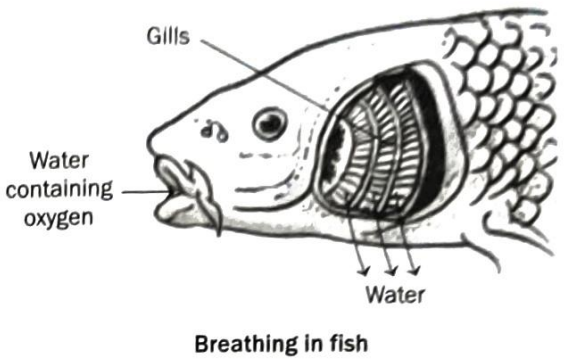
Respiration in fish is different from that in humans. Explain in brief how fish can breathe through gills?
Answer
Fishes are the aquatic animals that live in water. They have a special organ for breathing called gills. These are actually the projections of skin and have blood vessels for the exchange of respiratory gases.
The fish breathes by taking in water through its mouth and sending it over the gills. The oxygen dissolved in the water is extracted by the gills and is absorbed by the blood.
Image
This oxygen is then carried to all the parts of the fish for respiration. The carbon dioxide produced during respiration is brought back by the blood into the gills and expelled into the surrounding water.
View full question & answer
Question 143 Marks
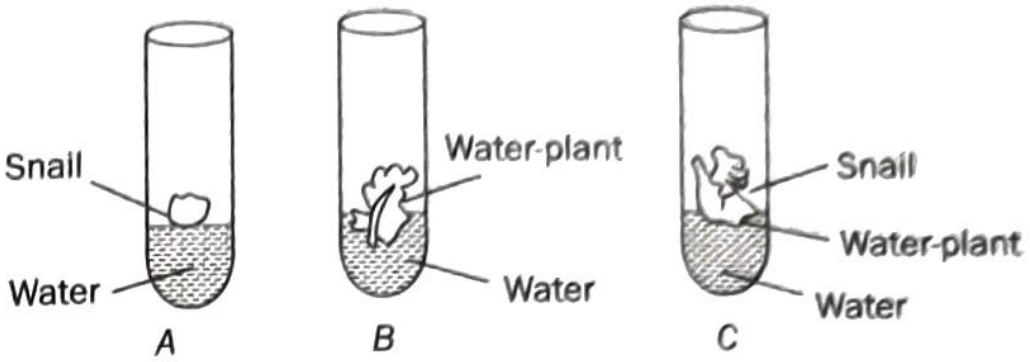
Take three test tubes. Fill 3/4th of each with water. Label them A, B and C. Keep a snall in test tube A, a water-plant in test tube B and in C, keep snall and plant both. Which test tube would have the highest concentration of $CO _2$ ?
Answer

Image
Test tube $A$ will have the highest concentration of $CO _2$.
This experiment shows the relationship between plants and animals. During breathing, snail inhales oxygen and releases $CO _2$.
Water-plant along with respiration performs another important function called photosynthesis. During photosynthesis, water-plant absorbs $CO _2$, prepares food and releases oxygen.
Therefore, test tube $B$ and $C$ will have less amount of $CO _2$ as compared to test tube $A$.
View full question & answer