Questions

3 Marks Question

Take a timed test

6 questions · self-marked practice — reveal the answer and mark yourself.

Question 13 Marks
Find whether 1156 and 2800 are perfect squares using prime factorisation.
Answer
(i) $1156=(2 \times 2) \times(17 \times 17)$
$\begin{array}{l}=2^2 \times 17^2 \\ =(2 \times 17)^2 \\ =(34)^2 \\ \therefore \sqrt{ } 1156=34\end{array}$
(ii) $2800=(2 \times 2) \times(2 \times 2) \times(5 \times 5) \times 7$
$=2^2 \times 2^2 \times 5^2 \times 7$
Since the factors cannot be paired
$\therefore 2800$ is not a perfect square.
View full question & answer
Question 23 Marks
Can you use this insight to find more numbers with an odd number of factors?
Answer
NumberFactorsNumber of factors
111 (odd)
41, 2, 43 (odd)
91,3,93 (odd)
161, 2, 4, 8, 165 (odd)
251, 5, 253 (odd)
361, 2, 3, 4, 6, 9, 12, 18, 369 (odd)
491, 7, 493 (odd)
641, 2, 4, 8, 16, 32, 647 (odd)
811, 3, 9, 27, 815 (odd)
1001, 2, 4, 5, 10, 20, 25, 50, 1009 (odd)
View full question & answer
Question 33 Marks
Does every number have an even number of factors?
Answer
Not every number has an even number of factors. Only perfect squares have an odd number of factors, because they each have one factor which, when multiplied by itself, equals the number.
NumberFactorsNumber of factors
111 (odd)
21, 22 (even)
31, 32 (even)
41, 2, 43 (odd)
51, 52 (even)
61, 2, 3, 64 (even)
71, 72 (even)
81, 2, 4, 84 (even)
91, 3, 93 (odd)
101, 2, 5, 104 (even)
View full question & answer
Question 43 Marks
Similar to squares, can you find the number of cubes with 1 digit, 2 digits, and 3 digits? What do you observe?
Answer
1-digit cubes : $1^3=8,2^3=8$
Count : 2 cubes $(1,8)$

2-digit cubes : $3^3=27,4^3=64$
Count : 2 cubes $(27,64)$

3-digit cubes : $5^3=125,6^3=216,7^3=343,8^3=512,9^3=729$
Count : 5 cubes ( $125,216,343,512,729$ )

The number of perfect cubes increases as the numbers get larger.
Unlike squares, cubes grow more quickly, so fewer cubes fit into smaller ranges.
View full question & answer
Question 53 Marks
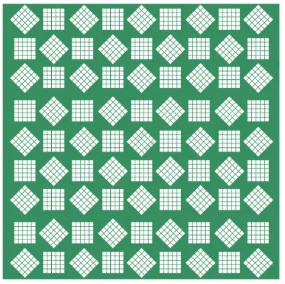
How many tiny squares are there in the following picture? Write the prime factorisation of the number of tiny squares.
Image
Answer
Number of squares in a row $=9$.
Number of squares in a column $=9$.
Total number of squares in the picture $=9 \times 9=81$.
Number of tiny squares in a square $=5 \times 5=25$.
Total number of tiny squares in the picture $=25 \times 81=2025$.
Prime factorization of 2025 :
$\begin{array}{l}2025=(3 \times 3) \times(3 \times 3) \times(5 \times 5) \\2025=3^2 \times 3^2 \times 5^2 \\2025=3^4 \times 5^2\end{array}$
View full question & answer
Question 63 Marks
Find the smallest number by which 9408 must be multiplied so that the product is a perfect square. Find the square root of the product.
Answer
$\begin{array}{l}9408=\underline{2 \times 2} \times \underline{2 \times 2} \times \underline{2 \times 2} \times 3 \times \underline{7 \times 7} \\9408=2^2 \times 2^2 \times 2^2 \times 7^2 \times 3\end{array}$
Here, 3 has no pair.
So, 9408 is not a perfect square. To make it a perfect square, we multiply it by 3 .
Therefore, $9408 \times 3=28224$, which is a perfect square.
$\begin{array}{l}\sqrt{28224} =\sqrt{2 \times 2 \times 2 \times 2 \times 2 \times 2 \times 3 \times 3 \times 7 \times 7} \\\sqrt{28224}=\sqrt{2^2 \times 2^2 \times 2^2 \times 3^2 \times 7^2} \\\therefore \sqrt{28224} =2 \times 2 \times 2 \times 3 \times 7=8 \times 21=168\end{array}$
View full question & answer
3 Marks Question - MATHS STD 8 Questions - Vidyadip