Questions

2 Marks Questions

Take a timed test

20 questions · self-marked practice — reveal the answer and mark yourself.

Question 12 Marks
Find the cube root of $15625$ by prime factorisation method.
Answer
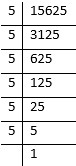

Prime factorisation of $15625$ is
$5 \times 5 \times 5 \times 5 \times 5 \times 5$ [grouping the factors in triplets]
$= 5^3 \times 5^3= (5 \times 5)^3= 25^3$
Therefore, $\sqrt[3]{{15625}} = 5 \times 5 = 25.$
View full question & answer
Question 22 Marks
Find the cube root of $27000$ by prime factorisation method.
Answer


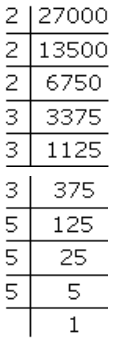
Prime factorisation of $27000$ is
$2 \times 2 \times 2 \times 3 \times 3 \times 3 \times 5 \times 5 \times 5$ [grouping the factors in triplets]
$=2^3 \times 3^3 \times 5^3$
Therefore, $\sqrt[3]{{27000}} = 2 \times 3 \times 5 = 30$
View full question & answer
Question 32 Marks
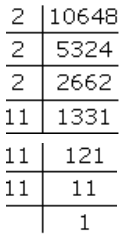
Find the cube root of $10648$ by prime factorisation method.
Answer


Prime factorisation of $10648$ is
$2 \times 2 \times 2 \times 11 \times 11 \times 11$ [grouping the factors in triplets]
$= 2^3 \times 11^3$
Therefore, $\sqrt[3]{{10648}} = 2 \times 11 = 22$
View full question & answer
Question 42 Marks
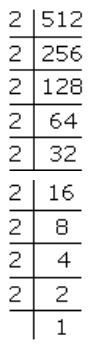
Find the cube root of $512$ by prime factorisation method.
Answer


Prime factorisation of $512$ is
$2 \times 2 \times 2 \times 2 \times 2 \times 2 \times 2 \times 2 \times 2 [grouping the factors in triplets]$
$=2^3 \times 2^3 \times 2^3=(2 \times 2 \times 2)^3=8^3$
Therefore, $\sqrt[3]{{512}} = 8$
View full question & answer
Question 52 Marks
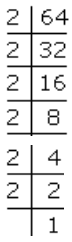
Find the cube root of $64$ by prime factorisation method.
Answer


Prime factorisation of $64$ is
$2 \times 2 \times 2 \times 2 \times 2 \times 2 [grouping the factors in triplets]$
$=2^3 \times 2^3=(2 \times 2)^3=4^3$
Therefore, $\sqrt[3]{{64}} = 4$
View full question & answer
Question 62 Marks
Parikshit makes a cuboid of plasticine of sides $5\ cm, 2\ cm, 5\ cm$. How many such cuboids will he need to form a cube?
Answer
Given numbers = $5\times2\times5$
Since factors of $5$ and $2$ both are not in a group of three.
Therefore, the number must be multiplied by $2\times5\times2$ $= 20$ to make it a perfect cube.
Hence, he needs $20$ cuboids.
View full question & answer
Question 72 Marks
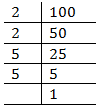
Find the smallest number by which of $100$ must be multiplied to obtain a perfect cube.
Answer

Prime factors of $100 = 2\times2\times5\times5$
Here factor $2$ and $5$ both do not appear in $3’s$ group.
Therefore $100$ must be multiplied by $2\times5 = 10$ to make it a perfect cube.
View full question & answer
Question 82 Marks
Find the smallest number by which $675$ must be multiplied to obtain a perfect cube.
Answer


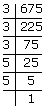
By prime factorisation,
$675 = 3 \times 3 \times 3 \times 5 \times 5$ [grouping the factors in triplets]
The prime factor $5$ does not appear in a group of three.
Therefore, $675$ is not a perfect cube. To make it a cube, we need one more $5$. In that case,
$675 \times 5 = 3 \times 3 \times 3 \times 5 \times 5 \times 5$
$3375= 3^3 \times 5^3$
$= (3 \times 5)^3$
$= 15^3$ which is a perfect cube.
Hence, the smallest number by which $675$ must be multiplied to obtain a perfect cube is $5$.
The resulting perfect cube is $3375 (= 15^3).$
View full question & answer
Question 92 Marks
Find the smallest number by which $72$ must be multiplied to obtain a perfect cube.
Answer


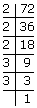
By prime factorisation,
$72 = 2 \times 2 \times 2 \times 3 \times 3$ [grouping the factors in triplets]
The prime factor $3$ does not appear in a group of three.
Therefore, $72$ is not a perfect cube. To make it a cube, we need one more $3$. In that case
$72 \times 3 = 2 \times 2 \times 2 \times 3 \times 3 \times 3$
$= 2^3 \times 3^3$
$= (2 \times 3)^3$
$= 6^3$ which is a perfect cube.
Hence, the smallest number by which $72$ must be multiplied to obtain a perfect cube is $3$.
View full question & answer
Question 102 Marks
Find the smallest number by which $256$ must be multiplied to obtain a perfect cube.
Answer


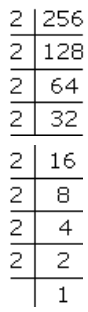
By prime factorisation,
$256 = 2 \times 2 \times 2 \times 2 \times 2 \times 2 \times 2 \times 2$ [grouping the factors in triplets]
In the above factorisation, $2$ remains after grouping $2's$ in triplets.
Therefore, $128$ is not a perfect cube. To make it a cube, we need one $2's$ more. In that case,
$256 \times 2 = 2 \times 2 \times 2 \times 2 \times 2 \times 2 \times 2 \times 2 \times 2$
$= 2^3 \times 2^3 \times 2^3 $
$= (2 \times 2 \times 2)^3$
$= 8^3= 512$ which is a perfect cube.
Hence, the smallest number by which $256$ must be multiplied to obtain a perfect cube is $2$.
The resulting perfect cube is $512 (= 8^3).$
View full question & answer
Question 112 Marks
Find the smallest number by which $243$ must be multiplied to obtain a perfect cube.
Answer


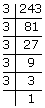
By prime factorisation,
$243 = 3 \times 3 \times 3 \times 3 \times 3$ [grouping the factors in triplets]
The prime factor $3$ does not appear in a group of three.
Therefore, $243$ is not a perfect cube. To make it a cube, we need one more $3$. In that case
$243 \times 3 = 3 \times 3 \times 3 \times 3 \times 3 \times 3$
$= 729$ which is a perfect cube.
Hence, the smallest number $3$ that should be multiplied by $243$ to make a perfect cube.
View full question & answer
Question 122 Marks
Is $46656$ a perfect cube?
Answer


By prime factorisation,
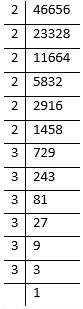
$46656 = 2 \times 2 \times 2 \times 2 \times 2 \times 2 \times 3 \times 3 \times 3 \times3 \times 3 \times 3$ [grouping the factors in triplets]
$=2^3 \times 2^3 \times 3^3 \times 3^3$
$=36^3$ which is a perfect cube.
All the terms form triplets
Therefore, $46656$ is a perfect cube.
View full question & answer
Question 132 Marks
Is $100$ a perfect cube?
Answer


By prime factorisation,
$100 = 2 \times 2 \times 5 \times 5$
In the above factorisation,$ 2 \times 2$ and $5 \times 5$ remains when try to group the factors in triplets.
Therefore, $100$ is $NOT$ a perfect cube.
View full question & answer
Question 142 Marks
Is $1000$ a perfect cube?
Answer


By prime factorisation,
$1000 = 2 \times 2 \times 2 \times 5 \times 5 \times 5 [grouping the factors in triplets]$
$ =2^3 \times 5^3$
$=(2 \times 5)^3=(10)^3$ , which is a perfect cube
All the terms form triplets
Therefore, $1000$ is a perfect cube.
View full question & answer
Question 152 Marks
Is $128$ a perfect cube?
Answer


By prime factorisation,
$128 = 2 \times 2 \times 2 \times 2 \times 2 \times 2 \times 2$ [grouping the factors in triplets]
$=2^3 \times 2^3 \times 2$
In the above factorisation, $2$ remains after grouping the $2's$ in triplets.
Therefore, $128$ is not a perfect cube.
View full question & answer
Question 162 Marks
Is $216$ a perfect cube?
Answer


By prime factorisation,
$216 = 2 \times 2 \times 2 \times 3 \times 3 \times 3 [grouping the factors in triplets]$
$ =2^3 \times 3^3 $
$ =(2 \times 3)^3$
$=6^3$ which is a perfect cube.
All the terms form triplets
Therefore, $216$ is a perfect cube.
View full question & answer
Question 172 Marks
Find the cube root of $8000$.
Answer


By prime factorisation,
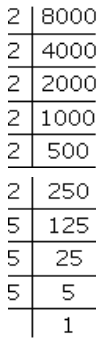
$8000 = 2 \times 2 \times 2 \times 2 \times 2 \times 2 \times 5  \times 5 \times 5$ [grouping the factors in triplets]
$=2^3 \times 2^3 \times 5^3$[by laws of exponents]
$=(2 \times 2 \times 5)^3$
$=20^3$ which is a perfect cube.
Hence, $8000$ is a perfect cube.
View full question & answer
Question 182 Marks
Is $1188$ a perfect cube? If not, by which smallest natural number should $1188$ be divided so that the quotient is a perfect cube?
Answer
$1188 = 2 \times 2 \times 3 \times 3 \times 3 \times 11$
The primes $2$ and $11$ do not appear in groups of three. So, $1188$ is not a perfect cube.
In the factorisation of $1188$, the prime $2$ appears only two times and the prime $11$ appears once.
So, if we divide $1188$ by $2 \times 2 \times 11 = 44$, then the prime factorisation of the quotient will not contain $2$ and $11$.
Hence the smallest natural number by which $1188$ should be divided to make it a perfect cube is $44$.
And the resulting perfect cube is $1188 ÷ 44 = 27 = 3^3$
View full question & answer
Question 192 Marks
Is $53240$ a perfect cube? If not, then by which smallest natural number should $53240$ be divided so that the quotient is a perfect cube?
Answer
$53240 = 2 \times 2 \times 2 \times 11 \times 11 \times 11 \times 5$
The prime factor $5$ does not appear in a group of three.
So, $53240$ is not a perfect cube. In the factorisation $5$ appears only one time.
If we divide the number by $5$, then the prime factorisation of the quotient will not contain $5$.
So, $53240 \div 5 = 2 \times 2 \times 2 \times 11 \times 11 \times 11$
Hence the smallest number by which $53240$ should be divided to make it a perfect cube is $5$.
The perfect cube in that case is $= 10648$.
View full question & answer
Question 202 Marks
Is $392$ a perfect cube? If not, find the smallest natural number by which $392$ must be multiplied so that the product is a perfect cube.
Answer
$392 = 2 \times 2 \times 2 \times 7 \times 7$
The prime factor $7$ does not appear in a group of three.
Therefore, $392$ is not a perfect cube. To make its a cube, we need one more $7$.
In that case $392 \times 7 = 2 \times 2 \times 2 \times 7 \times 7 \times 7 = 2744$ which is a perfect cube.
Hence the smallest natural number by which $392$ should be multiplied to make a perfect cube is $7$.
View full question & answer