Questions

3 Marks Question

🎯

Test yourself on this topic

16 questions · timed · auto-graded

Question 13 Marks
Consider the following pattern
$\begin{array}{l}2^3-1^3=1+2 \times 1 \times 3,3^3-2^3=1+3 \times 2 \times 3 \\4^3-3^3=1+4 \times 3 \times 3\end{array}$
Using the above pattern, find the value of the following:
(i) $7^3-6^3$$\qquad\quad$(ii) $12^3-11^3$
(iii) $20^3-19^3$$\quad~~$(iv) $51^3-50^3$
Answer
Using the given pattern, we can write
$\begin{aligned}\text{(i)} ~7^3-6^3 & =1+7 \times 6 \times 3 \\& =1+7 \times 18=1+126=127\end{aligned}$
$\begin{aligned}\text{(ii)} ~12^3-11^3 & =1+12 \times 11 \times 3 \\& =1+12 \times 33=1+396=397\end{aligned}$
$\begin{aligned}\text{(iii)}~ 20^3-19^3 & =1+20 \times 19 \times 3=1+20 \times 57 \\& =1+1140=1141\end{aligned}$
$\begin{aligned}\text{(iv)}~ 51^3-50^3 & =1+51 \times 50 \times 3=1+51 \times 150 \\& =1+7650=7651\end{aligned}$
View full question & answer
Question 23 Marks
Check which of the following are perfect cubes :
2700
Answer
We have, 2700
Resolving 2700 into prime factors,
we get
22700
21350
3675
3225
375
525
55
1

$2700=2 \times 2 \times \underline{3 \times 3 \times 3} \times 5 \times 5$
Clearly, the prime factors of 2 and 5 do not appear in groups of three (triples).
So, 2700 is not a perfect cube.
View full question & answer
Question 33 Marks
Find the cube root of each of the following number by prime factorisation method:
512
Answer
We have, 512
Resolving 512 into prime factors, we get
2512
2256
2128
264
232
216
28
24
22
1
$512=\underline{2\times2\times2}\times\underline{2\times2\times2}\times\underline{2\times2\times2}$
$=2^{3} \times 2^{3} \times 2^{3}$
$\therefore \sqrt{512}=2 \times 2 \times 2=8$
Hence, the cube root of 512 is 8.
View full question & answer
Question 43 Marks
Find the cube root of each of the following number by prime factorisation method:
64
Answer
We have, 64
Resolving 64 into prime factors, we get
264
232
216
28
24
2
1
$\begin{aligned} 64 & =\underline{2 \times 2 \times 2} \times \underline{2 \times 2 \times 2} \\ & =2^3 \times 2^3 \\ \therefore \sqrt[3]{64} & =2 \times 2=4\end{aligned}$
Hence, the cube root of 64 is 4.
View full question & answer
Question 53 Marks
Find the smallest number by which each of the following number must be divided to obtain a perfect cube :
128
Answer
We have, 128
Resolving 128 into prime factors, we get
2128
264
232
216
28
24
22
1
$128=\underline{2 \times 2 \times 2} \times \underline{2 \times 2 \times 2} \times 2$
The prime factor 2 does not appear in a group of three (triples).
So, 128 is not a perfect cube,
Thus, we will divide the number by 2.
$\therefore 128 \div 2=64=\underline{2 \times 2 \times 2} \times \underline{2 \times 2 \times 2}$
Hence, the smallest number by which 128 should be divided to make it a perfect cube is 2.
View full question & answer
Question 63 Marks
Find the cube of the following numbers.
(i) 16 $\quad$ (ii) 17 $\quad$ (iii) 23.
Answer
(i) Given, number is 16.
Cube of $16=16 \times 16 \times 16=4096 \quad\left[\because a^3=a \times a \times a\right]$
(ii) Given, number is 17.
Cube of $17=17 \times 17 \times 17=4913$
(iii) Given, number is 23.
Cube of $23=23 \times 23 \times 23=12167$
View full question & answer
Question 73 Marks
Complete the following cubes of numbers 1 to 10.
NumberCubeNumberCube
1$1^3= 1$6$6^3=$
2$2^3= 8$7$7^3=$
3$3^3= 27$8$8^3=$
4$4^3=$9$9^3=$
5$5^3=$10$10^3=$
Answer
NumberCubeNumberCube
1$1^3= 1$6$6^3=216$
2$2^3= 8$7$7^3=343$
3$3^3= 27$8$8^3=512$
4$4^3=64$9$9^3=729$
5$5^3=125$10$10^3=1000$
View full question & answer
Question 83 Marks
What is the value of $\sqrt[3]{64}-\frac{1}{\sqrt[3]{64}}?$
Answer
$\begin{array}{l}\sqrt[3]{64}-\frac{1}{\sqrt[3]{64}} \\ \because \text { Cube root of } 64=\sqrt[3]{64}=\overline{4 \times 4 \times 4}=4 \\ \therefore 4-\frac{1}{4}=\frac{15}{4}~ \text { or }~ 3 \frac{3}{4}\end{array}$
View full question & answer
Question 93 Marks
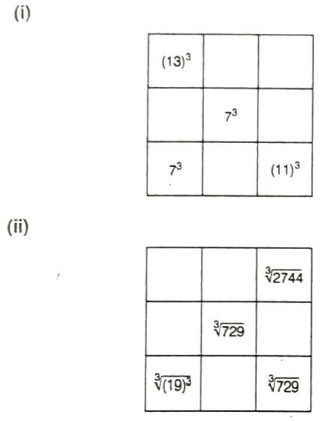
Magic Game Board
A magic game board is an array of numbers having the same number of row and columns arranged, so that the sum of the numbers in each row and column is the same.
Complete the magic game board below.
Image
View full question & answer
Question 103 Marks
Find the value of $17^3-16^3.$
Answer
We have, $17^3-16^3$
We know that $\text{b}^3-\text{a}^3=1+3 \text{ab,} \text{b}>\text{a},$
where $\text{a}$ and $\text{b}$ are consecutive numbers.
On putting $\text{a}=16$ and $\text{b}=17,$ we get
$17^3-16^3=1+3 \times 16 \times 17=817$
View full question & answer
Question 113 Marks
The volume of a cubical box is $4913\text{ cm}^3.$ Find the length of side of the cubical box.
Answer
Given the volume of cubical box
$=4913\text{ cm}^3$
By prime factorisation,
$4913=17 \times 17 \times 17$
$\Rightarrow \quad \sqrt[3]{4913}=17$
$\therefore$ The length of side of the cubical box is 17$\text{ cm.}$
View full question & answer
Question 123 Marks
Using prime factorisation, find the cube root of 5832 .
Answer
The prime factorisation of 5832
$\therefore 5832=\underline{2 \times 2 \times 2} \times \underline{3 \times 3 \times 3} \times \underline{3 \times 3 \times 3}$
25832
22916
21458
3729
3243
381
327
39
33
1
Therefore, $\sqrt[3]{5832}$
$\begin{array}{l}=\sqrt[3]{\underline{2 \times 2 \times 2}} \times \underline{3 \times 3 \times 3} \times \underline{3 \times 3 \times 3} \\=2 \times 3 \times 3=18\end{array}$
View full question & answer
Question 133 Marks
Find the cube root of 614125 through estimation.
Answer
Given, number is 614125.
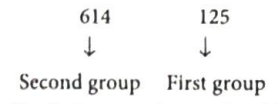
So, groups of 614125 are
Image
In the first group, the number 125 ends with 5.
We know that 5 comes at the unit place of a number only when its cube end in 5.
So, 5 will come at unit place.
Now, in the second group, the number is 614.
$\begin{array}{l}\because(8)^3=512 \text { and }(9)^3=729 \\ \text { and } 512<614<729\end{array}$
So, tens place of required cube root is 8.
Hence, $\sqrt[3]{614125}=85$
View full question & answer
Question 143 Marks
Is 68600 a perfect cube? If not, then find the smallest number by which 68600 must be multiplied to get a perfect cube.
Answer
Given number is 68600.
Now, prime factorisation of 68600
$68600=\underline{2 \times 2 \times 2} \times 5 \times 5 \times \underline{7 \times 7 \times 7}$
268600
234300
217150
58575
51715
7343
749
77
1
The prime factor 5 does not have triples.
$\therefore 68600$ is not a perfect cube.
So, if we multiply the number 68600 by 5, then we get a perfect cube.
i.e. $68600 \times 5=343000$
$\begin{array}{l}=2 \times 2 \times 2 \times 5 \times 5 \times 5 \times 7 \times 7 \times 7 \\ =2 \times 5 \times 7=70\end{array}$
View full question & answer
Question 153 Marks
Check whether 21600 is a perfect cube or not.
Answer
Given number is 21600.
Now, prime factorisation of 21600
$\therefore 21600=\underline{2 \times 2 \times 2} \times \underline{3 \times 3 \times 3}\times 2 \times 2 \times 5 \times 5$
221600
210800
25400
32700
3900
3300
2100
250
525
55
1
Prime factors 2 and 5 do not have triples.
So, 21600 is not a perfect cube.
View full question & answer
Question 163 Marks
Find the smallest number by which 256 must be multiplied to obtain a perfect cube.
Answer
Given, number іs 256.
Now, prime factorisation of 256
$256=\underline{2 \times 2 \times 2} \times \underline{2 \times 2 \times 2} \times 2 \times 2$
2256
2128
264
232
216
28
24
22
1
Here, the prime factor 2 does not appear in a group of triples.
So, to make 256 a perfect cube, we have to multiply 256 by 2.
$\begin{array}{lrl}\therefore & 256 \times 2 & =512 \\ \Rightarrow & (8)^3 & =512\end{array}$
View full question & answer
3 Marks Question - MATHS STD 8 Questions - Vidyadip