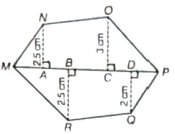
Find the area of polygon $M N O P Q R$, If $M P=9 cm$, $M D=7 cm, M C=6 cm$, $M B=4 cm, M A=2 cm . N A O C$, $Q D$ and $R B$ are perpendiculars to diagonal MP.
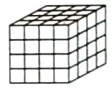
After the surface area of a cube is painted, the cube is cut into 64 smaller cubes of same dimensions (see the figure). How many have (i) no face painted? $\qquad$ (ii) 1 face painted? $\qquad$ (iii) 2 faces painted? $\qquad$ (iv) 3 faces painted?
Answer
In the given figure, we have (i) 16 cubes, which have no face painted. (ii) 24 cubes, which have 1 face painted. (iii) 16 cubes, which have 2 faces painted. (iv) 8 cubes, which have 3 faces painted.
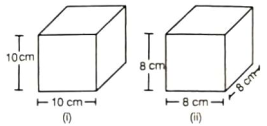
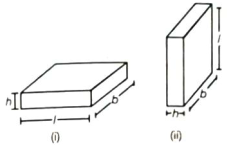
If we interchange the lengths of the base and the height of a cuboid [fig. (I)] to get another cuboid [fig. (ii)], will its lateral surface area change?
Answer
Lateral surface area of cuboid fig. $( i )=2(l+b) h$ Lateral surface area of another cuboid fig. (ii) $=2(h+b)$ It is clear that results are different. Hence, if we interchange the lengths of the base and the heign of a cuboid, then its lateral surface area will be changed.
Can we say that the total surface area of cubold $=$ Lateral surface area $+2 \times$ Area of base?
Answer
Yes, we can say that the total surface area of a cuboid = Lateral surface area $+2 \times$ Area of base, because four sides of walls make the lateral surface area of the cuboid and base and top are opposite faces which are congruent.
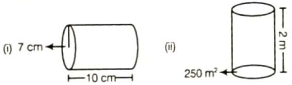
Why is it incorrect to call the solid shown here a cylinder?
Answer
We know that a cylinder has two identical (congruent) circular faces, parallel to each other but here its two parallel circular faces are not identical (congruent). So, it is incorrect to call the solid shown here a cylinder.
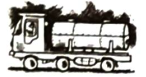
A milk tank is in the form of cylinder whose radius is 1.5 m and length is 7 m . Find the quantity of milk (in litres) that can be stored in the tank? TIPS Here, the required quantity of milk will be equal to the volume of cylindrical tank. So, firstly find the volume of cylindrical tank and then convert it into litres using $1 m^3=1000 L$.
Answer
Given, radius of cylindrical tank $=1.5 m=\frac{15}{10} m$ and height of cylindrical tank $=7 m$ $\therefore$ Volume (or capacity) of the tank $=\pi r^2 h$ $\begin{array}{l}=\frac{22}{7} \times\left(\frac{15}{10}\right)^2 \times 7=\frac{22}{7} \times \frac{15}{10} \times \frac{15}{10} \times 7 \\ =\frac{22 \times 15 \times 15}{10 \times 10}=\frac{22 \times 3 \times 3}{2 \times 2}\end{array}$ [dividing numerator and denominator both by 5 two times] $=\frac{11 \times 3 \times 3}{2}=\frac{99}{2} m^3$ Now, $1 m^3=1000 L$ $\therefore$ Quantity of milk in the tank $=$ Volume of the tank $\begin{array}{l}=\frac{99}{2} \times 1000 \\ =99 \times 500=49500 L\end{array}$ Hence, the quantity of milk that can be stores in the tank is 49500 L .
Find the height of a cubold whose base area is $180 cm^2$ and volume is $900 cm^3$ ?
Answer
Given, base area of cuboid $=180 cm^2$ and volume of cuboid $=900 cm^{3}$ We know that Volume of cuboid $=$ Base area $\times$ Height $ \Rightarrow \quad 900=180 \times \text { Height } \Rightarrow \text { Height }=\frac{900}{180}=5 $ Hence, the height of the cuboid is 5 cm.
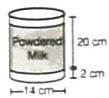
A company packages its milk powder in cylindrical contalner whose base has a dlameter of 14 cm and height 20 cm . Company places a label around the surface of the container (as shown in the figure). If the label is placed 2 cm from top and bottom, what is the area of the label?
Answer
Given, diameter of base of cylindrical container $=14 cm$ $\therefore$ Radius of base of cylindrical container, $r=\frac{14}{2}=7 cm$ and height of cylindrical container $=20 cm$ Now, label is placed 2 cm from top and bottom. $\therefore$ Height of label, $h=(20-2-2)=16 cm$ Now, area of label = Curved surface area of cylindrical portion on which label is placed $=2 \pi r h=2 \times \frac{22}{7} \times 7 \times 16=704 cm^2\qquad$ $[\because$ radius $=7 cm]$ Hence, the area of the label is $704 cm^2$.
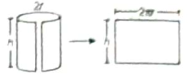
The lateral surface area of a hollow cylinder is $4224 cm^2$. It is cut along its height and formed a rectangular sheet of width 33 cm . Find the perimeter of rectangular sheet? TIPS On cutting a hollow cylinder along its height, we get a rectangular sheet whose width or breadth $=$ height of cylinder, length $=$ perimeter of base of cylinder. So, first find the length and breadth of rectangular sheet and then its perimeter $=2(I+b)$.
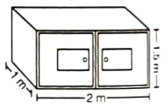
Rukhsar painted the outside of the cabinet of measure $1 m \times 2 m \times 1.5 m$. How much surface area did she cover, If she painted all except the bottom of the cabinet? TIPS Given, cabinet is in cuboidal shape, so subtract the area of bottom (which is rectangle in shape) from the total surface area of cuboid to get required surface area to be painted.
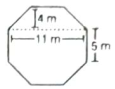
Top surface of a raised platform is in the shape of a regular octagon as shown in the figure. Find the area of the octagonal surface. TIPS Firstly, divide the given regular octagonal surface into two congruent trapeziums and one rectangle and then add their areas to get required area of octagonal surface.
Find the area of a rhombus whose side is 5 cm and whose altitude is 4.8 cm . If one of its diagonal is 8 cm long, find the length of the other diagonal. TIPS Firstly, find the area of mombus by two different methods (or formulae) and then equate them to get required length of diagonal.
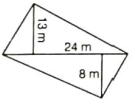
The diagonal of a quadrilateral shaped field is 24 m and the perpendiculars dropped on it from the remaining opposite vertices are 8 m and 13 m . Find the area of the field.
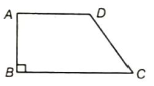
Length of the fence of a trapezium shaped field ABCDis 120 m . If $B C=48 m, C D=17 m$ and $A D=40 m$, find the area of this field. Side $A B$ is perpendicular to the parallel sides $A D$ and $B C$.
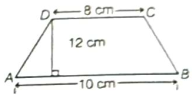
The area of a trapezium is $34 cm^2$ and the length of one of the parallel sides is 10 cm and its height is 4 cm . Find the length of the other parallel side.
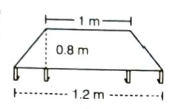
The shape of the top surface of a table is a trapezium. Find its area, if its parallel sides are 1 m and 1.2 m and perpendicular distance between them is 0.8 m .
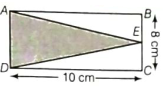
What is the area of $\triangle A D E$ in the following figure?
Answer
From the above figure, it is clear that the base of $\triangle A D E$ is $A D=8 cm$ and height of the $\triangle A D E$ is 10 cm. $ \begin{aligned} \therefore \text { Area of } \triangle A D E & =\frac{1}{2} \times \text { Base } \times \text { Height } \\ & =\frac{1}{2} \times A D \times D E \\ & =\frac{1}{2} \times 8 \times 10=40 cm^2 \end{aligned} $
A lawn mover takes 750 complete revolutions to cut grass on a field. Calculate the area of the field if the diameter of the lawn mover is 84 cm and the length is 1 m .
Answer
Given, length of lawn mover $=1 m=100 cm$ $ \text { Circumference }=\pi \times D=\frac{22}{7} \times 84=264 cm $ length of the field will be $=264 \times 750=198000 cm$ Here, the width of the field $ =\text { Length of the lawn mover i.e. } 100 cm $ $ \begin{aligned} \text { So, area of field } & =198000 \times 100 \\ & =19800000 cm^2 \\ & =1980 m^2 \end{aligned} $
A river 2 m deep and 45 m wide is flowing at the rate of $3 km / h$. Find the amount of water (in cubic metres) that runs into the sea per minute.
Answer
We have, $h=2 m$ and $b=45 m$ Since, in 60 min length of water flowing $=3 km$ $\therefore 1 min$, the length of water flowing $=\frac{3 \times 1000}{60}=50 m$ $\therefore$ Amount of the water flowing $=l \times b \times h=50 \times 45 \times 2$ $=4500 m^3$
A copper wire of length 44 cm is to be bent into a square and a circle. Which will have a larger area?
Answer
(i) When the wire is bent into a square side $ =\frac{44}{4}=11 cm $ $\therefore$ Area of the square $=(\text { Side })^2=(11)^2=21 cm^2$ (ii) When the wire is bent into a circle circumference $=2 \pi r$ $ \begin{array}{lrl} \Rightarrow \qquad 44 =2 \pi r \\ \therefore \qquad r =7 cm \\ \therefore \text { Area of the circle } =\pi r^2=\frac{22}{7} \times 7 \times 7=154 cm^2 \end{array} $ So, the circle will have a larger area.
The length and breadth of a rectangle are 10 cm and 8 cm . Find its perimeter is the length and breadth are (i) doubled $\qquad$ (ii) halved
Answer
Length of rectangle $=10 cm$ Breadth of rectangle $=8 cm$. (i) When they are doubled and $b=8 \times 2=16 cm$ $ \begin{aligned} l & =10 \times 2=20 cm . \\ \text { Perimeter } & =2(l+b)=2(20+16)=2 \times 36=72 cm . \end{aligned} $ (ii) When they are halved, $ \begin{array}{l} l=\frac{10}{2}=5 cm . \\ b=\frac{8}{2}=4 cm . \end{array} $ Perimeter $=2(l+b)=2(5+4)=2 \times 9=18 cm$.
If diagonals of rhombus are of length 6 cm and 5 cm , then find the area of rhombus.
Answer
Area of rhombus when diagonals are of length $d_1$ and $d_2$ is $ A=\frac{1}{2} \times d_1 \times d_2 $ Now, let $d_1=6 cm$ and $d_2=5 cm$ Hence, the area of rhombus will be $ \begin{aligned} A & =\frac{1}{2} \times 6 \times 5 \\ & =3 \times 5=15 \end{aligned} $ Therefore, area of rhombus is $15 cm^2$.
Two cylinders of equal volume have heights in the ratio $1: 16$. Find the ratio of their radii.
Answer
Let the radii of cylinders be $r_1, r_2$ and heights of the cylinders be $h_1, h_2$. $\therefore \quad h_1: h_2=1: 16 \qquad \text [{Given}]$ $\Rightarrow \quad \frac{h_1}{h_2}=\frac{1}{16} \Rightarrow h_2=16 h_1$ Since, volumes are equal for both the cylinders. $\begin{array}{ll}\therefore & \pi r_1^2 h_1=\pi r_2^2 h_2 \\ \Rightarrow & \pi r_1^2 h_1=\pi r_2^2 \times 16 h_1=\pi \times\left(4 r_2\right)^2 \times h_1 \\ \Rightarrow & r_1^2=\left(4 r_2\right)^2 \\ \Rightarrow & r_1=4 r_2 \Rightarrow \frac{r_1}{r_2}=\frac{4}{1}\end{array}$ Hence, the ratio of their radii will be $4: 1$.
If the area of a face of cube is $20 cm^2$, then find the total surface area of the cube.
Answer
We know that surface area of a cube whose each side is of length $a$ is $6 a^2$. $ a^2=20 cm^2 \qquad [given] $ $ \begin{aligned} \therefore \text { Total surface area of the cube } =6 a^2 \end{aligned} $ $ \begin{aligned} =6 \times 20=120 cm^2 \end{aligned} $