Questions

3 Marks Question

🎯

Test yourself on this topic

30 questions · timed · auto-graded
Question 33 Marks
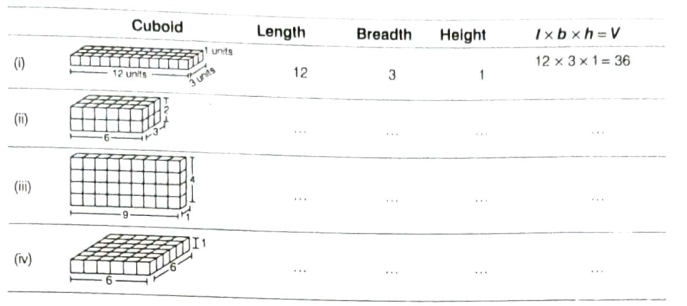
Take 36 cubes of equal size (i.e. length of each cube is same). Arrange them to form a cuboid. You can arrange them In many ways.
Observe the following table and fill in the blanks.
Image
Answer
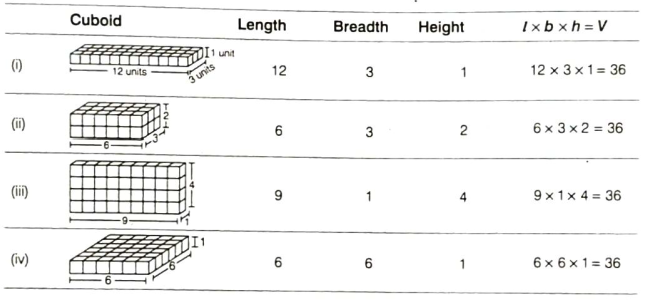
In the above table, four cuboids of different measures are given. The volume of cuboid $=l \times b \times h$ and we have to find volume of these cuboids. Then, the complete table is as follows
Image
From the above table, we also observe that given cuboid have different measures but their volumes are same.
View full question & answer
Question 53 Marks
Note that lateral surface area of a cylinder is the circumference of base $\times$ height of cylinder. Can we write lateral surface area of a cuboid as Perimeter of base $\times$ Height of cuboid?
Answer
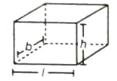
Let $l$ be the length, $b$ be the breadth and $h$ be the height of a cuboid. Then,
Image
Lateral surface area of a cuboid
$
\begin{array}{l}
=\text { Area of } 4 \text { walls of the cuboid } \\
=(l \times h)+(l \times h)+(b \times h)+(b \times h) \\
=2 l h+2 b h=2(l+b) \times h \\
=\text { Perimeter of base } \times \text { Height }
\end{array}
$
So, we can write lateral surface area of a cuboid as multiplication of perimeter of base and height.
View full question & answer
Question 63 Marks
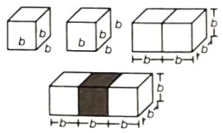
Two cubes each with side bare joined to form a cuboid (see the figure). What is the surface area of this cuboid? Is it $1 2 b ^{ 2 }$ ? Is the surface area of cuboid formed by joining three such cubes, $18 b^2 ?$ Why?
Image
Answer
By joining two cubes end-to-end each with side $b$, we get a cuboid whose length $=b+b=2 b$, breadth $=b$ and height $=b$
$\therefore$ Total surface area of this cuboid
$\begin{array}{l}=2(L B+B H+H L) \\ =2(2 b \times b+b \times b+b \times 2 b) \\ =2\left(2 b^2+b^2+2 b^2\right) \\ =2 \times 5 b^2=10 b^2\end{array}$
So, surface area of cuboid formed by joining two cubes is not equal to $12 b^2$, it is $10 b^2$.
Now, by joining three cubes end-to-end each with side $b$, we get
a cuboid whose length $=b+b+b=3 b$,
breadth $=b$ and height $=b$
$\therefore$ Total surface area of this cuboid
$\begin{array}{l}=2(L B+B H+H L) \\ =2(3 b \times b+b \times b+b \times 3 b) \\ =2 \times\left(3 b^2+b^2+3 b^2\right) \\ =2 \times 7 b^2=14 b^2\end{array}$
So, the surface area of cuboid formed by joining three such cuboids is, it is not equal to $18 b^2$, it is $14 b^2$.
View full question & answer
Question 73 Marks
Water is pouring into a cuboidal reservoir at the rate of $60 L / min$. If the volume of reservoir is $108 m^3$, find the number of hours it will take to fill the reservoir.
Image
TIPS Firstly, convert the given volume of reservoir in litres using $1 m^3=1000 L$ and then find water poured in an hour. Now, divide the capacity of reservoir by quantity of water poured in an hour to find required number of hours.
Answer
Given, volume of cuboidal reservoir $=108 m^3$ or capacity of cuboidal reservoir
$=108 m^3=108 \times 1000 L=108000 L$
Also, water poured in a minute $=60 L$
$\therefore$ Water poured in an hour $=60 \times 60 L$
Now, time taken to fill the reservoir
$\begin{array}{l}=\frac{\text { Capacity of reservoir }}{\text { Water poured in an hour }} \\ =\frac{108000}{60 \times 60}=30 h\end{array}$
Hence, the required number of hours is 30 .
View full question & answer
Question 83 Marks
If each edge of a cube is doubled.
(i) how many times will its surface area increase?
(ii) how many times will its volume increase?
Answer
Self
View full question & answer
Question 93 Marks
A cuboid is of dimensions $60 cm \times 54 cm \times 30 cm$.
How many small cubes with side 6 cm can be placed in the gliven cuboid?
TIPS Here, the number of small cubes will depend on the volume of cubold in which these cubes are placing. So, firstly find the volume of cuboid and one cube and then divide volume of cuboid by volume of one cube to get required number of cubes.
Answer
Given, dimensions of cuboid are $60 cm \times 54 cm \times 30 cm$
i.e. length $=60 cm$, breadth $=54 cm$ and height $=30 cm$
$\therefore \quad$ Volume of the cuboid $=l \times b \times h=60 \times 54 \times 30$
$=(60 \times 54 \times 30) cm ^3$
Also, given side of a small cube $=6 cm$
$\therefore$ Volume of one cube $=a^3=(6)^3=(6 \times 6 \times 6) cm^3$
Here, small cubes are placed in cuboid.
Required number of small cubes $=\frac{\text { Volume of cuboid }}{\text { Volume of one cube }}$
$=\frac{60 \times 54 \times 30}{6 \times 6 \times 6}=450$
View full question & answer
Question 103 Marks
Given a cylindrical tank, in which situation will you find surface area and in which situation volume.
(i) To find how much it can hold.
(ii) Number of cement bags required to plaster it.
(iii) To find the number of smaller tanks that can be filled with water from it.
Image
Answer
(i) To find, how much a cylindrical tank can hold, we will find its volume.
(ii) To find, number of cement bags required to plaster a cylindrical tank, we will find its surface area.
(iii) To find, the number of smaller tanks that can be filled with water from it, we will find volume of tank.
View full question & answer
Question 113 Marks
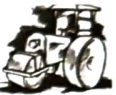
A road roller takes 750 complete revolutions to move once over to level a road. Find the area of the road, if the diameter of a road roller Is 84 cm and length is 1 m .
Image
TIPS The road roller is in cylindrical shape. So, firstly find the area of road cover in 1 revolution which is equal to curved of surface area of cylinder, then multiply by 750 to get total area of road.
Answer
Self
View full question & answer
Question 123 Marks
A closed cylindrical tank of radius 7 m and height 3 m is made from a sheet of metal. How much sheet of metal is required?
Answer
Given, radius of cylindrical tank $=7 cm$ and height of cylindrical tank $=3 m$
Here, metal sheet required to make the tank is equal to the total surface area of tank.
$
\begin{aligned}
\therefore \text { Metal sheet required } & =\text { Total surface area of tank } \\
& =2 \pi r(h+r) \\
& =2 \times \frac{22}{7}, 7(3+7) \\
& =44\times10=440
\end{aligned}
$
Hence, $440 m^{2}$ sheet of metal is required.
View full question & answer
Question 133 Marks
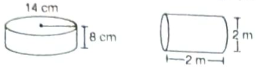
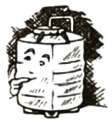
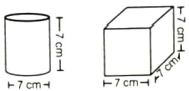
Describe how the two figures at the right are alike and how they are different? Which box has larger lateral surface area?
Image
Answer
Given figures are alike because height of both figure is same but first figures a cylinder and other is a cube, so both figures are different.
For cylinder, diameter $=7 cm$
$\therefore$ Radius $(r)=\frac{\text { Diameter }}{2}=\frac{7}{2} cm$ and height $(h)=7 cm$
$\therefore$ Curved (lateral) surface area of cylinder
$
=2 \pi r h=2 \times \frac{22}{7} \times \frac{7}{2} \times 7=154 cm^2
$
Now, for cube, side $=7 cm$
$
\begin{aligned}
\therefore \text { Curved surface area of cube } & =4 \times(\text { Side })^2=4 \times(7)^2 \\
& =4 \times 7 \times 7=196 cm^2
\end{aligned}
$
Hence, the cube i.e. second figure has larger lateral surface area.
View full question & answer
Question 143 Marks
Danlel is painting the walls and celling of a cuboldal hall with length, breadth and height of $15 m, 10 m$ and 7 m , respectlvely. From each can of paint $100 m^2$ of area is painted. How many cans of paint will she need to paint the room?
TIPS Firstly, find the area to be painted which is equal to area of 4 walls + area of celling. Then, divided this area by area painted in one can to get required number of cans.
Answer
Given, length of wall $(I)=15 m$
Breadth of wall $(b)=10 m$ and height of wall $(h)=7 m$
$\therefore$ Area to be painted $=$ Area of 4 walls + Area of ceiling
$\begin{array}{l}=2 h(l+b)+l \times b \\ =2 \times 7(15+10)+15 \times 10 \\ =2 \times 7 \times 25+150 \\ =350+150=500 m^2\end{array}$
Given, one can of paint covers $100 m^2$ area.
$
\therefore \text { Number of cans needed }=\frac{\text { Area to be painted }}{\text { Area painted by one can }}
$
$=\frac{500 m^2}{100 m^2}=5$
Hence, she will need 5 cans of paint for the room to be painted.
View full question & answer
Question 153 Marks
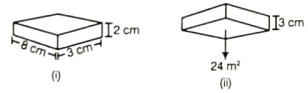
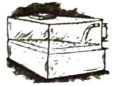
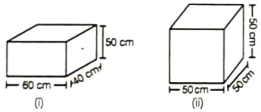
There are two cuboidal boxes as shown in the following figures. Which box requires the lesser amount of material to make?
Image
Answer
Self
View full question & answer
Question 163 Marks
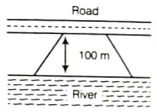
Mohan wants to buy a trapezium shaped field. Its side along the river is parallel to and twice the side along the road. If the area of this field is $10500 m^2$ and the perpendicular distance between the two parallel sides is 100 m , find the length of the side along the river.
Image
Answer
According to the question, the side along the river is parallel to and twice the side along the road.
Let the length of side along the road be $x m$.
Then, the length of side along the river $=2 x m$
Given, perpendicular distance between the two parallel sides $=100 m$
and area of the trapezium shaped field $=10500 m^2$
$\begin{array}{l}
\Rightarrow \quad \frac{1}{2} \times(\text { Sum of parallel sides }) \times \text { Height }=10500 \\
\Rightarrow \quad \frac{1}{2} \times(2 x+x) \times 100=10500
\end{array}$
$\Rightarrow \qquad 3 x \times 50=10500$
$\Rightarrow \qquad 3 x=\frac{10500}{50}=\frac{1050}{5}$
$\therefore \quad x=\frac{1050}{3 \times 5}=70$ and $2 x=2 \times 70=140$
Hence, the length of the side along the river is 140 m .
View full question & answer
Question 173 Marks
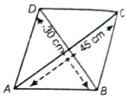
The floor of a bullding consists of 3000 tiles, which are rhombus shaped and each of its diagonals are 45 cm and 30 cm In length. Find the total cost of polishing the floor, if the cost per $m ^2$ is ₹ 4 .
TIPS Firstly, find the area of floor by multiplying area of one tile with total number of tiles. Then, multiply area of floor by cost per $m^2$ to get total cost of polishing.
Answer
Let $A B C D$ be the rhombus shaped tile whose diagonal $A C\left(d_1\right)=45 cm$ and diagonal $B D\left(d_2\right)=30 cm$.
Image
$\therefore$ Area of one rhombus shaped tile
$\begin{array}{l}=\frac{1}{2} \times d_1 \times d_2 \\ =\frac{1}{2} \times 45 \times 30=45 \times 15=675 cm^2\end{array}$
Now, floor of a building consists of 3000 tiles of such kind.
$\therefore$ Area of floor $=$ Number of tiles $\times$ Area of one tile
$\begin{array}{l}=3000 \times 675 \\ =2025000 cm^2=\frac{2025000}{10000} m^2\end{array}$
$\left[\begin{array}{l}\because 1 m=100 cm \\ \therefore 1 m^2=10000 cm^2\end{array}\right]$
$=202.5 m^2$
$\because$ Rate of the polishing floor $=$₹$ 4$ per $m ^2$
$\therefore$ Total cost of polishing the floor $=$₹$ 4 \times 202.5=$₹$ 810$
Hence, the total cost of polishing floor is ₹ 810 .
View full question & answer
Question 183 Marks
A housing society consisting of 5500 people needs 100 L of water per person per day. Due to shortage of drinking water in city, the city Jal Board advice to residence of housing society for their reducing daily consumption of water the cylindrical supply tank which is send by Jal Board, is 7 m high and has a diameter 10 m . For how many days will the tank last for the society?
Answer
Water consumed by the person per day $=$ Number of people $\times$ Water consumed by people in one day
$\begin{array}{l}=5500 \times 100=550000 L \\ =\frac{550000}{1000} m^3=550 m^3 \qquad\left[\because 1 L=1000 m^3\right]\end{array}$
Now, volume of the cylindrical tank $=\pi r^2 h$
$\begin{array}{l}=\frac{22}{7} \times 5 \times 5 \times 7 \\ =550 m^3\end{array}$
Let $d$ days be the water in the tank last for the society, then
$\begin{aligned} d & =\frac{\text { Volume of cylindrical tank }}{\text { Water consumed by the person per day }} \\ \Rightarrow d & =\frac{550}{550}=1 \text { day }\end{aligned}$
Hence, the tank has 1 day water capacity.
View full question & answer
Question 193 Marks
The diameter of a roller is 42 cm and its length is 100 cm . It takes 400 complete revolutions moving once over to level a playground. Determine the area of the playground. Also, find the cost of leveling the playground at ₹ 150 per $100 m^2$.
Answer
On rolling a roller over the ground in one complete revolution, it covers a ground area equal to its curved surface area.
$
\begin{array}{ll}
\therefore & r=\frac{42}{2}=21 cm=0.21 m \\
\text { and } & h=100 cm=1 m
\end{array}
$
$\therefore \quad$ Area of curved surface area $=2 \pi r h$
$
=2 \times \frac{22}{7} \times 0.21 \times 1=1.32 m^2 \qquad [ \because \text {roller is in cylindrical shape}]
$
$\therefore$ Area of the ground $=400 \times 1.32=528 m^2$
$\therefore$ Cost of leveling per $100 m^2=$₹$ 150$
$\therefore$ Cost of leveling $1 m^2=$₹$ \frac{150}{100}=$₹$ \frac{3}{2}$
Cost of levelling $528 m^2=$₹$ 528 \times \frac{3}{2}=$₹$ 264 \times 3=$₹$ 792$
View full question & answer
Question 203 Marks
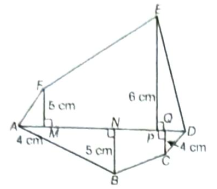
Find the area of polygon $A B C D E F$, if $A D=18 cm$, $A Q=14 cm, A P=12 cm, A N=8 cm, A M=4 cm$ and $F M, E P, Q C, B N$ are perpendiculars to diagonal $A D$.
Image
Answer
From the given figures, we have
$
\begin{array}{l}
M P=A P-A M=(12-4)=8 cm \\
P D=A D-A P=(18-12)=6 cm \\
N Q=A Q-A N=(14-8)=6 cm \\
Q D=A D-A Q=(18-14)=4 cm
\end{array}
$
Area of the polygon $A B C D E F$
$\begin{array}{r}=\text { Area of } \triangle A F M+\text { Area of trapezium } F M P E \\ + \text { Area of } \triangle E P D+\text { Area of } \triangle A N B \\ + \text { Area of trapezium } N B C Q \\ + \text { Area of } \triangle Q C D\end{array}$
$\begin{aligned}=\frac{1}{2} \times A M \times F M & +\frac{1}{2}(F M+E P) \times M P \\ & +\frac{1}{2} \times P D \times E P+\frac{1}{2} \times A N \times N B \\ & +\frac{1}{2}(N B+C Q) \times N Q+\frac{1}{2} \times Q D \times C Q \\ =\frac{1}{2} \times 4 \times 5 & +\frac{1}{2}(5+6) \times 8+\frac{1}{2} \times 6 \times 6 \\ & +\frac{1}{2} \times 8 \times 5+\frac{1}{2}(5+4) \times 6+\frac{1}{2} \times 4 \times 4 \\ =10+44 & +18+20+27+8=127 cm^2\end{aligned}$
View full question & answer
Question 213 Marks
The following table shows the dimensions of cuboids such that, their volumes remain the same. Extend the table with as many more dimensions such that all the cuboids thus formed have the same volume.
Complete the table and write your conclusion on surface area and volume of each cuboid.
Dimensions of Cuboid (in units)Surface Area (sq unit)Volume (cu unit)
15, 10, 8___1200
6, 10, 20___1200
_________
_________
_________
_________
Answer
Self
View full question & answer
Question 223 Marks
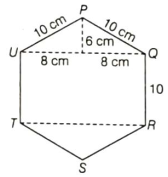
A regular hexagon $P Q R S T U$ with dimensions is given below. Find the area of hexagon.
Image
Answer
To find the area of hexagon, divide it into three parts.
$\triangle P Q U$, rectangle $U Q R T$ and $\triangle S T R$
Now, area of $\triangle P Q U=\frac{1}{2} \times$ Base $\times$ Height
$=\frac{1}{2} \times 16 \times 6$
Area of rectangle $U Q R T=$ Length $\times$ Breadth
$\begin{array}{l}=U Q \times(Q R) \\ =16 \times 10\end{array}$
Area of $\triangle S T R=\frac{1}{2} \times$ Base $\times$ Height $=\frac{1}{2} \times 16 \times 6$
$\therefore$ Area of regular hexagon $=$ Area of $\triangle P Q U$ + Area of rectangle $U Q R T$ + Area of $\triangle S T R$
$\begin{array}{l}=\frac{1}{2} \times 16 \times 6+16 \times 10+\frac{1}{2} \times 16 \times 6 \\ =16 \times 6+16 \times 10=16 \times(6+10) \\ =16 \times 16=256\end{array}$
Hence, the area of hexagon $P Q R S T U$ is $256 cm^2$.
View full question & answer
Question 233 Marks
A swimming pool is 200 m by 50 m and has an average depth of 2 m . By the end of a summer day, the water level drops by 2 cm . How many cubic metres of water is lost on that day?
Answer
Capacity of the swimming pool
$
=l \times b \times h=200 \times 50 \times 2=20000 m^3
$
Since, water level drop by 2 cm
$
\text { ie. } \quad h^{\prime}=\left(2-\frac{2}{100}\right) m=(2-0.02) m=1.98 m
$
$\therefore$ After dropping water level, capacity of the
swimming pool $=l \times b \times h^{\prime}$
$
=200 \times 50 \times 1.98=19800 m^3
$
$\therefore$ Cubic metre of water lost on that day
$
=20000 m^3-19800 m^3=200 m^3
$
View full question & answer
Question 243 Marks
A cuboidal box of dimensions $1 m \times 2 m \times 1.5 m$ is to be painted except its bottom. Calculate how much area of the box has to be painted.
Answer
Given, length of the box, $l=2 m$
breadth of box, $b=1 m$
Height of box, $h=1.5 m$
We know that the surface area of a cuboid
$
=2(l b+l h+b h)
$
But here the bottom part is not to be painted so, surface area of box to be painted
$\begin{array}{l}=1 b+2(b h+h f) \\ =2 \times 1+2(1 \times 15+15 \times 2) \\ =2+2(1.5+30) \\ =2+90 \\ =11 m^{2}\end{array}$
Hence, the required surface area of the cuboidal berx
$
=11 m^{2}
$
View full question & answer
Question 253 Marks
A square and a rectangle have the same perimeter. Calculate the area of the rectangle is the side of the square is 60 cm and the length of the rectangle is 80 cm .
Answer
Perimeter of square formula = 4 $\times$ Side of the square
Hence, P Square = 4 $\times$ 6 = 240 cm.
Perimeter of rectangle formula = 2 $\times$ (length + breadth)
Hence, P (rectangle) = 2 (80 + Breadth)
= 160 + 2 $\times$ Breadth
According to the question,
$
\begin{array}{rlrl}
160+2 \times \text { Breadth } =240 cm . \\
\Rightarrow 2 \times \text { Breadth } =240-160
\end{array}
$
$
\begin{array}{rlrl}
\Rightarrow \text { Breadth } =\frac{80}{2}
\end{array}
$
$\therefore$ The breadth of the rectangle = 40 cm Now, the area of rectangle $=$ length $\times$ Breadth
$
\begin{array}{l}
=80 \times 40 \\
=3200 cm^2
\end{array}
$
View full question & answer
Question 263 Marks
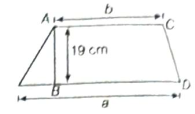
The difference between two parallel sides of a trapezium is 8 cm . The perpendicular distance between them is 19 cm . While the area of trapezium is $760 cm^2$. What will be the length of the parallel sides?
Answer

Image
Let the two parallel sides be $a$ and $b$. According to the question,
$
a-b=8
$
Area of trapezium
$
\begin{array}{cc}
& =\frac{1}{2} \times h(a+b) \\
\Rightarrow & \frac{1}{2}(a+b) \times 19=760 \\
\Rightarrow & a+b=40 \times 2 \\
\Rightarrow & a+b=80
\end{array}
$
From Eqs. (i) and (ii), we get
$
\begin{aligned}
2 a & =88 \\
\Rightarrow \quad a=\frac{88}{2} & =44
\end{aligned}
$
From Eq. (i), we get
$
\begin{aligned}
& a-b=8 \\
\Rightarrow & b=a-8=44-8=36 cm \\
\therefore & a=44 cm \text { and } b=36 cm
\end{aligned}
$
View full question & answer
Question 273 Marks
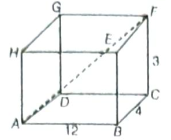
Find the length of the largest pole that can be placed in a room of dimensions $12 m \times 4 m \times 3 m$.
Answer
See the figure given below to understand the solution
Image
It is clear that the length of the largest pole is $A F$, which is forming a hypotenuse of right angled $\triangle A C F$.
Thus, $A C=\sqrt{A B^2+B C^2}=\sqrt{12^2+4^2}=\sqrt{160} m$
In $\triangle A C F$,
$A F=\sqrt{A C^2+C F^2}=\sqrt{160+3^2}=\sqrt{169}=13 m$
Alternate Method
Length of the largest pole $=$ Length of diagonal of the cube
$\begin{array}{l}=\sqrt{l^2+b^2+h^2} \\ =\sqrt{12^2+4^2+3^2} \\ =\sqrt{169}=13 m\end{array}$
View full question & answer
Question 283 Marks
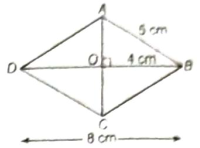
Find the area of a rhombus whose one side measures 5 cm and one diagonal as 8 cm .
Answer
Let $A B C I$ be the rhombus as shown below
Image
$D O=O B=4 cm$, since diagonals of a rhombus are perpendicular bisectors of each other.
Using Pythagoras theorem in $\triangle A O B$,
$\begin{aligned} A O^2+O B^2 & =A B^2 \\ A O & =\sqrt{A B^2-O B^2}=\sqrt{5^2-4^2}=3 cm \\ \therefore \quad A C & =2 \times 3=6 cm \quad[\because A C=2 A O\}\end{aligned}$
Thus, the area of rhombus
$
=\frac{1}{2} \times d_1 \times d_2=\frac{1}{2} \times 8 \times 6=24 cm^2 .
$
View full question & answer
Question 293 Marks
$160 m^3$ of water is to be used to irrigate a rectangular field whose area is $800 m^2$. What will be the height of the water level in the field?
Answer
Volume of water $=160 m^3$
Area of rectangular field $=800 m^2$
Let $h$ be the height of water level in the field.
Now, volume of water $=$ Volume of cuboid formed on the field by water
$
\begin{array}{ll}
\Rightarrow & 160=\text { Area of base } \times \text { Height } \\
\Rightarrow & 160=800 \times h \\
\therefore & h=\frac{160}{800}=0.2
\end{array}
$
Hence, the required height is 0.2 m .
View full question & answer
Question 303 Marks
How many small cubes with edge of 30 cm each can be just accomodated in a cubical box of 3 m edge?
Answer
Edge of a small cube $=30 cm$
Surface area of each small cube $=6 \times(\text { Edge })^2$
$
=6 \times 30 \times 30=5400 cm^2
$
Edge of the cubical box $=3 m=300 cm$
Surface area of cubical box $=6 \times(\text { Edge })^2$
$
\begin{array}{l}
=6 \times(300)^2 \\
=6 \times 300 \times 300=540000 cm^2
\end{array}
$
$\therefore \quad$ Number of small cubes accomodated in the cubical box of edge 3 m or 300 cm
$
\begin{array}{l}
=\frac{\text { Surface area of the cubical box }}{\text { Surface area of each small cube }} \\
=\frac{540000}{5400}=100
\end{array}
$
Hence, 100 small cubes can be accomodated in a cubical box of 3 m edge.
View full question & answer
3 Marks Question - MATHS STD 8 Questions - Vidyadip