Questions

5 Marks Questions

Take a timed test

9 questions · self-marked practice — reveal the answer and mark yourself.

Question 15 Marks
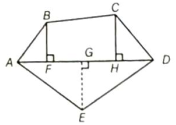
Polygon ABCDE is divided into parts as shown.
Find its area, if $A D=8 cm, A H=6 cm, A G=4 cm$, $A F=3 cm$ and perpendiculars $B F=2 cm$, $C H=3 cm, E G=2.5 cm$.
Image
Area of polygon $A B C D E=$ Area of $\triangle A F B+$
Area of $\triangle A F B=\frac{1}{2}, A F, B F=\frac{1}{2}, 3 \times 2=$
Area of trapezium
$\begin{aligned} F B C H & =F H \times \frac{(B F+C H)}{2} \\ & =3 \times \frac{(2+3)}{2}+\ldots\end{aligned}$
$\ [F H=A H-A F]$
Area of $\triangle C H D=\frac{1}{2} \times H D \times C H=\ldots$;
Area of $\triangle A D E=\frac{1}{2} \times A D \times G E=\ldots$
So, the area of polygon $A B C D E=\ldots$
Answer
Given, polygon $A B C D E$ is divided into four parts.
so it is clear from given figure that
Area of polygon $A B C D E=$ Area of $\triangle A F B$
$\begin{array}{l}\quad+\text { Area of trapezium } F B C H \\ + \text { Area of } \triangle C H D+\text { Area of } \triangle A D E\qquad \ldots(i)\end{array}$
Also, $A D=8 cm, A H=6 cm, A G=4 cm, A F=3 cm$.
$B F=2 cm, C H=3 cm$ and $E G=2.5 cm$
Now, area of $\triangle A F B=\frac{1}{2} \times A F \times B F=\frac{1}{2} \times 3 \times 2=3 cm^2$
Area of trapezium $FBCH =\frac{1}{2} \times FH \times( BF + CH )$
$\begin{array}{l}=\frac{1}{2} \times 3 \times(2+3) \\ {[\because F H=A H-A F=6-3=3 cm]} \\ =\frac{1}{2} \times 3 \times 5=\frac{15}{2}=7.5 cm^2\end{array}$
Area of
$\begin{aligned} \triangle C H D & =\frac{1}{2} \times H D \times C H \\ & =\frac{1}{2} \times(A D-A H) \times C H \\ & =\frac{1}{2} \times(8-6) \times 3=\frac{1}{2} \times 2 \times 3=3 cm^2\end{aligned}$
Now, area of
$
\begin{aligned}
\triangle A D E & =\frac{1}{2} \times A D \times G E=\frac{1}{2} \times 8 \times 25 \\
& =4 \times 25=10 cm^2
\end{aligned}
$
On putting all these values in Eq. (i), we get
Area of polygon $A B C D E=(3+75+3+10)=235 cm^2$
Hence, the area of polygon $A B C D E$ is $23.5 cm^2$.
View full question & answer
Question 25 Marks
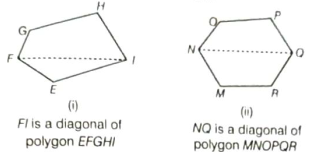
Divide the following polygons into parts (triangles and trapezium) to find out its area.
Image
Answer

Image
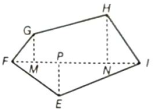
(i) Given, a polygon E F G H I and F I is a diagonal of it. To find the area, we have to divide this polygon into triangle and trapezium. So, firstly draw perpendiculars from opposite vertical on FI i.e. from points G, H and E to F I. Thus, we get perpendiculars G M, H N and E P respectively, on FI and polygon is divided into 5 parts, out of which four are triangles and one is trapezium.
$\begin{aligned} \therefore \text { Area of polygon } E F G H I & =\text { Area of } \triangle G M F \\ & + \text { Area of trapezium } G M N H\end{aligned}$
$\begin{aligned}+ & \text { Area of } \Delta H N I+\text { Area of } \triangle E P I+\text { Area of } \triangle E P F \\ & =\left(\frac{1}{2} \times F M \times G M\right)+\left[\frac{1}{2}(G M+H N) \times M N\right] \\ +\frac{1}{2} & \times N I \times H N+\left(\frac{1}{2} \times P I \times E P\right)+\left(\frac{1}{2} \times P F \times E P\right)\end{aligned}$
$\left[\begin{array}{l}\because \text { Area of triangle }=\frac{1}{2} \times \text { Base } \times \text { Height and } \\ \text { area of trapezium }=\frac{1}{2} \times(\text { Sum of parallel sides }) \times \text { Height }\end{array}\right]$
(ii) Do same as Part (i).
View full question & answer
Question 35 Marks
A company sells biscuits. For packing purpose they are using cuboidal boxes : Box $A \rightarrow 3 cm \times 8 cm \times 20 cm$ and Box $B \rightarrow 4 cm \times 12 cm \times 10 cm$. What size of the box will be economical for the company? Why? Can you suggest any other size (dimensions) which has the same volume but is more economical than these?
Answer
For Box A,
Given, length of box $=20 cm$
Breadth of box $=8 cm$ and height of $box =3 cm$
$\therefore$ Volume of the box $=1 \times b \times h=20 \times 8 \times 3=480 cm^{3}$
Total surface area of the box $=2(l b+b h+h t)$
$\begin{array}{l}=2(20 \times 8+8 \times 3+3 \times 20) \\ =2 \times(160+24+60)=2 \times 244 \\ =488 cm^2\end{array}$
For Box B,
Given, length of box $=12 cm$
Breadth of box $=10 cm$ and height of box $=4 cm$
$\therefore$ Volume of the box $=l \times b \times h=12 \times 10 \times 4=480 cm^3$
Total surface area of the box $=2(l b+b h+h l)$
$\begin{array}{l}=2(12 \times 10+10 \times 4+4 \times 12) \\ =2(120+40+48) \\ =2 \times 208=416 cm^2\end{array}$
It is clear from above that both boxes have same volume but the surface area of type $B$ box is less than that of type $A$ box. Thus, material required for Box $B$ is less.
$\therefore$ Box $B$ is more economical than Box $A$.
Now, let another box of size be $12 cm \times 8 cm \times 5 cm$.
Volume of this box $=12 \times 8 \times 5=480 cm^3$
and its surface area $=2(l b+b h+h l)$
$\begin{array}{l}=2(12 \times 8+8 \times 5+5 \times 12) \\ =2(96+40+60)=2 \times 196=392 cm^2\end{array}$
Clearly, surface area of this box is less than that of Box $B$.
Hence, we can suggest any other box of size $12 cm \times 8 cm \times 5 cm$, which has the same volume but is more economical than the given boxes.
View full question & answer
Question 45 Marks
How will you arrange 12 cubes of equal length to form a cuboid of smallest surface area?
Answer
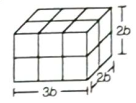
There are some cases in which we can arrange 12 cubes of equal length say $b$ to form a cuboid, as follows
Image
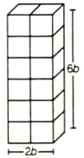
Case I We can arrange 12 cubes of equal length as shown in the figure.
Here, length $(L)=2 b$, breadth $(B)=b$ and height $(H)=6 b$
$\therefore$ Total surface area of the cuboid
$\begin{array}{l}=2(L B+B H+H L) \\ =2(2 b \times b+b \times 6 b+6 b \times 2 b) \\ =2\left(2 b^2+6 b^2+12 b^2\right) \\ =2 \times 20 b^2 \\ =40 b^2\end{array}$
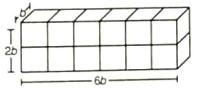
Case II We can arrange 12 cubes of equal length as shown in the figure.
Here, length $(L)=6 b$, breadth $(B)=b$
and height $(H)=2 b$
Image
$\therefore$ Total surface area of the cuboid
$
\begin{array}{l}
=2(L B+B H+H I L) \\
=2(6 b \times b+b \times 2 b+2 b \times 6 b) \\
=2\left(6 b^2+2 b^2+12 b^2\right)=2 \times 20 b^2 \\
=40 b
\end{array}
$
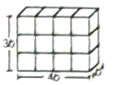
Case III We can arrange 12 cubes of equal length as shown in the figure.
Image
Here, length, $L=4 b$, breadth, $B=b$ and height, $H=3 b$
$\therefore$ Total surface area of the cuboid
$\begin{array}{l}=2(L B+B H+H L) \\ =2(4 b \times b+b \times 3 b+3 b \times 4 b) \\ =2\left(4 b^2+3 b^2+12 b^2\right) \\ =2 \times 19 b^2=38 b^2\end{array}$
Case IV We can arrange 12 cubes of equal length as shown in the figure.
Image
Here, length $(L)=3 b$, breadth $(B)=2 b$ and height $(H)=2 b$
$\therefore$ Total surface area of the cuboid
$\begin{array}{l}=2(L B+B H+H L) \\ =2(3 b \times 2 b+2 b \times 2 b+2 b \times 3 b) \\ =2\left(6 b^2+4 b^2+6 b^2\right) \\ =2 \times 16 b^2=32 b^2\end{array}$
It is clear from the above cases that in Case IV, we get minimum surface area.
So, we arrange 12 cubes according to the Case IV to get smallest surface area.
View full question & answer
Question 55 Marks
Answer
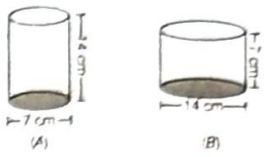
Given, diameter of Cylinder $A=7 cm$
$\therefore$ Radius of Cylinder $A=\frac{7}{2} cm$
and height of Cylinder $A=14 cm$
Also, diameter of Cylinder $B=14 cm$
$\therefore$ Radius of Cylinder $B=\frac{14}{2}=7 cm$
and height of Cylinder $B=7 cm$
Here, radius of Cylinder $B$ is more than that of Cylinder $A$.
So, without doing any calculations, we can suggests that volume of Cylinder $B$ is greater.
For verification
Volume of Cylinder $A=\pi r^2 h=\frac{22}{7} \times\left(\frac{7}{2}\right)^2 \times 14$
$=\frac{22}{7} \times \frac{7}{2} \times \frac{7}{2} \times 14=539 cm^3$
and volume of the Cylinder $B=\pi r^2 h=\frac{22}{7} \times(7)^2 \times 7$
$=1078 cm^3$
Hence, it is verified from calculation that the volume of Cylinder $B$ is greater.
Now, total surface area of the Cylinder $A=2 \pi r(h+r)$
$\begin{array}{l}=2 \times \frac{22}{7} \times \frac{7}{2} \times\left(14+\frac{7}{2}\right) \\ =22 \times\left(\frac{28+7}{2}\right)=\frac{22 \times 35}{2}=385 cm^2\end{array}$
and total surface area of the Cylinder $B=2 \pi r(h+r)$
$=2 \times \frac{22}{7} \times 7(7+7)=44 \times 14=616 cm^2$
$\because \quad 616>385$
So, surface area of Cylinder $B$ is greater than Cylinder $A$.
Hence, the cylinder with greater volume also has greater surface area.
View full question & answer
Question 65 Marks
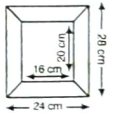
Diagram of the adjacent picture frame has outer dimensions $24 cm \times 28 cm$ and inner dimensions $16 cm \times 20 cm$. Find the area of each section of the frame, if the width of each section is same.
Image
Answer
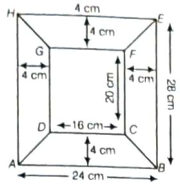
The diagram of the picture frame is as shown in the figure:
The picture frame has four trapezium shaped sections, which are $A B C D, B E F C, E H G F$ and $H A D G$.
Out of these four sections, the area of opposite sections will be same
i.e. Area of section $A B C D=$ Area of section $E H G F$
and area of section $B E F C=$ Area of section $H A D G$
Image
$
\begin{aligned}
\text { Width of section } A B C D & =\frac{(A H-D G)}{2} \\
& =\frac{(28-20)}{2}=\frac{8}{2}=4 cm
\end{aligned}
$
[ $\because$ width of $E F G H$ and $A B C D$ is same]
Then, the width of each section is 4 cm .
Now, area of trapezium $A B C D$
$
\begin{array}{l}
=\frac{1}{2}(A B+C D) \times \text { Width of frame } \\
=\frac{1}{2} \times(24+16) \times 4=\frac{1}{2} \times 40 \times 4=80 m^2
\end{array}
$
and area of trapezium BEFC
$
\begin{array}{l}
=\frac{1}{2}(B E+C F) \times \text { Width of frame } \\
=\frac{1}{2}(28+20) \times 4=\frac{1}{2} \times 48 \times 4=96 m^2
\end{array}
$
$\therefore$ Area of section $A B C D=$ Area of section $E H G F$
$=80 cm^2$
and area of section $B E F C=$ Area of section $H A D G$
$=96 cm^2$
View full question & answer
Question 75 Marks
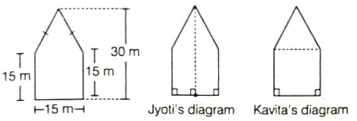
There is a pentagonal shaped park as shown in the figure. For finding its area, Jyoti and Kavita divided it in two different ways.
Image
Find the area of this park using both ways. Can you suggest some other way of finding its area?
Answer

Image
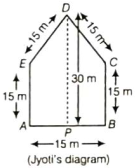
Let $A B C D E$ be a given pentagonal shaped park.
Given, length of each side of regular pentagon $=15 m$.
Now, Jyoti divide it into two congruent trapeziums by joining $D P$, where $P$ is the mid-point of $A B$. Here, $A E$ and $D P$ are parallel sides and $A P$ is perpendicular distance.
Given, length of $D P=30 m$
and length of $A P=\frac{A B}{2}=\frac{15}{2} m$
$\therefore$ Area of pentagonal park $A B C D E$
$=2 \times$ Area of trapezium $A P D E$
[ $\because$ both trapeziums are congruent, so their area will be same]
$=2 \times\left[\begin{array}{r}\frac{1}{2} \times \text { Sum of parallel sides } \times \text { Perpendicular } \\ \text { distance between parallel sides }\end{array}\right]$
$\begin{array}{l}=2 \times\left[\frac{1}{2} \times(30+15), \frac{15}{2}\right]=2, \frac{1}{2} \times 45, \frac{15}{2} \\ =\frac{45 \times 15}{2}=\frac{675}{2}=3375 m^2\end{array}$
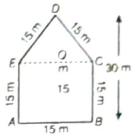
Now, Kavita divide it into two parts by joining EC out of which one is $\triangle D E C$ and other is a square $A B C E$.
Image
Then, the altitude of $\triangle D E C=D Q$
$
=30 m-15 m=15 m
$
$\therefore$ Area of pentagon $A B C D E$
$
\begin{array}{l}
=\text { Area of } \triangle D E C+\text { Area of square } A B C E \\
=\frac{1}{2} \times E C \times D Q+A B \times B C \\
=\frac{1}{2} \times 15 \times 15+15 \times 15 \\
=\frac{225}{2}+225=\frac{225+450}{2}=\frac{675}{2}=337.5 m^2
\end{array}
$
Hence, the area of park using both ways is same i.e. $337.5 m^2$.
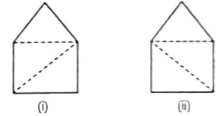
Yes, we can find the area of pentagonal park from two another ways by drawing the figure given below and then find its area :
Image
View full question & answer
Question 85 Marks
Horse stable is in the form of a cuboid whose external dimensions are $70 m \times 35 m \times 40 m$, surrounded by a cylinder halved vertically through diameter 35 m and it is open from one rectangular face $70 m \times 40 m$. Find the cost of painting the exterior of the stable at the rate of \₹$ 2$ per $m ^2$. Also, verify your answer.
Answer
We know that the dimensions of cuboid,
$
l=70 m, b=35 m, h=40 m
$
Diameter of cylinder is 35 m and cost of painting is ₹ 2 per $m ^2$.
Area of cylindrical part to be painted
$
\begin{array}{l}
=\frac{1}{2} \times \text { Total surface area }=\frac{1}{2}[2 \pi r(r+h)] \\
=\frac{1}{2}\left[2 \times \frac{22}{7} \times \frac{35}{2}\left(\frac{35}{2}+70\right)\right]=4812.5 m^2
\end{array}
$
Area of cuboid to be painted $=$ Area of three walls
$\begin{array}{l}=l h+2 b h \\ =70 \times 40+2 \times 40 \times 35 \\ =2800+2800=5600 m^2\end{array}$
Total area to be painted $=4812.5+5600=10412.5 m^2$
$\because$ Cost of painting per $m ^2=$₹$ 2$
$\therefore$ Cost of painting $10412.5 m^2=$₹$ 10412.5 \times 2=$₹$ 20825$
Verification Verify your answer by adopting some other plan i.e. here in this problem instead of taking area in two steps, let us find in one step.
Area to be painted
$\begin{array}{l}=\text { Area of three walls }+ \text { Area of cylindrical part } \\ =2 b h+l h+\frac{1}{2}\left[2 \pi r h+2 \pi r^2\right] \\ =h[2 b+l]+[\pi r(r+h)] \\ =40[2 \times 35+70]+\frac{22}{7} \times \frac{35}{2} \times\left(\frac{35}{2}+70\right) \\ =40[140]+55 \times 87.5 \\ =5600+4812.5=10412.5 m^2\end{array}$

View full question & answer
Question 95 Marks
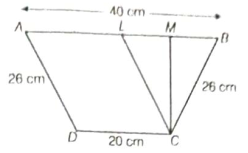
The parallel sides of a trapezium are 40 cm and 20 cm . If its non-parallel sides are both equal, each being 26 cm , find the area of the trapezium.
Answer
Let $A B C D$ be the trapezium such that $A B=40 cm$, $C D=20 cm$ and $A D=B C=26 cm$.
Image
Now, draw $C L \| A D$
Then, $A L C D$ is a parallelogram.
So, $A L=C D=20 cm$ and $C L=A D=26 cm$.
In $\triangle C L B$, we have
$
C L=C B=26 cm
$
Therefore, $\triangle C L B$ is an isosceles triangle.
Draw altitude $C M$ of $\triangle C L B$.
Since, $\triangle C L B$ is an isosceles triangle.
So, $C M$ is also the median.
Then, $L M=M B=\frac{1}{2} B L=\frac{1}{2} \times 20 cm=10 cm$
[as $B L=A B-A L=(40-20) cm =20 cm]$
On applying Pythagoras theorem in $\triangle C L M$, we have
$\begin{aligned} & & C L^2 & =C M^2+L M^2 \\ \Rightarrow & & 26^2 & =C M^2+10^2 \\ \Rightarrow & & C M^2 & =26^2-10^2 \\ \Rightarrow & & C M^2 & =(26-10)(26+10) \\ \Rightarrow & & C M^2 & =16 \times 36=576 \\ \Rightarrow & & C M & =\sqrt{576}=24 cm\end{aligned}$
$\therefore$ Area of the trapezium
$
\begin{array}{l}
=\frac{1}{2}(\text { Sum of parallel sides }) \times \text { Height } \\
=\frac{1}{2}(20+40) \times 24=30 \times 24=720 cm^2
\end{array}
$
View full question & answer