Sample QuestionsProbability questions
One sample from each question group in this chapter. Select any group above to see the full set with answer keys.
Tick the correct answer in the following: In a spinning wheel, there are $3$ white and $5$ green sectors. It is spinned. What is the probability of getting a green sector$?$
- A
$\frac{5}{3}$
- ✓
$\frac{5}{8}$
- C
$\frac{1}{5}$
- D
$\frac{3}{8}$
Answer: B.
View full solution →Tick the correct answer in the following: Two coins are tossed simultaneously. What is the probability of getting one head and one tail$?$
- A
$\frac{1}{4}$
- ✓
$\frac{1}{2}$
- C
$\frac{3}{4}$
- D
$\frac{2}{3}$
Answer: B.
View full solution →Tick the correct answer in the following: $8$ cards are numbered as $1, 2, 3, 4, 5, 6, 7, 8$ respectively. They are kept in a box and mixed thoroughly. One card is chosen at random. What is the probability of getting a number less than $4?$
- A
$\frac{1}{2}$
- B
$\frac{3}{4}$
- ✓
$\frac{3}{8}$
- D
$\frac{3}{5}$
Answer: C.
View full solution →Tick the correct answer in the following:
A die is thrown. What is the probability of getting an even number$?$
- ✓
$\frac{1}{2}$
- B
$\frac{2}{3}$
- C
$\frac{5}{6}$
- D
$\frac{1}{6}$
Answer: A.
View full solution →Tick the correct answer in the following:
From a well-shuffled deck of $52$ cards, one card is drawn at random. What is the probability that the drawn card is a black $6?$
- A
$\frac{3}{26}$
- ✓
$\frac{1}{26}$
- C
$\frac{1}{13}$
- D
$\frac{1}{52}$
Answer: B.
View full solution →Assertion (A) : Out of 100 cards bearing numbers 1 to 100, one card is drawn at random. Then, the probability of getting a two-digit number is $\frac{9}{10}$.
Reason (R) : There are 90 two-digit numbers in all.
- ✓
Both Assertion (A) and Reason (R) are true and Reason (R) is the correct explanation of Assertion (A).
- B
Both Assertion (A) and Reason (R) are true and Reason (R) is not the correct explanation of Assertion (A).
- C
Assertion (A) is true but Reason (R) is false.
- D
Assertion (A) is false but Reason (R) is true.
Answer: A.
View full solution →Assertion (A) : The probability of an event cannot be negative.
Reason (R) : The probability of an impossible event is 0.
- ✓
Both Assertion (A) and Reason (R) are true and Reason (R) is the correct explanation of Assertion (A).
- B
Both Assertion (A) and Reason (R) are true and Reason (R) is not the correct explanation of Assertion (A).
- C
Assertion (A) is true but Reason (R) is false.
- D
Assertion (A) is false but Reason (R) is true.
Answer: A.
View full solution →Assertion (A) : In rolling a die, the probability of getting an odd prime number is$\frac{1}{3}$.
Reason (R) : 1,3 and 5 are odd prime numbers.
- A
Both Assertion (A) and Reason (R) are true and Reason (R) is the correct explanation of Assertion (A).
- B
Both Assertion (A) and Reason (R) are true and Reason (R) is not the correct explanation of Assertion (A).
- ✓
Assertion (A) is true but Reason (R) is false.
- D
Assertion (A) is false but Reason (R) is true.
Answer: C.
View full solution →Assertion (A) : The probability of occurrence of an event may be greater or smaller than 1.
Reason (R) : The probability of a sure event is 1.
- A
Both Assertion (A) and Reason (R) are true and Reason (R) is the correct explanation of Assertion (A).
- B
Both Assertion (A) and Reason (R) are true and Reason (R) is not the correct explanation of Assertion (A).
- C
Assertion (A) is true but Reason (R) is false.
- ✓
Assertion (A) is false but Reason (R) is true.
Answer: D.
View full solution →Assertion (A) : If two coins are tossed together then the probability of not getting a head is $\frac{1}{4}$.
Reason (R) : Out of the total 4 outcomes, only one outcome of getting two tails is favourable.
- ✓
Both Assertion (A) and Reason (R) are true and Reason (R) is the correct explanation of Assertion (A).
- B
Both Assertion (A) and Reason (R) are true and Reason (R) is not the correct explanation of Assertion (A).
- C
Assertion (A) is true but Reason (R) is false.
- D
Assertion (A) is false but Reason (R) is true.
Answer: A.
View full solution →In a single throw of a coin, what is the probability of getting a tail?
In a lottery, there are $10$ prizes and $20$ blanks. A ticket is chosen at random. What is the probability of getting a prize?
View full solution →In a survey of $200$ ladies, it was found that $82$ like coffee while $118$ dislike it. From these ladies, one is chosen at random. What is the probability that the chosen lady dislikes coffee?
View full solution →One card is drawn at random from a well$-$shuffled deck of $52$ cards. Find the probability that the card drawn is:
$i.$ A $4$.
$ii.$ A queen.
$iii.$ A black card.
View full solution →A box contains $19$ balls bearing numbers $1, 2, 3, ..., 19$ respectively. A ball is drawn at random from the box. Find the probability that the number on the ball is:
$i.$ A prime number.
$ii.$ An even number.
$iii.$ A number divisible by $3$.
View full solution →In a single throw of two coins, find the probability of getting:
$i.$ Both tails,
$ii.$ At least $1$ tail,
$iii.$ At the most $1$ tail.
View full solution →It is known that a box of $100$ electric bulbs contains $8$ defective bulbs. One bulb is taken out at random from the box. What is the probability that the bulb drawn is:
$i.$ Defective?
$ii.$ Non$-$defective?
View full solution →A die is thrown at random. Find the probability of getting:
$i. 2.$
$ii.$ A number less than $3.$
$iii.$ A composite number.
$iv.$ A number not less than $4.$
View full solution →One card is drawn at random from a well$-$shuffled deck of $52$ cards. Find the probability that the card drawn is:
$i.$ A king.
$ii.$ A spade.
$iii.$ A red queen.
$iv.$ A black $8.$
View full solution →Examine the following case study carefully and answer the given questions.
For a game, a fair circular spinner is divided into 12 equal parts are shown in the figure. These sectors are then numbered as shown. The spinner wheel is now ready to be spun during the game.
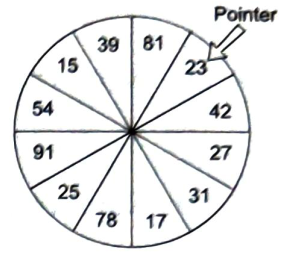
1. If the wheel is spun once, the probability of getting an odd number is
(a) $\frac{1}{2}$$\quad$ (b) $\frac{1}{3}$$\quad$ (c) $\frac{2}{3}$$\quad$ (d) $\frac{3}{4}$$\quad$
2. The probability of getting a prime number is
(a) $\frac{1}{4}$$\quad$ (b) $\frac{1}{3}$$\quad$ (c) $\frac{5}{12}$$\quad$ (d) $\frac{1}{2}$$\quad$
3.The probability of getting a multiple of 7 is
(a) $\frac{1}{6}$$\quad$ (b) $\frac{1}{4}$$\quad$ (c) $\frac{1}{3}$$\quad$ (d) $\frac{1}{2}$$\quad$
4. The probability of getting a multiple of both 2 and 3 is
(a) $\frac{1}{4}$$\quad$ (b) $\frac{1}{3}$$\quad$ (c) $\frac{5}{12}$$\quad$ (d) $\frac{1}{2}$$\quad$
5. How many of the following events are possible (likely to happen)?
I. Getting an even prime number.
II. Getting an odd composite number.
III. Getting a multiple of both 3 and 5.
IV. Getting a multiple of both 3 and 7.
(a) 1$\quad$ (b) 2$\quad$ (c) 3$\quad$ (d) All of these$\quad$ View full solution →From a well-shuffled deck of $52$ cards, one card is drawn at random. What is the number of all possible outcomes$?$
View full solution →Two coins are tossed simultaneously. What are all possible outcomes$?$
View full solution →Tick the correct answer in the following: From a well-shuffled deck of $52$ cards, one card is drawn at random. What is the probability that the drawn card is a queen ?
- A
$\frac{1}{4}$
- B
$\frac{1}{52}$
- ✓
$\frac{1}{13}$
- D
$\frac{1}{26}$
Answer: C.
View full solution →A die is thrown. What are all possible outcomes$?$
View full solution →A coin is tossed. What are all possible outcomes$?$
View full solution →