Question
Examine the following case study carefully and answer the given questions.
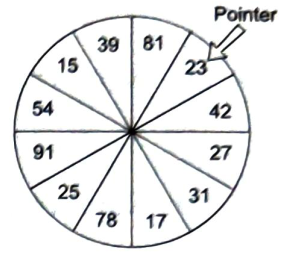
For a game, a fair circular spinner is divided into 12 equal parts are shown in the figure. These sectors are then numbered as shown. The spinner wheel is now ready to be spun during the game.
1. If the wheel is spun once, the probability of getting an odd number is
(a) $\frac{1}{2}$$\quad$ (b) $\frac{1}{3}$$\quad$ (c) $\frac{2}{3}$$\quad$ (d) $\frac{3}{4}$$\quad$
2. The probability of getting a prime number is
(a) $\frac{1}{4}$$\quad$ (b) $\frac{1}{3}$$\quad$ (c) $\frac{5}{12}$$\quad$ (d) $\frac{1}{2}$$\quad$
3.The probability of getting a multiple of 7 is
(a) $\frac{1}{6}$$\quad$ (b) $\frac{1}{4}$$\quad$ (c) $\frac{1}{3}$$\quad$ (d) $\frac{1}{2}$$\quad$
4. The probability of getting a multiple of both 2 and 3 is
(a) $\frac{1}{4}$$\quad$ (b) $\frac{1}{3}$$\quad$ (c) $\frac{5}{12}$$\quad$ (d) $\frac{1}{2}$$\quad$
5. How many of the following events are possible (likely to happen)?
I. Getting an even prime number.
II. Getting an odd composite number.
III. Getting a multiple of both 3 and 5.
IV. Getting a multiple of both 3 and 7.
(a) 1$\quad$ (b) 2$\quad$ (c) 3$\quad$ (d) All of these$\quad$
For a game, a fair circular spinner is divided into 12 equal parts are shown in the figure. These sectors are then numbered as shown. The spinner wheel is now ready to be spun during the game.
1. If the wheel is spun once, the probability of getting an odd number is
(a) $\frac{1}{2}$$\quad$ (b) $\frac{1}{3}$$\quad$ (c) $\frac{2}{3}$$\quad$ (d) $\frac{3}{4}$$\quad$
2. The probability of getting a prime number is
(a) $\frac{1}{4}$$\quad$ (b) $\frac{1}{3}$$\quad$ (c) $\frac{5}{12}$$\quad$ (d) $\frac{1}{2}$$\quad$
3.The probability of getting a multiple of 7 is
(a) $\frac{1}{6}$$\quad$ (b) $\frac{1}{4}$$\quad$ (c) $\frac{1}{3}$$\quad$ (d) $\frac{1}{2}$$\quad$
4. The probability of getting a multiple of both 2 and 3 is
(a) $\frac{1}{4}$$\quad$ (b) $\frac{1}{3}$$\quad$ (c) $\frac{5}{12}$$\quad$ (d) $\frac{1}{2}$$\quad$
5. How many of the following events are possible (likely to happen)?
I. Getting an even prime number.
II. Getting an odd composite number.
III. Getting a multiple of both 3 and 5.
IV. Getting a multiple of both 3 and 7.
(a) 1$\quad$ (b) 2$\quad$ (c) 3$\quad$ (d) All of these$\quad$