Questions

4 Mark Question

🎯

Test yourself on this topic

5 questions · timed · auto-graded

Question 14 Marks
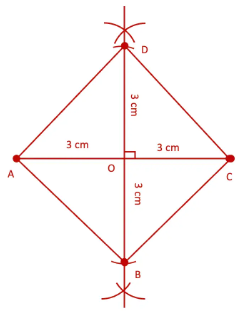
Construct a square with a diagonal 6 cm without using a protractor.
Answer
Image
Steps of construction :
(i) Draw a line segment AC = 6 cm and mark its midpoint as O.
(ii) With O as centre and radius greater than half of AC, draw arcs above and below AC from points A and C.
(iii) Join the arc intersections to get a line perpendicular to AC and passing through O.
(iv) Again, with O as centre and radius equal to 3 cm, mark points B and D on the perpendicular line.
(v) Connect A–B–C–D–A.
Hence, ABCD is the required square with a diagonal of 6 cm.
View full question & answer
Question 24 Marks
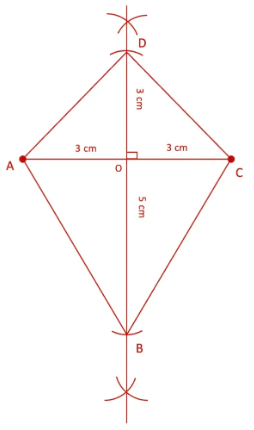
Construct a kite whose diagonals are of lengths 6 cm and 8 cm.
Answer

Image
(i) Draw a line segment $AC =6 cm$.
(ii) Construct the perpendicular bisector of AC ; let it meet AC at O (so O is the midpoint).
(iii) With centre O and radius 3 cm draw an arc to cut the bisector above AC ; label that point D . With centre O and radius 5 cm draw an arc to cut the bisector below AC ; label that point $B$.
(iv)Join A - B, B - C, C - D, D - A.
$A B C D$ is the required kite.
View full question & answer
Question 34 Marks
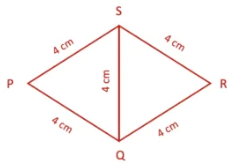
Find all the sides and the angles of the quadrilateral obtained by joining two equilateral triangles with sides 4 cm.
Answer

Image
Since all sides of an equilateral triangle are equal.
Thus, the lengths of all sides of the given quadrilateral are equal.
$\therefore PQ=QR=RS=SP=4 cm .$
Also, the measure of all angles of an equilateral triangle is $60^{\circ}$.
$\begin{array}{l}\angle P=\angle R=60^{\circ} \\\angle S=\angle PSQ+\angle RSQ=60^{\circ}+60^{\circ}=120^{\circ} . \\\angle Q=\angle PQR+\angle RQS=60^{\circ}+60^{\circ}=120^{\circ} .\end{array}$
View full question & answer
Question 44 Marks
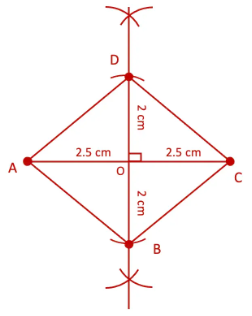
Using the diagonal properties, construct a rhombus whose diagonals are of lengths 4 cm and 5 cm.
Answer

Image
Steps of construction :
(i) Draw a line segment AC of length 5 cm.
(ii) Draw the perpendicular bisector of AC, intersecting it at O.
(iii) With O as centre and radius 2 cm, mark points B (below) and D (above) on the perpendicular bisector.
(iv) Join A–D, D–C, C–B, and B–A.
ABCD is the required rhombus.
View full question & answer
Question 54 Marks
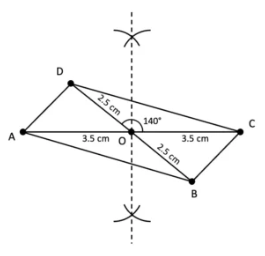
Using the diagonal properties, construct a parallelogram whose diagonals are of lengths 7 cm and 5 cm , and intersect at an angle of $140^{\circ}$.
Answer

Image
Steps of construction :
(i) Draw a line segment AC of length 7 cm and mark its midpoint as O .
(ii) At point 0 , draw an angle of $140^{\circ}$ with respect to diagonal AC .
(iii) From O , along the $140^{\circ}$ line in both directions, mark $OD =2.5 cm OD$ and $OB =$ 2.5 cm using a compass.
(iv) Join D to A and C .
Join B to A and C .
$A B C D$ is the required parallelogram.
View full question & answer
4 Mark Question - MATHS STD 8 Questions - Vidyadip