Question
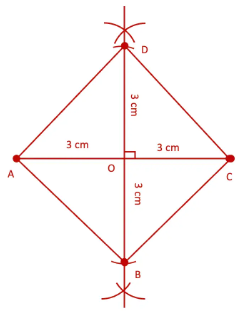
Construct a square with a diagonal 6 cm without using a protractor.
Answer


Image
Steps of construction :
(i) Draw a line segment AC = 6 cm and mark its midpoint as O.
(ii) With O as centre and radius greater than half of AC, draw arcs above and below AC from points A and C.
(iii) Join the arc intersections to get a line perpendicular to AC and passing through O.
(iv) Again, with O as centre and radius equal to 3 cm, mark points B and D on the perpendicular line.
(v) Connect A–B–C–D–A.
Hence, ABCD is the required square with a diagonal of 6 cm.

Need a full question paper?

Generate a complete, print-ready paper with questions like this in minutes — across 16+ boards, with answer keys.

Start Generating Free

Similar questions

RISE is a rectangle and its diagonals meet at O. If RO = (3x + 15) and IO = (5x + 7), then find the value of x.
A mixture of paint is prepared by mixing 1 part of red pigment with 8 parts of base. In the following table, find the parts of base that need to be added.
Parts of red pigment1471220
Parts of base8
How will you multiply two numbers given in Roman numerals, without converting them to Hindu numerals? Try to find the product of the following pairs of landmark numbers : V × L, L × D, V × D, VII × IX.
Principal $=₹  1000$, Rate $=8 \%$ per annum. Fill in the following table and find which type of interest (simple or compound) changes in direct proportion with time period.
Time period1 yr2 yr3 yr
Simple interest (in ₹)
Compound interest (in ₹)
Take a regular hexagon, in the given figure.
Image
(i) What is the sum of the measures of its exterior angles $x, y, z, p, q$ and $r$ ?
(ii) Is $x=y=z=p=q=r$ ? Why?
(iii) What is the measure of each?
(a) Exterior angle$\qquad$$\quad$ (b) Interior angle
(iv) Repeat this activity for the cases of
(a) A regular octagon $\quad$ (b) A regular 20-gon
Find the smallest number by which each of the following number must be multiplied to obtain a perfect cube :
256
If $12^2=144$ what is
(i) $(1.2)^2$
(ii) $(0.12)^2$
(iii) $(0.012)^2$
(iv) $120^2$
Suppose you are using the number system that uses sticks to represent numbers, as in Method 1. Without using either the number names or the numerals of the Hindu number system, give a method for adding, subtracting, multiplying and dividing two numbers or two collections of sticks.
Before the process begins, Khoisnam realises that he already knows which lockers will be open at the end. How did he figure out the answer?
In the following figure of a ship. ABDH and CEFG are two parallelogram. Find the value of x.
Image