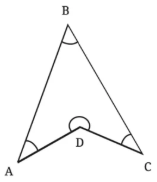
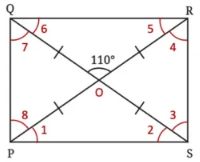
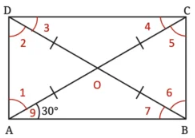
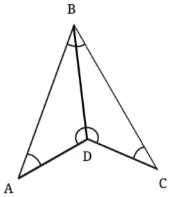
Will the sum of the angles in a quadrilateral such as the following one also be $360^{\circ}$ ? Find the answer using geometric reasoning as well as by constructing this figure and measuring.
What type of quadrilateral is one in which the opposite sides are equal? Justify your answer.
Answer
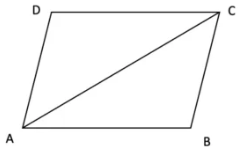
If a quadrilateral has opposite sides equal, then it is a parallelogram. Geometric reasoning using a diagonal : Given : Quadrilateral ABCD with $AB = CD$ and $BC = DA$. Draw diagonal $A C$. In $\triangle A B C$ and $\triangle C D A$, $AB = CD$ (given) $BC = DA$ (given) $AC = AC$ (common side) By SSS congruence, $\triangle ABC \cong \triangle CDA$. From congruence, corresponding angles are equal: $\angle BAC =\angle DCA$ and $\angle ACB =\angle CAD$. But these are alternate interior angles. $\therefore A B \| D C$ and $A D \| B C$. Hence, ABCD is a parallelogram.
If a quadrilateral has four equal sides and one angle of $90^{\circ}$, will it be a square? Find the answer using geometric reasoning as well as by construction and measurement.
Answer
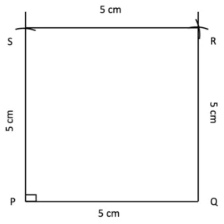
Reasoning : A rhombus is a quadrilateral with four equal sides. If a rhombus has one angle of $90^{\circ}$, then: Its opposite angle is also $90^{\circ}$ (opposite angles of a rhombus are equal). Each adjacent angle must also be $90^{\circ}$ (sum of adjacent angles in a parallelogram/rhombus is $180^{\circ}$ ). Thus, all four angles are $90^{\circ}$. Since the quadrilateral has all sides equal and all angles right angles, it is a square. Construction and measurement : Steps of construction : (i) Draw a line segment PQ of length 5 cm . (ii) At point PP , construct a perpendicular line to PQ . (iii) On this perpendicular, mark point S such that $PS =5 cm$. (iv) With S as centre and radius 5 cm , draw an arc to the right of PS . (v) With Q as centre and radius 5 cm , draw an arc above PQ to intersect the arc from step (4) at point R . Join $Q - R , R - S$, and $S - P$ to complete the square PQRS . Verification by measurement : All sides: $PQ = QR = RS = SP =5 cm$ All angles: $\angle P=\angle Q=\angle R=\angle S=90^{\circ}$. Conclusion: The figure constructed is a square.
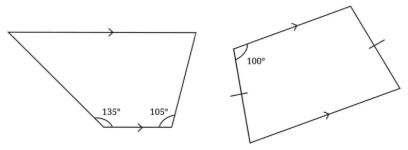
Find the remaining angles in the following trapeziums -
Answer
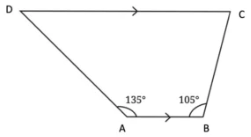
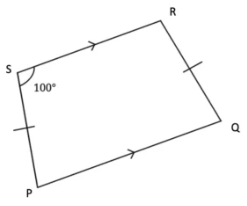
Since $A B\ \|\ D C$, and $A D$ is a tranversal, then $\angle A +\angle D =180^{\circ}$ $\qquad$ (Sum of angles on the same side of the transversal) $135^{\circ}+\angle D =180^{\circ}$ $\angle D =180^{\circ}-135^{\circ}$ $\angle D =45^{\circ}$ Also, since $AB\ \|\ DC$, and BC is a tranversal, then $\angle B +\angle C =180^{\circ}$ $\qquad$ (Sum of angles on the same side of the transversal) $\begin{array}{l}105^{\circ}+\angle C=180^{\circ} \\\angle C=180^{\circ}-105^{\circ} \\\angle C=75^{\circ}\end{array}$ Since $PQ \| SR$, and PS is a tranversal, then $\angle P +\angle S =180^{\circ}$ $\qquad$ (Sum of angles on the same side of the transversal) $\angle P+100^{\circ}=180^{\circ}$ $\angle P =180^{\circ}-100^{\circ}=80^{\circ}$. $\angle S =\angle R =100^{\circ}$ $\qquad$ (Angles opposite to equal sides are equal) Also, since $PQ \| SR$, and QR is a tranversal, then $\angle Q +\angle R =180^{\circ}$ $\qquad$ (Sum of angles on the same side of the transversal) $\angle Q+100^{\circ}=180^{\circ}$ $\angle Q=180^{\circ}-100^{\circ}=80^{\circ}$.