Questions

2 Marks Questions

🎯

Test yourself on this topic

36 questions · timed · auto-graded

Question 12 Marks
(i) If $11^2=121$, what is the square root of 121 ?
(ii) If $14^2=196$, what is the square root of $196 ?$
Answer
(i) We have, $\quad 11^2=121$
Therefore, the square root of 121 is 11.
(ii) We have $\quad 14^2=196$
Therefore, the square root of 196 is 14.
NoteGenerally when we take square root of any number, we will take both positive and negative signs.
View full question & answer
Question 22 Marks
Find the squares of the following numbers containing 5 in unit place.
(i) 15$\quad$(ii) 95$\quad$(iii) 105$\quad$(iv) 205
Answer
(i) $15^{2}=1\times(1+1)\times$ hundred $+25$
$=(1\times2)\times100+25=200+25=225$
(ii) $95^{2}=9\times(9+1)\times$ hundred $+25$
$=(9\times10)\times100+25=90\times100+25$
$=9000+25=9025$
(iii) $105^{2}=10\times(10+1)\times$ hundred $+25$
$=(10\times11)\times100+25=110\times100+25$
$=11000+25=11025$
(iv) $205^{2}=20\times(20+1)\times$ hundred $+25$
$=(20\times21)\times100+25$
$=420\times100+25$
$=42000+25=42025$
View full question & answer
Question 32 Marks
Can you find the square of the following numbers using the above pattern (from NCERT Page No. 57)? (i) $6666667^2$$\quad$(ii) $66666667^2$
Answer
self
View full question & answer
Question 42 Marks
Express the following as the sum of two consecutive integers.
(i) $21^2$ $\quad$ (ii) $13^2$ $\quad$ (iii) $11^2$$\quad$(iv) $19^2$
Answer
(i) Given number is $21^2$.
Using the formula, the square of any number can be expressed as two integers as
$\begin{aligned}n^2 & =\frac{n^2-1}{2}+\frac{n^2+1}{2} . \\\therefore 21^2 & =\frac{21^2-1}{2}+\frac{21^2+1}{2}=\frac{441-1}{2}+\frac{441+1}{2} \\& =\frac{440}{2}+\frac{442}{2}=220+221 .\end{aligned}$
which is expressed as the sum of two consecutive numbers.
(ii) Given number is $13^2$.
Using the formula, the square of any number can be expressed as two integers as
$\begin{aligned}n^2 & =\frac{n^2-1}{2}+\frac{n^2+1}{2} \\\therefore 13^2 & =\frac{13^2-1}{2}+\frac{13^2+1}{2}=\frac{169-1}{2}+\frac{169+1}{2}=84+85\end{aligned}$
which is expressed as the sum of two consecutive numbers.
(iii) 60 + 61
(iv) 180 + 181
View full question & answer
Question 52 Marks
Find whether each of the following numbers is a perfect square or not.
(i) 121 $\quad$ (ii) 55 $\quad$ (iii) 81 $\quad$ (iv) 49 $\quad$ (v) 69
Answer
(i) Given number is 121 .
Now, we subtract successively from $1,3,5, \ldots$.
Then, $121-1=120, \qquad 120-3=117$,
$\begin{array}{l}117-5=112, \qquad\quad\quad 112-7=105 \\105-9=96, \qquad\qquad\quad 96-11=85 \\85-13=72, \qquad\qquad\quad 72-15=57 \\57-17=40, \qquad\qquad\quad 40-19=21, \quad 21-21=0\end{array}$
We will get the result as zero in the end after 11 steps.
$\therefore 121=1+3+5+7+9+11+13+15+17+19+21$
So, 121 is a perfect square of 11.
(ii) Given number is 55 .
Now, we subtract successively from $1,3,5, \ldots$.
Then, $55-1=54,54-3=51,51-5=46,46-7=39$
$39-9=30,30-11=19,19-13=6,6-15=-9$
This shows that we do not express 55 as the sum of consecutive odd numbers starting with 1 .
So, 55 is not a perfect square.
(iii) 9
(iv) 7
(v) Not a perfect square
View full question & answer
Question 62 Marks
How many non-square numbers lie between the following pairs of numbers?
(i) $100^2$ and $101^2$ $\quad$ (ii) $90^2$ and $91^2$ $\quad$ (iii) $1000^2$ and $1001^2$
Answer
(i) Given, pair of numbers $100^2$ and $101^2$.
Non-square numbers between $100^2$ and $101^2=2 n$
$=2 \times 100=200 \quad[\because n=100]$
(ii) Given, pair of numbers $90^2$ and $91^2$.
Non-square numbers between $90^2$ and $91^2=2 n$
$=2 \times 90=180\quad$ $[\because n=90]$
(iii) Given, pair of numbers $1000^2$ and $1001^2$.
Non-square numbers between $1000^2$ and $1001^2$
$=2 n=2 \times 1000=2000 \quad[\because n=1000]$
View full question & answer
Question 72 Marks
How many natural numbers lie between
(i) $9^2$ and $10^2?$ $\quad$ (ii) $11^2$ and $12^2?$
Answer
We know that there are $2 n$ natural numbers lie between the squares of $n$ and $(n+1)$.
(i) To find natural numbers lie between $9^2$ and $10^2$.
Here, $n=9$ and $n+1=10$
$\therefore$ Total natural numbers between $9^2$ and $10^2$
$=2 n=2 \times 9=18$
(ii) To find natural numbers lie between $11^2$ and $12^2$.
Here, $n=11$ and $n+1=12$
$\therefore$ Total natural numbers between $11^2$ and $12^2$
$=2 n=2 \times 11=22$
View full question & answer
Question 82 Marks
What will be the number of zeroes in the square of the following numbers?
(i) 60 $\quad$ (ii) 400
Answer
We know that the number of zeroes in the end of a number is half of the number of zeroes in the end of its square.
(i) The number of zeroes in the square of 60 is 2.
(ii) The number of zeroes in the square of 400 is 4.
View full question & answer
Question 92 Marks
The square of which of the following numbers would be an odd number/an even number? Why?
(i) 727 $\quad$ (ii) 158 $\quad$ (iii) 269 $\quad$ (iv) 1980
Answer
(i) 727 is an odd number, so its square is also odd.
(ii) 158 is an even number, so its square is also even.
(iii) 269 is an odd number, so its square is also odd.
(iv) 1980 is an even number so its square is also even.
View full question & answer
Question 102 Marks
Can we say whether the following numbers are perfect squares? How do we know?
(i) 1057 $\qquad$ (ii) 23453$\quad$(iii) 7928
(iv) 222222$\quad$(v) 1069 $\quad$ (vi) 2061
Write five numbers which you can decide by looking at their ones digit that they are not square numbers.
Answer
We know that a number ends with $2,3,7$ or 8 is never a perfect square.
(i) The number 1057 ends with 7 , which is not one of the end digits of $0,1,4,5,6$ or 9 , so it is not a perfect square.
(ii) The number 23453 ends with 3 , which is not one of the end digits of $0,1,4,5,6$ or 9 , so it is not a perfect square.
(iii) The number 7928 ends with 8 , which is not one of the end digits of $0,1,4,5,6$ or 9 , so it is not a perfect square.
(iv) The number 222222 ends with 2 , which is not one of the end digits of $0,1,4,5,6$ or 9 , so it is not a perfect square.
(v) The number 1069 ends with 9, so it may or may not be a perfect square
$\begin{array}{r}\text { i.e. } 30 \times 30=900, \quad 31 \times 31=961, \\ 32 \times 32=1024, \quad 33 \times 33=1089\end{array}$
i.e. no natural number between 1024 and 1089 is a square.
So, 1069 is not a perfect square.
(vi) The number 2061 ends with 1, so it may or may not be a perfect square.
But $45^{2}=45\times45=2025,46^{2}=46\times46=2116$
So, 2061 is not a perfect square
Five numbers for which we can decide by looking at their ones digit that they are not square numbers are $268,43112,87547,1233$ and 193
View full question & answer
Question 112 Marks
Find the perfect square numbers between
(i) 30 and 40 $\quad$ (ii) 50 and 60
Answer
(i) We know that
$5 \times 5=25,6 \times 6=36 \text { and } 7 \times 7=49$
Hence, 36 is a perfect square number which is lying between 30 and 40.
(ii) We know that
$7 \times 7=49 \text { and } 8 \times 8=64$
Hence, there is no perfect square number lying between 50 and 60.
View full question & answer
Question 122 Marks
Can we say that if a perfect square is of n digits, then its square root will have $\frac{n}{2}$ digits, If n is even or $\frac{(n+1)}{2}$ digits, If n is odd?
Answer
Yes, we can say that if a perfect square is of n digits, then its square root will have
(i) $\frac{n}{2}$ digits, if $n$ is even.
(ii) $\frac{n+1}{2}$ digits, if $n$ is odd.
e.g.
(i) We have, 1296
Here, number of digits, n = 4$\qquad$[even]
$\therefore$ Number of digits in square root $=\frac{n}{2}=\frac{4}{2}=2$
Also, the square root of 1296 is 36, which is of 2 digits.$\qquad\qquad$Hence verified
(ii) We have, 529
ere, number of digit, n = 3$\qquad$[odd]
$\therefore$ Number of digits in square root
$=\frac{n+1}{2}=\frac{3+1}{2}=\frac{4}{2}=2$
Also, the square root of 529 is 17, which is of 2 digits.$\qquad\qquad$Hence verified
View full question & answer
Question 132 Marks
There are 500 children in a school. For a PT drill they have to stand in such a manner that the number of rows is equal to number of columns. How many children would be left out in this arrangement?
Answer
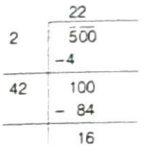
Given, total children in a school = 500
Also,
Number of rows = Number of columns
So, their product must be a square number.
Image
Now, remainder = 16
$\therefore \quad 22^2<500$
Obviously, the next square number would be 23.
$\therefore$ The number of children left in this arrangement
$\begin{array}{l}=500-22^2 \\ =500-484=16\end{array}$
Hence, 16 children would be left out in this arrangement.
View full question & answer
Question 142 Marks
A gardener has 1000 plants. He wants to plant these in such a way that the number of rows and the number of columns remains same. Find the minimum number of plants he needs more for his.
Answer
Given, total number of plants in a garden = 1000
Also,
Number of plants in a row = Number of plants in a column
So, their product must be a square number.
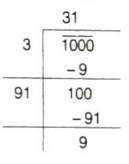
Image
Here, remainder is 9.
$\therefore \quad 31^2<1000$
Obviously, the next square number would be 32
i.e. the number of plants required to be added (to make it perfect square)
$=32^2-1000=1024-1000=24$
Hence, the minimum number of plants, we need more is 24.
View full question & answer
Question 152 Marks
Find the length of the side of a square whose area is $441 m^2$.
Answer
Let the side of a square be x m.
Then, the area of a square $=x^2$
According to the question,
Area of square $=441$
$\therefore \quad x^2=441 \qquad\qquad$ [given]
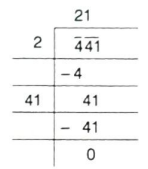
$\Rightarrow \quad x=\sqrt{441}$
Image
$\therefore \quad x=21 \text{ m}$
Hence, the length of the side of a square is 21 m.
View full question & answer
Question 162 Marks
Find the least number which must be added to each of the following numbers, so as to get a perfect square. Also, find the square root of the perfect square, so obtained.
1750
Answer
Given number is 1750.
We observe that
$41^2<1750<42^2$
The required least number to be added
$\begin{array}{l}=42^2-1750 \\ =1764-1750=14\end{array}$
$\therefore$ Required perfect square number
$=1750+14=1764$
Hence, the square root ofthe perfect square number 1764 is 42.
View full question & answer
Question 172 Marks
Find the least number which must be added to each of the following numbers, so as to get a perfect square. Also, find the square root of the perfect square, so obtained.
525
Answer
Given number is 525.
We observe that
$22^2<525<23^2$
$\begin{aligned} \text { The required least number to be added } & =23^2-525 \\ & \equiv 529-525=4\end{aligned}$
$\therefore$ Required perfect square number $=525+4=529$
Hence, the square root of the perfect square number 529 is 23.
View full question & answer
Question 182 Marks
Find the least number which must be subtracted from each of the following numbers, so as to get a perfect square. Also, find the square root of the perfect square so obtained.
1989
Answer
Given number is 1989.
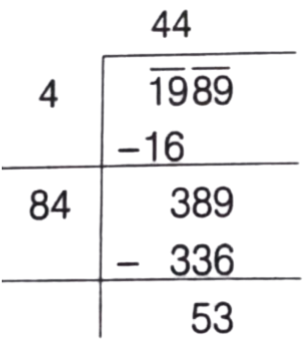
Firstly, place the bar over the numbers, then square root is given below :
Here, we get remainder 53. It shows that $44^{2}$ is less than 1989 by 53.
So, to get a perfect square, 53 must be subtracted from the given number.
$\therefore$ Required perfect square number $=1989-53=1936$
Hence, the square root of 1936 is 44.
Image
View full question & answer
Question 192 Marks
Find the least number which must be subtracted from each of the following numbers, so as to get a perfect square. Also, find the square root of the perfect square so obtained.
402
Answer
Given number is 402.
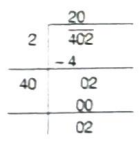
Firstly, place the bar over the number and then use the division method
Here, we get remainder 2. It shows that $20^2$ is less than 402 by 2.
So, to get a perfect square, 2 must be subtracted from the given number.
$\therefore$ Required perfect square number
$=402-2=400$
Here, the square root of 400 is 20.
Image
View full question & answer
Question 202 Marks
Find the square root of each of the following number by division method
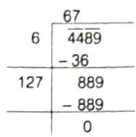
4489
Answer
Given number is 4489.
Firstly, place the bar over the number and then use the division method.
$\therefore\sqrt{4489}=67$
Hence, the square root of 4489 is 67.
Image
View full question & answer
Question 212 Marks
Find the square root of each of the following number by division method
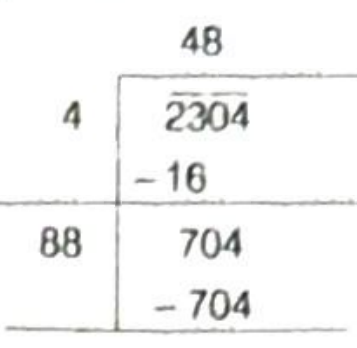
2304
Answer
Given number is 2304.
Firstly, place a bar over every pair of digits starting from the digits at ones place and then use the division method.
$\sqrt{2304}=48$
Hence, the square root of 2304 is 48.
Image
View full question & answer
Question 222 Marks
Find the smallest square number that is divisible by each of the numbers 4, 9 and 10.
Answer
The smallest number divisible by each one of 4,9 and 10 is equal to the LCM of 4,9 and 10.
The prime factorisation of $180=2 \times 2 \times 3 \times 3 \times 5$
Here, prime factor 5 is unpaired.
Clearly, to make it a perfect square, it must be multiplied by 5.
Therefore, the required number $=180 \times 5=900$
Hence, the smallest square number is 900.
View full question & answer
Question 232 Marks
Find the square roots of the following number by the prime factorisation method.
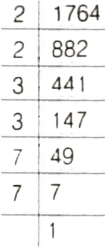
1764
Answer
Given number is 1764.
Using prime factorisation, we get
$\begin{aligned} 1764& =2 \times 2 \times 3 \times 3 \times 7 \times 7 \\ & =(2 \times 3 \times 7)^2 \\ \therefore \sqrt{1764} & =2 \times 3 \times 7=42\end{aligned}$
Hence, the square root of 1764 is 42.
Image
View full question & answer
Question 242 Marks
Find the square roots of the following number by the prime factorisation method.
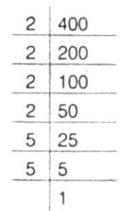
400
Answer
Given number is 400.
Using prime factorisation, we get
$\begin{aligned} 400 & =2 \times 2 \times 2 \times 2 \times 5 \times 5 \\ & =(2 \times 2 \times 5)^2 \\ \therefore \sqrt{400} & =2 \times 2 \times 5=20\end{aligned}$
Hence, the square root of 400 is 20.
Image
View full question & answer
Question 252 Marks
Find the square roots of the following number by the prime factorisation method.
729
Answer
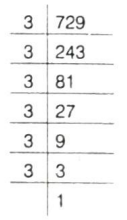
Given number is 729.
Using prime factorisation, we get
$\begin{aligned} 729 & =3 \times 3 \times 3 \times 3 \times 3 \times 3 \\ & =(3 \times 3 \times 3)^2 \\ \therefore \sqrt{729} & =3 \times 3 \times 3=27\end{aligned}$
Hence, the square root of 729 is 27.
Image
View full question & answer
Question 262 Marks
Find the square roots of 100 and 169 by the method of repeated subtraction.
Answer
(i) To find the square roots of 100, we subtract successive odd number starting from 1 as follows.
$\begin{array}{l}100-1=99,99-3=96,96-5=91, \\ 91-7=84 \\ 84-9=75,75-11=64,64-13=51, \\ 51-15=36 \\ 36-17=19, \quad 19-19=0\end{array}$
We observe that the number 100 reduced to zero after subtracting first 10 odd numbers.
So, 100 is a perfect square.
$\therefore \quad \sqrt{100}=10$
Hence, the square root of 100 is 10.
(ii) To find the square root of 169, we subtract successive odd number starting from 1 as follows:
$\begin{aligned} 169-1 & =168, \quad 168-3=165,\quad 165-5=160 \\ 160-7 & =153, \quad 153-9=144, \quad 144-11=133 \\ \quad133-13 & =120, \quad 120-15=105,\quad 105-17=88 \\ 88-19 & =69, \quad 69-21=48,\quad48-23=25 \\ 25-25 & =0\end{aligned}$
We observe that the number 169 reduced to zero after subtracting first 13 odd numbers.
So, 169 is a perfect square.
$\therefore \quad \sqrt{169}=13$
Hence, the square root of 169 is 13.
View full question & answer
Question 272 Marks
What could be the possible 'ones' digits of the square root of each of the following numbers?
(i) 9801$\quad$(ii) 99856$\quad$(iii) 998001$\quad$(iv) 657666025
Answer
The possible 'ones' digits of the square root of the numbers.
(i) In a given number 9801, ones digit is 1. We know that squares of 1 and 9 gives out 1 in ones digit.
Hence, possible ones digit of the square root of the given number is 1 or 9.
(ii) In a given number 99856, ones digit is 6.
We know that squares of 4 and 6 gives out 6 in ones digit.
Hence, possible ones digit of the square root of the given number is 4 or 6.
(iii) In a given number 998001, ones digit is 1.
We know that squares of 1 and 9 gives out 1 in ones digit.
Hence, possible ones digit of the square root of the given number is 1 or 9.
In a given number 657666025, ones digit is 5.
We know that square of 5 gives out 5 in ones digit.
Hence, possible ones digit of the square root of the given number is 5.
View full question & answer
Question 282 Marks
How many numbers lie between squares of the following numbers?
(i) 12 and 13$\quad$(ii) 25 and 26$\quad$(iii) 99 and 100
Answer
(i) Given, two consecutive numbers are 12 and 13.
Here, n = 12 and n + 1 = 13
We know that total numbers lie between $n^{2}$ and $(n+1)^{2}=2n$
$\therefore$ Total number lie between squares of 12 and 13 = $2\times12=24$
Hence, the total numbers lie between squares of 12 and 13 is 24.
(ii) 50
(iii) 198
View full question & answer
Question 292 Marks
(i) Express 49 as the sum of 7 odd numbers.
(ii)Express 121 as the sum of 11 odd numbers.
Answer
(i) Given, total numbers of odd terms = 7
$\therefore$ $49 = 7^{2}=1+3+5+7+9+11+13$
(ii) Given, total number of odd terms = 11
$\therefore$ $121=11^{2}=1+3+5+7+9+11+13+15+17+19+21$
View full question & answer
Question 302 Marks
Without adding, find the sum.
(i) $1+3+5+7+9$
(ii) $1+3+5+7+9+11+13+15+17+19$
(iii) $1+3+5+7+9+11+13+15+17+19+21+23$
Answer
We have, 1 + 3 + 5 + 7 + 9
Given expression is a sum of consecutive odd numbers.
Here, number of terms in the given expression is n = 5.
We know that the sum of n consecutive odd numbers is $n^2.$
$\therefore$ The sum of first 5 odd numbers = $5^2$ = 25
(ii) 100
(iii) 144
View full question & answer
Question 312 Marks
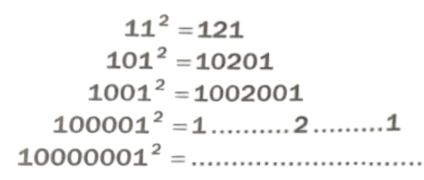
Observe the following pattern and the missing digits.
Image
Answer
According to the first three pattern, if the first and the last digits of a given number is 1 and having $n$ zeroes between it, then the square of that given number gives out the number whose first and last digits is 1, the middle digit is 2 and between the digits 1 and 2 and the digits 2 and 1, n zeroes exist.
In the number $100001^2$, there are four zeroes between first and last digits. So, the missing digits in $1 \ldots \ldots \ldots$ $2 \ldots \ldots \ldots 1$, are four zeroes lie between 1 and 2 and also four zeroes lie between 2 and 1 .
Hence, the required number is 10000200001.
In the number $10000001^2$, there are six zeroes between first and last digits.
So, the required number is 100000020000001.
View full question & answer
Question 322 Marks
Find three numbers in the ratio $2: 3: 5,$ the sum of whose squares is 608.
Answer
Let the numbers be $2 \text{x}, 3\text{x}$ and $5 \text{x}$, respectively.
Then, $(2 \text{x})^2+(3 \text{x})^2+(5 \text{x})^2=608$
$\Rightarrow \quad 4\text{x}^2+9\text{x}^2+25\text{x}^2=608$
$\Rightarrow \quad 38\text{x}^2=608$
$\Rightarrow \quad\text{x}^2=\frac{608}{38}=16=(4)^2$
$\Rightarrow \quad\text{x}=4$
Hence, the required numbers are $2 \times 4,3 \times 4,5 \times 4$
i.e. 8, 12 and 20.
View full question & answer
Question 332 Marks
The area of a square plot is $101 \frac{1}{400} \text{m}^2.$ Find the length of one side of the plot.
Answer
Let length of the square plot be $\text{a},$ then the area of square $=\text{a}^2$
According to the question,
Area $=101 \frac{1}{400} \text{m}^2$
$\Rightarrow \quad a^2=101 \frac{1}{400} \Rightarrow a^2=\frac{40401}{400}$
$\therefore \quad a=\frac{201}{20}=10 \frac{1}{20}$
Hence, length of one side of the plot is $10 \frac{1}{20} \text{ m}.$
View full question & answer
Question 342 Marks
Each student of Class VIII contributed some money for a picnic. The money contributed by each student was equal to square of the total number of students. If the total collected amount was 2209, then find the total number of students.
Answer
Total amount $=2209\qquad\quad$ [given]
According to the question,
Money contributed by each student = Square of the total number of students
$\therefore$ Total number of students
$=\sqrt{2209}=\sqrt{47 \times 47}=47$
View full question & answer
Question 362 Marks
How many non-perfect square natural numbers lie between $18^2$ and $19^2?$
Answer
We know that there are $2 \text{n}$ non-perfect square numbers between two consecutive square numbers $\text{n}^2$ and $(\text{n}+1)^2$.
Here, $18^2=324$ and $19^2=361$ and $2 \text{n}=2 \times 18$
So, there are 36 non-perfect square numbers between 324 and 361.
View full question & answer
2 Marks Questions - MATHS STD 8 Questions - Vidyadip