Questions

questions in details [4 marks ]

🎯

Test yourself on this topic

3 questions · timed · auto-graded

Question 14 Marks
Why do we feel ‘light’ or like we are ‘floating’ just after our swing reaches its highest point and begins to come down?

Image
Answer
The feeling of lightness or floating experienced on a swing just after it reaches its highest point and begins to descend is due to a change in acceleration and the resulting sensation of reduced gravitational force. As the swing moves upward, it slows down, and at its highest point, it momentarily stops before changing direction. During this brief moment, the force of gravity is still acting on us, but it’s not counteracted by any upward force from the swing, leading to a feeling of weightlessness. As the swing starts to descend, we accelerate downwards, and the feeling of lightness intensifies because our body is essentially falling with the swing.
View full question & answer
Question 24 Marks
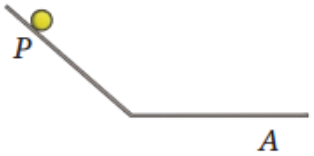
A ball is released from the point P and moves along an inclined plane and then along a horizontal surface as shown in the figure. It comes to a stop at point A on the horizontal surface. Think of a way so that when the ball is released from the same point P, it stops (i) before the point A, (ii) after crossing the point A.
Image
Answer
The ball’s motion is governed by the forces of gravity and friction. On the inclined plane, gravity provides the acceleration for the motion. On the horizontal surface, only friction acts on the ball.
• Stopping before A: Increasing friction on the horizontal surface will cause the ball to decelerate more rapidly, meaning it will come to a stop sooner, potentially before reaching point A.
• Stopping after A: Decreasing friction on the horizontal surface will reduce the deceleration, allowing the ball to travel further before losing all its kinetic energy and stopping.
View full question & answer
Question 34 Marks
If a ball is thrown upwards, it slows down, stops momentarily, and then falls back to the ground. Name the forces acting on the ball and specify their directions.
1. During its upward motion
2. During its downward motion
3. At its topmost position
Answer
When a ball is thrown upwards, the only force acting on it throughout its entire motion is gravity, which pulls it downwards. However, depending on the motion of the ball, the direction of this force relative to the ball’s velocity changes.
1. During its upward motion: The force of gravity is downwards, opposing the upward motion of the ball, causing it to slow down.
2. During its downward motion: The force of gravity is still downwards, but now it aligns with the ball’s direction of motion, accelerating it downwards.
3. At its topmost position: The ball has zero velocity, meaning it’s momentarily stationary. At this point, the force of gravity is still downwards, but since the ball is not moving upwards or downwards, it has no net effect on the ball’s motion.
View full question & answer
questions in details [4 marks ] - Science STD 8 Questions - Vidyadip