Question types

Exploring Forces question types

131 questions across 9 question groups — pick any mix to generate a Science paper with step-by-step answer keys.

131
Questions
9
Question groups
5
Question types
Sample Questions

Exploring Forces questions

One sample from each question group in this chapter. Select any group above to see the full set with answer keys.

Assertion (A): The force due to air in a column of the height of the atmosphere and area 15 cm × 15 cm (nearly equal to the area of your head) is nearly equal to the force of gravity on an object of mass 225 kg, then it is also bearable.
Reason (R): The atmospheric pressure is neutralised by the force of gravity experienced by us.
  • A
    Both (A) and (R) are true, and (R) is the correct explanation of (A).
  • B
    Both (A) and (R) are true, but (R) is not the correct explanation of (A).
  • (A) is true, but (R) is false.
  • D
    (A) is false, but (R) is true.

Answer: C.

View full solution
Assertion (A): In the game of tug of war, sometimes the rope doesn’t seem to move to any side even if strong forces are applied from both sides.
Reason (R): Equal force applied from opposite sides on any object makes the net applied force zero.
  • Both (A) and (R) are true, and (R) is the correct explanation of (A).
  • B
    Both (A) and (R) are true, but (R) is not the correct explanation of (A).
  • C
    (A) is true, but (R) is false.
  • D
    (A) is false, but (R) is true.

Answer: A.

View full solution
The force is always attractive in nature and extends to infinity
  • A
    magnetic force
  • B
    electrostatic force
  • gravitational force
  • D
    frictional force

Answer: C.

View full solution
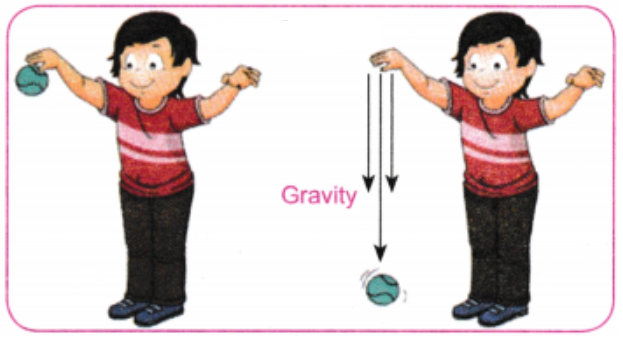
If we place some objects on water, some of them float, while others fall to the bottom. The gravitational force of the Earth is acting on all objects, so why don’t all objects fall to the bottom?
View full solution
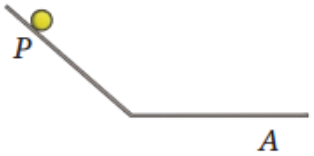
A ball is released from the point P and moves along an inclined plane and then along a horizontal surface as shown in the figure. It comes to a stop at point A on the horizontal surface. Think of a way so that when the ball is released from the same point P, it stops (i) before the point A, (ii) after crossing the point A.
Image
View full solution
If a ball is thrown upwards, it slows down, stops momentarily, and then falls back to the ground. Name the forces acting on the ball and specify their directions.
1. During its upward motion
2. During its downward motion
3. At its topmost position
View full solution
Column A (Type of Force)Column B (Example)
Q.1. Muscular force(a) A cricket ball stopping on its own just before touching the boundary line
Q.2. Magnetic force(b) A child lifting a school bag
Q.3. Frictional force(c) A fruit falling from a tree
Q.4. Gravitational force(d) A compass needle pointing North
View full solution
Column IColumn II
Q.1. Newton(i) Non-contact force
Q.2. Magnetic force(ii) Unit of force
Q.3. 1 kilogram(iii) Net force acting on a body
Q.4. Resultant force(iv) 9.8 N
View full solution

Generate a Exploring Forces paper free

Pick question groups from the list above, set marks and difficulty, and export a branded PDF with step-by-step answer keys. First 3 chapters free — no signup.

Download App