Questions

questions in short. [3 marks ]

🎯

Test yourself on this topic

12 questions · timed · auto-graded

Question 13 Marks
If we place some objects on water, some of them float, while others fall to the bottom. The gravitational force of the Earth is acting on all objects, so why don’t all objects fall to the bottom?
Answer
While the Earth’s gravitational force acts on all objects, whether they sink or float in water depends on the buoyant force and the density of the object relative to water. Objects with a density lower than water experience a stronger buoyant force, causing them to float, while those with a higher density experience a weaker buoyant force and sink.
View full question & answer
Question 23 Marks
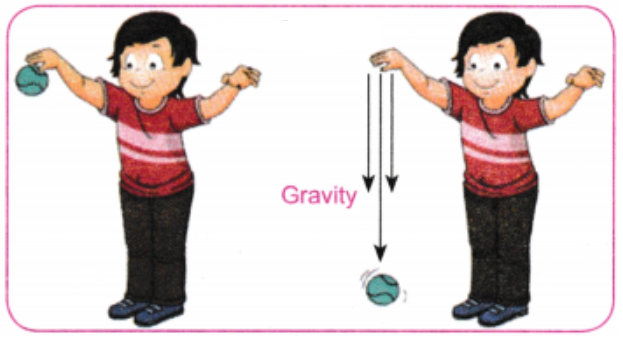
Does the Earth pull every object with equal force?
Image
Answer
No, the Earth does not pull every object with equal force. The force of gravity is stronger on objects with greater mass. While the Earth exerts a gravitational pull on all objects, the strength of that pull depends on the mass of the object being attracted.
View full question & answer
Question 33 Marks
Why does it feel harder to pedal a bicycle when going uphill than on flat ground?
Answer
When we cycle uphill, we’re constantly fighting against the Earth’s gravitational pull, which tries to pull us back down. This force acts perpendicular to the ground on a flat surface, meaning it doesn’t directly oppose our forward movement. But on a slope, a portion of the gravity acts against our direction of motion, requiring us to exert more force to move forward and upward.
View full question & answer
Question 43 Marks
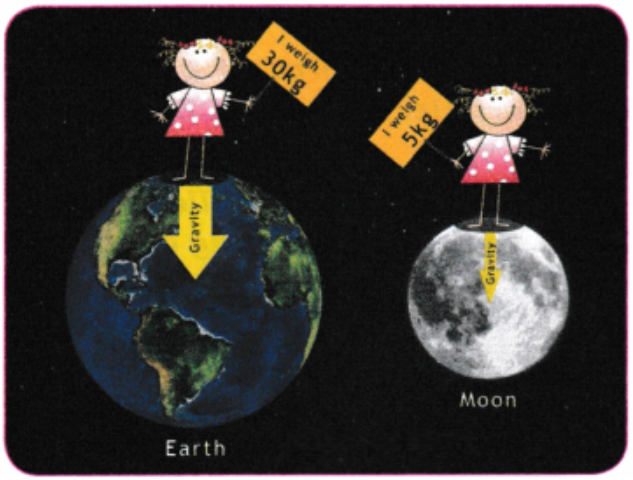
The weight of an object on the Moon becomes one-sixth of its weight on Earth. What causes this change? Does the mass of the object also become one-sixth of its mass on the Earth?
Answer
The change in an object’s weight on the moon compared to Earth is due to the difference in gravitational force. The moon’s gravity is significantly weaker than Earth’s, roughly one-sixth as strong. However, the mass of an object remains the same regardless of location; only weight changes with gravitational pull.
Image
View full question & answer
Question 53 Marks
Why do we sometimes slip on smooth surfaces like ice or polished floors? Explain.
Answer
When we walk on surfaces like ice, we often slip, which means we lose our balance and fall. This happens because the force that helps us stay upright and move forward (friction) is not enough. These surfaces have fewer irregularities. Minimizing the contact area and the force of friction between the surface and our shoes makes it easier to slide instead of grip. A layer of water, even a thin one on ice, can further reduce friction by acting as a lubricant, making the surface even more slippery.
View full question & answer
Question 63 Marks
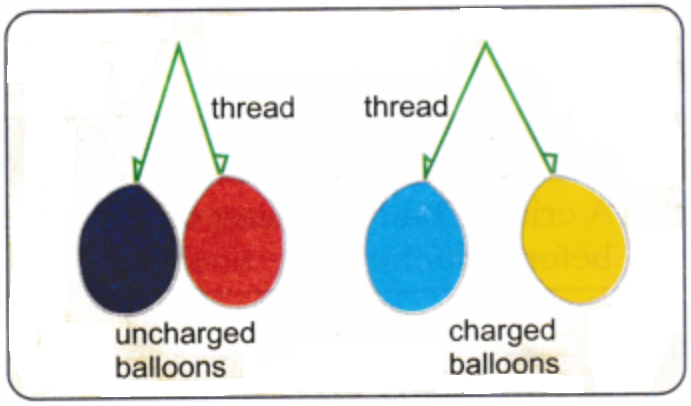
Two balloons rubbed with a woollen cloth are brought near each other. What would happen and why?
Answer
When two balloons are rubbed with a woollen cloth and brought near each other, they will repel each other. This happens because both balloons will acquire a negative charge when rubbed with wool, and like charges repel.
Image
View full question & answer
MCQ 73 Marks
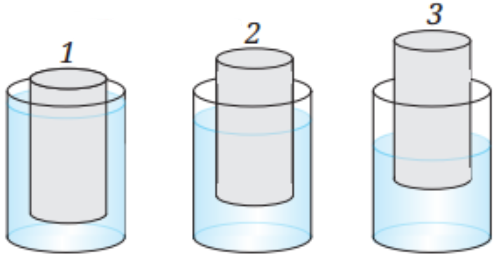
Three objects, 1, 2, and 3 of the same size and shape but made of different materials, are placed in the water. They dip to different depths as shown in the figure.
Image
If the weights of the three objects 1, 2, and 3 are w1, w2, and w3, respectively, then
(i) w1 = w2 = w3
(ii) w1 > w2 > w3
(iii) w2 > w3 > w1
(iv) w3 > w1 > w2
  • A
    w1 = w2 = w3
  • B
    w1 > w2 > w3
  • C
    w2 > w3 > w1
  • D
    w3 > w1 > w2
Answer
(ii) w1 > w2 > w3,
The relationship between the weights of the objects is w1 > w2 > w3
Object 1 is the deepest meaning it displaces the most water.
Object 2 is less deep than object 1 but deeper than object 3.
Object 3 is the least deep, meaning it displaces the least amount of water.
Since the objects have the same size and shape, the greater the depth, the greater the weight of the object (assuming they are all made of the same material).
Hence, the object with the greatest weight will sink the deepest, and the object with the least weight will be the closest to the surface.
View full question & answer
Question 83 Marks
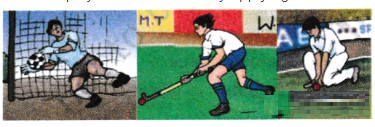
Read the given passage below and answer the question:In a game of volleyball, players often push the moving ball to their teammates to make a winning move. Sometimes the ball is returned to the other side of the court by pushing or smashing it. In cricket, a batsman plays his or her shot by applying a force on the ball with the bat.
Image
Q.1. What kind of force is applied by a batsman on a ball while hitting it?
(a) Magnetic Force
(b) Muscular Force
(c) Frictional Force
(d) Gravitation Force
Q.2. Force can be defined as:
(a) Work done
(b) Energy required to do work
(c) Push or Pull
(d) Push only
Q.3. In the given example of a volleyball game, what changes in force were brought about on the volleyball?
(a) Change in direction of motion
(b) Change in shape
(c) Change in state of motion
(d) Both Option (a) and (c)
Answer
1. Option (b) is correct.
Explanation: While hitting a ball, the force is caused by the action of muscles in the batsman’s body. The force resulting from the action of muscles is known as the muscular force.
2. Option (c) is correct.
Explanation: A push or a pull on an object is called a force.
3. Option (a) and (c)
Explanation: When players hit the volleyball, its speed changes, and also the direction of its motion changes.
View full question & answer
Question 93 Marks
Prove that the force of friction depends on the nature of the two surfaces in contact.
Answer
Collect the following things: A thick book, nylon cloth, gunny cloth, plastic sheet, jute cloth, and sandpaper. Place the book on each of the materials and slide it on the floor one by one. If our book slides off the plastic sheet or nylon cloth, use adhesive tape to stick it firmly on the surface of the book. We will observe that the different materials offer different amounts of resistance to sliding. This activity shows that the force of friction depends on the nature of the surface in contact. In general, a smooth surface offers less friction than a rough surface.
View full question & answer
Question 103 Marks
Name some non-contact forces with examples.
Answer
Some non-contact forces are :
Gravitational force
Example : A ball projected upwards falls back on Earth.
Magnetic force
Example: The force exerted by a magnet on iron.
Electrostatic force
Example: Sticking an inflated balloon to the wall after rubbing it with a dry cloth.
View full question & answer
Question 113 Marks
Give three examples of forces exerted by muscles in our body.
Answer
The three examples of muscular force in our body are :
- Blood circulation in our body.
- Inhalation and exhalation of air by the lungs.
- Running by the muscles of the legs.
View full question & answer
Question 123 Marks
What can be the result of a force applied to an object?
Answer
Force applied to an object may result in :
- change in the shape of the object.
- change in the direction of motion of an object.
- change in speed of an object if it is moving.
- movement of an object from rest.
- some or all of the above effects.
View full question & answer
questions in short. [3 marks ] - Science STD 8 Questions - Vidyadip