MCQ 511 Mark
Two mirrors $A$ and $B$ are placed at right angles to each other. $A$ ray of light incident on mirror $A$ at an angle of $25^\circ $ falls on mirror $B$ after reflection. The angle of reflection for the ray reflected from mirror $B$ would be:
- A
$25^\circ$
- B
$50^\circ$
- ✓
$65^\circ$
- D
$115^\circ$
AnswerCorrect option: C. $65^\circ$
View full question & answer→MCQ 521 Mark
Read the following sentences carefully, and choose the correct one:
- A
The ray of light which falls on the mirror surface is called incident ray.
- B
The point at which the incident ray strikes the mirror is called the point of incidence.
- C
The ray of light which is sent back by the mirror is called the reflected ray.
- ✓
AnswerHere, all the statements are correct.
View full question & answer→MCQ 531 Mark
If the object is placed $10\ cm$ in front of a convex mirror of radius of curvature $20\ cm,$ the magnification is:
- A
$2$
- B
$1$
- ✓
$\frac{1}{2}$
- D
$0$
AnswerCorrect option: C. $\frac{1}{2}$
View full question & answer→MCQ 541 Mark
In a quiz competition, you are asked a question where you have to choose the statement which is/ are correct?
- A
The image formed by a plane mirror is virtual and erect.
- B
The image formed by a plane mirror is behind the mirror.
- C
The image formed in a plane mirror is the same distance behind the mirror as the object is in front of it.
- ✓
AnswerHere, all the statements are correct.
View full question & answer→MCQ 551 Mark
If a mirror is rotated by $10^\circ$, the reflected ray is rotated by:
- A
$10^\circ$
- ✓
$20^\circ$
- C
$40^\circ$
- D
$30^\circ$
AnswerCorrect option: B. $20^\circ$
View full question & answer→MCQ 561 Mark
Consider the following statements and choose the incorrect one:
Answer Here, all the statements are correct.
View full question & answer→MCQ 571 Mark
When a light travels from one medium to another medium which are separated by sharp boundary, the characteristic which does not change is.
MCQ 581 Mark
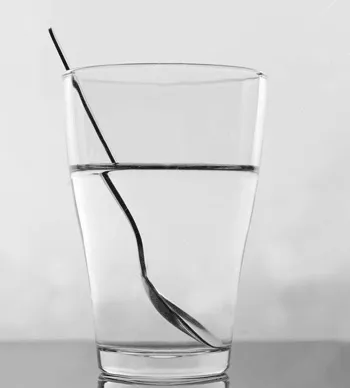
When we immerse a spoon in a glass containing water, it appears bent at the point, it enters in the water. This apparent bending of the spoon is due to $..........$
View full question & answer→MCQ 591 Mark
The diameter of spherical mirror in which reflection takes place is called.
MCQ 601 Mark
The least distance of distinct vision for a young adult with normal vision is about:
- A
$25\ m$
- B
$2.5\ cm$
- ✓
$25\ cm$
- D
$2.5\ m$
AnswerCorrect option: C. $25\ cm$
The least distance of distinct vision means the minimum distance for an object to be viewed clearly. This minimum distance for a young adult with normal vision is $25\ cm.$
View full question & answer→MCQ 611 Mark
Read the given statements and select the correct option.
Statement 1: A beam of light emitted by the point source placed in water always diverges in air.
Statement 2: The refracted ray moves away from normal when a ray goes from a denser medium to a rarer medium.
- ✓
Both statements $1$ and $2$ are true and statement $2$ is the correct explanation of statement $1.$
- B
Both statements $ 1$ and $2$ are true but statement $2$ is not the correct explanation of statement $1.$
- C
Statement $1$ is true but statement $2$ is false.
- D
Both statements $1$ and $2$ are false.
AnswerCorrect option: A. Both statements $1$ and $2$ are true and statement $2$ is the correct explanation of statement $1.$
Here, water is a denser medium and air is a rarer medium.
View full question & answer→MCQ 621 Mark
Statement $I:$ If refractive index of one medium is equal to refractive index of second medium, then beam does not bend at all.
Statement $II:$ The bending of light does not depend on refractive indices of media.
- ✓
Both Statements are true. Statement$-II$ is the correct explanation of Statement$-I$.
- B
Both Statements are true, Statement$-II$ is not correct explanation of Statement$-I$.
- C
Statement$-I$ is true. Statement$-II$ is false.
- D
Statement$-I$ is false. Statement$-II$ is true.
AnswerCorrect option: A. Both Statements are true. Statement$-II$ is the correct explanation of Statement$-I$.
View full question & answer→MCQ 631 Mark
Myopia is a defect of vision caused by:
- A
A decrease in the retinal distance from the lens.
- B
A decrease in the diameter of the eyeball.
- C
An increase in the thickness of the lens.
- ✓
An increase in the curvature of the lens.
AnswerCorrect option: D. An increase in the curvature of the lens.
In a myopic eye, the image of distant objects is formed in front of the retina and not on the retina, as shown in the given figure. Since eye lens is convex, all parallel rays converge at its focus. This is a clear indication of the shortening of the focal length of a myopic eye lens.
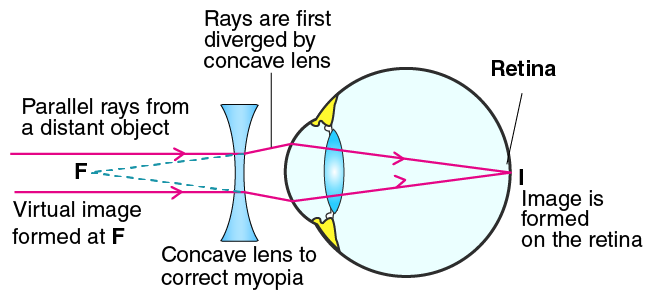
As a result, the curvature of the lens gets increased. Hence, myopia is caused by an increase in the curvature of the eye lens.
View full question & answer→MCQ 641 Mark
Tina has a defect in her eyes. She is not able to contract her iris properly. As a result of the defect in her eyes, Tina will not be able to see.
MCQ 651 Mark
Read the following sentences carefully, and choose the correct one:
- A
The retina is a screen on which the image is formed in the eye.
- B
The eye-lens focuses the image of an object on the retina.
- C
The optic nerve carries the image formed on retina to the brain in the form of electrical signals.
- ✓
AnswerHere, all the statements are correct.
View full question & answer→MCQ 661 Mark
A narrow beam of white light is passed through a glass prism as shown in the figure.
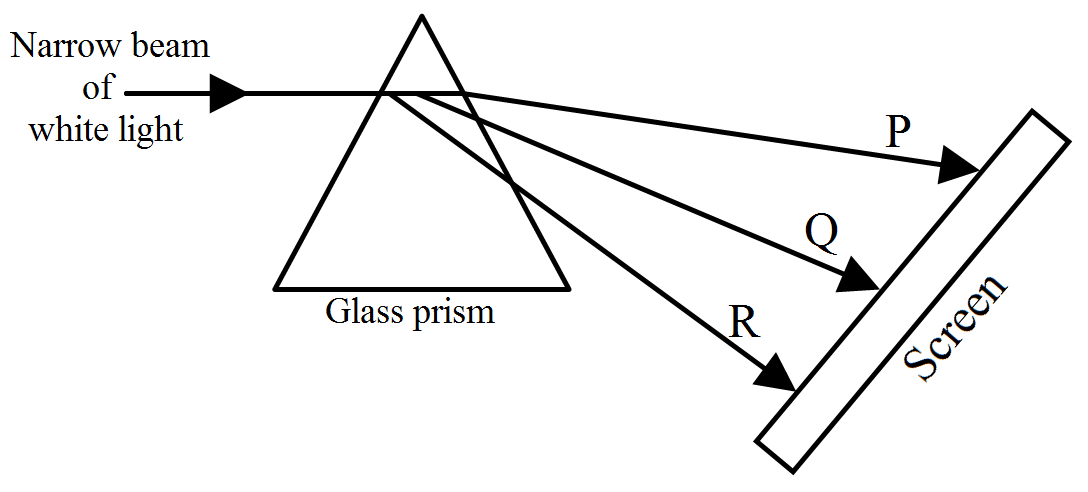
Which of the following is the correct order of colours emerging from the prism$?$ - A
| $P$ |
$Q$ |
$R$ |
| Red |
Blue |
Green |
- ✓
| $P$ |
$Q$ |
$R$ |
| Red |
Green |
Blue |
- C
| $P$ |
$Q$ |
$R$ |
| Blue |
Green |
Red |
- D
| $P$ |
$Q$ |
$R$ |
| Blue |
Red |
Green |
AnswerCorrect option: B.
| $P$ |
$Q$ |
$R$ |
| Red |
Green |
Blue |
When a narrow beam of light is allowed to pass through.
A prism, the white light splits into seven colours called spectrum. The order of colours emerging from the prism is Violet, Indigo, Blue, Green, Yellow, Orange and Red with Red colour deviating the least. So, $P$ is Red, $Q$ is Green and $R$ is Blue.Standards
View full question & answer→MCQ 671 Mark
In the human eye, the function of the optic nerves is to.
- A
Adjust the focus of the eye lens.
- ✓
Transmit electrical signals to the brain.
- C
Control the number of rod and cone cells.
- D
Donvert light signals into electrical signals.
AnswerCorrect option: B. Transmit electrical signals to the brain.
The optic nerves transmit the electrical signals generated by the retina to the brain.
View full question & answer→MCQ 681 Mark
Which of the following results in diffused reflection?
MCQ 691 Mark
Tina has a defect in her eyes. She is not able to contract her iris properly. As a result of the defect in her eyes, Tina will not be able to see.
AnswerIris is that part of the eye which controls the amount of light by contracting and expanding itself. In dim light, the iris contracts to expand the pupil, so as to allow more light to enter the eye. In this way, things become visible in dim light. It is given that Tina is not able to contract her iris properly. Hence, she will not be able to see properly in dim light.
View full question & answer→MCQ 701 Mark
When we look at a distant object, the ciliary muscles__$i$__, making the eye lens __$ii$__. This iii the focal length of the eye lens so that the image of that object gets focused on the retina. The information in which alternative completes the given statements?
- A
$i-$get released, $ii-$thicker, $iii-$decreases.
- B
$i-$contract, $ii-$thicker, $iii-$increases.
- ✓
$i-$get released, $ii-$thinner, $iii-$increses.
- D
$i-$contract, $ii-$thinner, $iii-$decreases.
AnswerCorrect option: C. $i-$get released, $ii-$thinner, $iii-$increses.
In the case of an object situated at a distance, almost parallel rays of light enter our eyes. Hence, the eye lens does not require a high converging power. As a result, the ciliary muscles get released and make the eye lens thinner, which in turn increases the focal length of the eye lens.
View full question & answer→MCQ 711 Mark
The nature of image formed by plane mirror is:
MCQ 721 Mark
An object is placed at a distance of $50\ cm$ from a concave lens of focal length $20\ cm.$ Find the position of the image $............$
- A
$10.2\ cm$
- B
$14.3\ cm$
- ✓
$-14.3\ cm$
- D
$-10.2\ cm$
AnswerCorrect option: C. $-14.3\ cm$
View full question & answer→MCQ 731 Mark
You are watching your right palm in the plane mirror by placing it parallel to it, which is in front of you, then you will observe your palm as.
MCQ 741 Mark
The primary function of the crystalline lens in the human eye is to.
- A
Reduce the intensity of light.
- ✓
Focus the incident light rays.
- C
Adjust the size of the pupil.
- D
Filter out the dust particles.
AnswerCorrect option: B. Focus the incident light rays.
The primary function of the crystalline lens present in the human eye is to focus the light coming from an object onto the retina.
View full question & answer→MCQ 751 Mark
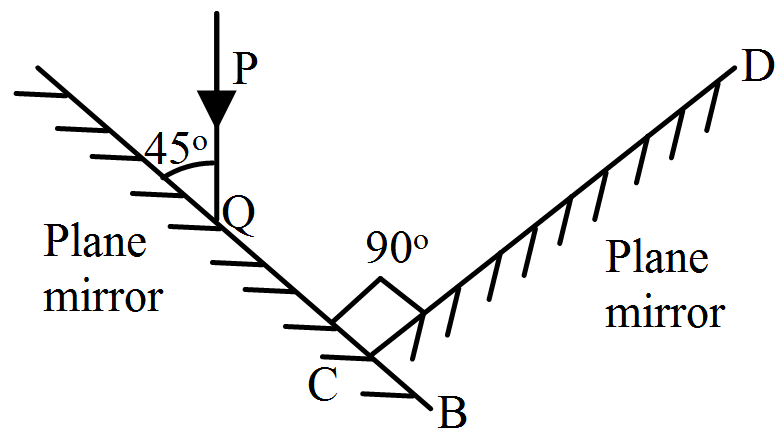
Two plane mirrors $AB$ and $CD$ are placed at right angles to one another. A ray of light $PQ$ hits $AB$ at $Q$ making an angle of $45^\circ $ as shown in the diagram. This ray will be reflected from mirror $CD$ at an angle.
- A
$20^\circ $
- B
$35^\circ$
- ✓
$45^\circ$
- D
$60^\circ$
AnswerCorrect option: C. $45^\circ$
Since $OS$ is normal to the mirror $AB.$
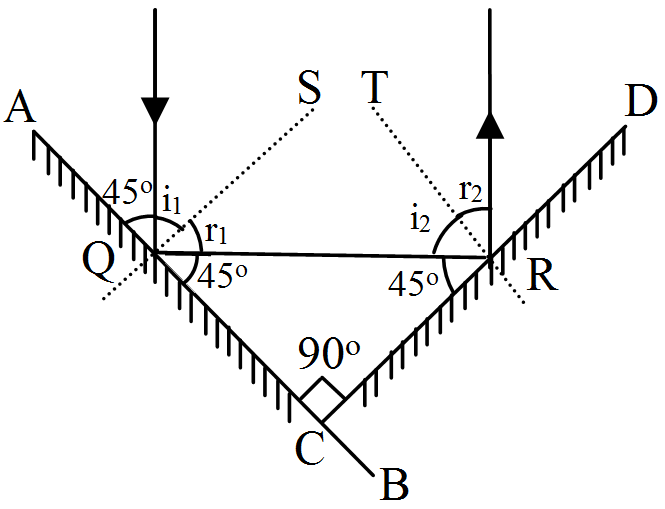
$\therefore\angle\text{i}_1=45^\circ, $ also $\angle\text{r}_1= 45^\circ$ in
$\Delta\text{CQR}, \angle\text{C} = 90^\circ, \angle\text{CQR} = 45^\circ$
$\therefore\angle\text{CQR} = 45^\circ$
$\big[$$\therefore$ sum of all the three angles in tringle is $180^\circ$$\big]$
Hence, $\angle\text{i}_2 = 45^\circ$
$\big[$ TR is the normal to the mirror BD$\big]$
$\therefore\angle\text{r}_2 = 45^\circ$
View full question & answer→MCQ 761 Mark
The refractive index of glass is $1.5$ and speed of light in air is $3 \times 10^{10}cm/ s,$ the speed of light in glass is.
AnswerCorrect option: B. $2 \times 10^{10}cm/ s$
View full question & answer→MCQ 771 Mark
A light ray is allowed to fall on the plane mirror. Now the mirror is rotated in plane of incidence, then which of the following will not change.
MCQ 781 Mark
When light travels from rarer medium to denser medium.
- ✓
Refracted ray bends to wards normal.
- B
Refracted ray bends away from normal.
- C
Ray undedicated from path.
- D
We cannot identified the ray.
AnswerCorrect option: A. Refracted ray bends to wards normal.
View full question & answer→MCQ 791 Mark
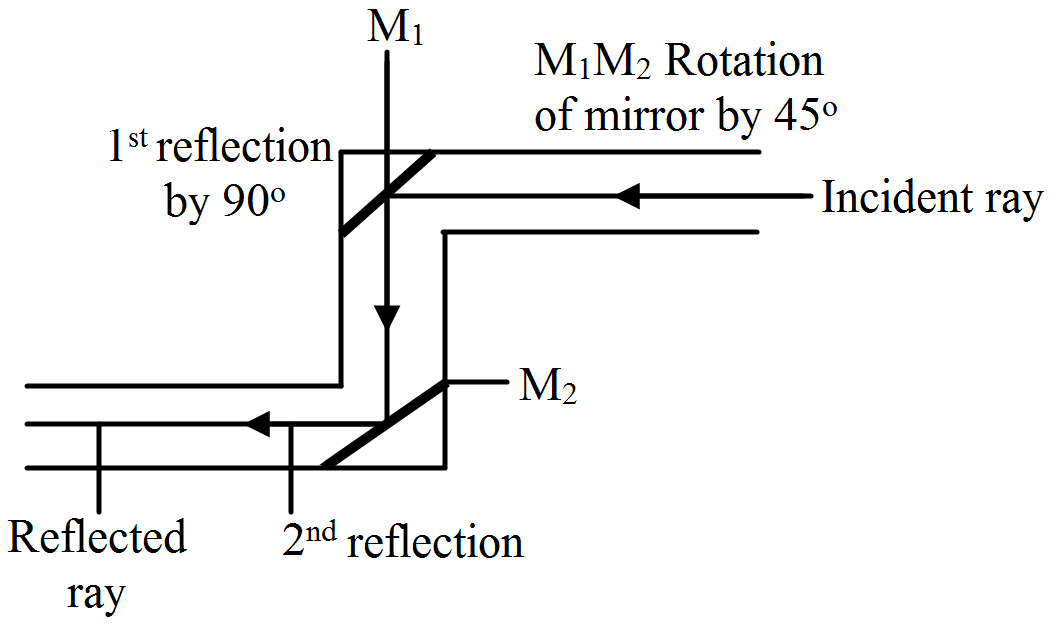
For a given incident ray, the plane of the mirror makes an angle $\theta$ with the incident ray, then the reflected ray is turned through $2\theta.$ Which of the following is based on the above principle?
AnswerIn the case of a periscope, the given fact is used and is illustrated below.
View full question & answer→MCQ 801 Mark
The velocity of light in air is $3 \times10^8\text{ms}^{-1}$ and in glass is $2 \times10^8\text{ms}^{-1}$. The refractive index of glass w.r.t air is.
- ✓
$\frac{2}{3}$
- B
$\frac{3}{2}$
- C
$\frac{4}{3}$
- D
$\frac{9}{4}$
AnswerCorrect option: A. $\frac{2}{3}$
$\text{V}_\text{a} = 3\times10^8\text{ms}^{-1}.....\text{V}_9 = 2\times10^8\text{ms}^{-1}$
$_\text{a}\mu^\text{g} = \frac{\text{V}_\text{g}}{\text{V}_\text{a}}= \frac{2\times10^8}{3\times10^8} = \frac{2}{3}$
View full question & answer→MCQ 811 Mark
A light bulb is placed between two plane mirrors inclined at an angle of $60^\circ .$ The number of images formed are:
View full question & answer→MCQ 821 Mark
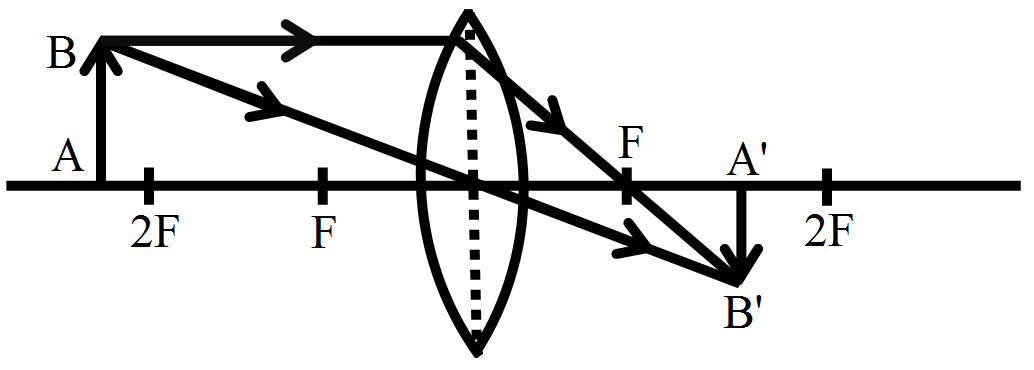
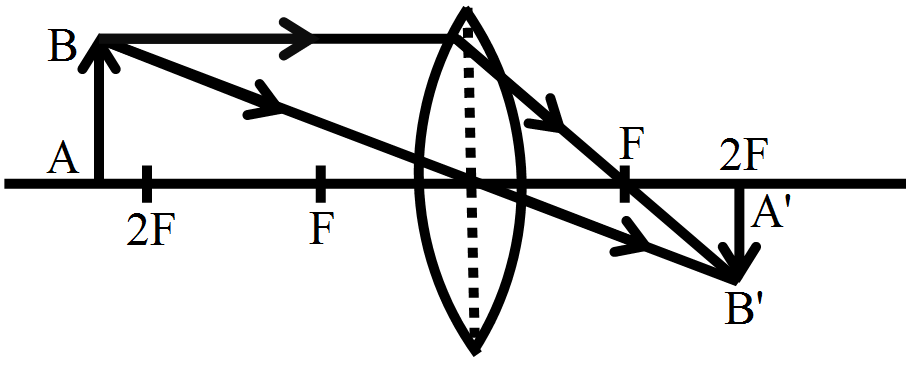
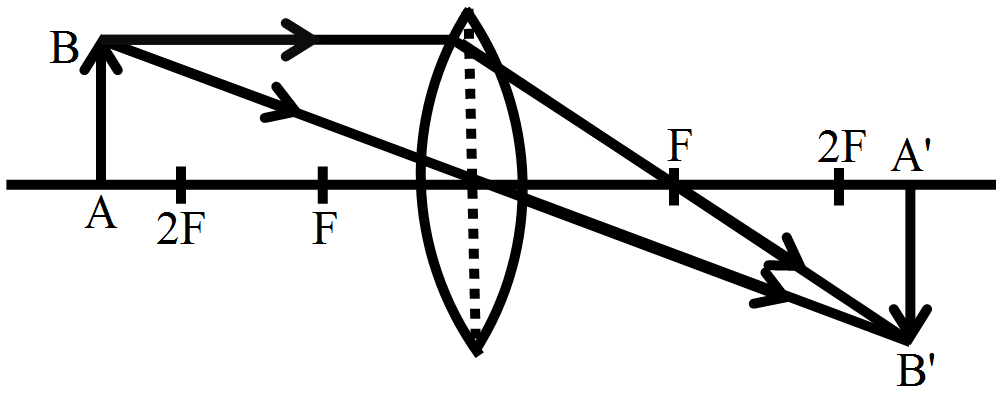
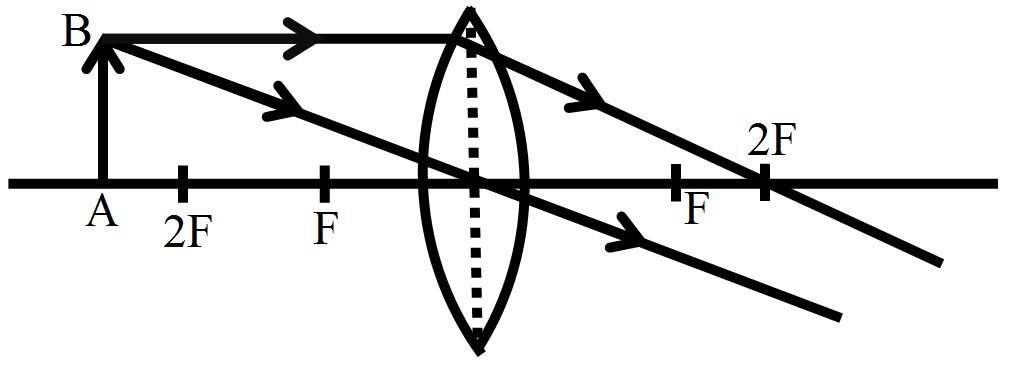
Which of the following ray diagrams shown below represents the image formed by the convex lens when the object is placed beyond $2F?$
AnswerWhen the object is placed beyond $2F,$ the image is formed between $F$ and $2F.$ It is real, inverted and diminished.
View full question & answer→MCQ 831 Mark
Which of the following produces diffuse reflection of light?
- A
Mirror on a dressing table.
- B
- ✓
- D
AnswerScreen in a cinema hall produces diffuse reflection of light. When light incidence on smooth surface, the light is reflected in one direction as parallel beam. This is why our eyes cannot view the reflection from mirror, water and polished wood directly. When the light incidence on rough surface, the light is reflected in many directions. So, in cinema hall, the screen is designed as rough and irregular surface. In theatre, the projector projects parallel light rays which falls on screen. Due to irregularity of screen, the light is reflected in different direction. This type of reflection helps people from anywhere in the theatre to see the picture projected by the projector.
View full question & answer→MCQ 841 Mark
Consider three statements regarding the defects of eye.
I. If the size of the eye ball decreases, then the person suffers from myopia.
II. If the near point of eye becomes greater than $25\ cm,$ then the person is said to suffer from hypermetropia.
III. A person, at older age, suffering from presbyopia uses a bifocal lens for correction. Among the given statements.
- A
Only statement $I$ is correct.
- B
Only statement $II$ is correct.
- C
Both statements $I$ and $II$ are correct.
- ✓
Both statements $II$ and $III$ are correct.
AnswerCorrect option: D. Both statements $II$ and $III$ are correct.
View full question & answer→MCQ 851 Mark
Identify the value of persistence of vision.
- A
$\frac{1}{10}^{th}$ of a second.
- B
$\frac{1}{12}^{th}$ of a second.
- ✓
$\frac{1}{16}^{th}$ of a second.
- D
$\frac{1}{20}^{th}$ of a second.
AnswerCorrect option: C. $\frac{1}{16}^{th}$ of a second.
Persistence of vision is a phenomenon where the brain continues to sense the image even after the object has been removed. This lasts for $\frac{1}{16}^{th}$ of a second.
View full question & answer→MCQ 861 Mark
A convergent lens of focal length $20\ cm$ and made of a material with refractive index $1.1$ is immersed in water the lens behaves as a.
- A
Converging lens of focal length $20\ cm.$
- B
Converging lens of focal length less than $20\ cm.$
- C
Converging lens of focal length more than $20\ cm.$
- ✓
View full question & answer→MCQ 871 Mark
In which of the following are plane mirrors arranged at an angle to get a number of colored images?
AnswerThree plane mirrors are arranged at an angle to get a number of colored images in a kaleidoscope.
View full question & answer→MCQ 881 Mark
Which of the following is the characteristic of an ideal mirror?
- A
It absorbs all the amount of light incident on it.
- B
It refracts all the light.
- ✓
It reflects all the light.
- D
AnswerCorrect option: C. It reflects all the light.
An ideal mirror reflects all the light.
View full question & answer→MCQ 891 Mark
Statement $I:$ When light travels from one medium to another, then frequency remains constant.
Statement $II:$ When the direction of light ray is reversed, the ray simply retraces its path, this statement is called the Principle of reversibility of light.
- A
Both Statements are true. Statement$-II$ is the correct explanation of Statement$-I.$
- ✓
Both Statements are true, Statement$-II$ is not correct explanation of Statement$-I.$
- C
Statement$-I$ is true, Statement$-II$ is false.
- D
Statement$-I$ is false. Statement$-II$ is true
AnswerCorrect option: B. Both Statements are true, Statement$-II$ is not correct explanation of Statement$-I.$
View full question & answer→MCQ 901 Mark
Payal is completed her science chapter where she wrote some statements. She wants to know whether the statements are correct or not? Payel wants to take help from you:
- A
A ray of light which is incident normally on a mirror is reflected back along the same path.
- B
In regular reflection, a parallel beam of incident light is reflected as a parallel beam in one direction.
- C
Regular reflection of light occurs from smooth surfaces like that of a plane mirror or highly polished metal surfaces.
- ✓
AnswerHere, all the statements are correct.
View full question & answer→MCQ 911 Mark
Which of the following is not a part of the human eye?
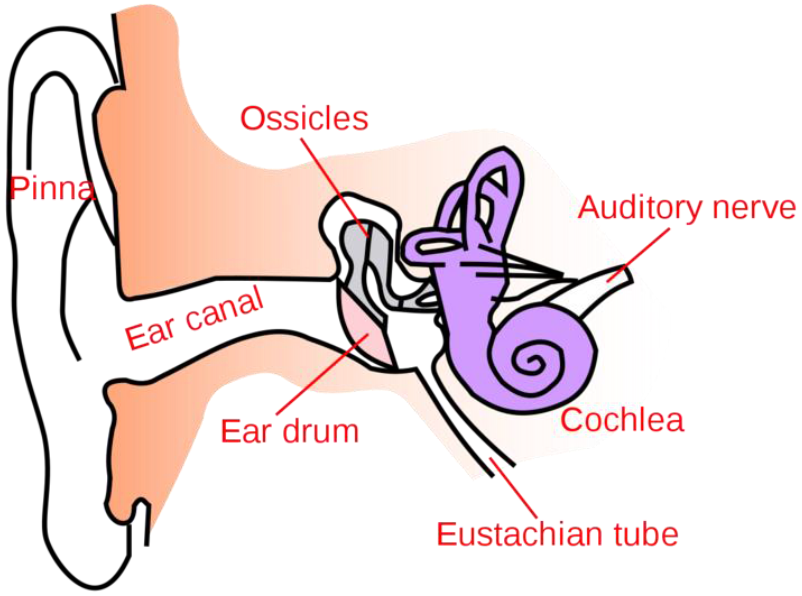
AnswerAuditory nerve is not a part of the human eye, but a part of human ear. It transmits hearing information between the brain and cochlea.
See the diagram of human ear attached:
View full question & answer→MCQ 921 Mark
The light ray, which strikes any surface, is called:
MCQ 931 Mark
Which of the following pairs of eye parts is responsible for controlling the amount of light entering into the eye?
- ✓
- B
- C
Cilliary muscles and iris.
- D
Cilliary muscles and pupil.
AnswerThe circular diaphragm in front of the eye lens is known as iris and the small opening in between the iris is known as pupil. The size of the pupil controls the amount of light entering into the eye. It is also true that the size of the pupil is controlled by the iris. Hence, both iris and pupil are responsible for controlling the amount of light entering into the eye.
View full question & answer→MCQ 941 Mark
In case of convex lens, as object is coming closer to the lens the image will $...........$
View full question & answer→MCQ 951 Mark
Front bulged part of the eyeball is called:
MCQ 961 Mark
$X$ is a surface that cannot produce clear images. What is $X?$
- ✓
- B
- C
- D
Smooth but curved surface.
AnswerWhen light is incident on a rough surface, irregular reflection takes place, hence the image formed is not clear.
View full question & answer→MCQ 971 Mark
The defect of vision in which the eye$-$lens of a person gets progressively cloudy resulting in blurred vision is called:
AnswerThe medical condition in which the lens of eye of a person becomes progressively cloudy resulting in blurred vision is called cataract. Cataract develops when the eye$-$lens of a person becomes cloudy or even opaque due to the formation of a membrane over it. Cataract decreases the vision of eye gradually. The vision of the person can be restored after getting surgery done on the having cataract. The eye defect called cataract cannot be corrected by any type of spectacle lenses.
View full question & answer→MCQ 981 Mark
View full question & answer→MCQ 991 Mark
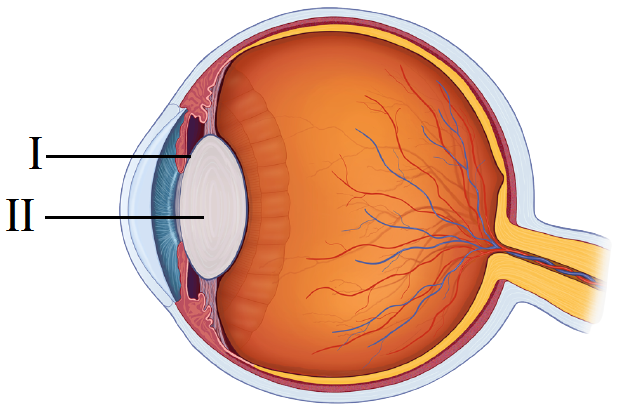
The given diagram is that of the human eye. In the given diagram, the parts labelled as $I$ and $II$ are respectively the.
View full question & answer→MCQ 1001 Mark
The angle between an incident ray and the plane mirror is $30^\circ .$ The total angle between the incident ray and the reflected ray will be:
- ✓
$30^\circ$
- B
$60^\circ$
- C
$90^\circ$
- D
$120^\circ$
AnswerCorrect option: A. $30^\circ$
The angle between the incident ray and the mirror is $30$ degrees.
Angle of incidence = angle of reflection.
$90$ degrees is going directly into the mirror.
So, $90 – 30 = 60$ degrees.
The total angle between the incident ray and the reflected ray will be $120$ degree.
View full question & answer→