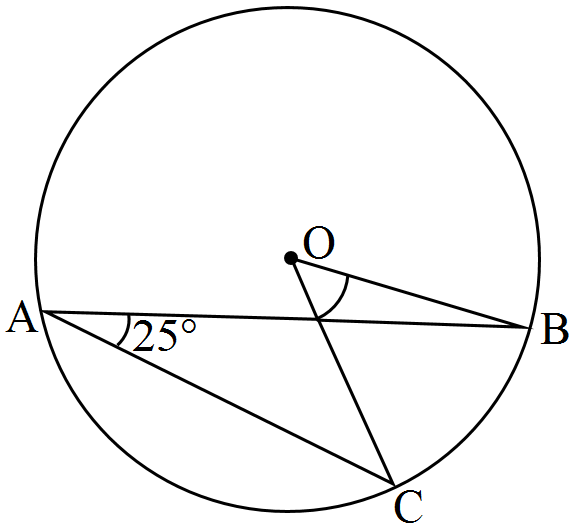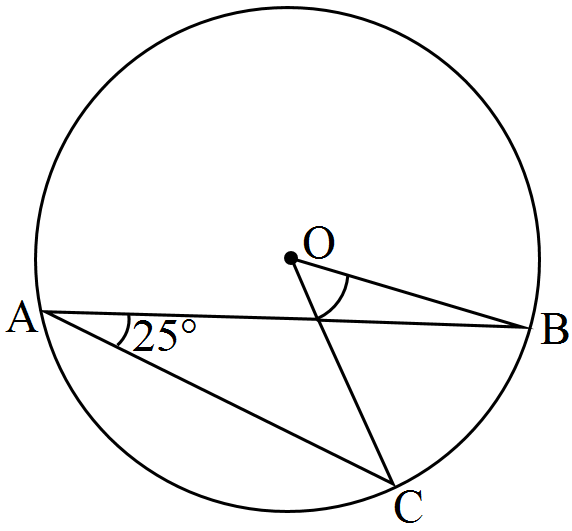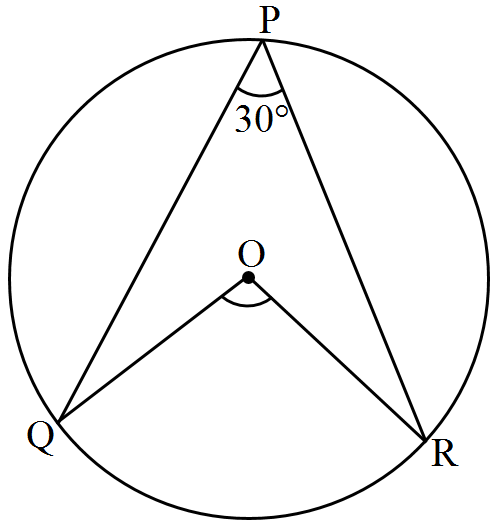
Questions · Page 2 of 5

M.C.Q

MCQ 511 Mark
  • A
    38º
  • B
    76º
  • C
    57º
  • D
    59º
Answer
  1. 57º
    Solution:
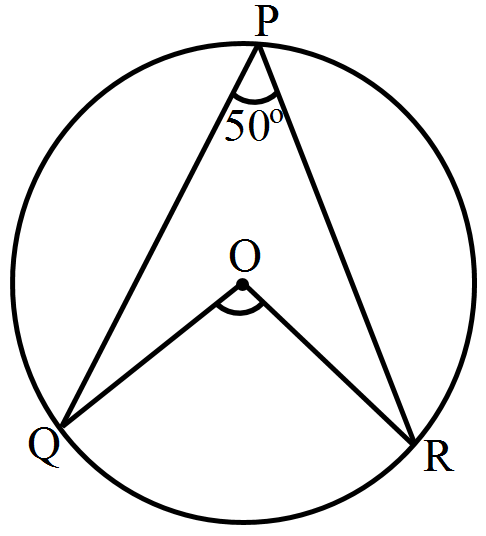
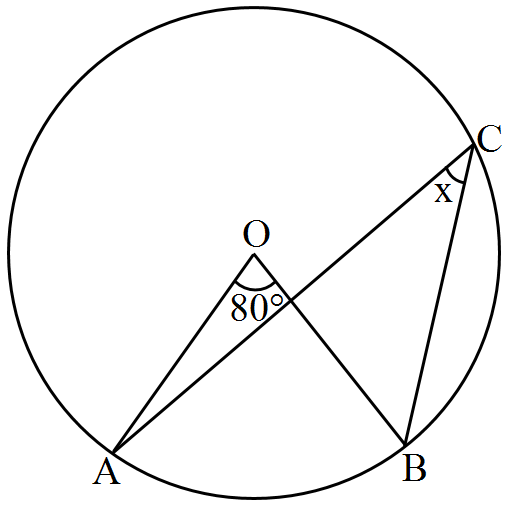
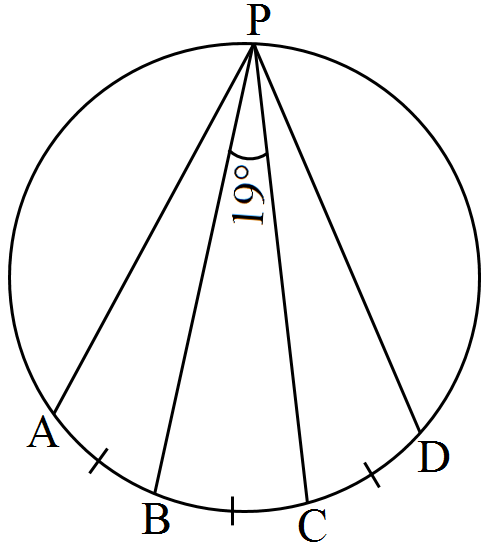
    Equal arcs subtend equal angles at the centre and the angle subtended by them at the circumference would be double the angle subtended by them at the centre. As the angle subtended at centre were same so the angle subtended at the circumference would also become same. Thus each arc would make an angle of 19º. Thus the total length of all the three angles would be thrice 19º that is 57º.
View full question & answer
MCQ 521 Mark
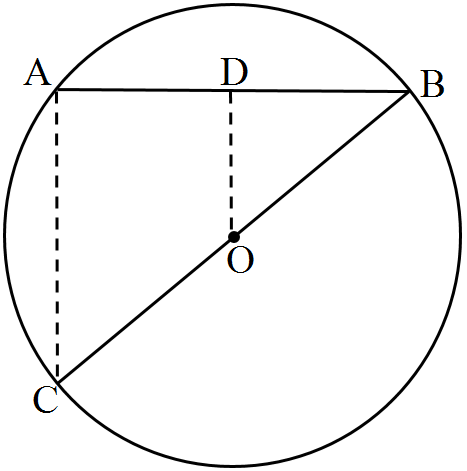
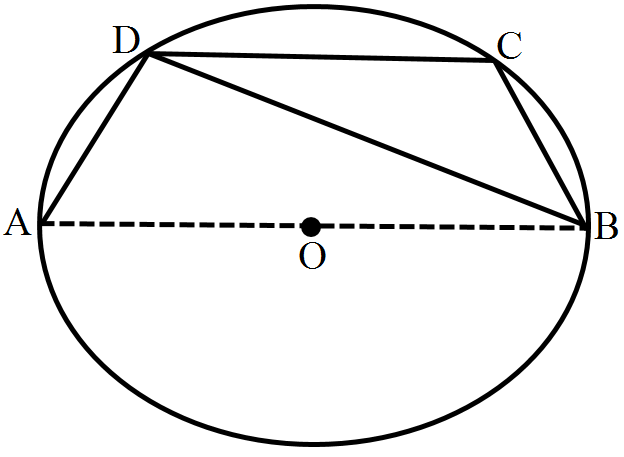
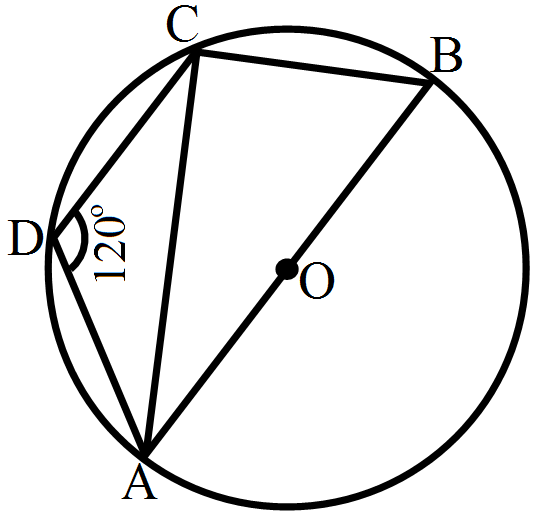
In the given figure, AOB is a diameter and ABCD is a cyclic quadrilateral. If $\angle\text{ADC}=120^\circ$ then $\angle\text{BAC}=?$
  • A
    60°
  • B
    30°
  • C
    20°
  • D
    45°

Answer
  1. 30°
    Solution:
    We know that the opposite angles of a quadrilateral are supplementary.
    $\angle\text{ADC}+\angle\text{ABC}=180^\circ$
    $\Rightarrow\ 120^\circ+\angle\text{ABC}=180^\circ$
    $\Rightarrow\ \angle\text{ABC}=60^\circ$
    Since BOC is a diameter $\angle\text{ACB}=90^\circ.$
    In $\triangle\text{CAB},$
    $\angle\text{ABC}+\angle\text{BAC}+\angle\text{ACB}=180^\circ$ [Angle sum property]
    $\Rightarrow\ 60^\circ+\angle\text{BAC}+90^\circ=180^\circ$
    $\Rightarrow\ \angle\text{BAC}=30^\circ$
View full question & answer
MCQ 561 Mark
  • A
    80º
  • B
    100º
  • C
    130º
  • D
    50º
Answer
  1. 100º
    Solution:
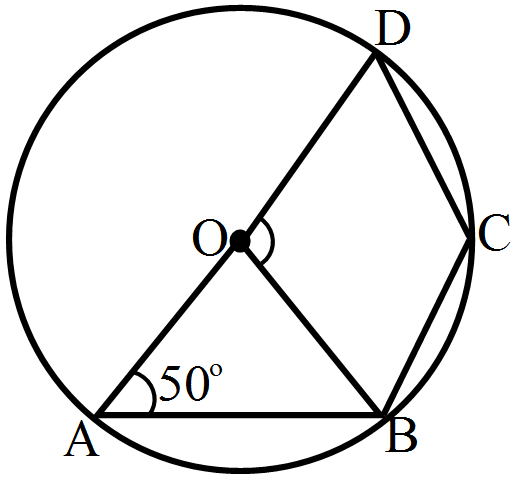
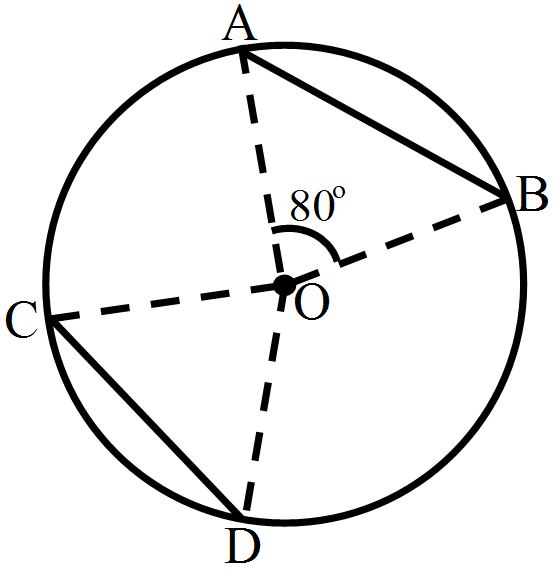
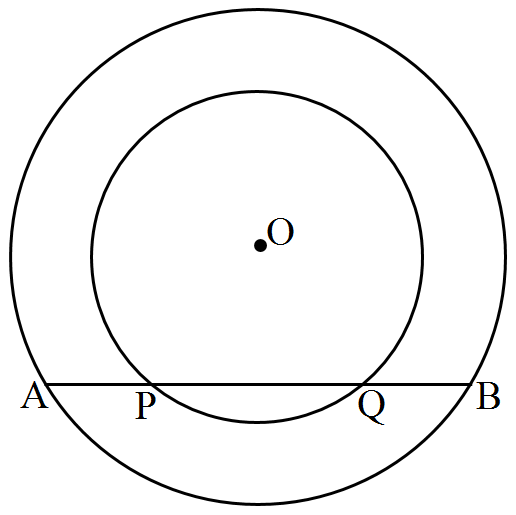
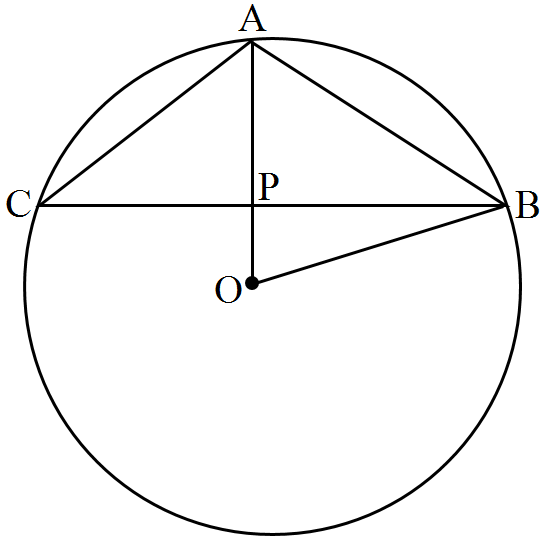
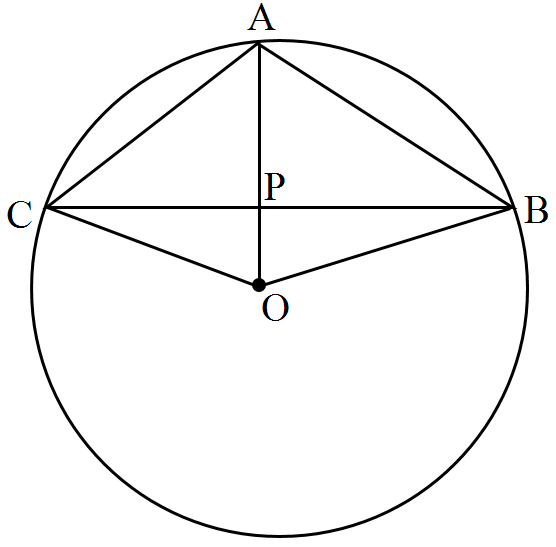
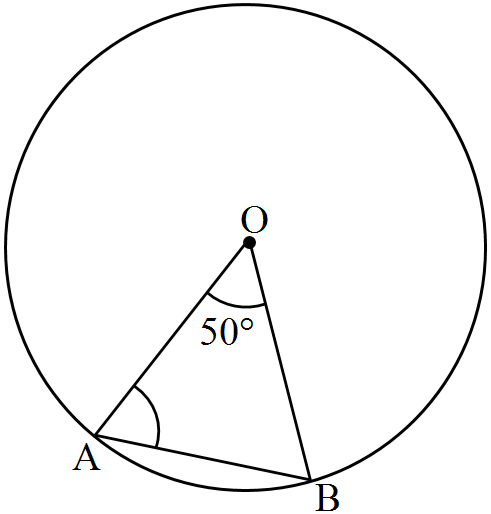
    OA = OB (Radii of a circle)
    $\Rightarrow\angle\text{OBA}=\angle\text{OAB}=50^\circ$
    In $\triangle\text{OAB},$ we have:
    $\angle\text{OAB}+\angle\text{OBA}+\angle\text{AOB}=180^\circ$ (Angle sum property of a triangle)
    $\Rightarrow50^\circ+50^\circ+\angle\text{AOB}=180^\circ$
    $\Rightarrow\angle\text{AOB}=(180^\circ-100^\circ)=80^\circ$
    Since $\angle\text{AOB}+\angle\text{BOD}=180^\circ$ (Linear pair)
    $\therefore\angle\text{BOD}=(180^\circ-80^\circ)=100^\circ$
    $\Rightarrow\angle\text{BOD}=100^\circ$
View full question & answer
MCQ 571 Mark
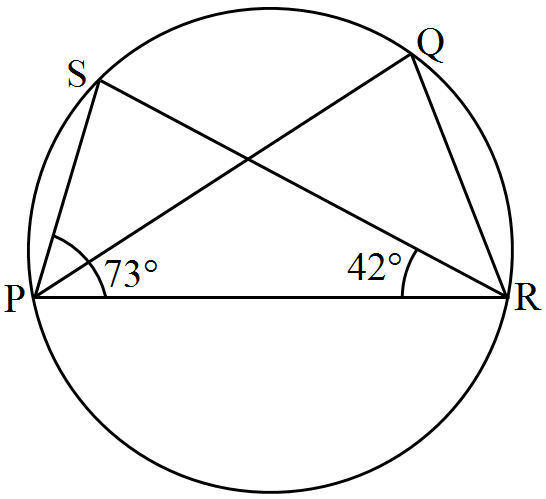
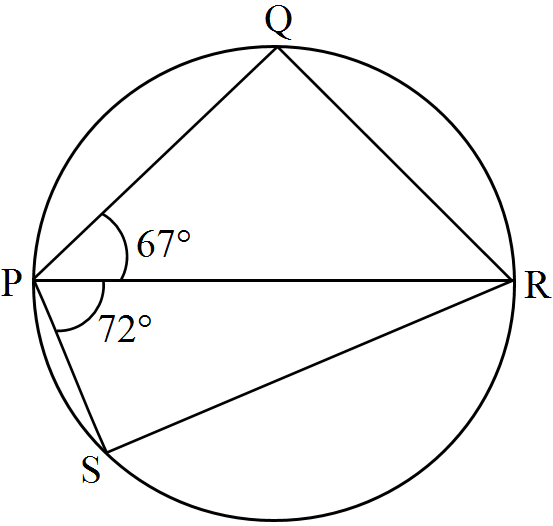
PQRS is a cyclic quadrilateral such that PR is a diameter of the circle. If 67º and $\angle\text{SPR}=72^\circ,$ then $\angle\text{QRS}=$
  • A
    41º
  • B
    23º
  • C
    67º
  • D
    18º
View full question & answer
MCQ 581 Mark
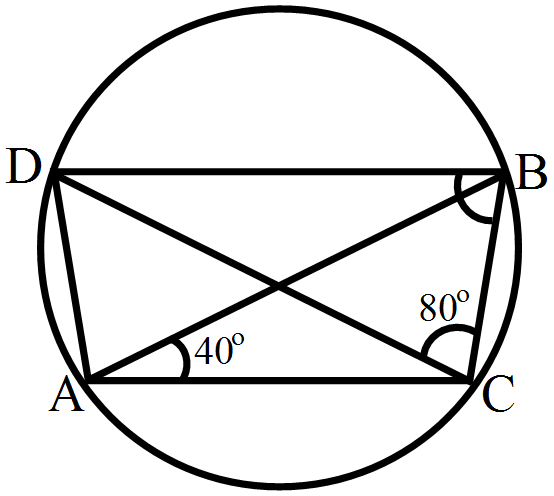
In the give figure, AB and CD are two intersecting chords of a circle. If $\angle\text{CAB}=40^\circ$ and $\angle\text{BCD}=80^\circ$then $\angle\text{CBD}=?$
  • A
    80°
  • B
    60°
  • C
    50°
  • D
    70°

Answer
  1. 60°
    Solution:
    Since angles in the same segment are equal,
    $\angle\text{BDC}=\angle\text{BAC}=40^\circ$
    In $\triangle\text{BDC},$
    $\angle\text{BDC}+\angle\text{BCD}+\angle\text{CBD}=180^\circ$ [Angle sum property]
    $\Rightarrow\ 40^\circ+80^\circ+\angle\text{CBD}=180^\circ$
    $\Rightarrow\ \angle\text{CBD}=60^\circ$
View full question & answer
MCQ 591 Mark
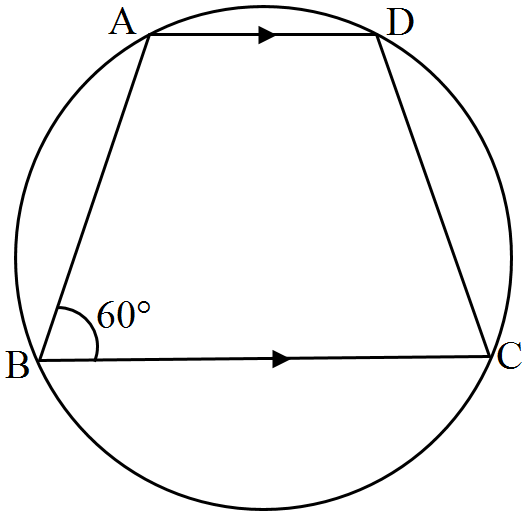
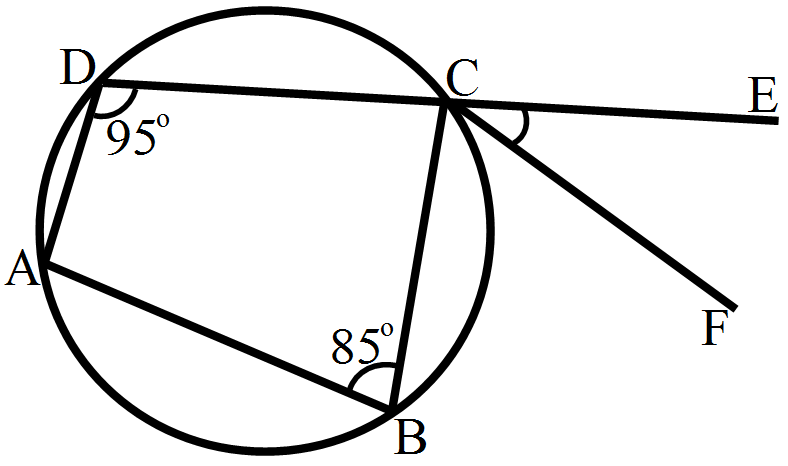
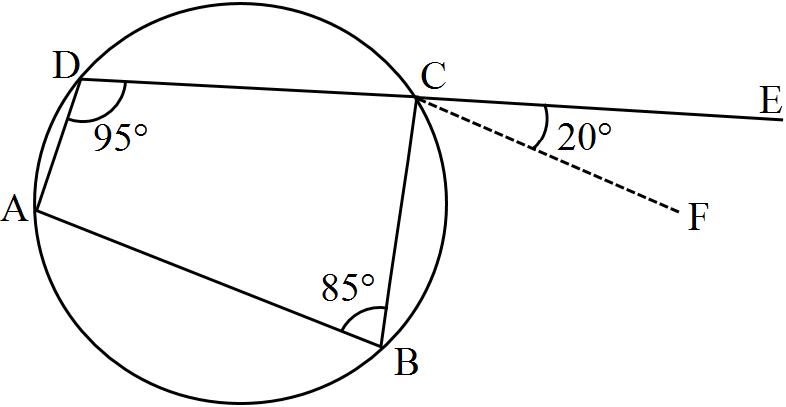
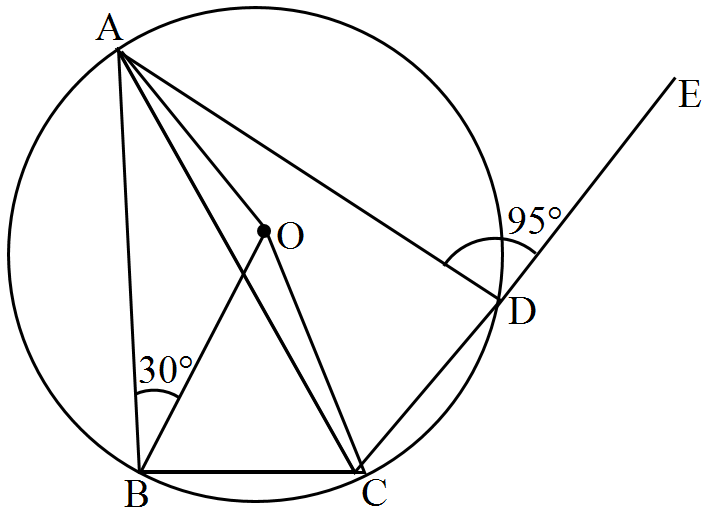
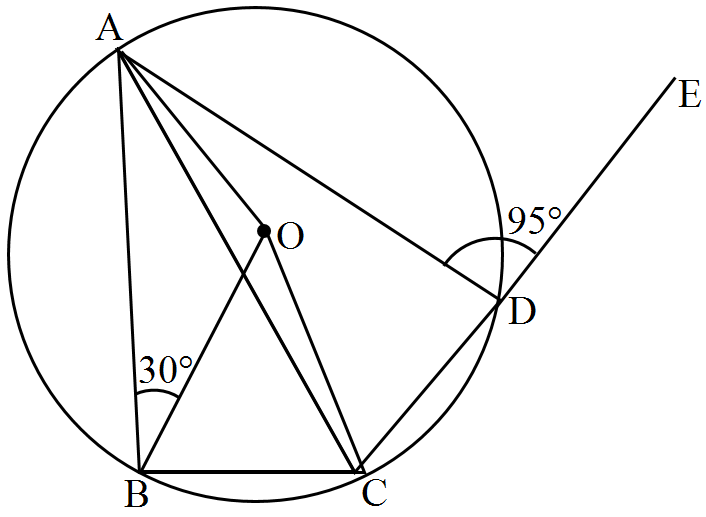
In the given figure, ABCD is a cyclic quadrilateral in which DC is produced to E and CF is drawn parallel to AB such that $\angle\text{ADC}=95^\circ$ and $\angle\text{ECF}=20^\circ.$ Then, $\angle\text{EAD}=?$
  • A
    95°
  • B
    85°
  • C
    105°
  • D
    75°

Answer
  1. 105°
    Solution:
    Since CF || AB, $\angle\text{ABC}=\angle\text{BCF}=85^\circ$
    $\angle\text{BAD}=\angle\text{BCE}$
    $\Rightarrow\ \angle\text{BAD}=\angle\text{BCF}+\angle\text{ECF}$
    $\Rightarrow\ \angle\text{BAD}=105^\circ$
View full question & answer
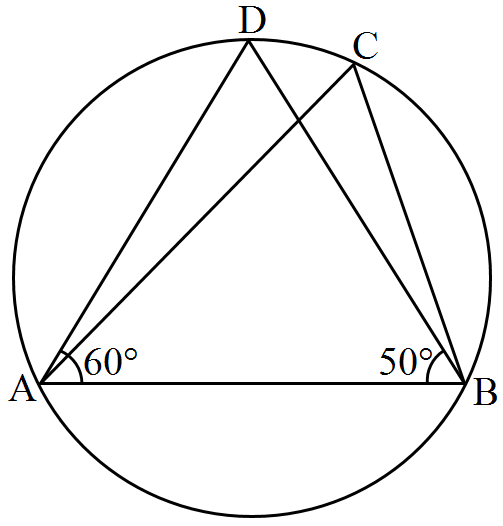
MCQ 601 Mark
  • A
    60°.
  • B
    50°.
  • C
    70°.
  • D
    80°.
Answer
  1. 70°.
    Solution:
    In $\triangle\text{ADB},$ we have
    $\angle\text{A}+\angle\text{B}+\angle\text{D}=180^\circ$ [Angle sum property of a triangle]
    $\Rightarrow60^\circ+50^\circ+\angle\text{D}=180^\circ$
    $\Rightarrow\angle\text{D}=180^\circ-110^\circ=70^\circ$
    i.e., $\angle\text{ABD}=70^\circ$
    Now, $\angle\text{ACB}=\angle\text{ADB}=70^\circ$
    [$\because$ Angles in the same segment of a circle are equal]
    Hence, (c) is the correct answer.
View full question & answer
MCQ 611 Mark
If a chord of a circle is equal to its radius, then the angle subtended by this chord in major segment is:
  • A
    30º
  • B
    90º
  • C
    45º
  • D
    60º
Answer
  1. 30º
    Solution:
    Since the chord is equal to the radius therefore, it will form an equilateral triangle inside the circlewith the third vertex being the centre of the circle.
    So the chord will make an angle of 60º at the centre. As the angle made by the chord at any other point of the circumfrence would be half.
    So, we have that angle made at the major segment would be 30º.
View full question & answer
MCQ 621 Mark
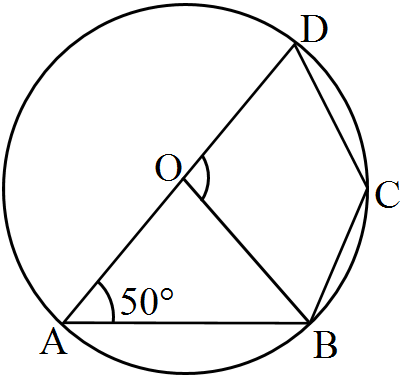
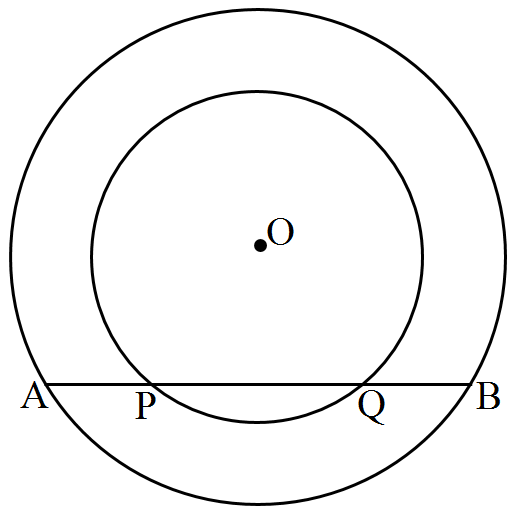
In the given figure, O is the centre of a circle and $\angle\text{OAB}=50^\circ.$ Then, $\angle\text{BOD}=?$
  • A
    130°
  • B
    50°
  • C
    100°
  • D
    80°

Answer
  1. 100°
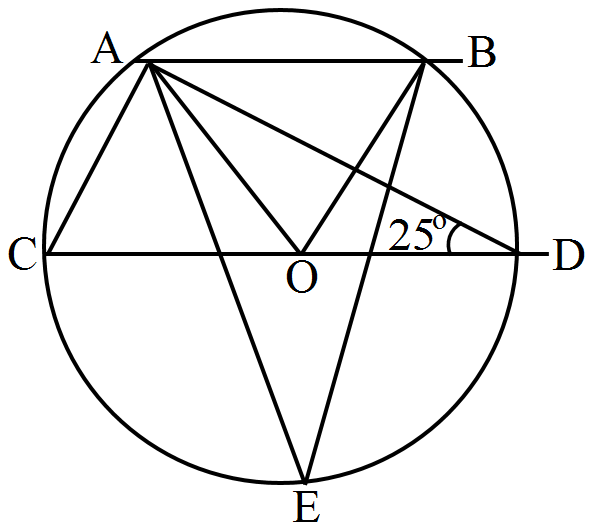
    Solution:
    OA = OB [Radii of the same circle]
    $\Rightarrow\ \angle\text{OAB}=\angle\text{OBA}=50^\circ$ [Angle opposite equal sides are equal]
    $\angle\text{BOD}=\angle\text{OAB}+\angle\text{OBA}$
    $\Rightarrow\ \angle\text{BOD}=50^\circ+50^\circ$
    $\Rightarrow\ \angle\text{BOD}=100^\circ$
View full question & answer
MCQ 641 Mark
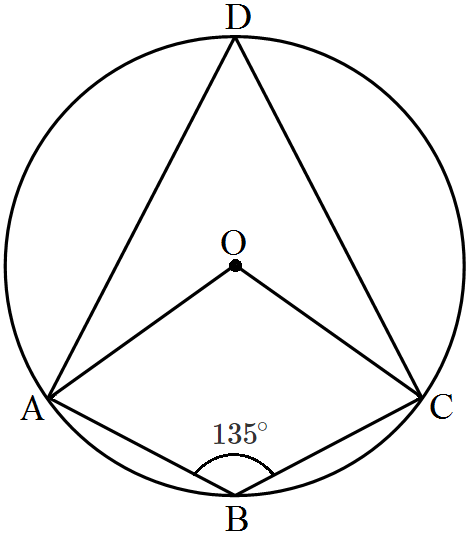
If ABC is an arc of a circle and $\angle\text{ABC} = 135^\circ,$ then the ratio of arc $\widehat{\text{ABC}}$ to the circumference is:
  • A
    1 : 4
  • B
    3 : 4
  • C
    3 : 8
  • D
    1 : 2
View full question & answer
MCQ 651 Mark
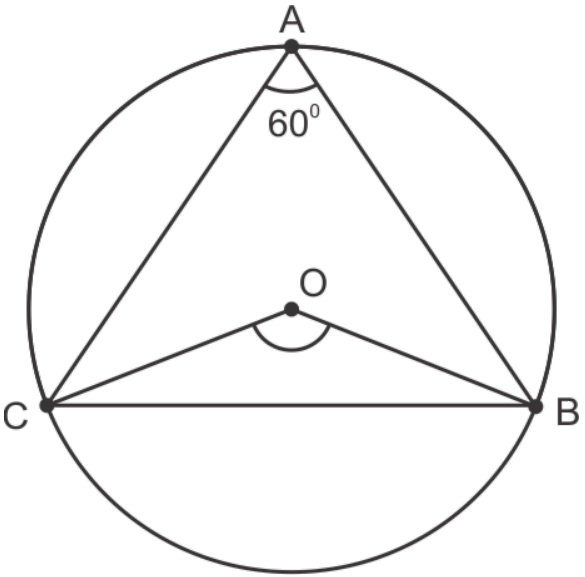
An equilateral triangle ABC is inscribed in a circle with centre O. The measures of $\angle\text{BOC}$ is:
  • A
    30°
  • B
    60°
  • C
    90°
  • D
    120°
View full question & answer
MCQ 661 Mark
If P and Q are any two Points on a circle then PQ is called a:
  • A
    Radius
  • B
    Diameter
  • C
    Secant
  • D
    Chord
Answer
  1. Chord
    Solution:
    A chord is a line formed by any two points on a circle.
View full question & answer
MCQ 681 Mark
If a chord of a circle is equal to its radius, then the angle subtended by this chord in major segment is:
  • A
    90º
  • B
    60º
  • C
    45º
  • D
    30º
Answer
  1. 30º
    Solution:
    Since the chord is equal to the radius therefore, it will form an equilateral triangle inside the circle with the third vertex being the centre of the circle.
    So the chord will make an angle of 60º at the centre. As the angle made by the chord at any other point of the circumference would be half.
    So, we have that angle made at the major segment would be 30º.
View full question & answer
MCQ 691 Mark
The angle in a semicircle measures.
  • A
    90º
  • B
    36º
  • C
    60º
  • D
    45º
Answer
  1. 90º
    Solution:
    The angle in a semicircle measures 90º.
View full question & answer
MCQ 711 Mark
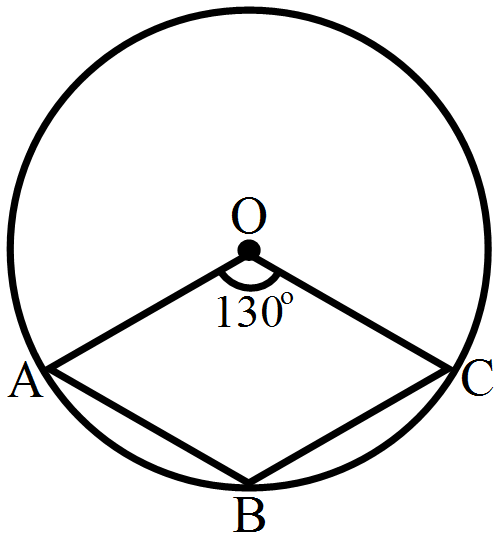
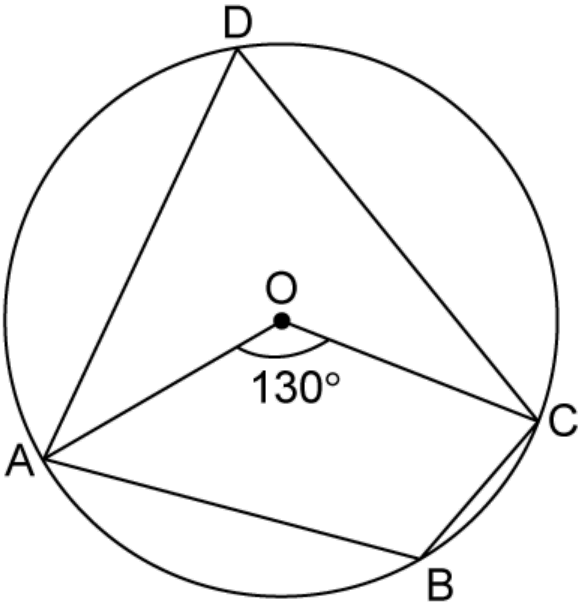
In the given figure, O is the centre of a circle and $\angle\text{AOC}=130^\circ.$ Then, $\angle\text{ABC}=?$
  • A
    50°
  • B
    65°
  • C
    115°
  • D
    130°

Answer
  1. 115°
    Solution:
    Minor $\angle\text{AOC}=130^\circ$
    Major $\angle\text{AOC}=360^\circ-130^\circ$
    ⇒ Major $\angle\text{AOC}=230^\circ$
    Since $\angle\text{ABC}=\frac{1}{2}\text{major}\angle\text{AOC}$
    $\Rightarrow\ \angle\text{ABC}=\frac{1}{2}(230^\circ)$
    $\Rightarrow\ \angle\text{ABC}=115^\circ$
View full question & answer
MCQ 741 Mark
  • A
    95º
  • B
    85º
  • C
    75º
  • D
    105º
Answer
  1. 105º
    Solution:
    We have:
    $\angle\text{ABC}+\angle\text{ADC}=180^\circ$
    $\Rightarrow\angle\text{ABC}+95^\circ=180^\circ$
    $\Rightarrow\angle\text{ABC}=(180^\circ-95^\circ)=85^\circ$
    Now, CF || AB and CB is the transversal.
    $\therefore\angle\text{BCF}=\angle\text{ABC}=85^\circ$ (Alternate interior angles)
    $\Rightarrow\angle\text{BCE}=(85^\circ+20^\circ)=105^\circ$
    $\Rightarrow\angle\text{DCB}=(180^\circ-105^\circ)=75^\circ$
    $\Rightarrow\angle\text{DCB}=75^\circ$
    Now, $\angle\text{BAD}+\angle\text{BCD}=180^\circ$
    $\Rightarrow\angle\text{BAD}+75^\circ=180^\circ$
    $\Rightarrow\angle\text{BAD}=(180^\circ-75^\circ)$
    $\Rightarrow\angle\text{BAD}=105^\circ$
View full question & answer
MCQ 751 Mark
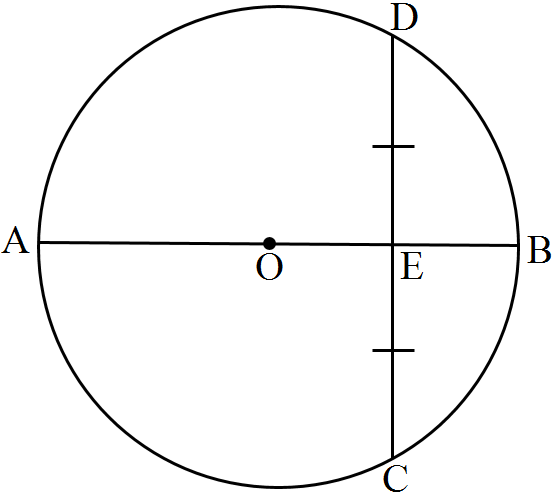
AB and CD are two equal chords of a circle with centre O such that $\angle\text{AOB}=80^\circ$ then $\angle\text{COD}=?$
  • A
    100°
  • B
    80°
  • C
    120°
  • D
    40°

Answer
  1. 80°
    Solution:
    Given that AB = CD.
    Since equal chord, subtend equal angles at the centre,
    $\angle\text{COD}=\angle\text{AOB}=80^\circ.$
View full question & answer
MCQ 761 Mark
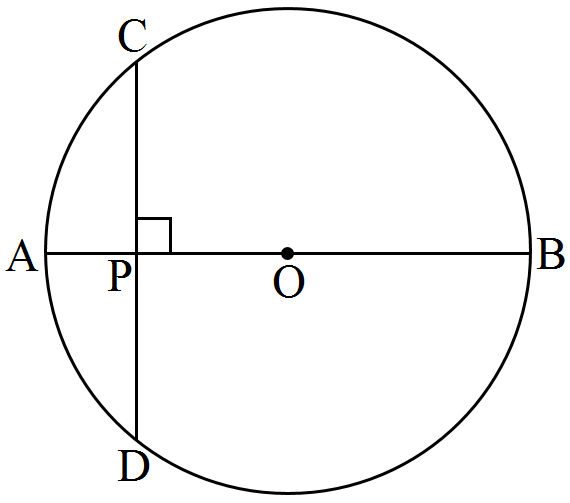
AB is a chord of a circle with radius r. if P is any point on the circle such that $\angle\text{APB}$ is a right angle, then AB is equal to:
  • A
    r2
  • B
    3r
  • C
    r
  • D
    2r
Answer
  1. 2r
    Solution:
    Since the angle subtended by the diameter or the semicircle is a right angle, therefore the AB is nothing but the diameter. Hence, it is equal to 2r, r being the radius.
View full question & answer
MCQ 771 Mark
  • A
    55º
  • B
    80º
  • C
    60º
  • D
    50º
View full question & answer
MCQ 801 Mark
  • A
    90º
  • B
    30º
  • C
    60º
  • D
    45º
Answer
  1. 45º
    Solution:
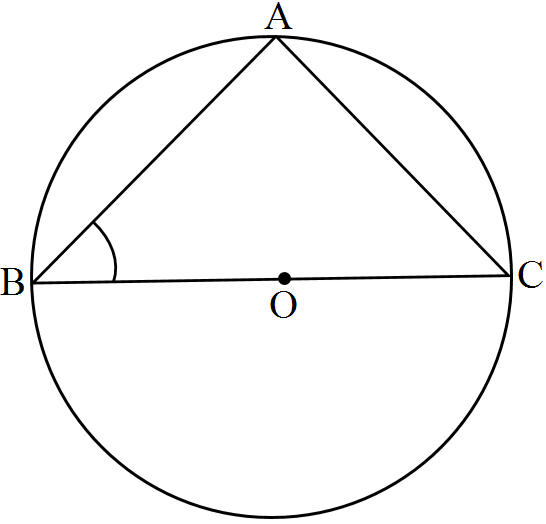
    Since an angle in a semicircle is a right angle, $\angle\text{BAC}=90^\circ$
    $\therefore\angle\text{ABC}+\angle\text{ACB}=90^\circ ....(\text{i})$
    Now, AB = AC (Given)
    $\Rightarrow\angle\text{ABC}=\angle\text{ACB}=45^\circ\ ....(\text{ii})$
    $\Rightarrow\angle\text{ABC}+\angle\text{ABC}=90^\circ$ [From (i) and (ii)]
    $\Rightarrow2\angle\text{ABC}=90$
    $\Rightarrow\angle\text{ABC}=45^\circ$
View full question & answer
MCQ 811 Mark
  • A
    20cm
  • B
    16cm
  • C
    10cm
  • D
    8cm
View full question & answer
MCQ 821 Mark
In the given figure, O is the centre of the circle such that $\angle\text{AOC} = 130^\circ,$ then $\angle\text{ABC} =$
  • A
    130°
  • B
    115°
  • C
    65°
  • D
    165°
View full question & answer
MCQ 831 Mark
  • A
    It is 2 : 1
  • B
    It is 3 : 1
  • C
    It is 1 : 3
  • D
    It is 1 : 2
Answer
  1. It is 3 : 1
    Solution:
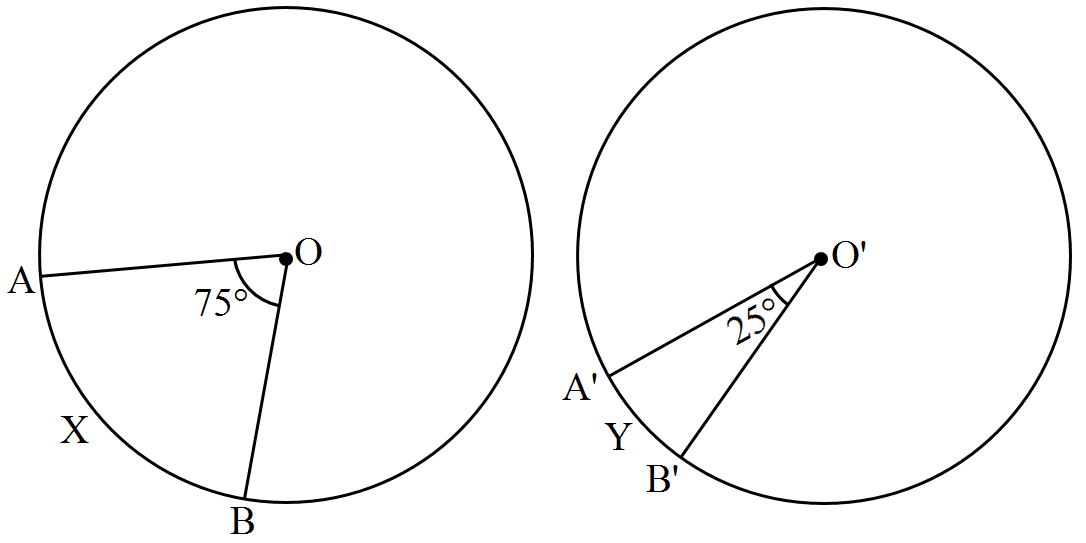
    Since, circles are congruent thus we can consider the two arcs as in the same circle. Now the length of the arcs is directly proportional the angle subtended by the arcs. Therefore the lengths of the given arcs would be same in ratio as the ratio of the given angles.
    Hence the required ratio is $\frac{75}{25}=\frac{3}{1}.$
View full question & answer
MCQ 841 Mark
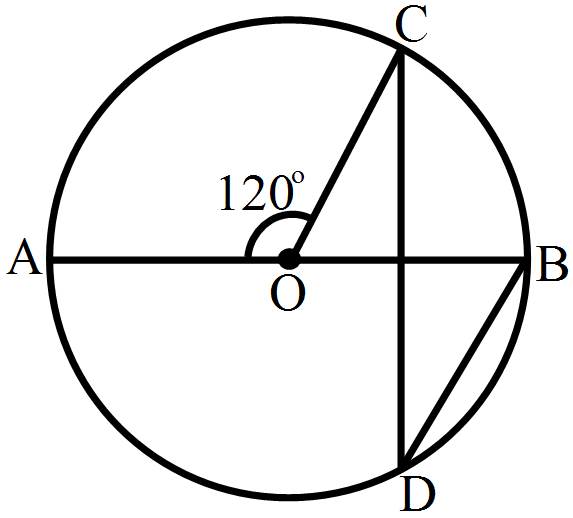
In the given figure, O is the centre of a circle and $\angle\text{AOC}=120^\circ.$ Then, $\angle\text{BDC}=?$
  • A
    60°
  • B
    45°
  • C
    30°
  • D
    15°

Answer
  1. 30°
    Solution:
    Since BOA is a diameter.
    $\angle\text{AOC}+\angle\text{BOC}=180^\circ$
    $\Rightarrow\ 120^\circ+\angle\text{BOC}=180^\circ$
    $\Rightarrow\ \angle\text{BOC}=60^\circ$
    So, $\angle\text{BDC}=\frac{1}{2}\angle\text{BOC}=\frac{1}{2}(60^\circ)=30^\circ$
View full question & answer
MCQ 851 Mark
  • A
    105º
  • B
    150º
  • C
    125º
  • D
    75º
View full question & answer
MCQ 871 Mark
  • A
    40º
  • B
    80º
  • C
    25º
  • D
    80º
View full question & answer
MCQ 891 Mark
  • A
    72º
  • B
    90º
  • C
    86º
  • D
    96º
View full question & answer
MCQ 901 Mark
If P and Q are any two points on a circle then PQ is called a:
  • A
    Chord
  • B
    Diameter
  • C
    Secant
  • D
    Radius
Answer
  1. Chord
    Solution:
    A chord is a line formed by any two points on a circle.
View full question & answer
MCQ 911 Mark
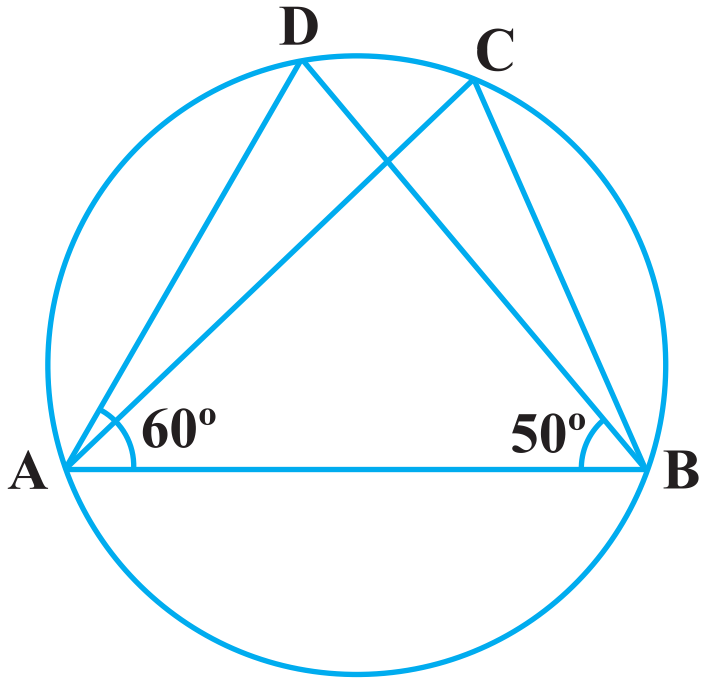
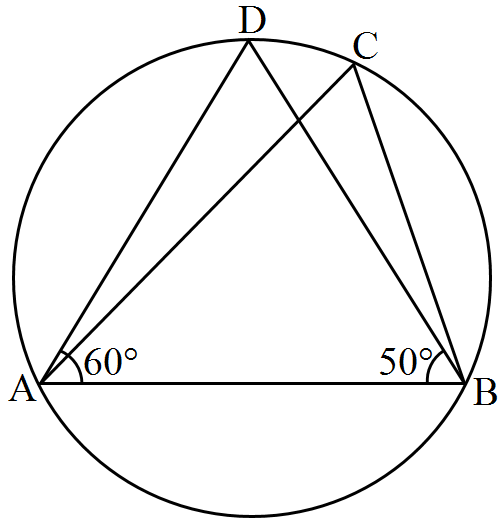
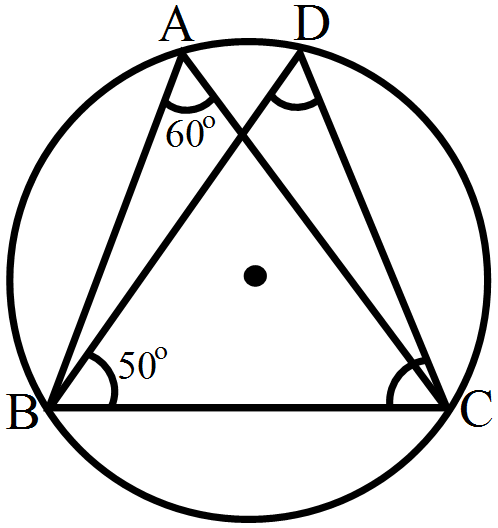
In the given figure, $\triangle\text{ABC}$ and $\triangle\text{DBC}$ are inscribed in a circle such that $\angle\text{BAC}=60^\circ$ and $\angle\text{DBC}=50^\circ.$ Then $\angle\text{BCD}=?$
  • A
    50°
  • B
    60°
  • C
    70°
  • D
    80°

Answer
  1. 70°
    Solution:
    Since angles in the same segment of a circle are equal.
    $\angle\text{BAC}=\angle\text{BDC}=60^\circ.$
    In $\triangle\text{BDC},$
    $\angle\text{BDC}+\angle\text{DBC}+\angle\text{BCD}=180^\circ.$
    $\Rightarrow\ 60^\circ+50^\circ+\angle\text{BCD}=180^\circ$
    $\Rightarrow\ \angle\text{BCD}=70^\circ$
View full question & answer
MCQ 921 Mark
The constant distance of a point on a circle from the centre of the circle is called.
  • A
    Diameter
  • B
    Circle
  • C
    Radius
  • D
    Centre
Answer
  1. Radius
    Solution:
    Radius is the fixed distance of a fixed point from a point on the circle.
    Also more precisely, a circle is the locii or the path of a point that moves maintaing a fixed distance from a given point.
View full question & answer
MCQ 931 Mark
  • A
    10º
  • B
    20º
  • C
    15º
  • D
View full question & answer
MCQ 941 Mark
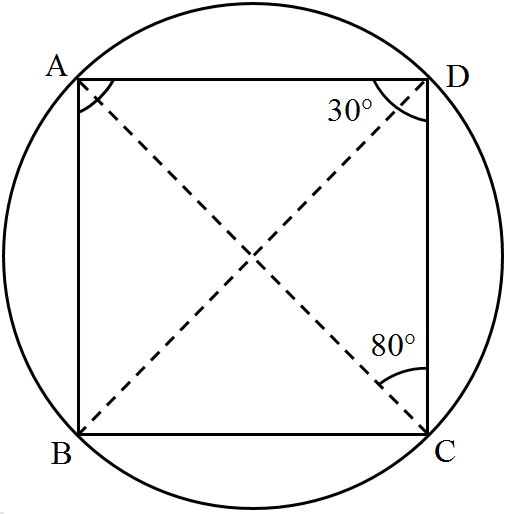
ABCD is a cyclic quadrilateral such that $\angle\text{ADB}=30^\circ$ and $\angle\text{DCA}=80^\circ,$ then $\angle\text{DAB}=$
  • A
    125º
  • B
    70º
  • C
    150º
  • D
    100º
View full question & answer
MCQ 971 Mark
ABCD is a cyclic quadrilateral such that AB is a diameter of the circle circumscribing it and $\angle\text{ADC}=140^\circ,$ then $\angle\text{BAC}$ is equal to:
  • A
    40º
  • B
    30º
  • C
    75º
  • D
    50º
Answer
  1. 50º
    Solution:
    ln the given quadrilateral,
    $\angle\text{ABC}+\angle\text{ADC}=180^\circ$
    $140^\circ+\angle\text{ABC}=180^\circ$
    $\angle\text{ABC}=40^\circ$
    Since, AB is diameter so ABCD lies in semi-circle.
    thus, $\angle\text{BCA}=90^\circ$
    In triangle, ABC,
    $\angle\text{A}+\angle\text{B}+\angle\text{C}=180^\circ$
    $\angle\text{BAC}=180^\circ-40^\circ-90^\circ=180^\circ-130^\circ=50^\circ$
    $\angle\text{BAC}=50^\circ$
View full question & answer
MCQ 981 Mark
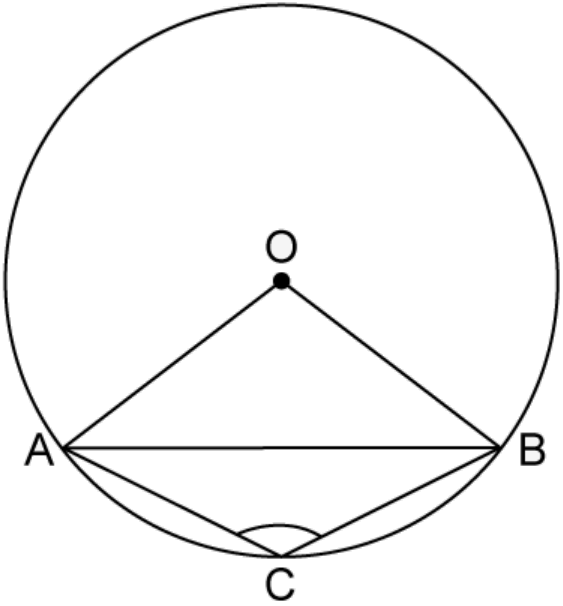
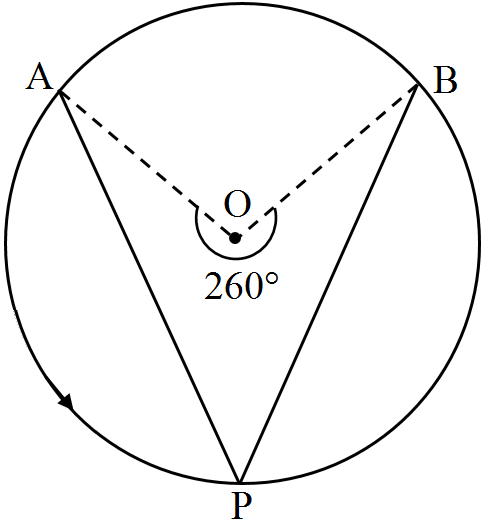
if A and B are two points on a circle such that m (AB^) = 260º. A possible value for the angle subtended by arc BA at a point on the circle is:
  • A
    50º
  • B
    100º
  • C
    75º
  • D
    25º
View full question & answer
MCQ 1001 Mark
  • A
    60º
  • B
    30º
  • C
    15º
  • D
    75º
View full question & answer
M.C.Q - Page 2 - Maths STD 9 Questions - Vidyadip