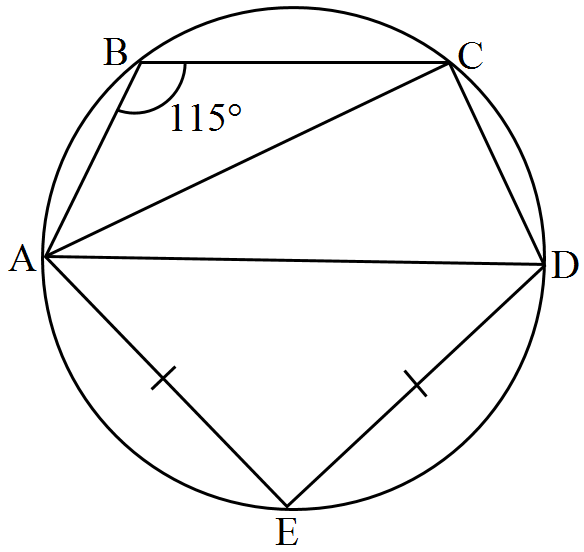
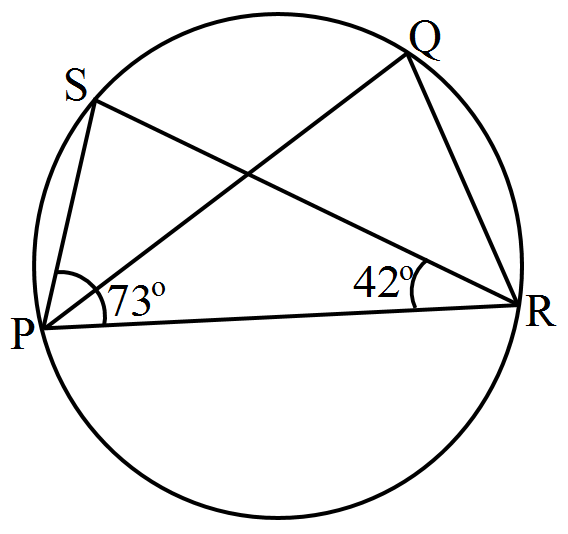
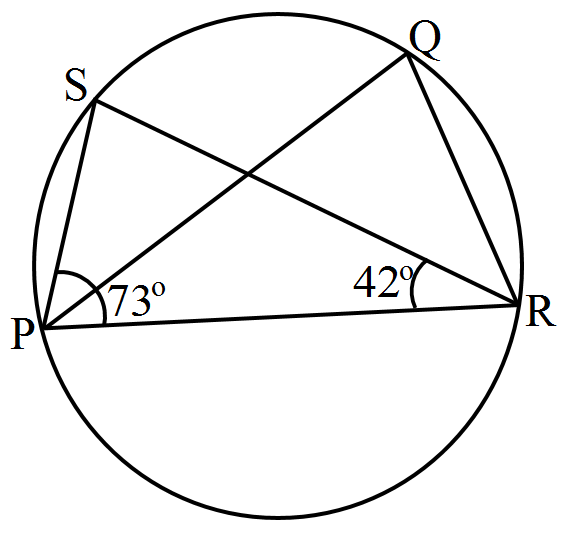
Questions · Page 3 of 5

M.C.Q

MCQ 1011 Mark
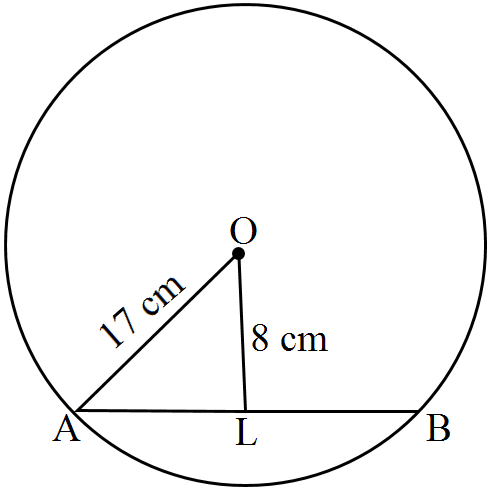
AD is diameter of a circle, O being the centre and AB is a chord. Let the centre of AB be denoted by M, then find OM.
  • A
    7cm
  • B
    8cm
  • C
    6cm
  • D
    5cm
Answer
  1. 7cm
    Solution:
    Join OM. OM will be perpendicular to AB. Since the line joining the midpoint of a chord to the centre is always perpendicular to the chord.
    AB = 48cm, so, $\text{AM}=\frac{48}{2}=24\text{cm}$ (O is the midpoint of AD)
    Now, applying pythagoras theorem, we get:-
    OA2 = AM2 + OM2
    252 = 242 + OM2
    OM2 = 252 - 242
    OM2 = 625 - 576 = 49
    OM = 7cm
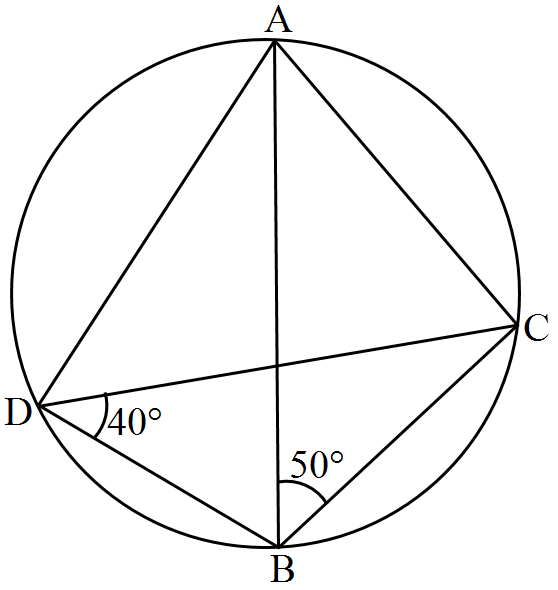
View full question & answer
MCQ 1031 Mark
  • A
    45º
  • B
    30º
  • C
    50º
  • D
    60º
Answer
  1. 30º
    Solution:
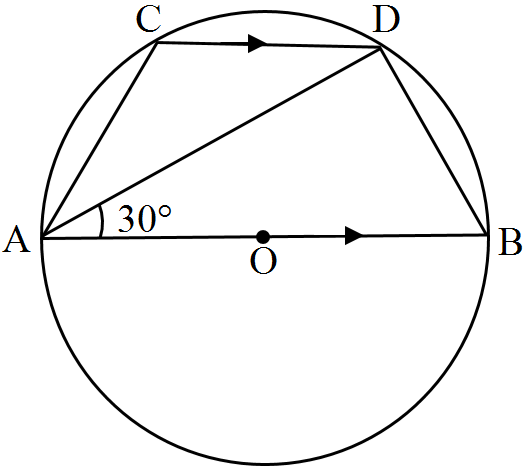
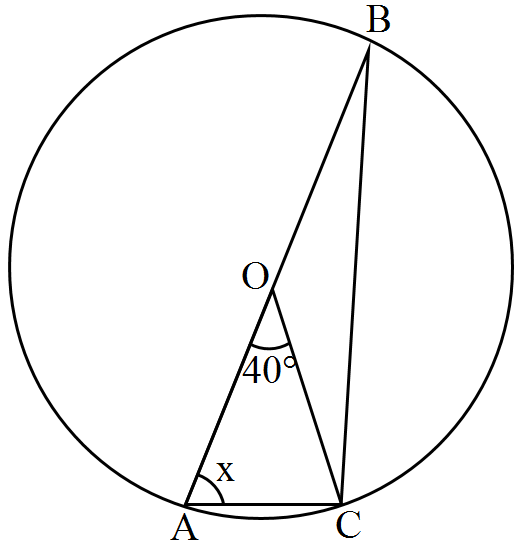
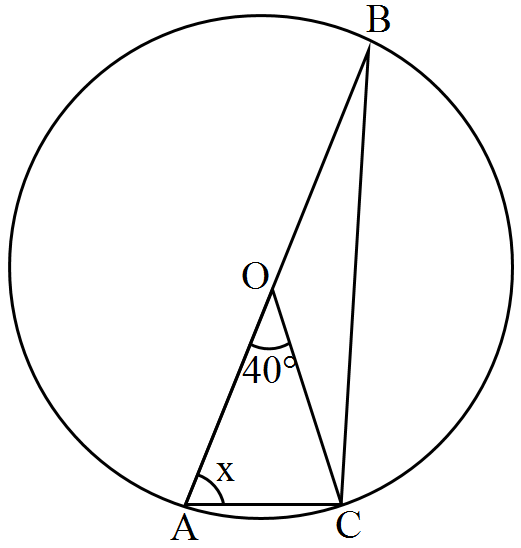
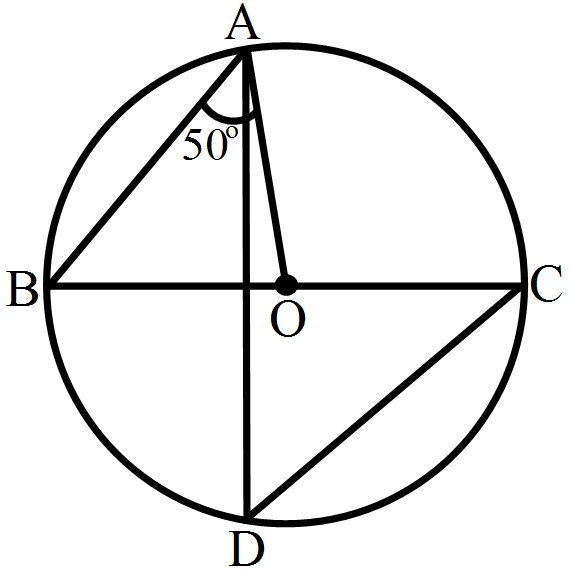
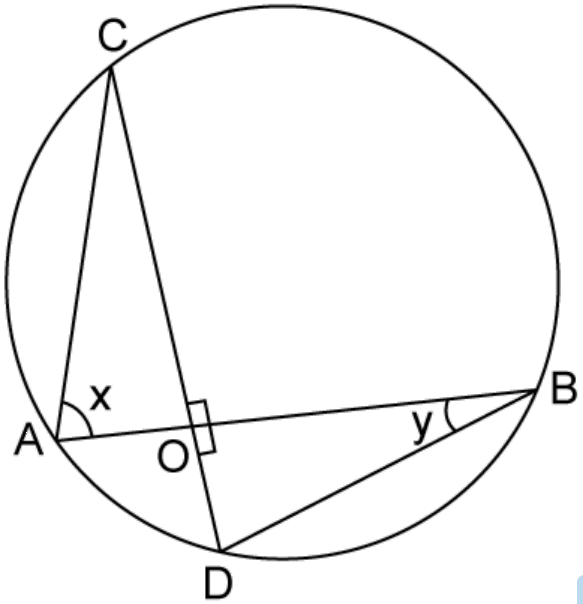
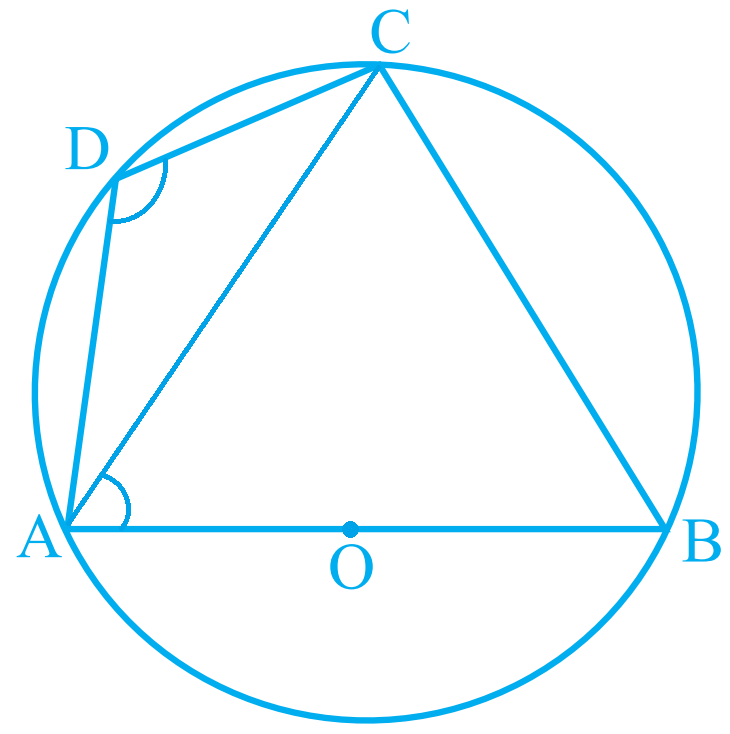
    $\angle\text{ADC}=\angle\text{BAD}=30^\circ$ (Alternate angles)
    $\angle\text{ADB}=90^\circ$ (Angle in semicircle)
    $\therefore\angle\text{CDB}=(90^\circ+30^\circ)=120^\circ$
    But ABCD being a cyclic quadrilateral, we have:
    $\angle\text{BAC}+\angle\text{CDB}=180^\circ$
    $\Rightarrow\angle\text{BAD}+\angle\text{CAD}+\angle\text{CDB}=180^\circ$
    $\Rightarrow30^\circ+\Rightarrow\angle\text{CAD}+120^\circ=180^\circ$
    $\Rightarrow\angle\text{CAD}=(180^\circ-150^\circ)=30^\circ$
    $\Rightarrow\angle\text{CAD}=30^\circ$
View full question & answer
MCQ 1041 Mark
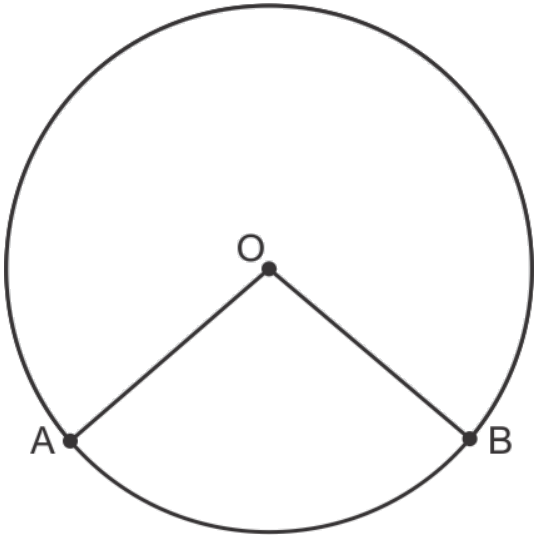
If the angles subtended by two chords of a circle at the centre are equal then the chords are:
  • A
    Angle equal.
  • B
    Equal.
  • C
    None of these.
  • D
    Not equal.
Answer
  1. Equal.
    Solution:
    If the angles subtended by two chords of a circle at the centre are equal then the chords are equal. It's a theorem.
View full question & answer
MCQ 1051 Mark
  • A
    15cm
  • B
    12.5cm
  • C
    10cm
  • D
    5cm
Answer
  1. 10cm
    Solution:
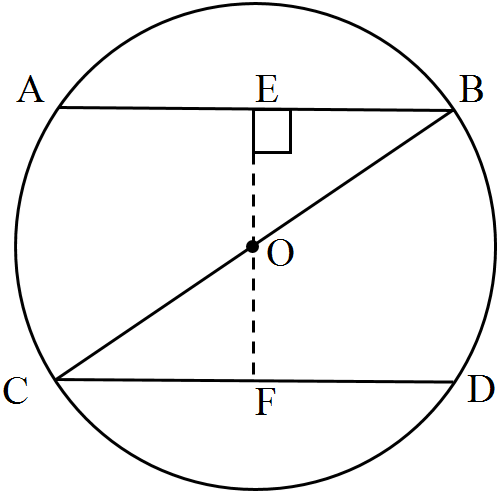
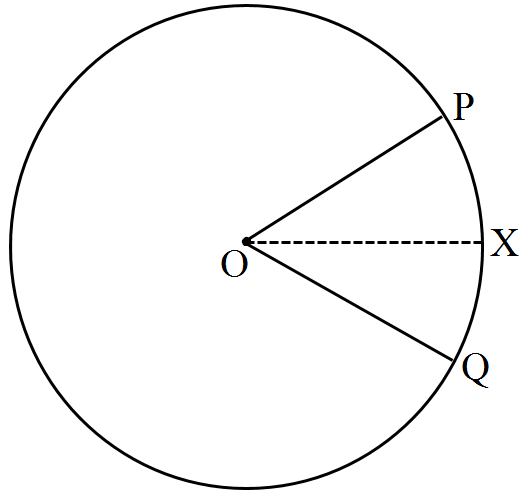
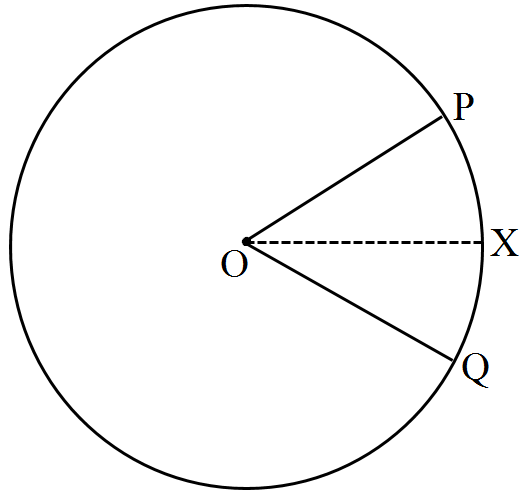
    Draw $\text{OE}\perp\text{AB}$ and $\text{OF}\perp\text{CD}.$
    In $\triangle\text{OEB}$ and $\triangle\text{OFC},$ we have:
    OB = OC (Radius of a circle)
    $\angle\text{BOE}=\angle\text{COF}$ (Vertically opposite angles)
    $\angle\text{OEB}=\angle\text{OFC}$ (90º each)
    $\therefore\triangle\text{OEB}\cong\triangle\text{OFC}$ (By ASA congruency rule)
    $\therefore\text{OE}=\text{OF}$ {by cpct}
    Chords equidistance from the centre is equal.
    $\therefore$ CD = AB = 10cm
View full question & answer
MCQ 1071 Mark
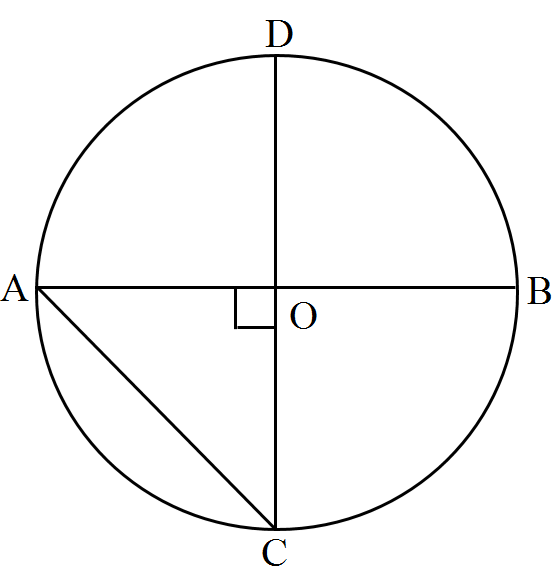
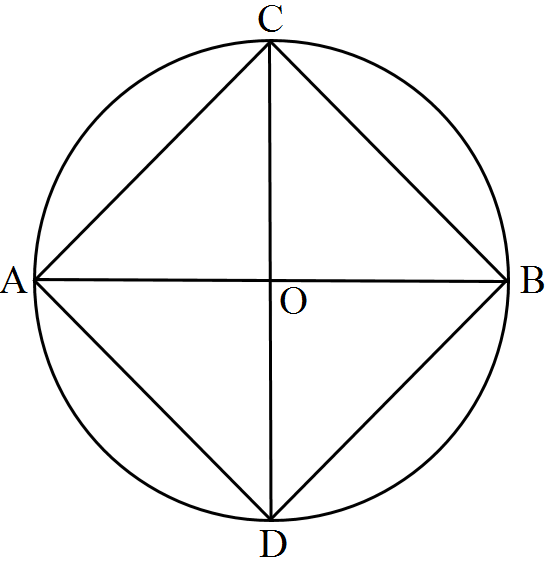
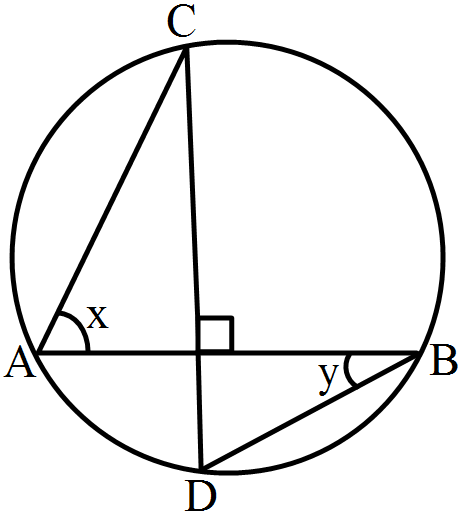
In a circle with centre O, AB and CD are two diameters perpendicular to each other. The length of chord AC, is:
  • A
    $\frac{1}{\sqrt{2}\text{ AB}}$
  • B
    $\sqrt{2}$
  • C
    $\frac{1}{2\text{AB}}$
  • D
    $\text{2AB}$
View full question & answer
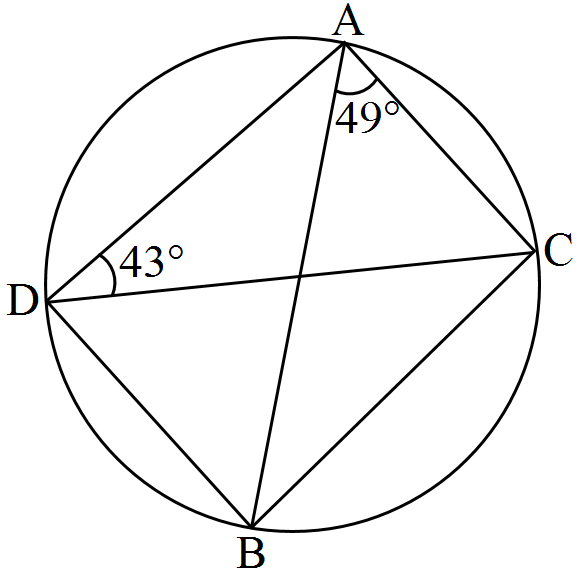
MCQ 1091 Mark
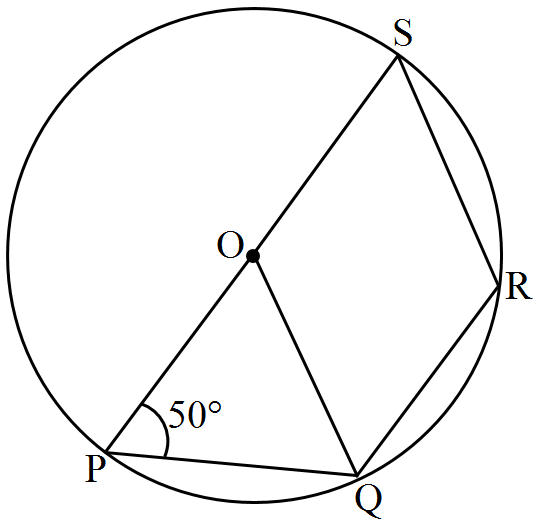
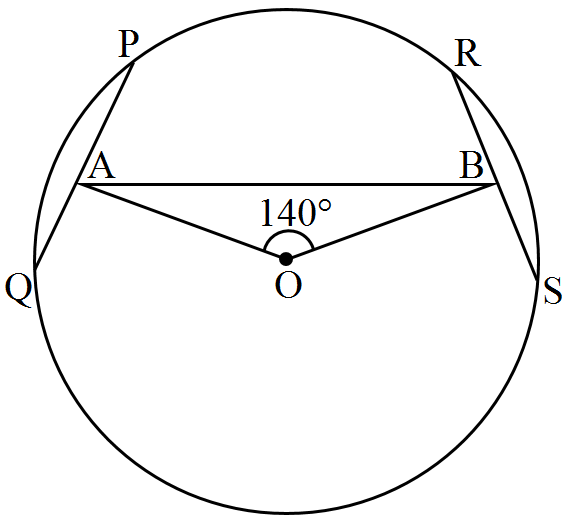
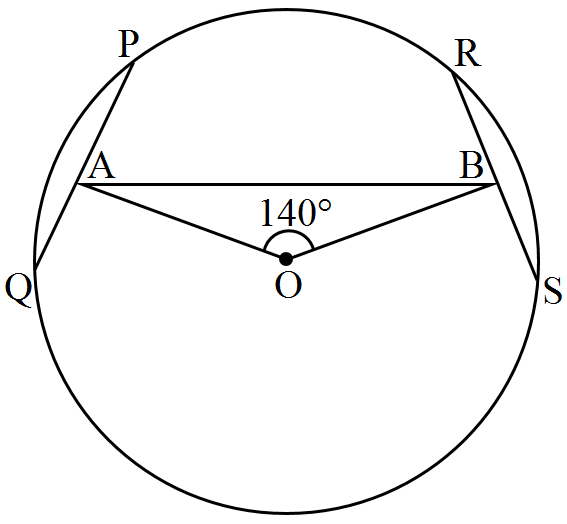
  • A
    70º
  • B
    60º
  • C
    80º
  • D
    90º
View full question & answer
MCQ 1101 Mark
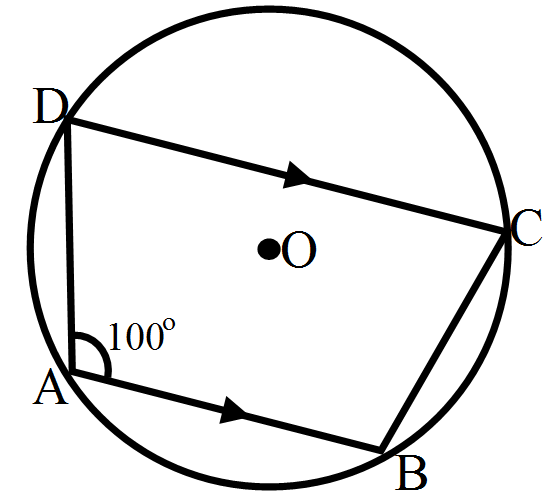
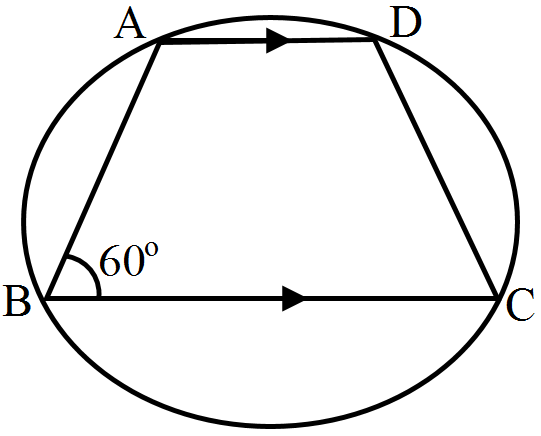
In the given figure ABCD is a cyclic quadrilateral in which AB || DC and $\angle\text{BAD}=100^\circ.$ Then, $\angle\text{ABC}=?$
  • A
    80°
  • B
    100°
  • C
    50°
  • D
    40°

Answer
  1. 100°
    Solution:
    Since AB || DC,
    $\angle\text{ADC}+\angle\text{BAD}=180^\circ$
    $\Rightarrow\ 100^\circ+\angle\text{BAD}=180^\circ$
    $\Rightarrow\ \angle\text{BAD}=80^\circ$
    We know that the opposite angles of a quadrilateral are supplementary.
    $\angle\text{BAD}+\angle\text{ABC}=180^\circ$
    $\Rightarrow\ 80^\circ+\angle\text{ABC}=180^\circ$
    $\Rightarrow\ \angle\text{ABC}=100^\circ$
View full question & answer
MCQ 1141 Mark
  • A
    45º
  • B
    30º
  • C
    15º
  • D
    60º
Answer
  1. 30º
    Solution:
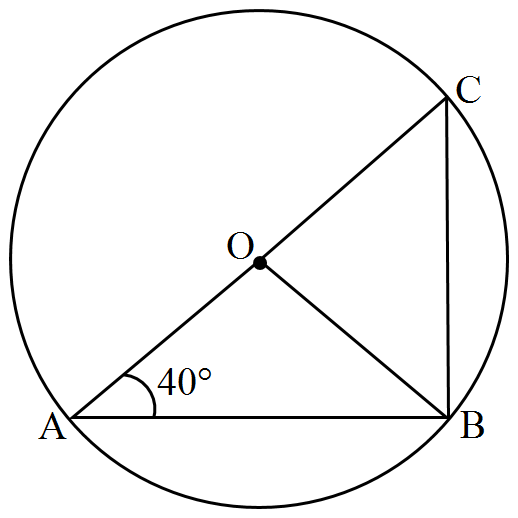
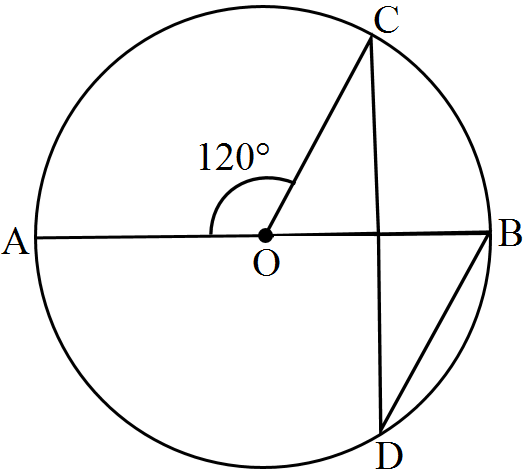
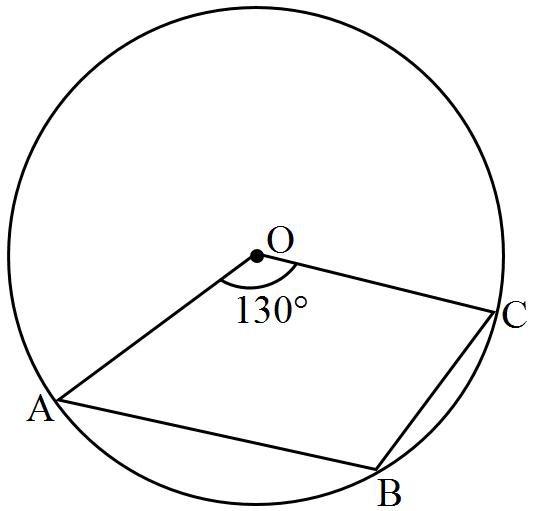
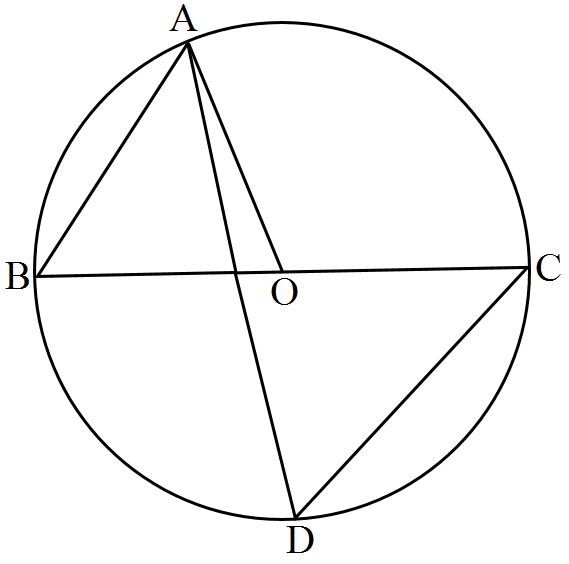
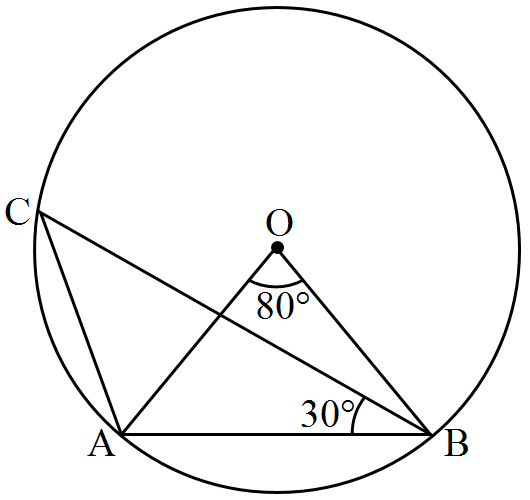
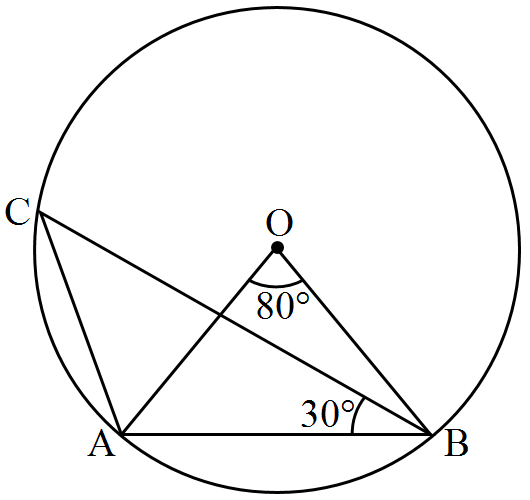
    $\angle\text{COB}=180^\circ-120^\circ=60^\circ$ (Linear pair)
    Now, arc BC subtends $\angle\text{COB}$ at the centre and $\angle\text{BDC}$ at the point D of the remaining part of the circle.
    $\therefore\angle\text{COB}=2\angle\text{BDC}$
    $\Rightarrow\angle\text{BDC}=\frac{1}{2}\angle\text{COB}=(\frac{1}{2}\times60^\circ)=30^\circ$
    $\Rightarrow\angle\text{BDC}=30^\circ$
View full question & answer
MCQ 1151 Mark
Circle having same centre are said to be:
  • A
    Secant
  • B
    Chord
  • C
    Concentric
  • D
    Circle
Answer
  1. Concentric
    Solution:
    Concentric circles are those circle that are drawn with same point as centre but different radii.
View full question & answer
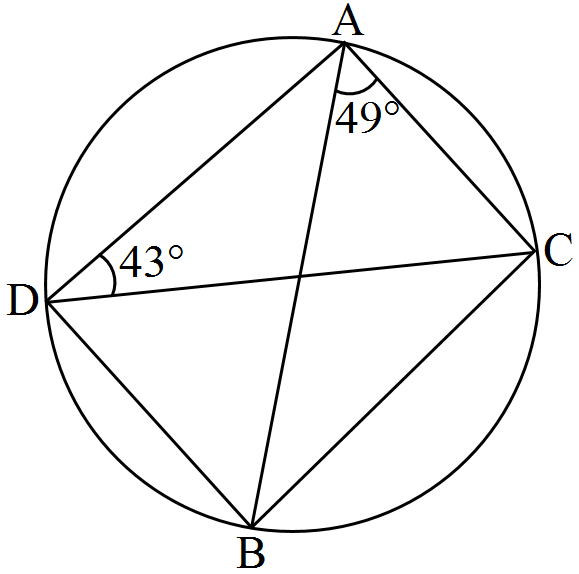
MCQ 1181 Mark
  • A
    90º
  • B
    70º
  • C
    60º
  • D
    80º
Answer
  1. 80º
    Solution:
    We have:
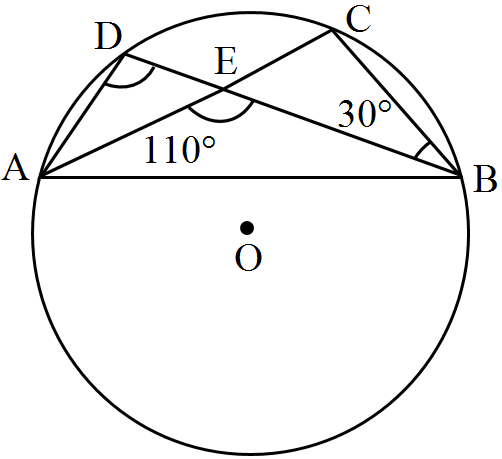
    $\angle\text{AEB}+\angle\text{CEB}=180^\circ$ (Linear pair angles)
    $\Rightarrow110^\circ+\angle\text{CEB}=180^\circ$
    $\Rightarrow\angle\text{CEB}=(180^\circ-110^\circ)=70^\circ$
    $\Rightarrow\angle\text{CEB}=70^\circ$
    In $\triangle\text{CEB},$ we have:
    $\angle\text{CEB}+\angle\text{EBC}+\angle\text{ECB}=180^\circ$ (Angle sum property of a triangle)
    $\Rightarrow70^\circ+30^\circ+\angle\text{ECB}=180^\circ$
    $\Rightarrow\angle\text{ECB}=(180^\circ-100^\circ)=80^\circ$
    The angles in the same segment are equal.
    Thus, $\angle\text{ADB}=\angle\text{ECB}=80^\circ$
    $\Rightarrow\angle\text{ADB}=80^\circ$
View full question & answer
MCQ 1221 Mark
Greatest chord of a circle is called its:
  • A
    Secant
  • B
    Radius
  • C
    Chord
  • D
    Diameter
Answer
  1. Diameter
    Solution:
    Since diameter is the longest segment that can be drawn in a circle(touching the circle at both ends), therefore it is the longest possible chord also.
View full question & answer
MCQ 1231 Mark
Write the correct answer in the following:
AD is a diameter of a circle and AB is a chord. If AD = 34cm, AB = 30cm, the distance of AB from the centre of the circle is:
  • A
    17cm.
  • B
    15cm.
  • C
    4cm.
  • D
    8cm.
Answer
  1. 8cm.
    Solution:
    Draw $\text{OP}\bot\text{AB}.$
    As perpendicular from the centre to a chord bisect the chord,
    So, $\text{AP}=\frac{1}{2}\times\text{AB}=\frac{1}{2}\times30=15\text{cm}$
    Radius $=\text{OA}=\frac{1}{2}\times34=17\text{cm}$
    In right $\triangle\text{OPA},$ we have
    $\text{OP}=\sqrt{\text{OA}^2-\text{AP}^2}=\sqrt{(17)^2-(15)^2}$
    $=\sqrt{289-225}=\sqrt{64}=8\text{cm}$
    Hence, (d) is the correct answer.
View full question & answer
MCQ 1241 Mark
What is a diameter in terms of the radius?
  • A
    $\text{d}=2\pi\text{r}$
  • B
    r = 2d
  • C
    d = r
  • D
    d = 2r
Answer
  1. d = 2r
    Solution:
    Diameter is twice of radius.
    thus, d = 2r.
View full question & answer
MCQ 1251 Mark
The angle in a semicircle measures:
  • A
    45°
  • B
    60°
  • C
    90°
  • D
    36°
Answer
  1. 90°
    Solution:
    The angle in a semicircle measures 90°.
View full question & answer
MCQ 1261 Mark
A circle is drawn. It divides the plane into:
  • A
    No Parts
  • B
    4 Parts
  • C
    5 Parts
  • D
    3 Parts
Answer
  1. 3 Parts
    Solution:
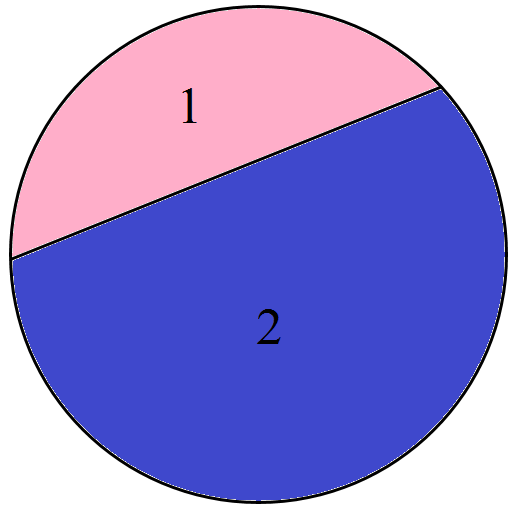
    A circle divides the plane into 3 parts namely, the points outside the circle, the points inside the circle and the points on the circle.
View full question & answer
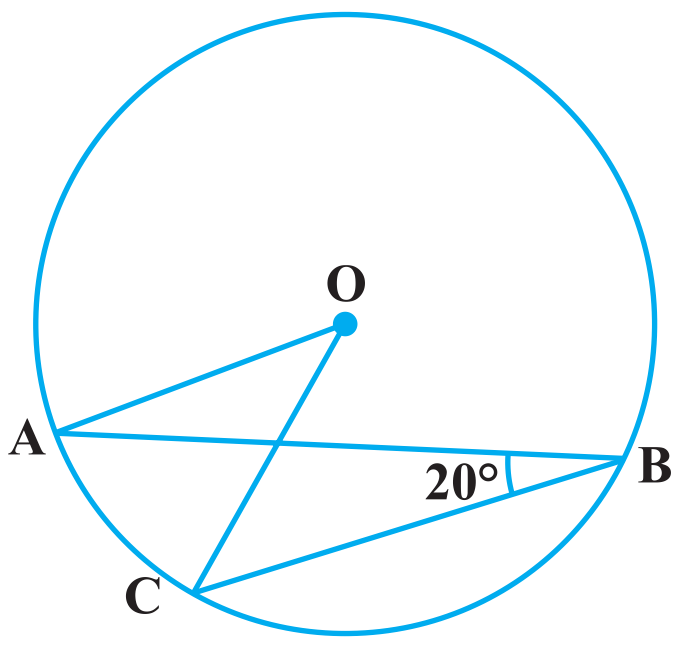
MCQ 1281 Mark
  • A
    80º
  • B
    50º
  • C
    40º
  • D
    25º
Answer
  1. 50º
    Solution:
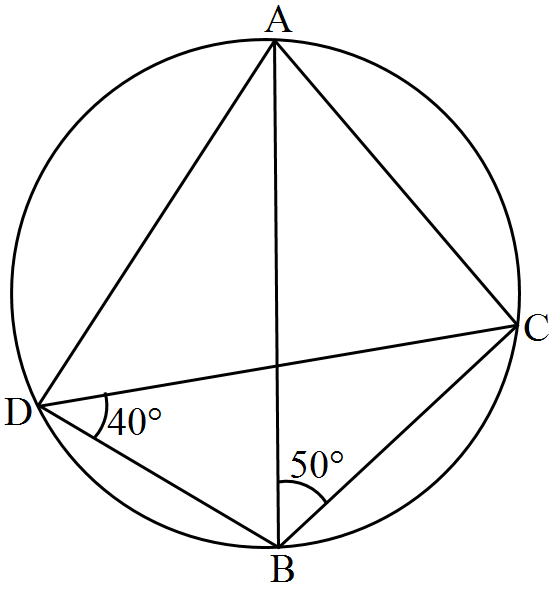
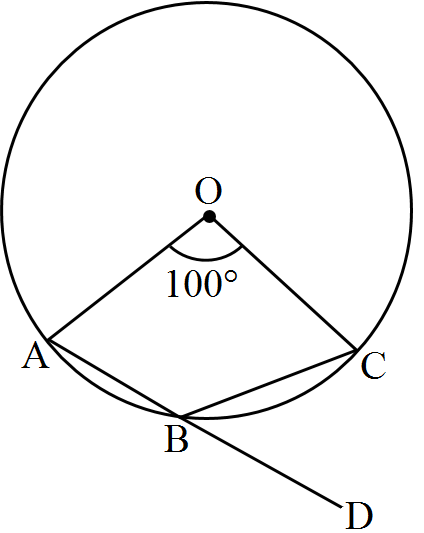
    Take a point E on the remaining part of the circumference.
    Join AE and CE.
    Then, $\angle\text{AEC}=\frac{1}{2}\angle\text{AOC}=(\frac{1}{2}\times100^\circ)=50^\circ$
    Now, side AB of the cyclic quadrilateral ABCE has been produced to D.
    $\therefore$ Exterior $\angle\text{CBD}=\angle\text{AEC}=50^\circ$
    $\Rightarrow\angle\text{CBD}=50^\circ$
View full question & answer
MCQ 1291 Mark
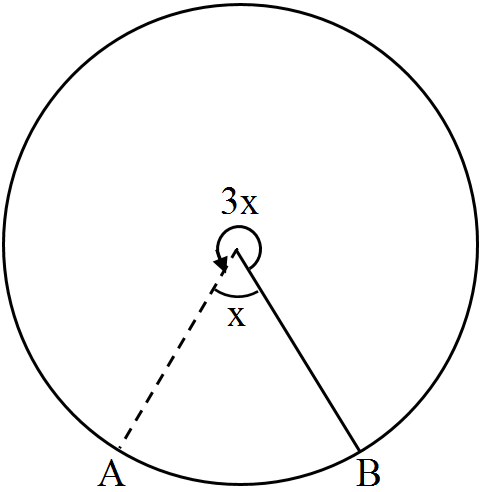
In a circle, the major arc is 3 times the minor arc. The corresponding central angles and the degree measures of two arcs are:
  • A
    90° and 270°
  • B
    90° and 90°
  • C
    270° and 90°
  • D
    60° and 210°
View full question & answer
MCQ 1301 Mark
In the given figure, O is the centre of a circle and $\angle\text{OAB}=50^\circ.$ Then, $\angle\text{CDA}=?$
  • A
    40°
  • B
    50°
  • C
    75°
  • D
    25°

Answer
  1. 50°
    Solution:
    OA = OB [Radii of the same circle]
    $\Rightarrow\ \angle\text{OBA}=\angle\text{OAB}=50^\circ$
    Since angles in the same segment are equal, $\angle\text{ABC}=\angle\text{CDA}.$
    That is, $\angle\text{ABO}=\angle\text{CDA}=50^\circ$
View full question & answer
MCQ 1321 Mark
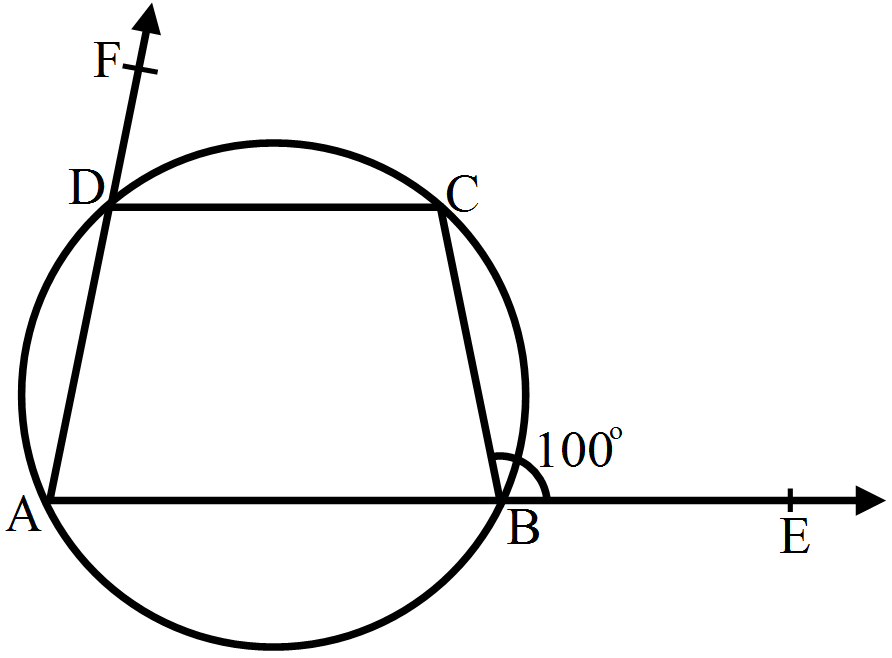
In the given figure, sides AB and AD of quad. ABCD are produced to E and F respectively. If $\angle\text{CBE}=100^\circ$ then $\angle\text{CDF}=?$
  • A
    100°
  • B
    80°
  • C
    130°
  • D
    90°

Answer
  1. 80°
    Solution:
    Since ABCD is a cyclic equilateral,
    $\angle\text{CBE}=\angle\text{ADC}=100^\circ$
    Since ADF is a straight line,
    $\angle\text{CDF}+\angle\text{ADC}=180^\circ$
    $\Rightarrow\ \angle\text{CDF}+100^\circ=180^\circ$
    $\Rightarrow\ \angle\text{CDF}=80^\circ$
View full question & answer
MCQ 1351 Mark
  • A
    130º
  • B
    100º
  • C
    110º
  • D
    120º
View full question & answer
MCQ 1361 Mark
In a circle, the major arc is 3 times the minor arc. The corresponding central angles and the degree measures of two arcs are:
  • A
    60º and 210º
  • B
    90º and 90º
  • C
    90º and 27º
  • D
    270º and 90º
View full question & answer
MCQ 1371 Mark
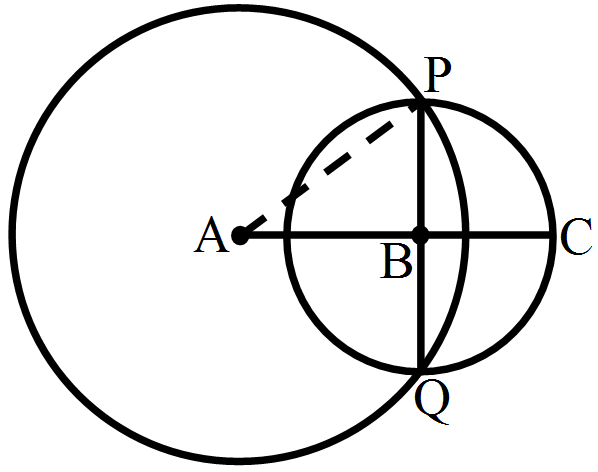
In the given figure, A and B are the centres of two circles having radii 5cm and 3cm respectively and intersecting at points P and Q respectively. If AB = 4cm, then the length of common chord PQ is:
  • A
    3cm
  • B
    6cm
  • C
    7.5cm
  • D
    9cm

Answer
  1. 6cm
    Solution:
    We know that, the line joining centres is the perpendicular bisector of the common chord.
    Then,
    AP = 5cm, BP = 3cm and AB = 4cm
    AP2 = 52 = 25
    BP2 + AB2 = 32 + 42 = 25
    In $\triangle\text{ABP},$
    Since AP2 = BP2 + AB2
    $\triangle\text{ABP},$ is a right-angled triangle and PQ = 2BP = 2(3) = 6cm.
View full question & answer
MCQ 1381 Mark
One chord of a circle is known to be 10cm. The radius of this circle must be:
  • A
    Greater than 5cm.
  • B
    5cm.
  • C
    Greater than or equal to 5cm.
  • D
    Less than 5cm.
Answer
  1. Greater than 5cm.
    Solution:
    We are given length of a chord to be 10cm and we have to give information about the radius of the circle.
    Since in any circle, the diameter of the circle is greater than any chord.
    So diameter > 10
    ⇒ 2r > 10
    ⇒ r > 5cm
    Radius is greater than 5cm.
View full question & answer
MCQ 1411 Mark
  • A
    135º
  • B
    155º
  • C
    165º
  • D
    115º
View full question & answer
MCQ 1421 Mark
Write the correct answer in the following:
ABCD is a cyclic quadrilateral such that AB is a diameter of the circle circumscribing it and $\angle\text{ADC}=140^\circ,$ then $\angle\text{BAC}$ is equal to:
  • A
    80°.
  • B
    50°.
  • C
    40°.
  • D
    30°.
View full question & answer
MCQ 1431 Mark
  • A
    60º
  • B
    40º
  • C
    80º
  • D
    30º
View full question & answer
MCQ 1441 Mark
  • A
    40º
  • B
    25º
  • C
    65º
  • D
    75º
View full question & answer
MCQ 1451 Mark
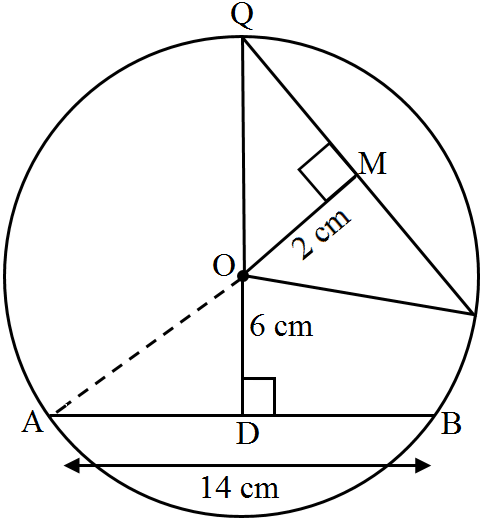
A chord of length 14cm is at a distance of 6cm from the centre of a circle. The length of another chord at a distance of 2cm from  he centre of the circle is:
  • A
    12cm
  • B
    18cm
  • C
    14cm
  • D
    16cm
View full question & answer
MCQ 1461 Mark
  • A
    75º
  • B
    105º
  • C
    150º
  • D
    125º
View full question & answer
MCQ 1471 Mark
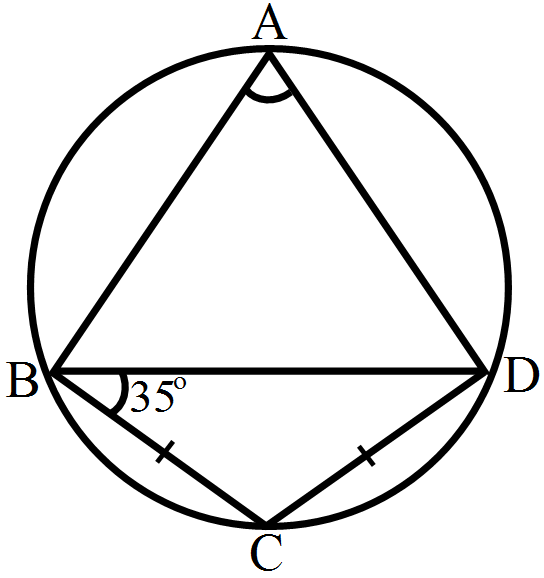
In the give figure, ABCD is a cyclic quadrilateral in which BC = CD and $\angle\text{CBD}=35^\circ.$ Then, $\angle\text{BAD}=?$
  • A
    65°
  • B
    70°
  • C
    110°
  • D
    90°

Answer
  1. 70°
    Solution:
    BC = BD [Given]
    $\angle\text{BDC}=\angle\text{CBD}=35^\circ$ [Angle opposite equal sides are equal]
    In $\triangle\text{BCD},$
    $\angle\text{BCD}+\angle\text{BDC}+\angle\text{CBD}=180^\circ$ [Angle sum property]
    $\Rightarrow\ \angle\text{BCD}+35^\circ+35^\circ=180^\circ$
    $\Rightarrow\ \angle\text{BCD}=110^\circ$
    Since ABCD is a cyclic quadrilateral,
    $\angle\text{BAD}+\angle\text{BCD}=180^\circ$
    $\Rightarrow\ \angle\text{BAD}+110^\circ=180^\circ$
    $\Rightarrow\ \angle\text{BAD}=70^\circ$
View full question & answer
MCQ 1481 Mark
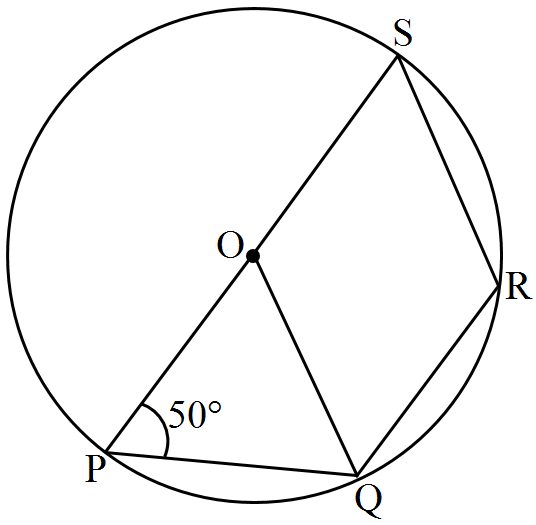
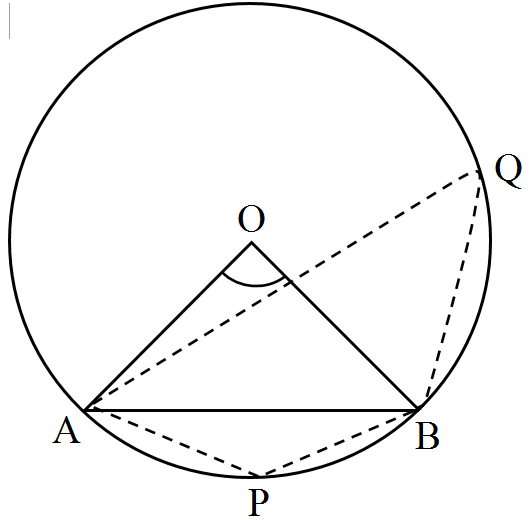
  • A
    70º
  • B
    50º
  • C
    60º
  • D
    40º
View full question & answer
MCQ 1491 Mark
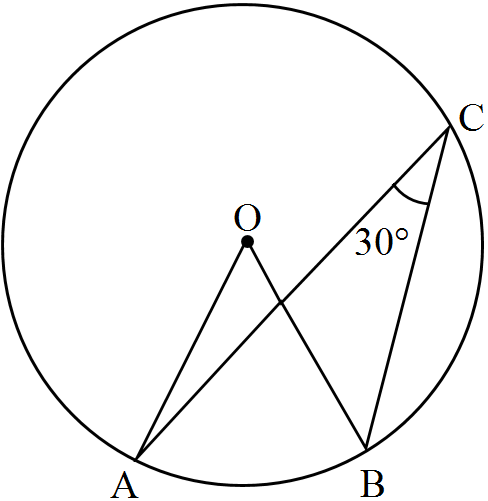
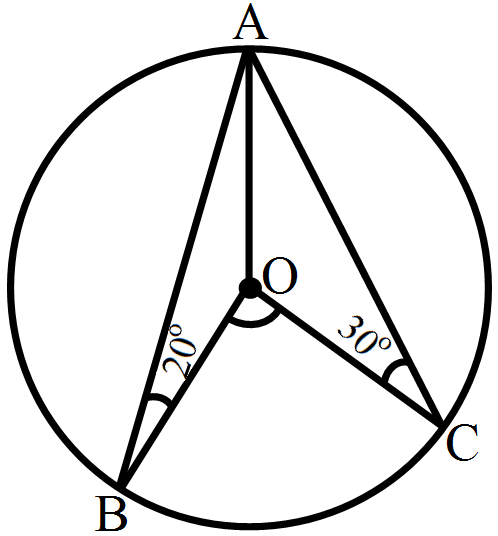
In the given figure, O is the centre of a circle in which $\angle\text{OBA}=20^\circ$ and $\angle\text{OCA}=30^\circ.$ Then, $\angle\text{BOC}=?$
  • A
    50°
  • B
    90°
  • C
    100°
  • D
    130°

Answer
  1. 100°
    Solution:
    In $\triangle\text{OAB},$
    OA = OB [Radii of the same circle]
    $\Rightarrow\ \angle\text{OBA}=\angle\text{OAB}=20^\circ$ [Angle opposite equal sides are equal]
    In $\triangle\text{OAC},$
    OA = OC [Radii of the same circle]
    $\Rightarrow\ \angle\text{OCA}=\angle\text{OAC}=30^\circ$ [Angle opposite equal sides are equal]
    Now, $\angle\text{BAC}=\angle\text{BAO}+\angle\text{CAO}$
    $=20^\circ+30^\circ$
    $=50^\circ$
    $\angle\text{BOC}=2\angle\text{BAC}=2(50^\circ)=100^\circ.$
View full question & answer
MCQ 1501 Mark
The chord of a circle is equal to its radius. The angle subtended by this chord at the minor arc of the circle, is:
  • A
    60º
  • B
    75º
  • C
    120º
  • D
    150º
View full question & answer