MCQ 11 Mark
Write the correct answer in the following: If $P(5, 1), Q(8, 0), R(0, 4), S(0, 5)$ and $O(0, 0)$ are plotted on the graph paper, then the point(s) on the $x$-axis are:
- A
$P$ and $R$
- B
$R$ and $S$
- C
Only $Q$
- ✓
$Q$ and $O$
AnswerCorrect option: D. $Q$ and $O$
We now that, a point lies on $X$-axis, if its $y$-coordinate is zero.
So, the points on the axis are $Q(8, 0)$ and $O(0, 0)$.
View full question & answer→MCQ 21 Mark
Write the correct answer in the following: Point $(0, -7)$ lies:
- A
On the $x$-axis.
- B
- C
On the $y$-axis.
- ✓
AnswerIn Point $(0, -7)$ co-ordinate of $x$ axis is zero so it lies on $y$ axis.
View full question & answer→MCQ 31 Mark
Write the correct answer in the following: The points $(-5, 2)$ and $(2, -5)$ lie in the:
- A
- B
$II$ and $III$ quadrants, respectively.
- ✓
$II$ and $IV$ quadrants, respectively.
- D
$IV$ and $II$ quadrants, respectively.
AnswerCorrect option: C. $II$ and $IV$ quadrants, respectively.
In point $(-5, 2)$, $x$-coordinate is negative and $y$-coordinate is positive, so it lies in II quadrant and in point $(2, -5), x$- coordinate is positive and $y-$coordinate is negative, so it lies in IV quadrant.
View full question & answer→MCQ 41 Mark
Write the correct answer in the following: Which of the points $P(0, 3), Q(1, 0), R(0, -1), S(-5, 0), T(1, 2)$ do not lie on the $x$-axis?
- A
$P$ and $R$ only.
- B
$Q$ and $S$ only.
- ✓
$P, R$ and $T$.
- D
$Q, S$ and $T$.
AnswerCorrect option: C. $P, R$ and $T$.
We know that, if a point is of the form $(x, 0)$ i.e., its $y$-coordinate is zero, then it will lie on $X$-axis otherwise not.
Here, $y$-coordinates of points $P(0, 3), R(0, -1)$ and $T(1, 2)$ are not zero, so these points do not lie on the $X$-axis.
View full question & answer→MCQ 51 Mark
Write the correct answer in the following: If y coordinate of a point is zero, then this point always lies:
AnswerWe know that if $y$-coordinate of a point, i.e., ordinate is zero, then this point always lies on $x$-axis.
View full question & answer→MCQ 61 Mark
Write the correct answer in the following: The points whose abscissa and ordinate have different signs will lie in:
AnswerCorrect option: D. $II$ and $IV$ quadrants.
The points whose abscissa and ordinate have different sings will be of the from $(-x, y)$ or $(x, -y)$ and these points will lie in $II$ and $IV$ quadrants.
View full question & answer→MCQ 71 Mark
Write the correct answer in the following: Ordinate of all points on the $x$-axis is:
AnswerOrdinate of all the points on the $x$-axis is $0$.Because ordinate (or $y$-coordinate) of a point is perpendicular distance of this point from the $x$-axis measured along the $y$–axis.
View full question & answer→MCQ 81 Mark
Write the correct answer in the following: If the perpendicular distance of a point $P$ from the $x$-axis is $5$ units and the foot of the perpendicular lies on the negative direction of $x$-axis, then the point P has:
- A
$x$ coordinate $= -5$
- B
$y$ coordinate = $5$ only
- C
$y$ coordinate = $–5$ only
- ✓
$y$ coordinate $= 5$ or $-5$
AnswerCorrect option: D. $y$ coordinate $= 5$ or $-5$
We do know that perpendicular distance of a point from the $X$-axis $Y$-coordinate of that point.
Here foot of perpendicular lies on the negative direction of $X$-axis,
so perpendicular distance can be measure in $II$ quadrant or $III$ quadrant.
Hence, the point $P$ has y coordinate $= 5$ or $-5$
View full question & answer→MCQ 91 Mark
Write the correct answer in the following: Abscissa of all the points on the $x$-axis is:
AnswerAbscissa of all the points on the $X$-axis is any number because $X$-axis is a number line which contains many real numbers on it.
View full question & answer→MCQ 101 Mark
Write the correct answer in the following: The point whose ordinate is $4$ and which lies on $y$-axis is:
- A
$(4, 0)$
- ✓
$(0, 4)$
- C
$(1, 4)$
- D
$(4, 2)$
AnswerCorrect option: B. $(0, 4)$
Given ordinate of the point is $4$ arid the point lies on $Y$-axis, so its abscissa is zero. Hence, the required point is $(0, 4)$.
View full question & answer→MCQ 111 Mark
Write the correct answer in the following: The perpendicular distance of the point $P(3, 4)$ from the $y$-axis is:
AnswerThe perpendicular distance of the point $P(3, 4)$ from the y-axis is abscissa $(x$-coordinate$)$ of the point $(3, 4),$ which is $3$.
View full question & answer→MCQ 121 Mark
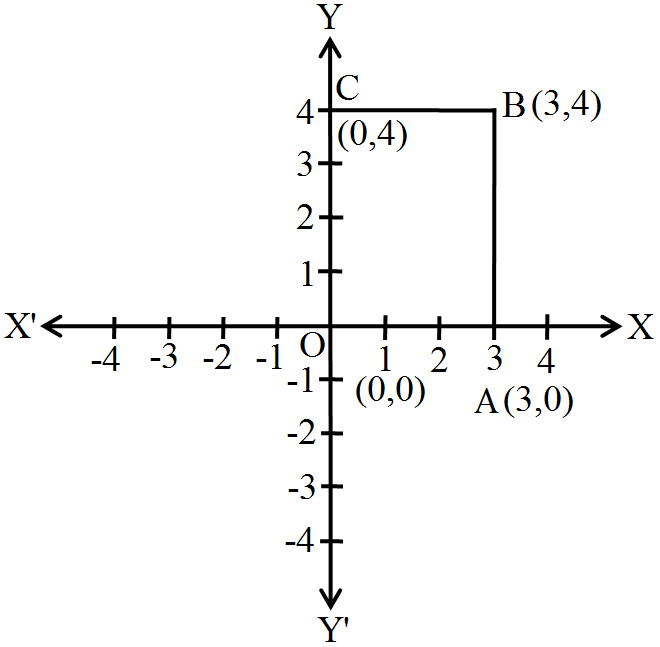
Write the correct answer in the following: On plotting the points $O(0, 0), A(3, 0), B(3, 4), C(0, 4)$ and joining $OA, AB, BC$ and $CO$ which of the following figure is obtained?
AnswerHere, point $O(0, 0)$ is the origin. $A(3, 0)$ lies on positive direction of $X$-axis, $B(3, 4)$ lies in $1^{st}$ quadrant and $C(0, 4)$ lines on positive direction of $Y$-axis. On joining $OA AB, BC$ and $CO$ the figure obtained is a rectangle.
View full question & answer→MCQ 131 Mark
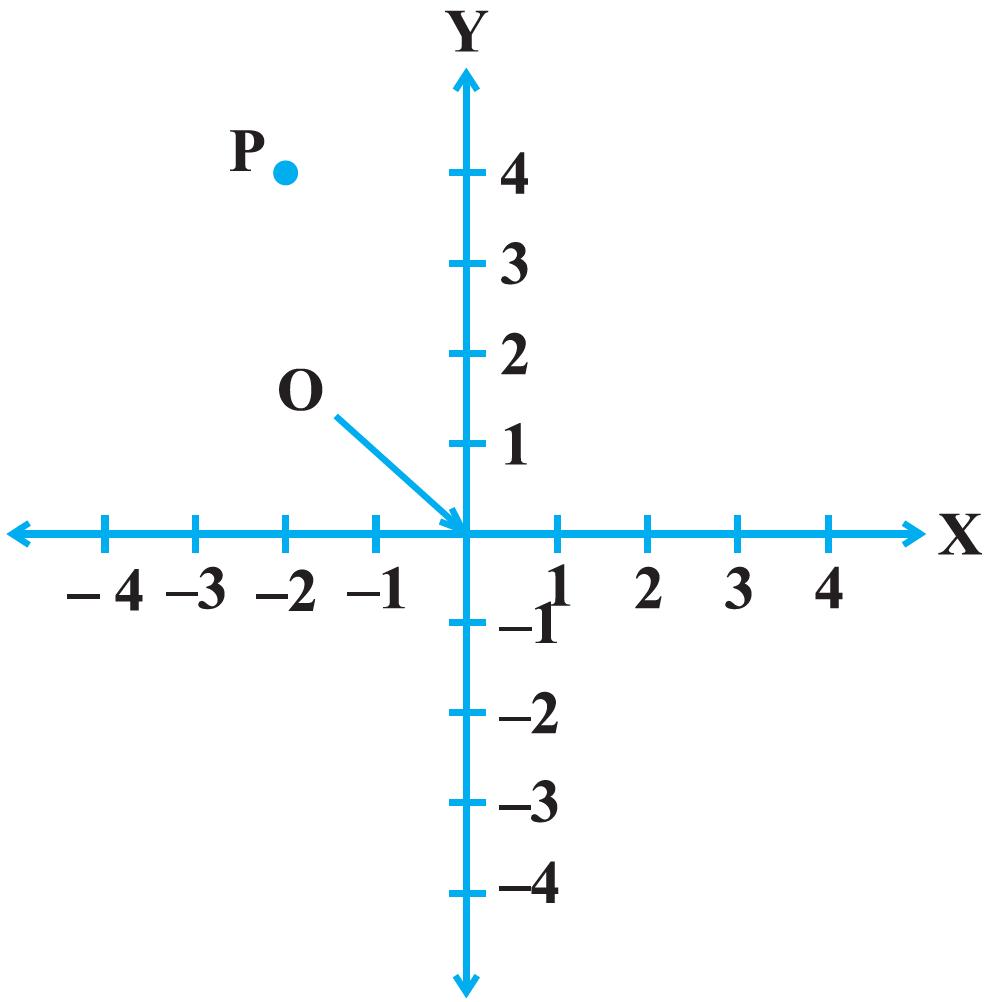
Write the correct answer in the following: In coordinates of $P$ are:
- A
$(-4, 2)$
- ✓
$(-2, 4)$
- C
$(4, -2)$
- D
$(2, -4)$
AnswerCorrect option: B. $(-2, 4)$
Here, given point $P$ lies in $II$ quadrant,
so its abscissa will be negative and ordinate will be positive.
Also its perpendicular distance from $X$-axis is $4$ y-coordinate of $P$ is $4$ and its perpendicular distance from $Y$-axis is $2$.
So, $x$–coordinate is $-2$. Hence, coordinate of $P$ are $(-2, 4)$.
View full question & answer→MCQ 141 Mark
Write the correct answer in the following: If the coordinates of the two points are $P(-2, 3)$ and $Q(-3, 5)$, then (abscissa of $P$) – (abscissa of $Q$) is:
AnswerWe have, points $P(-2, 3)$ and $Q(-3, 5)$
Here, abscissa of P i.e., $x$-coordinate of $P$ is $-2$ and abscissa of $Q$ i.e., $x$-coordinate of $Q$ is $-3$.
So, (Abscissa of $P$) - (Abscissa of $Q$)
$= -2 - (-3) = -2 + 3 = 1$
View full question & answer→MCQ 151 Mark
Write the correct answer in the following: The point at which the two coordinate axes meet is called the:
AnswerThe points at which the two coordinate axes meet is called the origin.
View full question & answer→MCQ 161 Mark
Write the correct answer in the following: Point $(-3, 5)$ lies in the:
AnswerIn the point $(-3, 5)$ abscissa is negative and ordinate is positive. So, it lies in the second quadrant.
View full question & answer→MCQ 171 Mark
Write the correct answer in the following: In the point identified by the coordinates $(-5, 3)$ is:
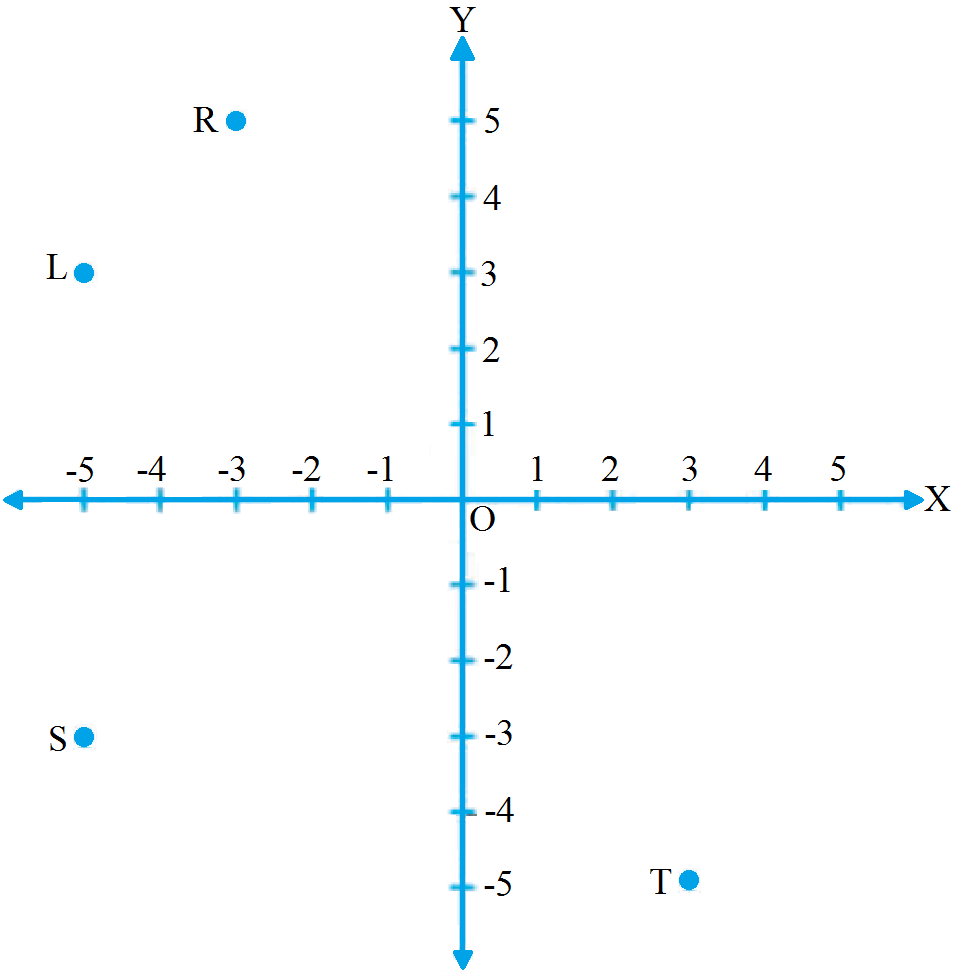
AnswerClearly, point $T$ lies in the fourth quadrant. The distance of $T$ from $y$-axis is $3$ unit and from $x$-axis is $-5$ units.
So, the points identified by the coordinate $(-5, 3)$ is $T$.
View full question & answer→MCQ 181 Mark
Write the correct answer in the following: Points $(1, -1), (2, -2), (4, -5)$ and $(-3, -4)$:
- A
lie in $II$ quadrant.
- B
lie in $III$ quadrant.
- C
lie in $IV$ quadrant.
- ✓
Do not lie in the same quadrant.
AnswerCorrect option: D. Do not lie in the same quadrant.
In points $(1, -1), (2, -2)$ and $(4, -5)$ $x$-coordinate is positive and $y$-coordinate is negative,
So, they all lie in IV quadrant.
In point $(-3, -4)$ $x$-coordinate is negative and y-coordinate is negative.
So, it lies in $III$ quadrant. So, given points do not lie in the same quadrant.
View full question & answer→MCQ 191 Mark
Write the correct answer in the following: The point which lies on $y$-axis at a distance of $5$ units in the negative direction of $y$-axis is:
- A
$(0, 5)$
- B
$(5, 0)$
- ✓
$(0, -5)$
- D
$(-5, 0)$
AnswerCorrect option: C. $(0, -5)$
Given the point lies on $Y$-axis this shows that this $x$-coordinate is zero.
Also it is at a distance of $5$ units in negative direction of $Y$-axis, so its $y$–coordinate is negative.
Hence, the required point is $(0, -5).$
View full question & answer→MCQ 201 Mark
Write the correct answer in the following: Point $(-10, 0)$ lies:
AnswerCorrect option: A. On the negative direction of the $x$-axis.
In point $(-10, 0)$ $y$-coordinate is zero, so it lies on $X$-axis and its $x$-coordinate is negative, so the point $(-10, 0)$ lies on the $X$-axis in the negative direction.
View full question & answer→MCQ 211 Mark
Write the correct answer in the following: A point both of whose coordinates are negative will lie in:
AnswerA point both of whose coordinates are negative will lie in III quadrant because, in III quadrant x-coordinate and y-coordinate both are negative.
View full question & answer→MCQ 221 Mark
Write the correct answer in the following: If $P(-1, 1), Q(3, -4), R(1, -1), S(-2, -3)$ and $T(-4, 4)$ are plotted on the graph paper, then the point(s) in the fourth quadrant are:
- A
$P$ and $T$
- ✓
$Q$ and $R$
- C
Only $S$
- D
$P$ and $R$
AnswerCorrect option: B. $Q$ and $R$
We know that quadrant $IV$ consists of the all points $(x, y)$ for which $x$ is positive and $y$ negative. So, the points in the fourth quadrants are $Q(3, -4)$ and $R(1, -1)$.
View full question & answer→MCQ 231 Mark
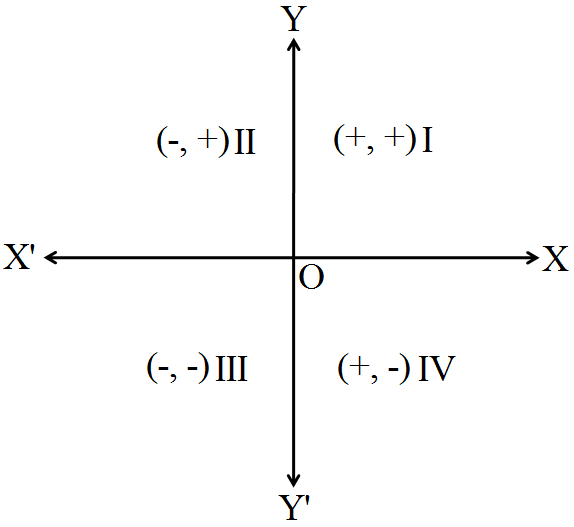
Write the correct answer in the following: Abscissa of a point is positive in:
- A
$I$ and $II$ quadrants.
- ✓
$I$ and $IV$ quadrants.
- C
$I$ quadrant only.
- D
$II$ quadrant only.
AnswerCorrect option: B. $I$ and $IV$ quadrants.
Abscissa of a point is positive in $I$ and $IV$ quadrants.
View full question & answer→MCQ 241 Mark
Write the correct answer in the following: Signs of the abscissa and ordinate of a point in the second quadrant are respectively:
- A
$+, +$
- B
$-, -$
- ✓
$-, +$
- D
$+, -$
AnswerCorrect option: C. $-, +$
Signs of the abscissa and ordinate of a point in the second in the second quadrant $a-, +$
View full question & answer→