Questions

5 Marks Questions

Take a timed test

6 questions · self-marked practice — reveal the answer and mark yourself.

Question 15 Marks
Using factor theorem, factorize the polynomial : $x^3-6 x^2+3 x+10$
Answer
Let, $f(x)=x^3-6 x^2+3 x+10$
The constant term in $f(x)$ is $10$
The factors of $10$ are $\pm 1, \pm 2, \pm 5, \pm 10$
Let, $x +1=0$
$\Rightarrow x=-1$
Substitute the value of x in f(x)
$f(-1)=(-1)^3-6(-1)^2+3(-1)+10$
$=-1-6-3+10$
$=0$
Similarly, $(x-2)$ and $(x-5)$ are other factors of $f(x)$
Since, $f ( x )$ is a polynomial having a degree $3,$ it cannot have more than three linear factors.
$\therefore f(x)=k(x+1)(x-2)(x-5)$
Substitute $x = 0$ on both sides
$\Rightarrow x^3-6 x^2+3 x+10=k(x+1)(x-2)(x-5)$
$\Rightarrow 0-0+0+10=k(1)(-2)(-5)$
$\Rightarrow 10=k(10)$
$\Rightarrow k=1$
Substitute $k=1$ in $f(x)=k(x+1)(x-2)(x-5)$
$f(x)=(1)(x+1)(x-2)(x-5)$
so, $x^3-6 x^2+3 x+10=(x+1)(x-2)(x-5)$
This is the required factorisation of $f(x)$
View full question & answer
Question 25 Marks
Two sides of a triangular field are $85 m$ and $154 m$ in length and its perimeter is $324 m.$ Find the area of the field.
Answer
Let : $a = 85 m$ and $b = 154 m$
Given that perimeter $= 324 m$
Perimeter $= 2s = 324 m$
$\Rightarrow s =\frac{324}{2} m$
or, $a + b + c =324$
$\Rightarrow c =324-85-154=85 m$
By Herons's formula, we have:
Area of triangle $=\sqrt{s(s-a)(s-b)(s-c)}$
$=\sqrt{162(162-85)(162-154)(162-85)}$
$=\sqrt{162 \times 77 \times 8 \times 77}$
$=\sqrt{1296 \times 77 \times 77}$
$=\sqrt{36 \times 77 \times 77 \times 36}$
$=36 \times 77$
$=2772 m^2$
View full question & answer
Question 35 Marks
The length of the sides of a triangle are in the ratio $3 : 4 : 5$ and its perimeter is $144 \ cm.$ Find the area of the triangle and the height corresponding to the longest side
Answer
Given, perimeter $= 144 \ cm$ and ratio of the sides $= 3 : 4 : 5$
Sum of ratio terms $= 3 + 4 + 5 = 12$
$\therefore 1$ st side, $a =144 \times \frac{3}{12}=36 \ cm$
IInd side, $b=144 \times \frac{4}{12}=48 \ cm$
IIIrd side, $c=144 \times \frac{5}{12}=60 \ cm$
Now, semi$-$perimeter of the triangle,
$s =\frac{a+b+c}{2}=\frac{36+48+60}{2}=\frac{144}{2}=72 \ cm$
Area of triangle $=\sqrt{s(s-a)(s-b)(s-c)} [$ by Heron's formula $]$
$=\sqrt{72 \times(72-36)(72-48)(72-60)}$
$=\sqrt{72 \times 36 \times 24 \times 12}$
$=\sqrt{(36)^2 \times(24)^2}$
$=36 \times 24=864 \ cm^2$
Hence, the area of the given triangle is $864 \ cm^2$
Let height of a triangle be $h \ cm.$
Then, area of triangle $=\frac{1}{2} \times$ Base $\times$ Height
$\Rightarrow 864=\frac{1}{2} \times 60 \times h [$ Since the longest side of a triangle is  $60 \ cm,$ so we consider it as base of the triangle $]$
$\Rightarrow 864=30 h$
$\Rightarrow h=28.8 \ cm$
Hence, the height corresponding to the longest side is $28.8 \ cm.$
View full question & answer
Question 45 Marks
What length of tarpaulin $3 m$ wide will be required to make conical tent of height $8 m$ and base radius $6 m?$
Assume that the extra length of material that will be required for stitching margins and wastage in cutting is approximately $20 \ cm . ($Use $\pi=3.14$ )
Answer
Height of the conical tent $(h)=8 m$ and Radius of the conical tent $(r)=6 m$
Slant height of the tent $(l)=\sqrt{r^2+h^2}$
$=\sqrt{(6)^2+(8)^2}$
$=\sqrt{36+64}$
$=\sqrt{100}$
$=10 m$
Area of tarpaulin $=$ Curved surface area of tent $=\pi r l=3.14 \times 6 \times 10=188.4 m^2$
Width of tarpaulin $= 3 m$
Let Length of tarpaulin $= L$
$\therefore$ Area of tarpaulin $=$ Length $\times$ Breadth $=L \times 3=3 L$
Now According to question, $3L = 188.4$
$\Rightarrow L =188.4 / 3=62.8 m$
The extra length of the material required for stitching margins and cutting is $20 \ cm = 0.2 m.$
So the total length of tarpaulin bought is $(62.8 + 0.2) m = 63 m$
View full question & answer
Question 55 Marks
View full question & answer
Question 65 Marks
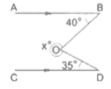
In the given figure, $\ce{AB \| CD , \angle ABO=40^{\circ}, \angle CDO}=35^{\circ}$. Find the value of the reflex $\ce{\angle BOD}$ and hence the value of $x$.
Image
Answer
Through $O$ , draw $\ce{EO \| AB \| CD}$
Then, $\ce{B \| EO}$ and $BO$ is the transversal
$\ce{\therefore \angle ABO + \angle BOE}=180^{\circ} [$ consecutive interior angles$]$
$\Rightarrow 40^{\circ}+\ce{\angle BOE}=180^{\circ}$
$\Rightarrow \ce{ \angle BOE}=\left(180^{\circ}-40^{\circ}\right)=140^{\circ}$
$\Rightarrow \ce{\angle BOE}=140^{\circ}$
Again $[\text{CD}\|\text{EO}$ and $\text{OD]}$ is the transversal.
$\therefore \angle EOD + \angle ODC=180^{\circ}$
$\ce{\Rightarrow \angle EOD} + 35^{\circ}=180^{\circ}$
$\ce{\Rightarrow \angle EOD}=\left(180^{\circ}-35^{\circ}\right)=145^{\circ}$
$\ce{\Rightarrow \angle EOD}=145^{\circ}$
$\therefore$reflex $\ce{\angle BOD=x^{\circ}=(\angle BOE + \angle EOD)}$
$=\left(140^{\circ}+145^{\circ}\right)=285^{\circ}$
Hence, $x^{\circ}=285^{\circ}$
$\Rightarrow \ce{\angle BOD} = x ^{\circ}=285^{\circ}$
Image
View full question & answer
5 Marks Questions - Maths STD 9 Questions - Vidyadip