Question
Using factor theorem, factorize the polynomial : $x^3-6 x^2+3 x+10$

Answer

Let, $f(x)=x^3-6 x^2+3 x+10$
The constant term in $f(x)$ is $10$
The factors of $10$ are $\pm 1, \pm 2, \pm 5, \pm 10$
Let, $x +1=0$
$\Rightarrow x=-1$
Substitute the value of x in f(x)
$f(-1)=(-1)^3-6(-1)^2+3(-1)+10$
$=-1-6-3+10$
$=0$
Similarly, $(x-2)$ and $(x-5)$ are other factors of $f(x)$
Since, $f ( x )$ is a polynomial having a degree $3,$ it cannot have more than three linear factors.
$\therefore f(x)=k(x+1)(x-2)(x-5)$
Substitute $x = 0$ on both sides
$\Rightarrow x^3-6 x^2+3 x+10=k(x+1)(x-2)(x-5)$
$\Rightarrow 0-0+0+10=k(1)(-2)(-5)$
$\Rightarrow 10=k(10)$
$\Rightarrow k=1$
Substitute $k=1$ in $f(x)=k(x+1)(x-2)(x-5)$
$f(x)=(1)(x+1)(x-2)(x-5)$
so, $x^3-6 x^2+3 x+10=(x+1)(x-2)(x-5)$
This is the required factorisation of $f(x)$

Need a full question paper?

Generate a complete, print-ready paper with questions like this in minutes — across 16+ boards, with answer keys.

Start Generating Free

Similar questions

Following are the ages $($in years$)$ of $360$ patients, getting medical treatment in a hospital:
Age $($in years$)$
$10 - 20$
$20 - 30$
$30 - 40$
$40 - 50$
$50 - 60$
$60 - 70$
Number of patients
$90$
$50$
$60$
$80$
$50$
$30$
One of the patients is selected at random. What is the probability that his age is:
$i. 30$ years or more but less than $40$ years$?$
$ii. 50$ years or more but less than $70$ years$?$
$iii.10$ years or more but less than $40$ years$?$
$iv. 10$ years or more$?$
$v.$ Less than $10$ years$?$
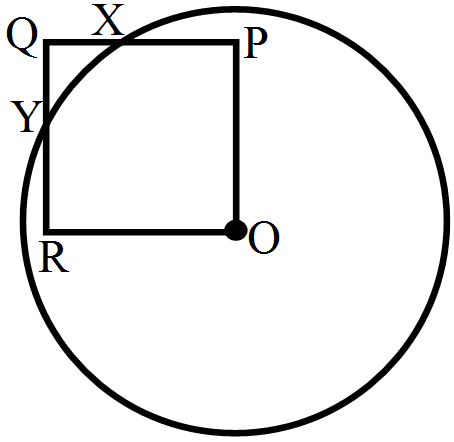
In the adjoining figure, $OPQR$ is a square. A circle drawn with centre $O$ cuts the square at $X$ and $Y$. Prove that $QX = QY$.
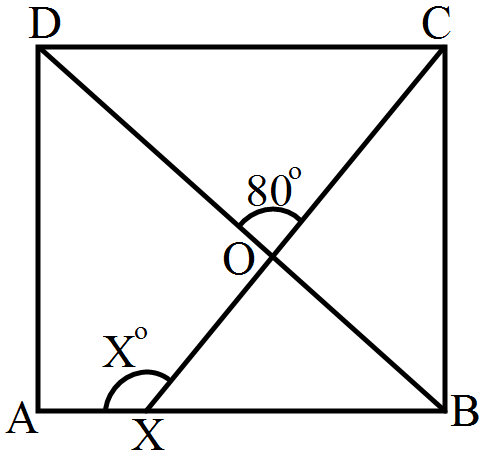
In the adjoining figure, $ABCD$ is a square. $A$ line segment $CX$ cuts $AB$ at $X$ and the diagonal $BD$ at $O$ such that $\angle\text{COD}=80^{\circ}$ and $\angle\text{OXA}=\text{x}^{\circ}.$ Find the value of x.
The expression $x^4 + 4$ can be factorized as:
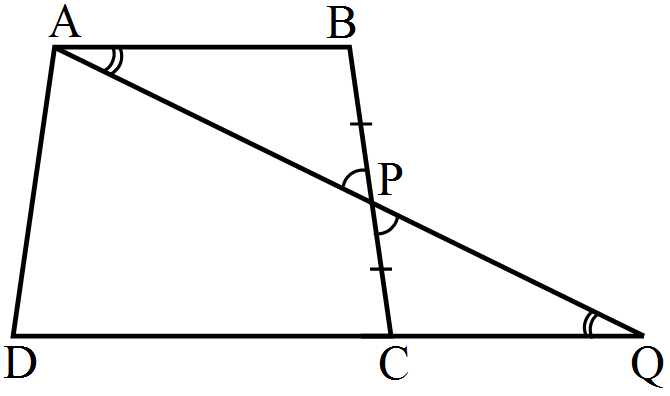
In the given figure, $\text{ABCD}$ is a quadrilateal in which $AB \|\ DC$ and $P$ is the midpoint of $BC$. On producing, $AP$ and $DC$ meet at $Q$. Prove that
$i. AB = CQ$,
$ii. DQ = DC + AB$.
$100$ surnames were randomly picked up from a local telephone directory and a frequency distribution of the number of letters in the English alphabets in the surnames was found as follows :
Number of letters Number of surnames
$1-4$ $6$
$4-6$ $30$
$6-8$ $44$
$8-12$ $16$
$12-20$ $4$
$i.$ Draw a histogram to depict the given information.
$ii.$ Write the class interval in which the maximum number of surnames lie.
Find the remainder obtained on dividing $p(x) = x^3 + 1 by x + 1.$
A heap of wheat is in the form of a cone of diameter $9\ m$ and height $3.5\ m$. Find its volume. How much canvas cloth is required to just cover the heap? $\big(\text{Use}\ \pi = 3.14\big).$
If two straight lines intersect in such a way that one of the angles formed measures $90^\circ$, show that each of the remaining angles measures $90^\circ $.
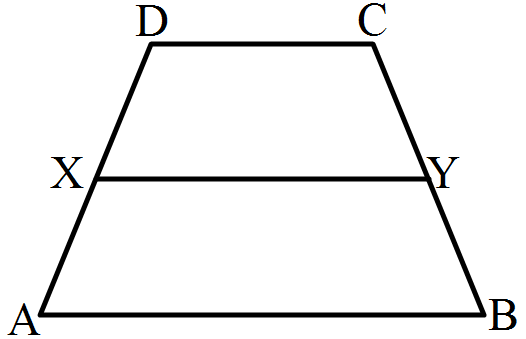
In figure, $\text{ABCD}$ is a trapezium in which $AB \| DC$ and $DC = 40\ cm$ and $AB = 60\ cm$. If $X$ and $Y$ are, respectively, the mid$-$points of $AD$ and $BC,$ prove that:
$i. XY = 50\ cm$
$ii. \text{DCYX}$ is a trapezium
$iii. \text{ar}($trap.$\ \text{DCYX})=\Big(\frac{9}{11}\Big)\text{ar}(\text{XYBA}).$