Questions

M.C.Q

Take a timed test

18 questions · 9 auto-graded MCQ + 9 self-marked written.

MCQ 11 Mark
The value of $\frac{\left(a^2-b^2\right)^3+\left(b^2-c^2\right)^3+\left(c^2-a^2\right)^3}{(a-b)^3+(b-c)^3+(c-a)^3}$ is
  • A
    $3(a - b)(b - c)(c - a)$
  • $(a + b)(b + c)(c + a)$
  • C
    $3(a + b)(b + c)(c + a)(a - b)(b - c)(c - a)$
  • D
    $2(a - b)(b - c)(c - a)$
Answer
Correct option: B.
$(a + b)(b + c)(c + a)$
$\frac{\left(a^2-b^2\right)^3+\left(b^2-c^2\right)^3+\left(c^2-a^2\right)^3}{(a-b)^3+\left(b-c)^3+(c-a)^3\right.}$
$=\frac{3\left(a^2-b^2\right)\left(b^2-c^2\right)\left(c^2-a^2\right)}{3(a-b)(b-c)(c-a)}[$ Since $x^3+y^3+z^3=3 x y z,$ if $x+y+z=0]$
$=\frac{3(a-b)(a+b)(b-c)(b+c)(c-a)(c+a)}{3(a-b)(b-c)(c-a)}$
$=(a+b)(b+c)(c+a)$
View full question & answer
MCQ 21 Mark
If $(-2, 5)$ is a solution of $2x + my = 11,$ then the value of $'m\ ’$ is
  • A
    $-2$
  • B
    $2$
  • $3$
  • D
    $-3$
Answer
Correct option: C.
$3$
If $(-2, 5)$ is a solution of $2x + my = 11$
then it will satisfy the given equation
$2 .(-2)+5 m=11$
$-4+5 m=11$
$5 m=11+4$
$5 m=15$
$m=\frac{15}{5}=3$
$m=3$
View full question & answer
MCQ 31 Mark
x co-ordinate is known as
  • A
    Origin
  • B
    Points
  • C
    Abscissa
  • D
    Ordinate
Answer
(c) Abscissa
Explanation: Any point $p$ in cartesian plane is written as $p(x, y)$.
x coordinate of point p is called abscissa and Y co-ordinate of point p is called ordinate.
View full question & answer
MCQ 41 Mark
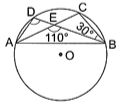
In the given figure, $O$ is the centre of a circle and chords $AC$ and $BD $intersect at $E.$ If $\angle \text{AEB} =110^{\circ}$ and $\angle \text{CBE}=30^{\circ}$, then $\angle \text{ADB} =$ ?
Image
  • $80^{\circ}$
  • B
    $60^{\circ}$
  • C
    $90^{\circ}$
  • D
    $70^{\circ}$
Answer
Correct option: A.
$80^{\circ}$
We have :
$\ce{\angle AEB +\angle CEB =180^{\circ}} ($Linear pair angles $)$
$\Rightarrow 110^{\circ}+ \ce{\angle CEB} =180^{\circ}$
$\Rightarrow \ce{\angle CEB} =\left(180^{\circ}-110^{\circ}\right)=70^{\circ}$
$\Rightarrow \ce{\angle CEB} =70^{\circ}$
In $\triangle \ce{CEB}$, we have:
$\ce{\angle CEB +\angle EBC +\angle ECB =180^{\circ}} ($ Angle sum property of a triangle$)$
$\Rightarrow 70^{\circ}+30^{\circ}+\angle \text{ECB} =180^{\circ}$
$\Rightarrow \ce{\angle ECB =\left(180^{\circ}-100^{\circ}\right)}=80^{\circ}$
The angles in the same segment are equal.
Thus, $\ce{\angle ADB =\angle ECB}=80^{\circ}$
$\Rightarrow \ce{\angle ADB}=80^{\circ}$
View full question & answer
MCQ 51 Mark
After rationalising the denominator of $\frac{7}{3 \sqrt{3}-2 \sqrt{2}}$, we get the denominator as
  • A
    $5$
  • B
    $35$
  • $19$
  • D
    $13$
Answer
Correct option: C.
$19$
After rationalizing :
$\frac{7}{3 \sqrt{3}-2 \sqrt{2}}$
$=\frac{7}{3 \sqrt{3}-2 \sqrt{2}} \times \frac{3 \sqrt{3}+2 \sqrt{2}}{3 \sqrt{3}+2 \sqrt{2}}$
$=\frac{7(3 \sqrt{3}+2 \sqrt{2})}{(3 \sqrt{3})^2-(2 \sqrt{2})^2}$
$=\frac{7(3 \sqrt{3}+2 \sqrt{2})}{27-8}$
$=\frac{7(3 \sqrt{3}+2 \sqrt{2})}{19}$
View full question & answer
MCQ 61 Mark
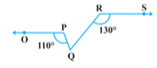
In a figure, if $\ce{OP \| RS , \angle OPQ} =110^{\circ}$ and $\ce{\angle QRS} =130^{\circ}$, then $\ce{\angle PQR}$ is equal to
Image
  • A
    $40^{\circ}$
  • B
    $50^{\circ}$
  • C
    $70^{\circ}$
  • $60^{\circ}$
Answer
Correct option: D.
$60^{\circ}$
Produce $OP$ to intersect $RQ$ at point $N.$
Now, $\ce{OP \| RS}$ and transversal $RN$ intersects them at $N$ and $R$ respectively.
$\ce{\therefore \angle RNP=\angle SRN}($ Alternate interior angles$)$
$\ce{\Rightarrow \angle RNP =130^{\circ}}$
$\ce{\therefore \angle PNQ}=180^{\circ}-130^{\circ}=50^{\circ}($Linear pair$)$
$\ce{\angle OPQ=\angle PNQ + \angle PQN}($Exterior angle property$)$
$\Rightarrow 110^{\circ}=50^{\circ}+\ce{\angle PQN}$
$\ce{\Rightarrow \angle PQN=110^{\circ}-50^{\circ}=60^{\circ}=\angle PQR}$
View full question & answer
MCQ 71 Mark
How many linear equations in ‘x’ and ‘y’ can be satisfied by x = 1, y = 2?
  • A
    Infinitely many
  • B
    Two
  • C
    Only one
  • D
    Three
Answer
(a) Infinitely many
Explanation: There are many linear equations in ‘x’ and ‘y’ can be satisfied by x = 1, y = 2 for example
x + y = 3 $\quad$$\quad$x - y = -1
2x + y = 4
and so on there are infinte number of examples
View full question & answer
MCQ 81 Mark
An irrational number between $\frac{1}{7}$ and $\frac{2}{7}$ is
  • A
    $\sqrt{\frac{1}{7} \times \frac{2}{7}}$
  • B
    $\frac{1}{2}\left(\frac{1}{7}-\frac{2}{7}\right)$
  • C
    $\left(\frac{1}{7} \times \frac{2}{7}\right)$
  • D
    $\frac{1}{2}\left(\frac{1}{7}+\frac{2}{7}\right)$
Answer
(a) $\sqrt{\frac{1}{7} \times \frac{2}{7}}$
Explanation: An irrational number between a and b is given by $\sqrt{a b}$.
So, an irrational number between $\frac{1}{7}$ and $\frac{2}{7}$ is $\sqrt{\frac{1}{7} \times \frac{2}{7}}$.
View full question & answer
MCQ 91 Mark
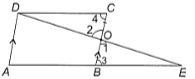
ABCD is a parallelogram. If is produced to E such that ED bisects BC at O. Then which of the following is correct?
  • A
    OC = BE
  • B
    OE = OC
  • C
    AB = OE
  • D
    AB = BE
View full question & answer
MCQ 101 Mark
The value of $15 \sqrt{15} \div 3 \sqrt{5}$ is
  • A
    $5 \sqrt{3}$
  • B
    $3 \sqrt{5}$
  • C
    3
  • D
    5
Answer
(a) $5 \sqrt{3}$
$\quad$$\quad$$\quad$$\quad$$\quad$$\quad$$\frac{15 \sqrt{15}}{3 \sqrt{5}}$
$\begin{aligned} Explanation:& =\frac{(3 \times 5) \sqrt{3} \times \sqrt{5}}{3 \sqrt{5}} \\ & =5 \sqrt{3}\end{aligned}$
View full question & answer
MCQ 111 Mark
If $x-3$ is a factor of $x^2-a x-15$, then $a=$
  • A
    $5$
  • $-2$
  • C
    $-5$
  • D
    $3$
Answer
Correct option: B.
$-2$
Put $x-3=0$, then $x=3$
Therefore, value of $x^2-a x-15$ at $x=3$ is zero
$\Rightarrow 3^2-3 a-15=0$
$\Rightarrow-6-3 a=0$
$\Rightarrow a=-2$
View full question & answer
MCQ 121 Mark
x = 2, y = -1 is a solution of the linear equation
  • A
    $2 x+y=0$
  • B
    $x+2 y=0$
  • C
    $x+2 y=4$
  • D
    $2 x+y=5$
Answer
(b) $x+2 y=0$
Explanation: $2+2(-1)=2-2=0$
View full question & answer
MCQ 141 Mark
The value of $x^{p-q} x^{q-r} x^{r-p}$ is equal to
  • A
    $x^{p q r}$
  • B
    $0$
  • C
    $x$
  • $1$
Answer
Correct option: D.
$1$
$x^{p-q} \times q^{q-r} x^{r-p}$
$=x^{p-q+q-r+r-p}$
$=x^0$
$=1$
View full question & answer
MCQ 151 Mark
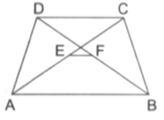
In a trapezium $\text{ABCD, E}$ and $F$ be the midpoints of the diagonals $\text{AC}$ and $\text{BD}$ respectively. Then, $\text{EF} = ?$
Image
  • A
    $\frac{1}{2} AB$
  • B
    $\frac{1}{2}(AB+CD)$
  • $\frac{1}{2}(AB-CD)$
  • D
    $\frac{1}{2} CD$
Answer
Correct option: C.
$\frac{1}{2}(AB-CD)$
Construction: Join $CF$ and extent it to cut $AB$ at point $M$
Firstly, in triangle $\text{MFB}$ and triangle $\text{DFC}$
$\ce{DF = FB}($As $F$ is the mid$-$point of $DB )$
$\ce{\angle DFC =\angle MFB} ($Vertically opposite angle$)$
$\ce{\angle DFC =\angle FBM}$ (Alternate interior angle)
$\therefore$ By $\text{ASA}$ congruence rule
$\ce{\triangle MFB \cong \triangle DFC}$
Now, in triangle $\text{CAM}$
$E$ and $F$ are the mid$-$points of $AC$ and $CM$ respectively
$\ce{\therefore EF =\frac{1}{2}(AM)}$
$\ce{EF =\frac{1}{2} AB - MB)}$
$\ce{EF =\frac{1}{2}( AB - CD )}$
View full question & answer
MCQ 171 Mark
The length of the sides of a triangle are $5 \ cm, 7 \ cm$ and $8 \ cm.$ Area of the triangle is :
  • A
    $100 \sqrt{3} \ cm^2$
  • $10 \sqrt{3} \ cm^2$
  • C
    $300 \ cm^2$
  • D
    $50 \sqrt{3} \ cm^2$
Answer
Correct option: B.
$10 \sqrt{3} \ cm^2$
$s =\frac{5+7+8}{2}=10 \ cm$
$\text { Area of triangle }=\sqrt{s(s-a)(s-b)(s-c)}$
$=\sqrt{10(10-5)(10-7)(10-8)}$
$=\sqrt{10 \times 5 \times 3 \times 2}$
$=10 \sqrt{3} sq . \ cm $
View full question & answer
MCQ 181 Mark
The point which lies on x-axis at a distance of 3 units in the positive direction of x-axis is
  • A
    $(0,-3)$
  • B
    $(0,3)$
  • C
    $(3,0)$
  • D
    $(-3,0)$
Answer
(c) (3, 0)
Explanation: Since it lies on x-axis so ordinate will be zero because the value of the y-coordinate in the x-axis is equal to zero. Thus point will be (3, 0).
View full question & answer
M.C.Q - Maths STD 9 Questions - Vidyadip