MCQ
An irrational number between $\frac{1}{7}$ and $\frac{2}{7}$ is
  • A
    $\sqrt{\frac{1}{7} \times \frac{2}{7}}$
  • B
    $\frac{1}{2}\left(\frac{1}{7}-\frac{2}{7}\right)$
  • C
    $\left(\frac{1}{7} \times \frac{2}{7}\right)$
  • D
    $\frac{1}{2}\left(\frac{1}{7}+\frac{2}{7}\right)$
Answer

(a) $\sqrt{\frac{1}{7} \times \frac{2}{7}}$
Explanation: An irrational number between a and b is given by $\sqrt{a b}$.
So, an irrational number between $\frac{1}{7}$ and $\frac{2}{7}$ is $\sqrt{\frac{1}{7} \times \frac{2}{7}}$.

Need a full question paper?

Generate a complete, print-ready paper with questions like this in minutes — across 16+ boards, with answer keys.

Start Generating Free

Similar questions

Directions: In the following questions, the Assertions $(A)$ and Reason$(s) (R)$ have been put forward. Read both the statements carefully and choose the correct alternative from the following:
Assertion: If two irrational number whose quotient is a rational number.
Reason: If two irrational number whose product is irrational number.
Write the correct answer in the following: The construction of a triangle $ABC$, given that $BC = 6\ cm$, $\angle\text{B}=45^\circ$ is not possible when difference of $AB$ and $AC$ is equal to:
A right circular cylinder and a right circular cone have the same radius and the same volume. The ratio of the height of the cylinder to that of the cone is:
In $\triangle A B C, \angle B=\angle C$ and ray $A X$ bisects the exterior angle $\angle D A C$. If $\angle D A X=70^{\circ}$, then $\angle A C B=$
In $\triangle\text{ABC},\angle\text{A}=30^\circ,\angle\text{B}=40^\circ$ and $\angle\text{C}=110^\circ.$ The angles of the triangle formed by joining the mid-points of the sides of this triangle are:
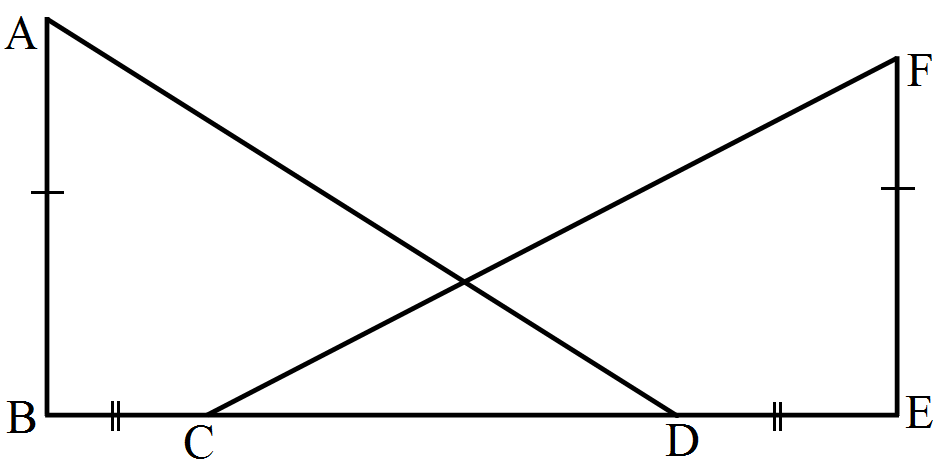
In Fig. $\text{AB}\perp\text{BE}$ and $\text{FE}\perp\text{BE},$ If $\text{BC}=\text{DE}$ and $\text{AB}=\text{EF},$ then $\triangle\text{ABD}$ is congruent to:
If $\angle\text{A}=4\angle\text{B} = 6\angle\text{C},$ then $A : B : C?$
The area and length of one diagonal of a rhombus are given as $200\ cm^2$ and 10cm respectively. The length of other diagonal is:
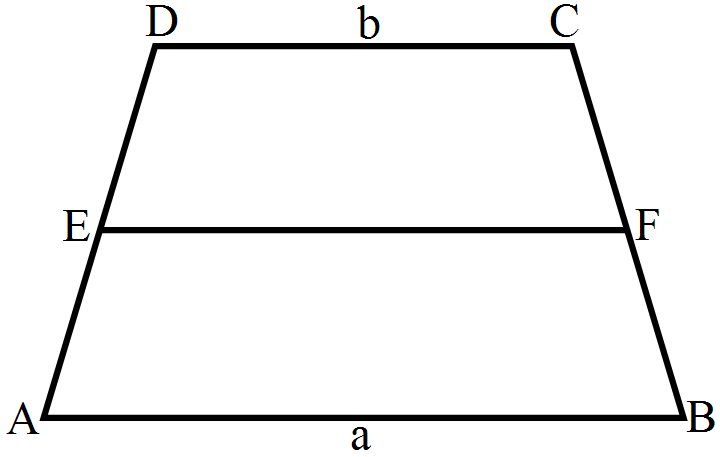
In the given figure $ABCD$ is a trapezium in which $AB || DC$ such that $AB = a\ cm$ and $DC = b\ cm.$ If $E$ and $F$ are the midpoints of $AD$ and $BC$ respectively. Then, $ar(ABFE) : ar(EFCD) = ?$
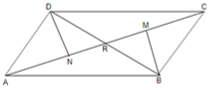
In quadrilateral $\text{ABCD , BM}$ and $DN$ are drawn perpendiculars to $AC$ such that $BM = DN$. If $BR =8 \ cm$. then $B D$ is
Image