Questions

2 Marks Questions

Take a timed test

7 questions · self-marked practice — reveal the answer and mark yourself.

Question 22 Marks
Find whether the given equation have x = 2, y = 1 as a solution:x + y + 4 = 0.
Answer
For x = 2, y = 1
x + y + 4 = 0
L.H.S. = x + y + 4
= 2 + 1 + 4 = 7
$\neq$ R.H.S
$\therefore x=2, y=1$ is not a solution of $x+y+4=0$.
View full question & answer
Question 32 Marks
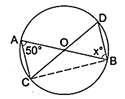
If $O$ is the centre of the circle, find the value of $x$ in given figure :
Image
Answer
$\ce{\angle ODB=\angle OAC=50^{\circ}} [$angles in the same segment$]$
$\ce{OB = OD}$
$\ce{\Rightarrow \angle OBD=\angle ODB=50^{\circ}=x^{\circ}}$
$\Rightarrow x ^{\circ}=50^{\circ}$
View full question & answer
Question 42 Marks
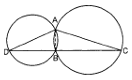
In the given figure, two circles intersect at two points A and B. AD and AC are diameters to the two circles. Prove that B lies on the line segment DC. 
Image
Answer
In the given diagram join AB. Also $\angle ABD =90^{\circ}$ (because angle in a semicircle is always $90^{\circ}$)
Similarly, we have $\angle A B C=90^{\circ}$
So, $\angle ABD +\angle ABC =90^{\circ}+90^{\circ}=180^{\circ}$
Therefore, DBC is a line i.e., B lies on the line segment DC.
View full question & answer
Question 52 Marks
The outer diameter of a spherical shell is $10 \ cm$ and the inner diameter is $9 \ cm.$ Find the volume of the metal contained in the shell.
Answer
Outer diameter $=10 \ cm$
$\therefore$ Outer radius $( R )=\frac{10}{2} \ cm=5 \ cm$
As Inner diameter $=9 \ cm$
$\therefore$ Inner radius $(r) =\frac{9}{2} \ cm$
Volume of the metal contained in the shell $=\frac{4}{3} \pi R^3-\frac{4}{3} \pi r^3$
$\frac{4}{3} \pi\left(R^3-r^3\right)$
$=\frac{4}{3} \times \frac{22}{7} \times\left[(5)^3-\left(\frac{9}{3}\right)\right]$
$=\frac{4}{3} \times \frac{22}{7} \times\left(125-\frac{729}{8}\right)$
$=\frac{4}{3} \times \frac{22}{7} \times \frac{271}{8}$
$=\frac{2981}{21} \ cm^3$
View full question & answer
Question 62 Marks
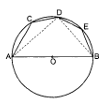
In given figure, $\text{AOB}$ is a diameter of the circle and $\text{C, D, E}$ are any three points on the semi$-$circle. Find the value of $\angle ACD +\angle BED$.
Image
Answer
Image
Join $\text{BC}$,
Then, $\angle ACB =90^{\circ} ($Angle in the semicircle$)$
Since $DCBE$ is a cyclic quadrilateral.
$\angle BCD +\angle BED =180^{\circ}$
Adding $\angle ACB$ both the sides, we get
$\angle BCD +\angle BED +\angle ACB =\angle ACB +180^{\circ}$
$(\angle BCD +\angle ACB )+\angle BED =90^{\circ}+180^{\circ}$
$\angle ACD +\angle BED =270^{\circ}$
View full question & answer
Question 72 Marks
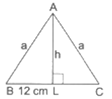
The base of an isosceles triangle measures $24 \ cm$ and its area is $192 \ cm^2$. Find its perimeter.
Answer
Let $\triangle ABC$ be an isosceles triangle and let $AL \perp BC$
$\therefore \frac{1}{2} \times B C \times A L=192 \ cm^2$
$\Rightarrow \frac{1}{2} \times 24 \ cm \times h=192 \ cm^2$
$\Rightarrow h=\left(\frac{192}{12}\right) \ cm =16 \ cm$
Now, $B L=\frac{1}{2}(B C)=\left(\frac{1}{2} \times 24\right) \ cm =12 \ cm$ and $AL =16 \ cm$.
In $\triangle ABL$
$AB^2= BL^2+ AL^2$
$\Rightarrow a ^2= BL ^2+ AL ^2$
$\therefore a=\sqrt{B L^2+A L^2}$
$=\sqrt{(12)^2+(16)^2} \ cm$
$=\sqrt{144+256} \ cm$
$\Rightarrow a=\sqrt{400} \ cm=20 \ cm$
Hence, perimeter $= (20 + 20 + 24) \ cm$
$= 64 \ cm.$
Image
View full question & answer
2 Marks Questions - Maths STD 9 Questions - Vidyadip