Questions

3 Marks Question

🎯

Test yourself on this topic

7 questions · timed · auto-graded

Question 13 Marks
If $x+y+z=0$, show that $x^3+y^3+z^3=3xyz$.
Answer
We know that
$x^3+y^3+z^3-3 x y z$
$=(x+y+z)(x^2+y^2+z^2-x y-y z-z x)$
$($Using Identity $a^3+b^3+c^3-3 a b c=(a+b+c)(a^2+b^2+c^2-a b-b c-c a))$
$=(0)(x^2+y^2+z^2-x y-y z-z x)(\because x+y+z=0)$
$=0$
$\Rightarrow x^3+y^3+z^3$
$=3 x y z$.
View full question & answer
Question 23 Marks
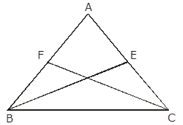
$\text{ABC}$ is an isosceles triangle in which $\text{AB = AC. BE}$ and $\text{CF}$ are its two medians. Show that $\text{BE = CF.}$
Answer
Image
Given, $\text{ABC}$ is an isosceles triangle
$\text{AB = AC}$
$\text{BE}$ and $\text{CF}$ are two medians
To prove: $\text{BE = CF}$
Proof: In $\triangle BEC$ and $\triangle CFB$
$\text{CE = BF}$ (SInce, $AC = AB =\frac{1}{2} AC =\frac{1}{2} AB = CE = BF$ )
$\angle E C B=\angle F B C ($Angle opposite to equal sides are equal$)$
$\text{BC = BC}($ Common $)$
Therefore By $\text{SAS}$ theorem
$\triangle BEC \cong \triangle C F B$
$\text{BE = CF}($ By $c.p.c.t.)$
View full question & answer
Question 33 Marks
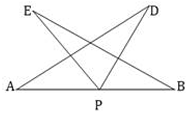
$AB$ is a line segment and $P$ is the mid$-$point. $D$ and $E$ are points on the same side of $AB$ such that $\angle BAD =\angle ABE $ and $\angle EPA =\angle DPB$. Show that:
$i. \Delta DAP \cong \Delta EBP$
$ii. AD = BE ($See figure$)$​​​​​​​
Image
Answer
Given that $\angle E P A=\angle D P B$
Adding $\angle EPD$ on both sides, we get
$\angle EPA+\angle EPD=\angle DPB+\angle EPD$
$\Rightarrow \angle A P D=\angle B P E......\text { (i) }$
Also given, $\angle B A D=\angle A B E$
$\Rightarrow \angle P A D=\angle P B E......\text{ (ii) }$
Now in $\Delta APD$ and $\Delta BPE$,
$\angle P A D=\angle P B E. [$from $(ii)]$
$AP = PB [ P$ is the mid$-$point of $AB ]$
$\angle A P D=\angle B P E [$From $(i)]$
Hence, by $\text{ASA}$ congruency criteria;
$\Delta D A P \cong \Delta E B P$
$\Rightarrow \text{AD=BE}[$ By $\text{C.P.C.T.}]$ Proved
View full question & answer
Question 43 Marks
Find at least $3$ solutions for the linear equation $2x – 3y + 7 = 0.$
Answer
$2 x-3 y+7=0$
$\Rightarrow 3 y=2 x+7$
$\Rightarrow y=\frac{2 x+7}{3}$
Put $x =0$, then $y=\frac{2(0)+7}{3}=\frac{7}{3}$
Put $x =1$, then $y=\frac{2(1)+7}{3}=3$
Put $x =2$, then $y=\frac{2(2)+7}{3}=\frac{11}{3}$
Put $x=3$, then $y=\frac{2(3)+7}{3}=\frac{13}{3}$
$\therefore\left(0, \frac{7}{3}\right),(1,3),\left(2, \frac{11}{3}\right)$ and $\left(3, \frac{13}{3}\right)$ are the solutions of the equation $2 x-3 y+7=0$.
View full question & answer
Question 53 Marks
View full question & answer
Question 63 Marks
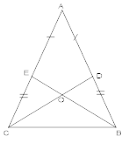
If $\text{AE = AD}$ and $\text{BD = CE}$. Prove that $\triangle AEB \cong \triangle ADC$
Image
Answer
We have,
$\text{AE = AD} [$ GIVEN $] \ldots(1)$ and $\text{CE = BD}[$ GIVEN $] \ldots(2)$
$\Rightarrow \text{AE + CE = AD + BD} [$ adding equation $(1) (2)]$
$\Rightarrow \text{AC = AB} \ldots(3)$
Now, in $\triangle AEB$ and $\triangle ADC$,
$\text{AE = AD}[$ given $]$
$\angle EAB =\angle DAC  [$ common $] $
$AB = AC [$ from $(3)]$
$\triangle AEB \cong \triangle ADC [$by $\text{SAS}]$
View full question & answer
Question 73 Marks
Find the value of $\frac{4}{(216)^{-\frac{2}{3}}}+\frac{1}{(256)^{-\frac{3}{4}}}+\frac{2}{(243)^{-\frac{1}{5}}}$
Answer
We have $\frac{4}{(216)^{-\frac{2}{3}}}+\frac{1}{(256)^{-\frac{3}{4}}}+\frac{2}{(243)^{-\frac{1}{5}}}$
$=4(216)^{\frac{2}{3}}+(256)^{\frac{3}{4}}+2(243)^{\frac{1}{5}}$
$=4\left(6^3\right)^{\frac{2}{3}}+\left(4^4\right)^{\frac{3}{4}}+2\left(3^5\right)^{\frac{1}{5}}$
$=4 \times 6^{3 \times \frac{2}{3}}+4^{4 \times \frac{3}{4}}+2 \times 3^{5 \times \frac{1}{5}}$
$=4 \times 6^2+4^3+2 \times 3$
$=144+64+6$
$=214$
View full question & answer