Questions

5 Marks Questions

Take a timed test

6 questions · self-marked practice — reveal the answer and mark yourself.

Question 15 Marks
Factorize: $x^3-2 x^2-x+2$
Answer
$x^3-2 x^2-x+2$
We need to consider the factors of $2 ,$ which are $\pm 1, \pm 2$
Let us substitute $1$ in the polynomial $x^3-2 x^2-x+2$ to get
$(1)^3-2(1)^2-(1)+2=1-2-1+2=0$
Thus, according to factor theorem, we can conclude that $(x-1)$ is a factor of the polynomial
$x^3-2 x^2-x+2$
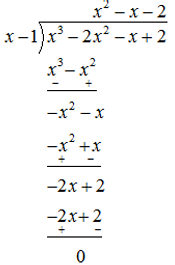
Let us divide the polynomial $x^3-2 x^2-x+2$ by $(x-1)$,to get
Image
$x^3-2 x^2-x+2$
$=(x-1)\left(x^2-x-2\right) .$
$=(x-1)\left(x^2+x-2 x-2\right)$
$=(x-1)[x(x+1)-2(x+1)]$
$=(x-1)(x-2)(x+1) .$
Therefore, we can conclude that on factorizing the polynomial $x^3-2 x^2-x+2$,
we get $(x-1)(x-2)(x+1)$
View full question & answer
Question 25 Marks
The perimeter of a right triangle is $24 \ cm.$ If its hypotenuse is $10 \ cm,$ find the other two sides. Find its area by using the formula area of a right triangle. Verify your result by using Heron's formula.
Answer
Let $x$ and $y$ be the two lines of the right $\angle$
$\therefore A B=x \ cm, B C=y ~ c m$ and $A C=10 \ cm$
$\therefore$ By the given condition,
Perimeter $= 24 \ cm$
$x + y +10 = 24 \ cm$
Or $x + y = 14 \ldots (I)$
By Pythagoras theorem,
$x^2+y^2=(10)^2=100 \ldots (II)$
From $(1), (x+y)^2=(14)^2$
Or $x^2+y^2+2 x y=196$
$\therefore 100+2 x y=196[$ From $(II)]$
$xy =\frac{96}{2}=48 sq \ cm . . . (III)$
Area of $\Delta ABC =\frac{1}{2} x y\ sq \ cm$
$=\frac{1}{2} \times 48\ sq \ cm$
$=24\ sq \ cm . . .( IV )$
Again, we know that
$(x-y)^2=(x+y)^2-4 x y$
$=(14)^2-4 \times 48[$ From $(I) (III)]$
Or $x-y= \pm 2$
$(i)$ When, $x-y=2$ and $x+y=14$, then $2 x=16$
or $x=8, y=6$
$(ii)$ When, $X-y=-2$ and $x+y=14$, then $2 x=12$
Or $x=6, y=8$
Verification by using Heron’s formula:
Sides are $6 \ cm, 8 \ cm$ and $10 \ cm$
$S=\frac{24}{2}=12 \ cm$
Area of $\Delta ABC =\sqrt{12(12-6)(12-8)(12-10)}\ sq \ cm$
$=\sqrt{12 \times 6 \times 4 \times 2} sq \ cm$
$=24\ sq \ cm $
Which is same as found in $(IV)$
Thus, the result is verified.
View full question & answer
Question 35 Marks
The perimeter of a triangular field is $420 m$ and its sides are in the ratio $6 : 7 : 8.$ Find the area of the triangular field.
Answer
Suppose that the sides in metres are $6x, 7x$ and $8x.$
Now, $6x + 7x + 8x =$ perimeter $= 420$
$\Rightarrow 21 x=420$
$\Rightarrow x=\frac{420}{21}$
$\Rightarrow x=20$
$\therefore$ The sides of the triangular field are $6 \times 20 m, 7 \times 20 m, 8 \times 20 m$,
i.e., $120 m, 140 m$ and $160 m.$
Now, $s =$ Half the perimeter of triangular field.
$=\frac{1}{2} \times 420 m=210 m$
Using Heron’s formula,
Area of triangular field $=\sqrt{s(s-a)(s-b)(s-c)}$
$=\sqrt{210(210-120)(210-140)(210-160)}$
$=\sqrt{210 \times 90 \times 70 \times 50}$
$=\sqrt{66150000}$
$=8133.265 m^2$
Hence, the area of the triangular field $=8133.265 m^2$.
View full question & answer
Question 45 Marks
Prove that the line joining the mid-points of the diagonals of a trapezium is parallel to each of the parallel sides and is equal to half of the difference of these sides.
Answer
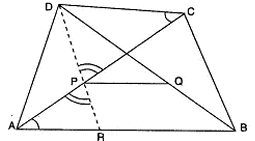
Given : $\text{ABCD}$ is trapezium. $P$ and $Q$ are the mid-points of the diagonals $AC$ and $BD$ respectively.
To Prove :
$i. P Q \| A B$ or $D C$
$ii. PQ =\frac{1}{2}( AB - DC )$
Construction : Join $DP$ and produce $DP$ to meet $AB$ in $R$.
Image
In $\triangle APR$ and $\triangle CPD$,
$\angle PAR =\angle PCD \ldots [$Alternate angles$]$
$\angle APR =\angle CPD . .. [$Vertically opp. angles$]$
$AP = CP \ldots [$Given$]$
$\therefore \triangle APR \cong \triangle CPD \ldots \text { [By ASA axiom] }$
$\therefore PR = PD \ldots \text { [c.p.c.t.] }$
and $AR = CD . . . [c.p.c.t.]$
In $\triangle DRB$,
As $P$ and $Q$ are the mid-points of $DR$ and $BD$ respectively.
$\triangle PQ \| RB$ or $AB$ or $DC$
and $PQ =\frac{1}{2} RB =\frac{1}{2}( AB - AR )=\frac{1}{2}( AB - DC ) \ldots . .[ As AR = DC ]$
View full question & answer
Question 55 Marks
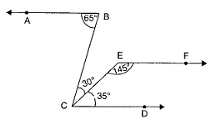
In figure, $\angle ABC =65^{\circ}, \angle BCE =30^{\circ}, \angle DCE =35^{\circ}$ and $\angle CFE =145^{\circ}$. Prove that $AB \| EF$.
Image
Answer
Image
$\angle ABC =65^{\circ}$
$\angle BCD =\angle BCE +\angle ECD =30^{\circ}+35^{\circ}=65^{\circ}$
$\therefore \angle ABC =\angle BCD $
These angles form a pair of equal alternate angles
$\therefore AB \| CD \ldots(1)$
$\angle FEC +\angle ECD =145^{\circ}+35^{\circ}=180^{\circ}$
These angles are consecutive interior angles formed on the same side of the transversal.
$\therefore C D \| E F \ldots \text { (2) }$
$\text { AB } \| E F \ldots[\text { From (1) and (2) }]$
View full question & answer
Question 65 Marks
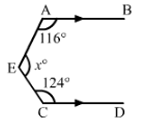
In each of the figures given below, $AB \| CD$. Find the value of $x ^{\circ}$ in each other case.
Image
Answer
Image
Draw $EF$
$\|A B\| C D$
Then, $\angle A E F+\angle C E F=x^{\circ}$
Now, $EF \| AB$ and $AE$ is the transversal
$\therefore \angle A E F+\angle B A E=180^{\circ} \text { [Consecutive Interior Angles] }$
$\Rightarrow \angle A E F+116=180$
$\Rightarrow \angle A E F=64^{\circ}$
Again, $EF \| CD$ and $CE$ is the transversal.
$\angle C E F+\angle E C D=180^{\circ} \text { [Consecutive Interior Angles] }$
$\Rightarrow \angle C E F+124=180$
$\Rightarrow \angle C E F=56^{\circ}$
Therefore,
$x^{\circ}=\angle A E F+\angle C E F$
$x ^{\circ}=(64+56)^{\circ}$
$x ^{\circ}=120^{\circ}$
View full question & answer
5 Marks Questions - Maths STD 9 Questions - Vidyadip