Questions

M.C.Q

Take a timed test

18 questions · 9 auto-graded MCQ + 9 self-marked written.

MCQ 11 Mark
The maximum number of zeroes that a polynomial of degree 3 can have is
  • A
    Zero
  • B
    One
  • C
    Two
  • D
    Three
Answer
(d) Three
Explanation: The maximum number of zeroes that a polynomial of degree 3 can have is three because the number of zeroes of a polynomial is equals to the degree of that polynomial.
View full question & answer
MCQ 21 Mark
If a linear equation has solutions (-2, 2), (0, 0) and (2, -2), then it is of the form:
  • A
    x + y = 0
  • B
    -2x + y = 0
  • C
    x – y = 0
  • D
    -x + 2y = 0
Answer
(a) x + y = 0
Explanation: Linear equation has solutions (-2, 2), (0, 0) and (2, -2), then the equation will be x + y = 0
As all the given three points satisfy the given equation
View full question & answer
MCQ 31 Mark
A point of the form $(0, b)$ lies on:
  • A
    x - axis
  • B
    quadrant I
  • C
    quadrant III
  • D
    y - axis
Answer
(d) y- axis
Explanation: Let P be any point whose co-ordinate be P(0, b)
Then, if the value of x-coordinate or abscissa is zero then the point P lies in y-axis.
View full question & answer
MCQ 41 Mark
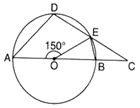
$\text{AOB}$ is the diameter of the circle. If $\angle A O E=150^{\circ}$, then the measure of $\angle C B E$ is
Image
  • A
    $115^{\circ}$
  • B
    $125^{\circ}$
  • C
    $120^{\circ}$
  • $105^{\circ}$
Answer
Correct option: D.
$105^{\circ}$
Image
Here, $\text{AOB}$ is diameter,
so, $\angle B O E=180-150=30^{\circ} ($Angles lie in straight line $)$
Now, $\text{OE \ OB}$ are radius
so, $\text{OE = OB}$.
i.e $\angle O E B=\angle O B E$
In $\triangle B O E, \angle B O E+\angle O B E+\angle B E O=180^{\circ}$
$=30+2 \angle O B E$
$=180^{\circ}$
$=2 \angle O B E$
$=180-30$
$=150^{\circ}$
$=\angle O B E$
$=75^{\circ}$
Now, $\angle O B E \ \angle C B E$ lie on staright line
so, $\angle O B E+\angle C B E=180^{\circ}$
$\angle C B E=180-75=105^{\circ}$
View full question & answer
MCQ 51 Mark
If $x=\sqrt{5}+2$, then $x-\frac{1}{x}$ equals
  • A
    $2$
  • $4$
  • C
    $2 \sqrt{5}$
  • D
    $\sqrt{5}$
Answer
Correct option: B.
$4$
$x=\sqrt{5}+2$, then equals
$\frac{1}{x}=\frac{1}{\sqrt{5}+2}$
$=\frac{1}{\sqrt{5+2}} \times \frac{\sqrt{5-2}}{\sqrt{5-2}}$
$=\frac{\sqrt{5}-2}{5-4}$
$=\sqrt{5}-2$
now,
$x-\frac{1}{x}=\sqrt{5}+2-(\sqrt{5}-2)$
$=\sqrt{5}+2-\sqrt{5}+2$
$=4$
View full question & answer
MCQ 61 Mark
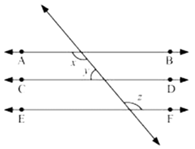
In the given figure, $\ce{AB \| CD , CD \| EF}$ and $y : z =3: 7$, then $x =$ ?
Image
  • A
    $63^{\circ}$
  • $126^{\circ}$
  • C
    $108^{\circ}$
  • D
    $162^{\circ}$
Answer
Correct option: B.
$126^{\circ}$
$y : z = 3 : 7$
Let common ratio be a
$y=3 a$
$z=7 a$
$x=z ($ corresponding angle $)$
$x=7 a$
$x+y=180^{\circ}($ interior angle $)$
$7 a+3 a=180^{\circ}$
$10 a=180^{\circ}$
$a=180 / 10$
$a=18$
$x=7 a$
$x=7 \times 18$
$x=126^{\circ}$
View full question & answer
MCQ 71 Mark
x = 2, y = 5 is a solution of the linear equation
  • A
    5 x + y = 7
  • B
    x + y = 7
  • C
    5x +2y = 7
  • D
    x + 2y = 7
Answer
(b) x + y = 7
Explanation: x = 2 and y = 5 satisfy the given equation.
View full question & answer
MCQ 81 Mark
The value of $\sqrt{3-2 \sqrt{2}}$ is
  • A
    $\sqrt{2}+\sqrt{1}$
  • $\sqrt{2}-\sqrt{1}$
  • C
    $\sqrt{3}+\sqrt{2}$
  • D
    $\sqrt{3}-\sqrt{2}$
Answer
Correct option: B.
$\sqrt{2}-\sqrt{1}$
$=\sqrt{3-2 \sqrt{2}}$
$=\sqrt{(\sqrt{2})^2+(1)^2-2 \times \sqrt{2} \times 1}$
$=\sqrt{(\sqrt{2}-1)^2}$
$=(\sqrt{2}-1)$
View full question & answer
MCQ 91 Mark
If a diagonal AC and BD of a quadrilateral ABCD bisect each other, then ABCD is a
  • A
    Parallelogram
  • B
    Rhombus
  • C
    Rectangle
  • D
    Triangle
Answer
(a) Parallelogram
Explanation: Two diagonals of quadrilateral form four triangles. Out of these four triangles two triangles of opposite to each other are congruent by SAS. By using CPCT property we can prove that both pair of opposite sides in a quadrilateral are parallel. A quadrilateral with both pair of opposite sides parallel is called parallelogram.
View full question & answer
MCQ 101 Mark
The value of $\left(x^{a-b}\right)^{a+b} \times\left(x^{b-c}\right)^{b+c} \times\left(x^{c-a}\right)^{c+a}$ is
  • A
    $3$
  • B
    $2$
  • $1$
  • D
    $0$
Answer
Correct option: C.
$1$
$\left(x^{a-b}\right)^{a+b} \times\left(x^{b-c}\right)^{b+c} \times\left(x^{c-a}\right)^{c+a}$
$\Rightarrow x^{a^2-b^2} \times x^{b^2-c^2} \times x^{c^2-a^2}$
$\Rightarrow x^{a^2-b^2+b^2-c^2+c^2-a^2}$
$\Rightarrow x^0=1$
View full question & answer
MCQ 111 Mark
The zeros of the polynomial $p(x)=3 x^2-1$ are
  • A
    $\frac{1}{3}$ and $3$
  • $\frac{1}{\sqrt{3}}$ and $\frac{-1}{\sqrt{3}}$
  • C
    $\frac{-1}{\sqrt{3}}$ and $\sqrt{3}$
  • D
    $\frac{1}{\sqrt{3}}$ and $\sqrt{3}$
Answer
Correct option: B.
$\frac{1}{\sqrt{3}}$ and $\frac{-1}{\sqrt{3}}$
Let: $p(x)=3 x^2-1$
To find the zeroes of $p(x),$ we have:
$p(x)=0 $
$\Rightarrow 3 x^2-1=0$
$\Rightarrow 3 x^2=1$
$\Rightarrow x^2=\frac{1}{3}$
$\Rightarrow x= \pm \frac{1}{\sqrt{3}}$
$\Rightarrow x=\frac{1}{\sqrt{3}} \text { and } x=\frac{-1}{\sqrt{3}}$
View full question & answer
MCQ 121 Mark
The cost of a notebook is twice the cost of a pen. The equation to represent this statement is
  • A
    2x = 3y
  • B
    x = 3y
  • C
    x + 2y = 0
  • D
    x - 2y = 0
Answer
(d) x - 2y = 0
Explanation: Let the cost of the notebook is ₹ x and pen is ₹ y and we have given that the cost of a notebook is twice the cost of a pen.
So we have
x = 2y
or x - 2y = 0
View full question & answer
MCQ 131 Mark
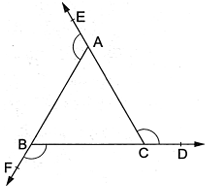
The sides $\text{BC, CA}$ and $\text{AB}$ of $\triangle A B C$ have been produced to $D, E$ and $F$ respectively.
$(\angle B A E+\angle C B F+\angle A C D=?)$
Image
  • A
    $240^{\circ}$
  • $360^{\circ}$
  • C
    $300^{\circ}$
  • D
    $320^{\circ}$
Answer
Correct option: B.
$360^{\circ}$
We have :
$\angle 1+\angle B A E=180^{\circ} \ldots . . \text { (i) }$
$\angle 2+\angle C B F=180^{\circ} \ldots \ldots \text { (ii) }$
$\angle 3+\angle A C D=180^{\circ} \ldots . . \text { (iv) }$
Adding $(i),(ii)$ and $(iii),$ we get:
$(\angle 1+\angle 2+\angle 3)+(\angle B A E+\angle C B F+\angle A C D)=540^{\circ}$
$\Rightarrow 180^{\circ}+\angle B A E+\angle C B F+\angle A C D=540^{\circ}\left[\because \angle 1+\angle 2+\angle 3=180^{\circ}\right]$
$\Rightarrow \angle B A E+\angle C B F+\angle A C D=360^{\circ}$
View full question & answer
MCQ 141 Mark
The value of 1.9999………….. in the form $\frac{p}{q}$, where ' p ' and ' $q$ ' are integers and $q \neq 0$, is
  • A
    $\frac{1999}{1000}$
  • B
    $\frac{19}{10}$
  • C
    2
  • D
    $\frac{1}{9}$
Answer
(c) 2
Explanation: 1.9999 can be written as 2,
2 is taken as approx vlaue .
View full question & answer
MCQ 151 Mark
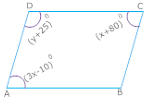
In the fig, $\text{ABCD}$ is a Parallelogram. The values of $x$ and $y$ are
Image
  • $45^{\circ}, 30^{\circ}$
  • B
    $30^{\circ}, 35^{\circ}$
  • C
    $45^{\circ}, 45^{\circ}$
  • D
    $55^{\circ}, 35^{\circ}$
Answer
Correct option: A.
$45^{\circ}, 30^{\circ}$
$3 x -10^{\circ}= x +80^{\circ} [$opposite angles of a parallelogram are equal.$];$
$3 x-x=80^{\circ}+10^{\circ}$
$2 x=90^{\circ}$
$x=90^{\circ} / 2$
$x=45^{\circ}$
$3 x -10^{\circ}+ y +25^{\circ}=180^{\circ} [$ In a parallelogram co$-$interior angles are supplementary.$];$
$3 \times 45^{\circ}-10^{\circ}+ y +25^{\circ}=180^{\circ};$
$135^{\circ}+25^{\circ}-10^{\circ}+ y =180^{\circ};$
$150^{\circ}+ y=180^{\circ}$
$y=180^{\circ}-150^{\circ}$
$y=30^{\circ}$
View full question & answer
MCQ 161 Mark
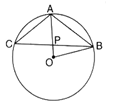
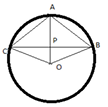
In the given, $\text{AB}$ is side of regular five sided polygon and $\text{AC}$ is a side of a regular six sided polygon inscribed in the circle with centre $\text{O . AO}$ and $\text{CB}$ intersect at $P$ , then $\angle A P B$ is equal to
Image
  • A
    $90^{\circ}$
  • B
    $72^{\circ}$
  • C
    $86^{\circ}$
  • $96^{\circ}$
Answer
Correct option: D.
$96^{\circ}$
Image
Here $\text{AC}$ is side of hexagon,
so it will subtend $60^{\circ}$ angle at centre and also sides radius are equal.
Thus, $\text{AC = OC = OA}$ and $\angle C O A=\angle O A C=\angle A C O=60^{\circ}$
$\text{AB}$ is side of pentagon,
so it would subtend angle of $\frac{360}{5}=72^{\circ}$ angle at centre.
so, $\angle B O P=72^{\circ}$
SO, $\angle C O B=72+60=132^{\circ}$
Also since, $OC = OB , \angle O C P=O B P$
$\triangle C O B\ \angle  C O B+\angle O B C+\angle O C B=180^{\circ}$
$2 \angle O B C=180-(132)=48^{\circ}$
$\angle O B C=24^{\circ}$
NOW, $\triangle B O P\ \angle B O P+\angle O P B+\angle P B O=180^{\circ}$
$\angle O P B=180-(24+72)=180-96=84^{\circ}$
Now,
$\angle A P B$ and $\angle O P B$ lie on straight line,
so they are supplementry angles.
$\angle A P B=180-\angle O P B=180-84=96^{\circ}$
View full question & answer
MCQ 171 Mark
If the area of an isosceles right triangle is $8 cm^2$, what is the perimeter of the triangle?
  • A
    $8+4 \sqrt{2} cm^2$
  • B
    $8+\sqrt{2} cm^2$
  • C
    $12 \sqrt{2} cm^2$
  • D
    $4+8 \sqrt{2} cm^2$
Answer
(a) $8+4 \sqrt{2} cm^2$
Explanation: Let each of the two equal sides of an isosceles right triangle be a cm
Then, third side $=a \sqrt{2} m$
Area of $\Delta=\frac{1}{2} \times 2 \times 2$
$\Rightarrow 8=\frac{a^2}{2}$
$\Rightarrow a ^2=16$
$\Rightarrow a =4 cm$
$\Rightarrow$ Perimeter
$\Rightarrow a+a+a \sqrt{2}=4+4+4 \sqrt{2}=8+4 \sqrt{2} cm^2$
View full question & answer
MCQ 181 Mark
Ordinate of all points on the y-axis is
  • A
    $0$
  • B
    -1
  • C
    any number
  • D
    1
Answer
(c) any number
Explanation: In the cartesian plane any point P is written as p(x, y)
when the value of x co-ordinate is equal to zero then the point P lies on y axis,
So,Ordinate of any point on y-axis can be any number but abscissa will be zero
View full question & answer