Questions

2 Marks Questions

Take a timed test

7 questions · self-marked practice — reveal the answer and mark yourself.

Question 12 Marks
Find whether the given equation have $x = 2, y = 1$ as a solution : $2x – 3y = 1$
Answer
For $x = 2, y = 1$
$\text{L.H.S.} = 2x – 3y$
$=2(2)-3(1)$
$=4-3=1$
$=\text { R.H.S. }$
$\therefore x=2, y=1$ is a solution of $2 x-3 y=1$.
View full question & answer
Question 22 Marks
Find whether (2, 0) is the solution of the equation x – 2y = 4 or not?
Answer
$x-2 y=4$
Put $x=2$ and $y=0$ in given equation, we get
$x-2 y=2-2(0)=2-0=2$, which is not 4 .
$\therefore(2,0)$ is not a solution of given equation.
View full question & answer
Question 32 Marks
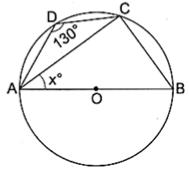
In the given figure, $O$ is the centre of a circle and $\angle A D C=130^{\circ}$. If $\angle B A C=x^{\circ}$, then find the value of $x$.
Image
Answer
Since $\ce{ABCD}$ is a cyclic quadrilateral.
$\therefore \angle ADC +\angle ABC =180^{\circ}$
$\Rightarrow 130^{\circ}+\angle ABC =180^{\circ}$
$\Rightarrow \angle ABC =50^{\circ}$
Since $\angle A C B$ is the angle in a semi$-$circle.
Image
$\therefore \angle ACB=90^{\circ}$
Using angle sum property in $\triangle ABC$, we obtain
$\angle BAC +\angle ACB +\angle ABC =180^{\circ}$
$\Rightarrow \angle BAC +90^{\circ}+50^{\circ}=180^{\circ}$
$\Rightarrow \angle BAC =40^{\circ}$
View full question & answer
Question 42 Marks
Find the length of a chord which is at a distance of $5 \ cm$ from the centre of a circle of radius $10 \ cm.$
Answer
Given that, Distance $(OC) = 5 \ cm$
Radius of circle $(OA) = 10 \ cm$
In $\triangle OCA$, by using Pythagoras theorem
$ AC ^2+ OC ^2= OA ^2$
$AC ^2+5^2=10^2$
$AC ^2=100-25$
$AC ^2=75$
$AC =8.66 \ cm$
We know that,
The perpendicular from centre to chord bisects the chord
Therefore, $AC = BC =8.66 \ cm$
Then, Chord $AB =8.66+8.66$
$=17.32 \ cm$.
View full question & answer
Question 52 Marks
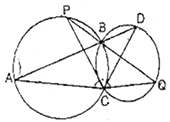
Two circles intersect at two points $B$ and $C.$ Through $B,$ two line segments $\ce{ABD}$ and $\ce{PBQ}$ are drawn to intersect the circles at $\ce{A, D, P, Q}$ respectively $($see figure$).$ Prove that $\ce{ACP=QCD}$.
Image
Answer
In triangles $A C D$ and $Q C P$,
$\angle A =\angle P$ and $\angle Q =\angle D [$Angles in same segment$]$
$\therefore \angle ACD=\angle QCP [$Third angles$] ...(i)$
Subtracting $\angle PCD$ from both the sides of $eq. (i),$ we get,
$\angle ACD =\angle PCD =\angle QCP -\angle PCD$
$\angle ACP =\angle QCD $
Hence proved.
View full question & answer
Question 62 Marks
Sides of a triangle are in the ratio of $12: 17: 25$ and its perimeter is $540 \ cm.$ Find its area.
Answer
Let the sides of the triangle be $12x, 17x$ and $25x$
Therefore, $12x + 17x + 25x = 540$
$\Rightarrow 54 x=540$
$\Rightarrow x=10$
$\therefore$ The sides are $120 \ cm, 170 \ cm$ and $250 \ cm.$
Semi$-$perimeter of triangle $s=\frac{120+170+250}{2}=270 \ cm$
Now, Area of triangle $=\sqrt{s(s-a)(s-b)(s-c)}$
$=\sqrt{270(270-120)(270-170)(270-250)}$
$=\sqrt{270 \times 150 \times 100 \times 20}$
$=9000 \ cm^2$
View full question & answer
Question 72 Marks
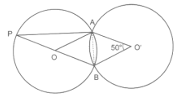
In a given figure, two congruent circles with centres $O$ and $O^{\prime}$ intersect at $A$ and $B$. If $\angle A O B=50^{\circ}$, then find $\angle APB$.
Image
Answer
As we are given that, both the triangle are congruent which means their corresponding angles are equal.
Therefore, $\angle AOB =\angle AO ^{\prime} B =50^{\circ}$
Now, by degree measure theorem, we have
$\angle APB =\frac{\angle A O B}{2}=50^{\circ} / 2=25^{\circ}$
$\angle APB =25^{\circ}$
View full question & answer