Questions

M.C.Q

🎯

Test yourself on this topic

18 questions · timed · auto-graded

MCQ 11 Mark
Let $f ( x )$ be a polynomial such that $f\left(-\frac{1}{2}\right)=0$, then a factor of $f ( x )$ is
  • A
    $X+1$
  • B
    $2 x+1$
  • C
    $X -1$
  • D
    $X -1$
Answer
(b) $2 x+1$
Explanation: Let $f ( x )$ be a polynomial such that $f\left(-\frac{1}{2}\right)=0$
i.e., $x+\frac{1}{2}=0$ is a factor.
On rearranging $x+\frac{1}{2}=0$ can be written as $(2 x +1)=0$
Thus, $(2 x+1)$ is a factor of $f(x)$.
View full question & answer
MCQ 21 Mark
The graph of x + y = 6 intersect coordinate axes at
  • A
    Both $(0,6)$ and $(6,0)$
  • B
    $(6,0)$
  • C
    $(0,6)$
  • D
    $(2,3)$
Answer
(a) Both (0, 6) and (6, 0)
Explanation: Both (0, 6) and (6, 0)
View full question & answer
MCQ 31 Mark
The co-ordinates of two points A and B are (4, 3) and (4, -5) respectively. The co-ordinates of the point at which the line segment AB meets the x-axis are
  • A
    $(-5,0)$
  • B
    $(3,0)$
  • C
    $(0,4)$
  • D
    $(4,0)$
Answer
(d) (4, 0)
Explanation: Since it will meet at x-axis and we know that any point on x-axis have ordinate equals to zero. So point will be (4, 0).  
View full question & answer
MCQ 41 Mark
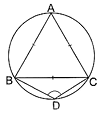
In the given figure, equilateral $\triangle A B C$ is inscribed in a circle and $\ce{ABCD}$ is a quadrilateral, as shown. Then, $\angle BDC =$ ?
Image
  • $120^{\circ}$
  • B
    $60^{\circ}$
  • C
    $150^{\circ}$
  • D
    $90^{\circ}$
Answer
Correct option: A.
$120^{\circ}$
$\triangle ABC$ is an equilateral triangle so $\angle BAC =60^{\circ}$
In cyclic quadrilateral $\ce{ABCD},$ we have:
$\angle BDC +\angle BAC =180^{\circ}$
$\Rightarrow \angle BDC +60^{\circ}=180^{\circ}$
$\therefore \angle BDC =\left(180^{\circ}-60^{\circ}\right)$
$=120^{\circ}$
View full question & answer
MCQ 51 Mark
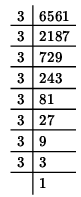
If $\frac{3^{5 x} \times 81^2 \times 6561}{2^{2 x}}=3^7$, then $x=$
  • A
    $-\frac{1}{3}$
  • B
    $3$
  • $-3$
  • D
    $\frac{1}{3}$
Answer
Correct option: C.
$-3$
$\frac{3^{5 x} \times 81^2 \times 6561}{3^{2 x}}=3^7$
$\Rightarrow 3^{5 x} \times 81^2 \times 6561$
$=3^7 \times 3^{2 x}$
Image
$\Rightarrow 3^{5 x } \times\left(3^4\right)^2 \times 3^8=3^7 \times 3^{2 x }$
$\Rightarrow 3^{5 x +8+8}=3^{7+2 x }$
$\Rightarrow 5 x +16=7+2 x$
$\Rightarrow 5 x -2 x =7-16$
$\Rightarrow 3 x =-9$
$\Rightarrow x =-3$
View full question & answer
MCQ 61 Mark
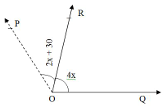
In the given figure, the value of $x$ which makes $\ce{POQ}$ a straight line is:
Image
  • A
    $40^{\circ}$
  • B
    $30^{\circ}$
  • C
    $35^{\circ}$
  • $25^{\circ}$
Answer
Correct option: D.
$25^{\circ}$
We know that he measure of a straight angle is $180^{\circ}$
$\left(2 x+30^{\circ}\right)+4 x=180^{\circ}$
$2 x+30^{\circ}+4 x=180^{\circ}$
$6 x=180^{\circ}-30^{\circ}$
$6 x=150^{\circ}$
$x=\frac{150^{\circ}}{6}$
$=25^{\circ}$
View full question & answer
MCQ 71 Mark
The graph of the linear equation y = x passes through the point
  • A
    $\left(\frac{3}{2}, \frac{-3}{2}\right)$
  • B
    $\left(0, \frac{3}{2}\right)$
  • C
    $\left(\frac{-1}{2}, \frac{1}{2}\right)$
  • D
    $(1,1)$
Answer
(d) $(1,1)$
Explanation: $y = x , \Rightarrow$ both the coordinates are the same. Hence $(1,1)$ is correct option.
View full question & answer
MCQ 81 Mark
The number $x =1.242424.........$. can be expressed in the form $x =\frac{p}{q}$, where $p$ and $q$ are positive integers having no common factors. Then $p+q$ equals
  • A
    $41$
  • $74$
  • C
    $53$
  • D
    $72$
Answer
Correct option: B.
$74$
We have, $x = 1.2424.....(i)$
$\Rightarrow 100 x=124.2424 ........(ii)$
Subtracting $(i)$ from $(ii),$ we get
$100x - x = 123$
$\Rightarrow 99 x=123 $
$\Rightarrow x=\frac{123}{99}=\frac{41}{33}$
$\therefore p=41, q=33 $ and $p+q=41+33=74$
View full question & answer
MCQ 91 Mark
In which of the following figures are the diagonals equal?
  • A
    Rhombus
  • B
    Rectangle
  • C
    Parallelogram
  • D
    Trapezium
Answer
(b) Rectangle
Explanation: Rectangle is the correct answer. As we know that from all the quadrilaterals given in other options, diagonals of a rectangle are equal.
View full question & answer
MCQ 101 Mark
If $x=\frac{\sqrt{3}-\sqrt{2}}{\sqrt{3}+\sqrt{2}}$ and $y=\frac{\sqrt{3}+\sqrt{2}}{\sqrt{3}-\sqrt{2}}$, then $x^2+x y+y^2=$
  • A
    $102$
  • B
    $101$
  • $99$
  • D
    $98$
Answer
Correct option: C.
$99$
Given $x=\frac{\sqrt{3}-\sqrt{2}}{\sqrt{3}+\sqrt{2}}$ and $y=\frac{\sqrt{3}+\sqrt{2}}{\sqrt{3}-\sqrt{2}}$,
Consider,
$x=\frac{\sqrt{3}-\sqrt{2}}{\sqrt{3}+\sqrt{2}}$
$=\frac{\sqrt{3}-\sqrt{2}}{\sqrt{3}+\sqrt{2}} \times \frac{\sqrt{3}-\sqrt{2}}{\sqrt{3}-\sqrt{2}}$
$=\frac{(\sqrt{3}-\sqrt{2})^2}{(\sqrt{3})^2+(\sqrt{2})^2}$
$=\frac{(\sqrt{3})^2+(\sqrt{2})^2-2(\sqrt{3})(\sqrt{2})}{3-2}$
$=\frac{3+2-2 \sqrt{6}}{1}$
$=5-2 \sqrt{6}$
Hence $x=5-2 \sqrt{6}$
$\Rightarrow x^2=(5-2 \sqrt{6})^2$
$=25+24-20 \sqrt{6}$
$=49-20 \sqrt{6}$
i.e. $x^2=49-20 \sqrt{6}........(i)$
Again consider
$ y =\frac{\sqrt{3}+\sqrt{2}}{\sqrt{3}-\sqrt{2}}$
$=\frac{\sqrt{3}+\sqrt{2}}{\sqrt{3}-\sqrt{2}} \times \frac{\sqrt{3}+\sqrt{2}}{\sqrt{3}+\sqrt{2}}$
$=\frac{(\sqrt{3}+\sqrt{2})^2}{(\sqrt{3})^2-(\sqrt{2})^2}$
$=\frac{(\sqrt{3})^2+(\sqrt{2})^2+2(\sqrt{3})(\sqrt{2})}{3-2}$
$=\frac{3+2+2 \sqrt{6}}{1}$
$=5+2 \sqrt{6}$
Hence $y=5+2 \sqrt{6}$
$\Rightarrow y^2=(5+2 \sqrt{6})^2$
$=25+24+20 \sqrt{6}$
$=49+20 \sqrt{6}$
i.e. $y ^2=49+20 \sqrt{6}-\ldots (ii)$
Then $x^2+x y+y^2$
$=49-20 \sqrt{6}+\frac{\sqrt{3}-\sqrt{2}}{\sqrt{3}+\sqrt{2}} \times \frac{\sqrt{3}+\sqrt{2}}{\sqrt{3}-\sqrt{2}}+49+20 \sqrt{6}[$ from $(i)$ nd $(ii)]$
$=98+1$
$=99$
View full question & answer
MCQ 111 Mark
Which of the following is a true statement?
  • A
    $5 x^3$ is a monomial
  • B
    $x^2+5 x-3$ is a linear polynomial
  • C
    $x +1$ is a monomial
  • D
    $x^2+4 x-1$ is a binomial
Answer
(a) $5 x^3$ is a monomial
Explanation: $5 x ^3$ is a monomial as it contains only one term.
View full question & answer
MCQ 121 Mark
Express$ ' x\ '$ in terms of  $'y\ '$  in the equation $2 x-3 y-5=0$.
  • A
    $x=\frac{3 y-5}{2}$
  • $x=\frac{3 y+5}{2}$
  • C
    $x=\frac{5-3 y}{2}$
  • D
    $x=\frac{3+5 y}{2}$
Answer
Correct option: B.
$x=\frac{3 y+5}{2}$
$2 x-3 y-5=0$
$2 x=3 y+5$
$x=\frac{3 y+5}{2}$
View full question & answer
MCQ 131 Mark
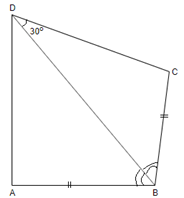
In the adjoining figure, $AB = BC$ and $\angle ABD =\angle CBD$, then another angle which measures $30^{\circ}$ is
Image
  • A
    $\angle BCA$
  • B
    $\angle BCD$
  • C
    $\angle BDA$
  • D
    $\angle BAD$
Answer
(c) $\angle BDA$
Explanation: In triangle ABD and CBD
$AB = BC$ and $\angle ABD =\angle CBD$ (Given)
BD (Common)
Therefore In triangle ABD and CBD are congruent by SAS criteria.
Therefore, $\angle BDA =30^{\circ}$ (by CPCT)
View full question & answer
MCQ 141 Mark
The value of $\frac{2}{\sqrt{5}-\sqrt{3}}$ is
  • A
    $\frac{1}{\sqrt{5}-\sqrt{3}}$
  • B
    $\sqrt{5}-\sqrt{3}$
  • $\sqrt{5}+\sqrt{3}$
  • D
    $\frac{1}{\sqrt{5}+\sqrt{3}}$
Answer
Correct option: C.
$\sqrt{5}+\sqrt{3}$
$\frac{2}{\sqrt{5}-\sqrt{3}}$
multiplying $nu$ nominator and denominator by
$\sqrt{5}+\sqrt{3} \text {, we get }$
$\frac{2(\sqrt{5}+\sqrt{3})}{(\sqrt{5}-\sqrt{3})(\sqrt{5}+\sqrt{3})}$
$=\frac{2(\sqrt{5}+\sqrt{3})}{5-3}$
$=\sqrt{5}+\sqrt{3}$
View full question & answer
MCQ 151 Mark
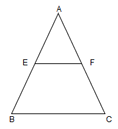
$E$ and $F$ are the mid$-$points of the sides $A B$ and $A C$ of a $\triangle A B C$. If $A B=6 \ cm, B C=5 \ cm$ and $A C=6 \ cm$, Then $EF$ is equal to
Image
  • A
    $4 \ cm$
  • B
    $3 \ cm$
  • $2.5 \ cm$
  • D
    $2 \ cm$
Answer
Correct option: C.
$2.5 \ cm$
since $E$ and $F$ are the mid points of sides $AB$ and $AC$ respectively.
according to mid point theorem of triangle;
$ EF =\frac{1}{2} \times B C$
$EF =\frac{1}{2} \times 5$
View full question & answer
MCQ 161 Mark
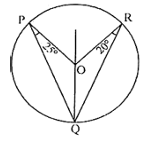
In the figure, O is the centre of the circle. If $\angle O P Q=25^{\circ}$ and $\angle O R Q=20^{\circ}$, then the measures of $\angle P O R$ and $\angle P Q R$ are respectively :
Image
  • A
    $150^{\circ}, 30^{\circ}$
  • B
    $120^{\circ}, 60^{\circ}$
  • C
    $90^{\circ}, 45^{\circ}$
  • D
    $60^{\circ}, 30^{\circ}$
Answer
(c) $90^{\circ}, 45^{\circ}$
Explanation: Here, given
$OP = OQ$ and $OR = OQ$ (Radius of circle)
So, $\{$angles opposite to equal sides are also equal $\}$
Hence,
$PQR=25^{\circ}+20^{\circ}=45^{\circ}$
and $PQR =2 PQR =245^{\circ}=90^{\circ}$
$\{$Angle subtended by same sides on centre is double the angle at opposite vertex$\}$
View full question & answer
MCQ 171 Mark
Each equal side of an isosceles triangle is $13 \ cm$ and its base is $24 \ cm$ Area of the triangle is :
  • A
    $40 \sqrt{3} \ cm^2$
  • B
    $25 \sqrt{3} \ cm^2$
  • $60 \ cm^2$
  • D
    $50 \sqrt{3} \ cm^2$
Answer
Correct option: C.
$60 \ cm^2$
$s =\frac{13+13+24}{2}=25 \ cm$
$\text { Area of triangle }=\sqrt{s(s-a)(s-b)(s-c)}$
$=\sqrt{25(25-13)(25-13)(25-24)}$
$=\sqrt{25 \times 12 \times 12 \times 1}$
$=60 sq . \ cm $
View full question & answer
MCQ 181 Mark
Abscissa of a point is negative in
  • A
    quadrant IV only
  • B
    quadrant II and III
  • C
    quadrant I and IV
  • D
    quadrant I only
Answer
(b) quadrant II and III
Explanation: The abscissa (x-axis) is -ve in 2nd and 3rd quadrant only because, Sign of point in 2nd quadrant is $(-,+)$, and in 3rd quadrant, it is $(-,-)$.
View full question & answer
M.C.Q - Maths STD 9 Questions - Vidyadip