Questions

M.C.Q

🎯

Test yourself on this topic

18 questions · timed · auto-graded

MCQ 11 Mark
The volume of a spherical shell is given by
  • A
    $\frac{4}{3} \pi\left(R^3-r^3\right)$
  • B
    $\pi\left(R^3-r^3\right)$
  • C
    $\frac{4}{3} \pi\left(R^2-r^2\right)$
  • D
    $4 \pi\left(R^3-r^3\right)$
Answer
(a) $\frac{4}{3} \pi\left(R^3-r^3\right)$
Explanation: The volume of a spherical shell is given by $\frac{4}{3} \pi\left( R ^3-r^3\right)$ where $R =$ Larger radius and $r =$ smaller radius
View full question & answer
MCQ 21 Mark
If $\left(3 x+\frac{1}{2}\right)\left(3 x-\frac{1}{2}\right)=9 x^2-p$ then the value of $p$ is
  • $\frac{1}{4}$
  • B
    $-\frac{1}{4}$
  • C
    $0$
  • D
    $\frac{1}{2}$
Answer
Correct option: A.
$\frac{1}{4}$
$\left(3 x+\frac{1}{2}\right)\left(3 x-\frac{1}{2}\right)=9 x^2-p$
$\Rightarrow(3 x)^2-\left(\frac{1}{2}\right)^2=9 x ^2- p$
$\Rightarrow 9 x^2-\frac{1}{4}=9 x ^2- p$
$\Rightarrow p=\frac{1}{4}$
View full question & answer
MCQ 31 Mark
In $\triangle A B C$ and $\triangle D E F$ its is given that $\angle B=\angle E$ and $\angle C=\angle F$ in order that $\triangle A B C \cong \triangle D E F$ we must have
  • A
    $BC = EF$
  • B
    $\angle A=\angle D$
  • C
    $A B=D F$
  • D
    $AC = DE$
Answer
(a) $BC = EF$
Explanation: In $\triangle A B C$ and $\triangle D E F$
$\angle B=\angle E$ and $\angle C=\angle F$
For congruence, $BC = EF$
Therefore by AAS axiom
$\triangle A B C \cong \triangle D E F$
View full question & answer
MCQ 41 Mark
The positive solutions of the equation $a x+b y+c=0$ always lie in the
  • A
    3rd quadrant
  • B
    4th quadrant
  • C
    2nd quadrant
  • D
    1st quadrant
Answer
(d) 1st quadrant
Explanation: The positive solutions of the equation $a x+b y+c=0$ always lie in the 1 st quadrant Because in 1st quadrant both $x$ and $y$ have positive value.
View full question & answer
MCQ 51 Mark
Read the statements carefully.
Statement-1: The product of a rational and an irrational number is an irrational number.
Statement 2: Reciprocal of every rational number is a rational number.
  • A
    Statement-1 is false but Statement-2 is true.
  • B
    Statement-1 is true but Statement-2 is false.
  • C
    Both Statement-1 and Statement-2 are false.
  • D
    Both Statement-1 and Statement-2 are true.
Answer
(b) Statement-1 is true but Statement-2 is false.
Explanation: Statement-1 is true and statement- 2 is false as 0 is a rational number but $\frac{1}{0}$ is not defined.
View full question & answer
MCQ 61 Mark
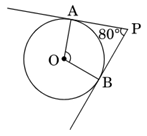
In Figure, if tangents $PA$ and $PB$ from an external point $P$ to a circle with centre $O$, are inclined to each other at an angle of $80^{\circ}$, then is equal to
Image
  • $100^{\circ}$
  • B
    $60^{\circ}$
  • C
    $50^{\circ}$
  • D
    $80^{\circ}$
Answer
Correct option: A.
$100^{\circ}$
By angle sum proporty for qud.
$\angle A+\angle B+\angle O+\angle P=360$.
also $OA \perp AP$ and $OB \perp PB$.
$( \because OA$ and $PB$ are radius and tangent of circe$)$
$\therefore 90+90+\angle O+\angle P=360$
$\angle O+80=360-180$
$\angle O=180-80$
$\angle O=100^{\circ}$
Image
View full question & answer
MCQ 71 Mark
In $\triangle A B C$, EF is the line segment joining the mid-points of the sides AB and $AC . BC =7.2 cm$, Find EF .
  • A
    2.6 cm
  • B
    3.5 cm
  • C
    3.6 cm
  • D
    3.4 cm
Answer
(c) 3.6 cm
Explanation: E and F are midpoints of sides AB and AC . By midpoint theorem, EF is parallel to BC and EF is $\frac{1}{2}$ of BC . So, $EF =\frac{1}{2}$ of $(7.2)=3.6 cm$
View full question & answer
MCQ 81 Mark
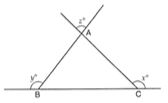
In figure, what is $z$ in terms of $x$ and $y$?
Image
  • $x+y-180^{\circ}$
  • B
    $x+y+180^{\circ}$
  • C
    $x+y+360^{\circ}$
  • D
    $180^{\circ}-(x+y)$
Answer
Correct option: A.
$x+y-180^{\circ}$
From figure
$\angle A=z^{\circ}$
$\angle A C B=180-z^{\circ}$
$\angle A B C=180-y^{\circ}$
Now, in $\triangle ABC$
$\angle A +\angle B +\angle C =180^{\circ}$
$\Rightarrow z ^{\circ}+180- y ^{\circ}+180^{\circ}- x ^{\circ}=180^{\circ}$
$\Rightarrow z ^{\circ}= x ^{\circ}+ y ^{\circ}-180^{\circ}$
View full question & answer
MCQ 91 Mark
Which of the following is not a solution of $2x – 3y = 12$ ?
  • A
    $(0,-4)$
  • $(2,3)$
  • C
    $(6,0)$
  • D
    $(3,-2)$
Answer
Correct option: B.
$(2,3)$
We have to check $(2,3)$ is a solution of $2 x-3 y=12$ if $(2,3)$ satisfy the equation then $(2,3)$ solution of $2 x-3 y= 12$
$\text { LHS }=2 x-3 y$
$2 \times 2-3 \times 3$
$4-9=-5$
$\text {RHS}=-5$
$\text {LHS} \neq \text {RHS}$
So $(2, 3)$ is not a solution of $2x - 3y = 12$
View full question & answer
MCQ 101 Mark
If $a^2+b^2+c^2=30$ and $a+b+c=10$, then the value of $a b+b c+c a$ is
  • A
    $30$
  • B
    $25$
  • $35$
  • D
    $40$
Answer
Correct option: C.
$35$
Using identity
$(a+b+c)^2=a^2+b^2+c^2+2 a b+2 b c+2 c a$
$\Rightarrow(a+b+c)^2=a^2+b^2+c^2+2(a b+b c+c a)$
$\Rightarrow a b+b c+c a=\frac{(a+b+c)^2-\left(a^2+b^2+c^2\right)}{2}$
$\Rightarrow a b+b c+c a=\frac{(10)^2-(30)}{2}$
$\Rightarrow a b+b c+c a=\frac{100-30}{2}$
$\Rightarrow a b+b c+c a=\frac{70}{2}$
$\Rightarrow a b+b c+c a=35$
View full question & answer
MCQ 111 Mark
If one angle of a parallelogram is $24^{\circ}$ less than twice the smallest angle, then the measure of the largest angle of the parallelogram is
  • $112^{\circ}$
  • B
    $68^{\circ}$
  • C
    $176^{\circ}$
  • D
    $102^{\circ}$
Answer
Correct option: A.
$112^{\circ}$
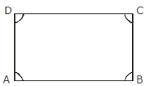
Let angles of parallelogram are $\angle A , \angle B , \angle C , \angle D$
Image
Let smallest angle $=\angle A$
Let largest angle $=\angle B$
$=\angle B =2 \angle A-24^{\circ} \ldots \text { (i) }$
$\angle A +\angle B =180^{\circ}  [$adjacent angle of parallelogram$] $
So, $\angle A +2 \angle A-24^{\circ}=180^{\circ}$
$=3 \angle A=180^{\circ}+24^{\circ}=204^{\circ}$
$=\angle A =\frac{204^{\circ}}{3}=68^{\circ}$
$=\angle B =2 \times 68^{\circ}-24^{\circ}$
$=112^{\circ}$
View full question & answer
MCQ 121 Mark
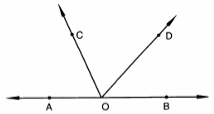
In Fig. $A O B$ is a straight line. If $\angle A O C+\angle B O D=85^{\circ}$, then $\angle C O D=$
Image
  • A
    $100^{\circ}$
  • B
    $85^{\circ}$
  • C
    $90^{\circ}$
  • $95^{\circ}$
Answer
Correct option: D.
$95^{\circ}$
Given,
$AOB =$ Straight line
$\angle AOC +\angle BOD =85^{\circ}$
$\angle AOC +\angle COD +\angle BOD =180^{\circ}($Straight line$)$
$85^{\circ}+\angle COD =180^{\circ}$
$\angle COD =95^{\circ}$
View full question & answer
MCQ 131 Mark
A and B have the same weight. If they gain weight by 3 kg, then
  • A
    Weight of $A \neq$ Weight of $B$
  • B
    Weight of A > Weight of B
  • C
    Weight of A < Weight of B
  • D
    Weight of $A=$ Weight of $B$
Answer
(d) Weight of $A=$ Weight of $B$
Explanation: Let the weights of A and B be $x$ kgs. If both of them gain weight by 3 kgs , their new weight would be ' $x +3$ ' kgs . According to Euclid's axiom if equals are added in equals, then whole are equal.
Hence, Weight of A = Weight of B.
View full question & answer
MCQ 141 Mark
The equation $x =7$ in two variables can be written as
  • A
    $1 \cdot x+1 \cdot y=7$
  • B
    $1 . x+0 . y=7$
  • C
    $0 . x+1 \cdot y=7$
  • D
    $0 . x+0 . y=7$
Answer
(b) $1 . x+0 . y=7$
Explanation: The equation $x=7$ in two variables can be written as exactly $1 . x+0 . y=7$ because it contain two variable $x$ and $y$ and coefficient of $y$ is zero as there is no term containing $y$ in equation $x=7$
View full question & answer
MCQ 151 Mark
In a histogram the area of each rectangle is proportional to
  • A
    the class size of the corresponding class interval
  • B
    cumulative frequency of the corresponding class interval
  • C
    the class mark of the corresponding class interval
  • D
    frequency of the corresponding class interval
Answer
(d) frequency of the corresponding class interval
Explanation: A histogram is a display of statistical information that uses rectangles to show the frequency of data items in successive numerical intervals of equal size. In the most common form of histogram, the independent variable is plotted along the horizontal axis and the dependent variable is plotted along the vertical axis.  
View full question & answer
MCQ 161 Mark
A $(-6,3)$ be a point on the graph. Draw $A L \perp x-$ axis. The co-ordinates of L are
  • A
    $(-6,3)$
  • B
    $(0,0)$
  • C
    $(-6,0)$
  • D
    $(0,-6)$
Answer
(c) (-6, 0)
Explanation: Since AL perpendicular to x-axis, So ,point L lies on x-axis, and we know that for any point on x-axis y-ordinate is zero. So,we have L= (—6 , 0 )
View full question & answer
MCQ 171 Mark
For what value of $'k\ ', x=2$ and $y=-1$ is a solution of $x+3 y-k=0$ ?
  • A
    $2$
  • B
    $-2$
  • $-1$
  • D
    $1$
Answer
Correct option: C.
$-1$
For finding value of $'k\ ',$ we put $x = 2$ and $y = -1$ iin a equation $x + 3y – k = 0$
$x+3 y-k=0$
$2+3(-1)=k$
$2-3=k$
$k=-1$
View full question & answer
MCQ 181 Mark
If $x=2+\sqrt{3}$, then $x+\frac{1}{x}=$
  • $4$
  • B
    $-5$
  • C
    $-4$
  • D
    $5$
Answer
Correct option: A.
$4$
$x+\frac{1}{x}$
$\Rightarrow \frac{x^2+1}{x}$
now, put $x=2+\sqrt{3}$
we have, $\frac{(2+\sqrt{3})^2+1}{2+\sqrt{3}}$
$\Rightarrow \frac{4+3+2(2 \sqrt{3})+1}{2+\sqrt{3}}$
$\Rightarrow \frac{8+4 \sqrt{3}}{2+\sqrt{3}}$
$\Rightarrow \frac{4(2+\sqrt{3})}{2+\sqrt{3}}$
$=4$
View full question & answer