Questions · Page 2 of 5

M.C.Q

MCQ 511 Mark
Length of the line segment joining the mid-points of two sides of a triangle is ________ the third side of the Triangle.
  • A
    None of these.
  • B
    Full the length of.
  • C
    Half the length of.
  • D
    One-third the length of.
Answer
  1. Half the length of.
    Solution:
    According to mid point theorem, A line segment joining mid points of any two sides of a triangle is parallel to third side and length of that line segment is half of the third side.
View full question & answer
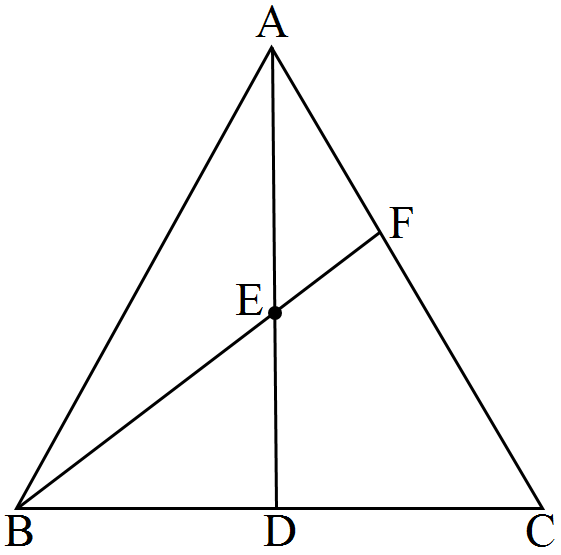
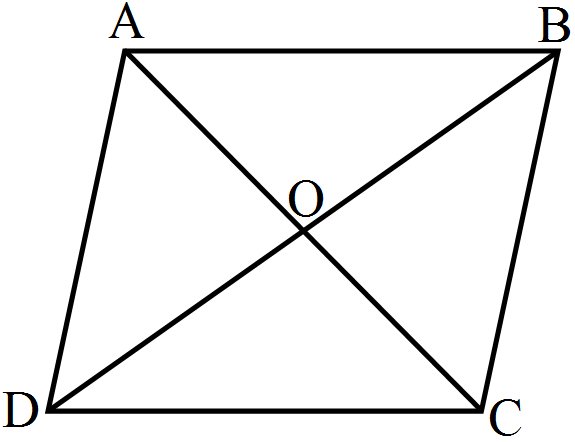
MCQ 521 Mark
  • A
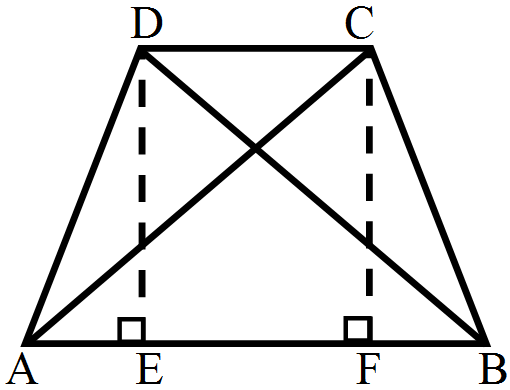
    BC2 + AD2 + 2BC ⋅ AD
  • B
    AB2 + CD2 + 2AB ⋅ CD
  • C
    AB2 + CD2 + 2AD ⋅ BC
  • D
    BC2 + AD2 + 2AB ⋅ CD
View full question & answer
MCQ 531 Mark
If $\angle\text{A},\angle\text{B},\angle\text{C}$ and $\angle\text{D}$ of a quadrilateral ABCD taken in order, are in the ratio 3 : 7 : 6 : 4 then ABCD is a:
  • A
    Rhombus.
  • B
    Kite.
  • C
    Trapezium.
  • D
    Parallelogram.
Answer
  1. Trapezium.
    Solution:
    Let the common multiple be x.
    $\therefore$ The angle measure 3x, 7x, 6x and 4x.
    Since the sum of the angles of a quadrilateral is 360°, we have
    3x + 7x + 6x + 4x = 360
    ⇒ 20x = 360
    ⇒ x = 18°
    $\therefore$ The angles of the quadrilateral are
    3x = 3(18) = 54°
    7x = 7(18) = 126°
    6x = 6(18) = 108° and
    4x = 4(18) = 72°
    Now, 54 + 126 = 180° and 108 + 72 = 180°
    So, the angles are interior angles and hence we get one pair of parallel sides of ABCD.
    Hence, ABCD is a trapezium.
View full question & answer
MCQ 541 Mark
In a square ABCD, the diagonals AC and BD bisects at O. Then $\triangle\text{AOB}$ is:
  • A
    Obtuse angled
  • B
    Acute angled
  • C
    Right-angled
  • D
    Equilateral
Answer
  1. Right-angled
    Solution:
    Diagonals of a square are perpendicular bisectors, hence angle AOB = 90º. So triangle AOB is right-angled.
View full question & answer
MCQ 551 Mark
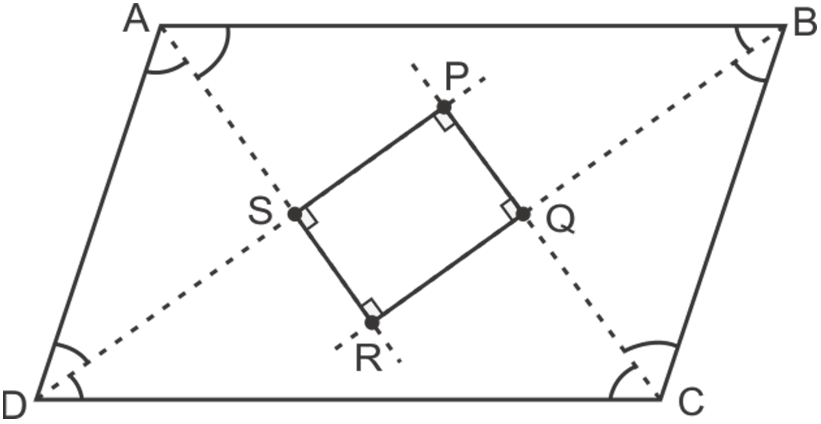
The bisectors of the angles of a Parallelogram enclose a:
  • A
    Rhombus
  • B
    Parallelogram
  • C
    Rectangle
  • D
    Square
Answer
  1. Rectangle
    Solution:
    Let ABCD be a parallelogram. $\angle\text{A} + \angle\text{D} = 180$ (co-interior angles)
    $\frac{1}{2}$ of $(\angle\text{A} + \angle\text{D}) = 90.$
    Triangle formed by bisectors of $\angle\text{A} $ and $\angle\text{D} ,$ have sum of two angles equals to 90 therefore, remaining angle is of 90. similarly, we can prove that other angles formed are of 90 each by bisectors of angles of ABCD. The quadrilateral formed by angle bisectors of ABCD has all angles equal to 90 (Vertically opposite angles). A quadrilateral with all right angles is a Rectangle.
View full question & answer
MCQ 561 Mark
If the diagonals of a quadrilateral bisect each other at right angles, then the figure is a:
  • A
    Trapezium.
  • B
    Parallelogram.
  • C
    Rectangle.
  • D
    Rhombus.
Answer
  1. Rhombus.
    Solution:
    If the diagonals of a quadrilateral bisect each other at right angles,
    then the figure is a rhombus.
    This is because in a rhombus, the diagonals are perpendicular bisectors of each other.
View full question & answer
MCQ 571 Mark
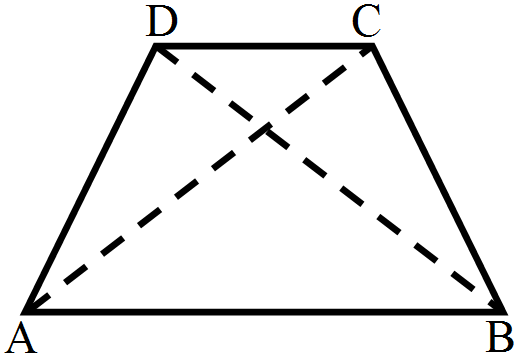
In a Quadrilateral ABCD, $\text{AB || CD},$ then ABCD is a:
  • A
    Rectangle
  • B
    Parallelogram
  • C
    Trapezium
  • D
    Square
Answer
  1. Trapezium
    Solution:
    A quadrilateral with only one pair of opposite sides parallel is called Trapezium.
View full question & answer
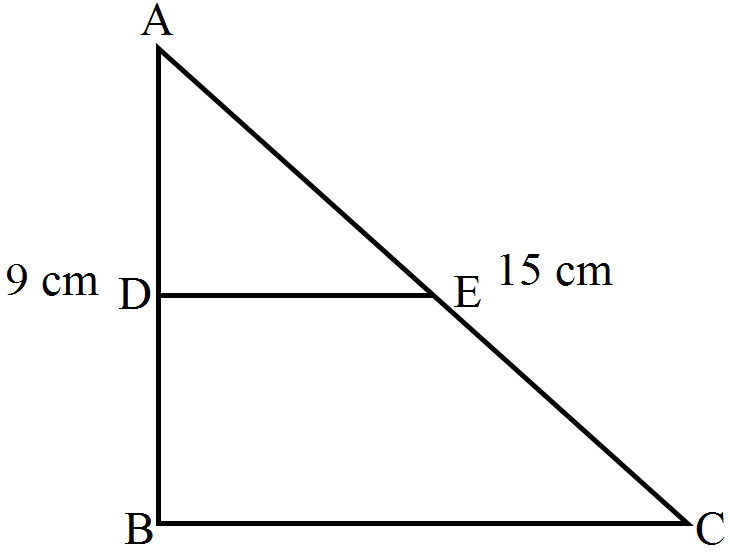
MCQ 581 Mark
  • A
    12.5cm2
  • B
    None of these.
  • C
    13.5cm2
  • D
    11.5cm2
Answer
  1. 13.5cm2
    Solution:
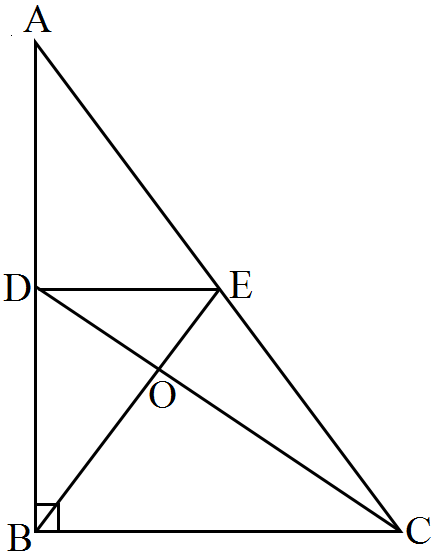
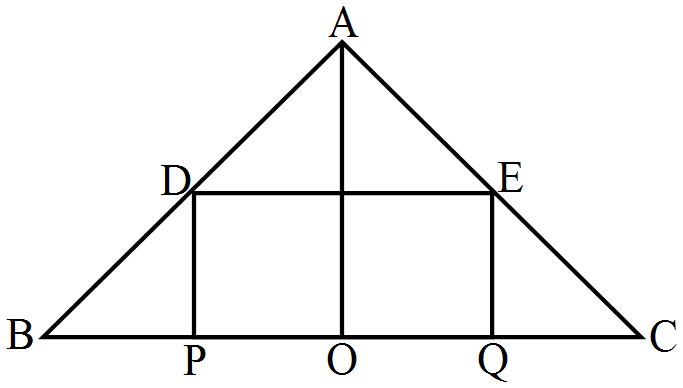
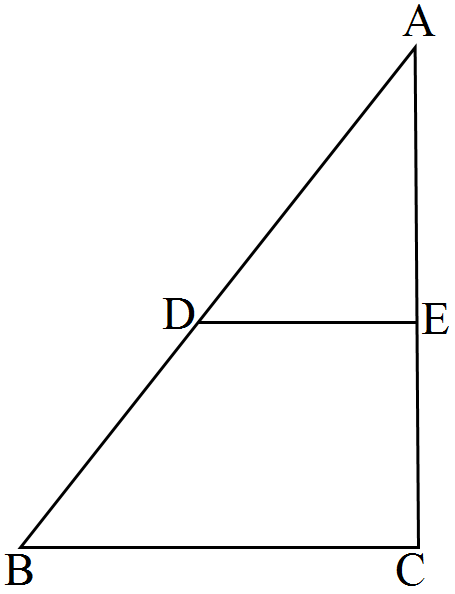
    As D and E are the midpoints of AB and AC.
    So, by mid-point theorem
    $\text{DE} = \frac{\text{BC}}{2} = \frac{12}{2} = 6\text{cm}$
    $\text{AD} = \frac{\text{AB}}{2} = \frac{9}{2} = 4.5\text{cm}$
    Area of $\triangle\text{ADE} = 0.5 × \text{DE} × \text{AD}$
    $= 0.5 × 6 × 4.5 = 13.5\text{cm}^2$
View full question & answer
MCQ 591 Mark
Write the correct answer in the following:
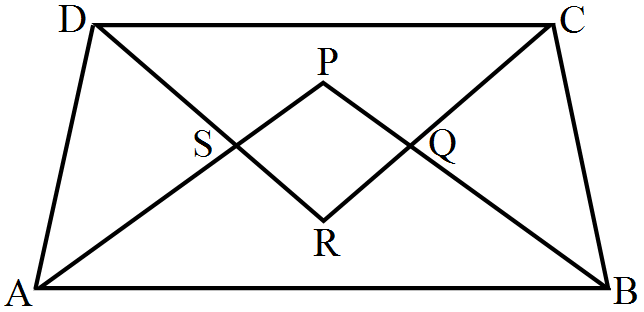
If bisectors of $\angle \text{A}$ and $\angle \text{B}$ of a quadrilateral ABCD intersect each other at P, of $\angle \text{B}$ and $\angle \text{C}$ at Q, of $\angle \text{C}$ and $\angle \text{D}$ at R and of $\angle \text{D}$ and $\angle \text{A}$ at S, then PQRS is a:
  • A
    Rectangle.
  • B
    Rhombus.
  • C
    Parallelogram.
  • D
    Quadrilateral whose opposite angles are supplementary.
View full question & answer
MCQ 601 Mark
  • A
    x = 35º and y = 35º
  • B
    x = 40º and y = 40º
  • C
    x = 37º and y = 37º
  • D
    x = 45º and y = 45º
Answer
  1. x = 35º and y = 35º
    Solution:
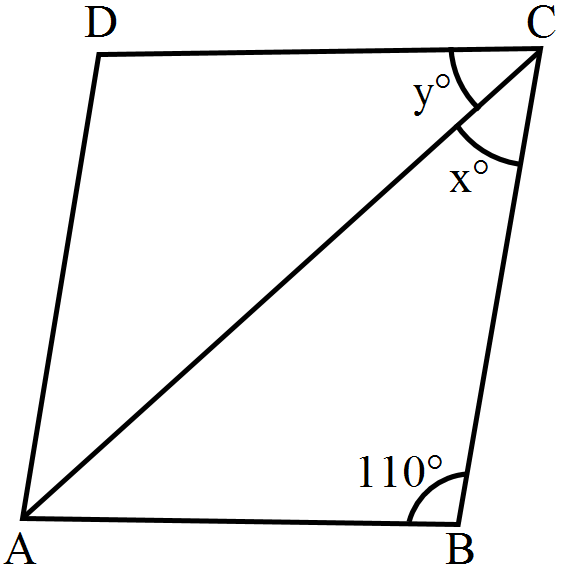
    ABCD is a rhombus and a rhombus is also a parallelogram. A rhombus has four equal sides.
    In $\triangle\text{ABC},\ \angle\text{BAC} = \angle\text{BCA} = \text{x}$
    In $\triangle\text{ABC}$
    x + x + 110º = 180º (angle sum property of triangle)
    ⇒ 2x = 180º - 110º = 70º
    ⇒ x = 35º
    Now, $\angle\text{B} + \angle\text{C} = 180^\circ$ (Adjacent angles are supplementary)
    But, $\angle\text{C} = \text{x} + \text{y} = 70^\circ$
    ⇒ y = 70º – x
    ⇒ y = 70º – 35º = 35º
    Hence, x = 35º and y = 35º
View full question & answer
MCQ 611 Mark
ABCD is a rhombus. If $\angle\text{ACB} = 30^\circ,$ then $\angle\text{ADB}$ is:
  • A
    45º
  • B
    120º
  • C
    30º
  • D
    60º
Answer
  1. 60º
    Solution:
    If $\angle\text{ACB} = 30^\circ$ then $\angle\text{CAD} = 30^\circ$ (The diagonals bisect the angles in a Rhombus) and in $\triangle\text{AOD}, \ \angle\text{AOB} = 90^\circ$ diagonals perpendicular to each other, so by angle sum property of a $\angle\text{ADB} = 60^\circ.$
View full question & answer
MCQ 621 Mark
ABCD is a Parallelogram in which AB = 9.5cm and its perimeter is 30cm. Find the length of each side of the Parallelogram?
  • A
    9.5cm, 9.5cm, 5.6cm, 5.4cm
  • B
    9.5cm, 9.5cm, 5.4cm, 5.6cm
  • C
    10cm, 10cm, 11cm, 11cm
  • D
    9.5cm, 9.5cm, 5.5cm, 5.5cm
Answer
  1. 9.5cm, 9.5cm, 5.5cm, 5.5cm
    Solution:
    Perimeter of ABCD = AB + BC + CD + DA = 30
    In a parallelogram, opposite sides are equal.
    AB = CD = 9.5 and BC = DA = x
    So, 9.5 + x + 9.5 + x = 30
    2x = 30 - 19
    x = 5.5
    AB = 9.5 = CD and BC = DA = 5.5
View full question & answer
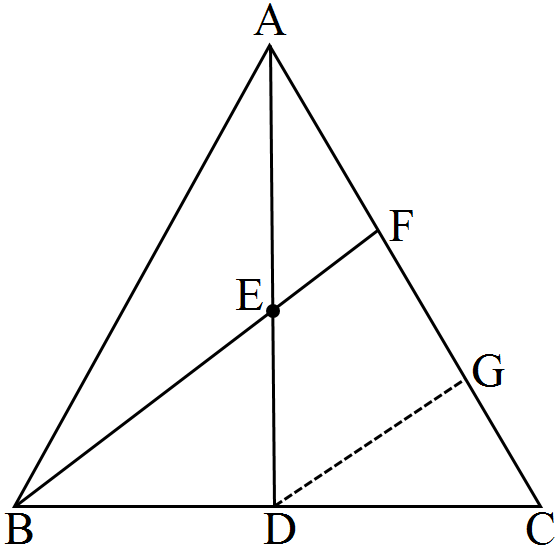
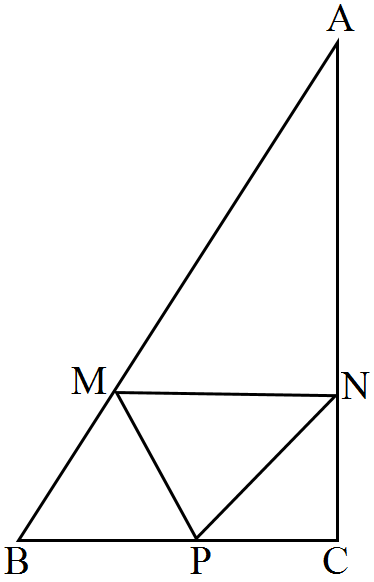
MCQ 631 Mark
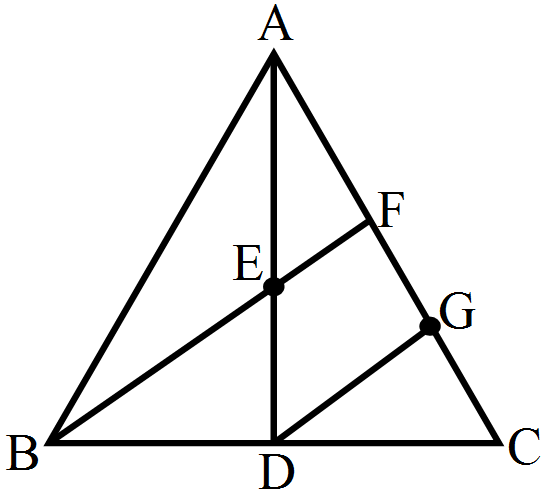
  • A
    $\frac{1}{3}\text{AC}$
  • B
    $\frac{3}{4}\text{AC}$
  • C
    $\frac{1}{2}\text{AC}$
  • D
    $\frac{2}{3}\text{AC}$
View full question & answer
MCQ 641 Mark
Write the correct answer in the following:
The quadrilateral formed by joining the mid-points of the sides of a quadrilateral PQRS, taken in order, is a rectangle, if:
  • A
    PQRS is a rectangle.
  • B
    PQRS is a parallelogram.
  • C
    Diagonals of PQRS are perpendicular.
  • D
    Diagonals of PQRS are equal.
Answer
  1. Diagonals of PQRS are perpendicular.
    Solution:
    If diagonals of PQRS are perpendicular.
    Hence, (c) is the correct answer.
View full question & answer
MCQ 651 Mark
Write the correct answer in the following:
The quadrilateral formed by joining the mid-points of the sides of a quadrilateral PQRS, taken in order, is a rhombus, if:
  • A
    PQRS is a rhombus.
  • B
    PQRS is a parallelogram.
  • C
    Diagonals of PQRS are perpendicular.
  • D
    Diagonals of PQRS are equal.
Answer
  1. Diagonals of PQRS are equal.
    Solution:
    If diagonals of PQRS are equal.
    Hence, (d) is the correct answer.
View full question & answer
MCQ 661 Mark
The bisectors of the angle of a parallelogram enclose a:
  • A
    Parallelogram.
  • B
    Rhombus.
  • C
    Rectangle.
  • D
    Square.
View full question & answer
MCQ 671 Mark
The angles of the quadrilateral are in the ratios 3 : 5 : 9 : 13. Find all the angles of the Quadrilateral.
  • A
    40º, 50º, 80º, 150º
  • B
    100º, 60º, 36º, 156º
  • C
    36º, 60º, 108º, 154º
  • D
    36º, 60º, 108º, 156º
Answer
  1. 36º, 60º, 108º, 156º
    Solution:
    Let ABCD be a quadrilateral with $\angle\text{A} = 3\text{x}, \ \angle\text{B} = 5\text{x},\ \angle\text{C} = 9\text{x}$ and $\angle\text{D} = 13\text{x}$
    $\angle\text{A} + \angle\text{B} + \angle\text{C} + \angle\text{D} = 360^\circ$ (angle sum property)
    $3\text{x} + 5\text{x} + 9\text{x} + 13\text{x} = 360^\circ$
    $30\text{x} = 360^\circ$
    $\text{x} = 12^\circ$
    $\angle\text{A} = 3 (12^\circ) = 36^\circ$
    $\angle\text{B} = 5 (12^\circ) = 60^\circ$
    $\angle\text{B} = 9 (12^\circ) = 1800^\circ$
    $\angle\text{B} = 13 (12^\circ) = 156^\circ$
View full question & answer
MCQ 691 Mark
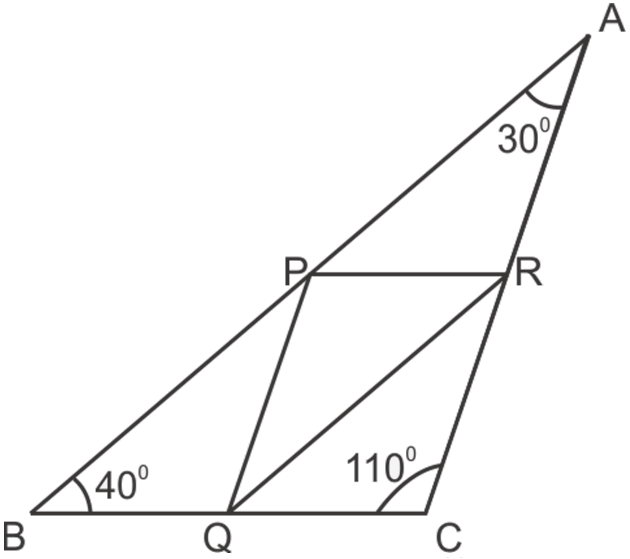
In $\triangle\text{ABC},\angle\text{A}=30^\circ,\angle\text{B}=40^\circ$ $$and $\angle\text{C}=110^\circ.$ The angles of the triangle formed by joining the mid-points of the sides of this triangle are:
  • A
    70°, 70°, 40°
  • B
    60°, 40°, 80°
  • C
    30°, 40°, 110°
  • D
    60°, 70°, 50°
View full question & answer
MCQ 701 Mark
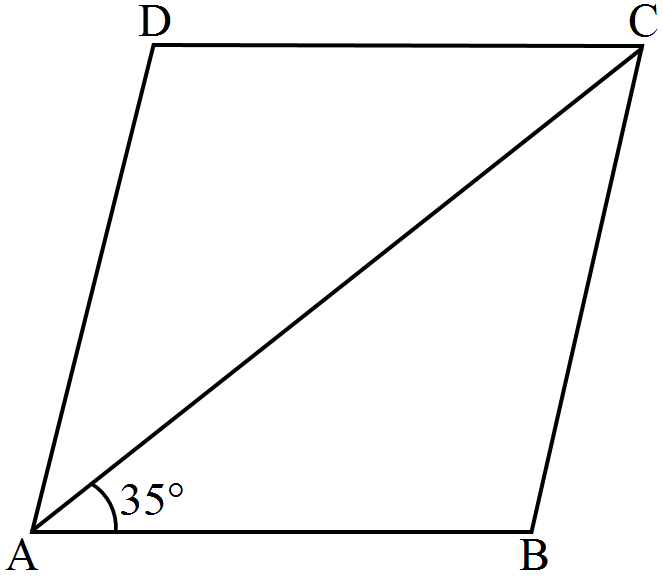
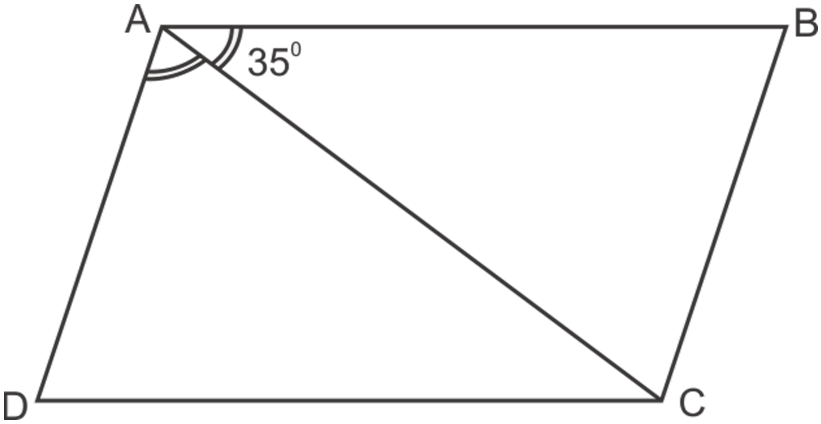
ABCD is a parallelogram in which diagonal AC bisects $\angle\text{BAD}.$ If $\angle\text{BAC} = 35^\circ,$ then $\angle\text{ABC} =\ ?$
  • A
    70º
  • B
    110º
  • C
    90º
  • D
    120º
View full question & answer
MCQ 711 Mark
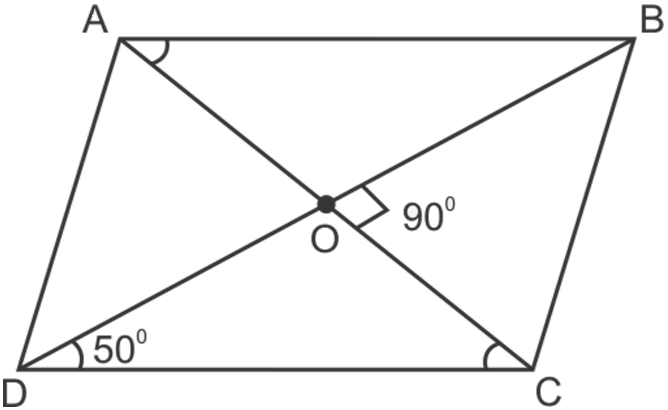
Diagonals of a Parallelogram ABCD intersect at O. If $\angle\text{BOC}=90^\circ,\ \angle\text{BDC}=50^\circ$ then $\angle\text{OAB} $ is:
  • A
    10º
  • B
    50º
  • C
    40º
  • D
    90º
Answer
  1. 40º
    Solution:
    $\angle\text{BOC} + \angle\text{COD} = 180^\circ$ (linear pair).
    $\angle\text{COD} = 180^\circ - 90^\circ = 90^\circ$
    In $\angle\text{DOC} + \angle\text{DCO} + \angle\text{ODC} = 180^\circ$ (angle sum property).
    $90^\circ + \angle\text{DCO} + 50^\circ = 90^\circ$
    $\angle\text{DCO} = 180^\circ - 140^\circ = 40^\circ$
    $\angle\text{DCO} = \angle\text{OAB} = 40^\circ$ (alternate angles).
View full question & answer
MCQ 721 Mark
If APB and CQD are 2 parallel lines, then the bisectors of the angles APQ, BPQ, CQP and PQD form, square only if:
  • A
    None of these.
  • B
    Diagonals of ABCD are unequal.
  • C
    Diagonals of ABCD are equal.
  • D
    ABCD is a Rhombus.
Answer
  1. Diagonals of ABCD are equal.
    Solution:
    The diagonals of a square bisect its angles. Opposite sides of a square are both parallel and equal in length. All four angles of a square are equal.
View full question & answer
MCQ 731 Mark
D and E are the mid-points of the sides AB and AC res. Of $\triangle\text{ABC}.$ DE is produced to F. To prove that CF is equal and parallel to DA, we need an additional information which is:
  • A
    $\text{AE = EF}$
  • B
    $\text{DE = EF}$
  • C
    $\angle\text{ADE}= \angle\text{EGF}$
  • D
    $\angle\text{DAE}= \angle\text{EFC}$
Answer
  1. $\text{DE = EF}$
    Solution:
    If DE= EF then $\triangle\text{AED}$ become congruent to $\triangle\text{CEF}$ by SSS congruence rule.
    By CPCT, $\angle\text{ECF} = \angle\text{EAD}$ which forms a pair of an alternate angles.
    Which proves that AD is parallel to CF.
View full question & answer
MCQ 741 Mark
The figure formed by joining the mid-points of the adjacent sides of a rectangle is a:
  • A
    Trapezium
  • B
    Rhombus
  • C
    Square
  • D
    None of these
View full question & answer
MCQ 751 Mark
Write the correct answer in the following:
The figure formed by joining the mid-points of the sides of a quadrilateral ABCD, taken in order, is a square only if,
  • A
    ABCD is a rhombus.
  • B
    Diagonals of ABCD are equal.
  • C
    Diagonals of ABCD are equal and perpendicular.
  • D
    Diagonals of ABCD are perpendicular.
Answer
  1. Diagonals of ABCD are equal and perpendicular.
    Solution:
    If diagonal of ABCD are equal and perpendicular.
    Hence, (c) is the correct answer.
View full question & answer
MCQ 761 Mark
  • A
    $\frac{1}{2}\text{AC}$
  • B
    $\frac{1}{3}\text{AC}$
  • C
    $\frac{2}{3}\text{AC}$
  • D
    $\frac{3}{4}\text{AC}$
View full question & answer
MCQ 771 Mark
  • A
    80º
  • B
    10º
  • C
    90º
  • D
    100º
Answer
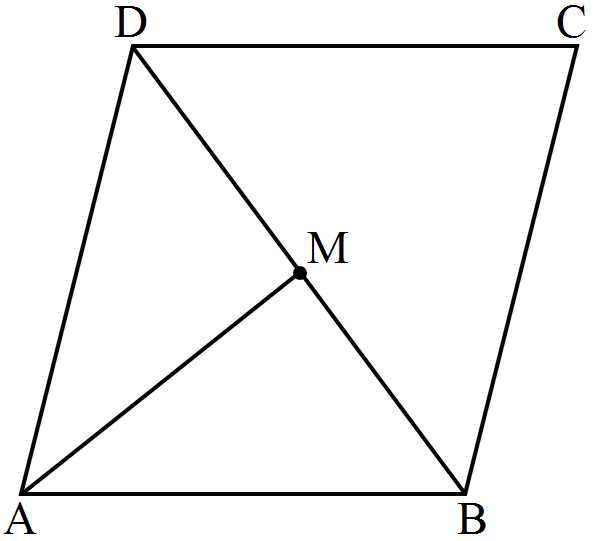
  1. 90º
    Solution:
    ABCD is a parallelogram. BD is the diagonal and M is the mid point of BD. BD is a bisector of $\angle\text{B}.$
    We know that, diagonals of the parallelogram bisect each other.
    $∴$ M is the mid point of AC.
    $\text{AB || CD}$ and BD is the transversal,
    $∴ \angle\text{ABD} = \angle\text{BDC}\ ...(1)$ (Alternate interior angles)
    $\angle\text{ABD} = \angle\text{DBC}\ ...(2)$ (Given)
    From (1) and (2), we get
    $\angle\text{BDC} = \angle\text{DBC}$
    In $\triangle\text{BCD},$
    $\angle\text{BDC} = \angle\text{DBC}$
    ⇒ BC = CD ...(3) (In a triangle, equal angles have equal sides opposite to them)
    AB = CD and BC = AD ...(4) (Opposite sides of the parallelogram are equal)
    From (3) and (4), we get
    AB = BC = CD = DA
    $∴$ ABCD is a rhombus.
    $⇒ \angle\text{AMB} = 90^\circ$ (Diagonals of rhombus are perpendicular to each other)
View full question & answer
MCQ 781 Mark
The sum of all the four angles of a quadrilateral is:
  • A
    270º
  • B
    180º
  • C
    90º
  • D
    360º
Answer
  1. 360º
    Solution:
    One Diagonal divides it into two triangles and the sum of angles of one triangle is 180º and 180 × 2 = 360º.
View full question & answer
MCQ 791 Mark
Write the correct answer in the following:
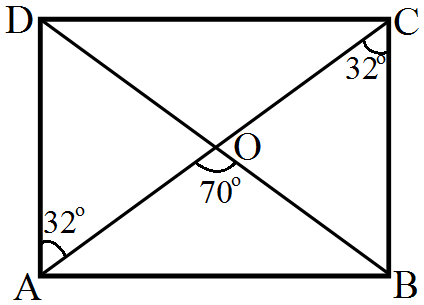
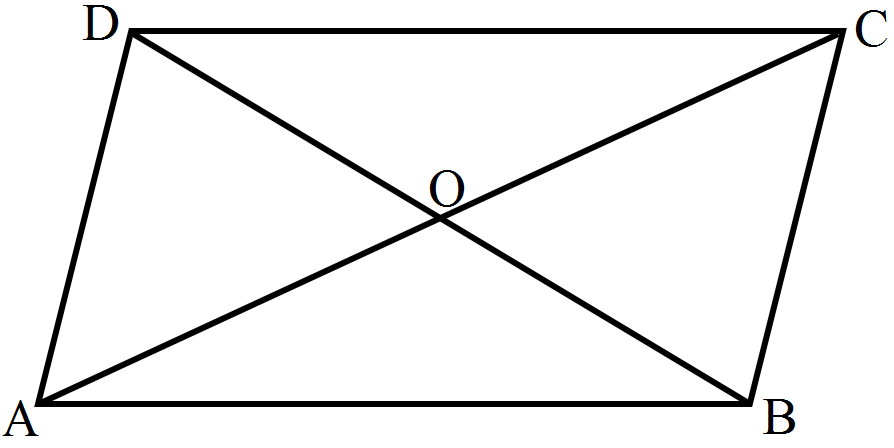
The diagonals AC and BD of a parallelogram ABCD intersect each other at the point O. If $\angle\text{DAC}=32^\circ$ and $\angle\text{AOC}=70^\circ,$ then $\angle\text{DBC}$ is equal to:
  • A
    24º
  • B
    86º
  • C
    38º
  • D
    32º
View full question & answer
MCQ 801 Mark
If area of a Parallelogram with sides ‘a’ and ‘b’ is A and that of a rectangle with sides ‘a’ and ‘b’ is B, then
  • A
    None of these
  • B
    A = B
  • C
    A > B
  • D
    A < B
Answer
  1. A < B
    Solution:
    Area of Parallelogram = Base × Height
    If 'a' is the side and 'b' is the base the height will be less than 'a' using Pythagoras theorem, a as Hypotenuse, h as height, A < B.
View full question & answer
MCQ 811 Mark
The Diagonals AC and BO of a Parallelogram ABCD intersect each other at point 0. If $\angle\text{DAC} = 32^\circ$ and $\angle\text{AOB} = 70^\circ,$ then $\angle\text{DBC}$ is equal to:
  • A
    86º
  • B
    38º
  • C
    32º
  • D
    24º
Answer
  1. 38º
    Solution:
    $\angle\text{OAC} = \angle\text{ACB} = 32^\circ$ (alternate angles)
    $\angle\text{AOB} = \angle\text{COB} = 180^\circ$ (linear pair)
    $\angle\text{COB} = 180 - 70 = 110^\circ$
    In $\triangle\text{BOC}, \ \angle\text{BOC} + \angle\text{OCB} + \angle\text{CBO} = 180^\circ$ (angle sum property)
    $110 + 32 + \angle\text{CBO} = 180^\circ$
    $\angle\text{CBO} = 180 - 142 = 38^\circ$
View full question & answer
MCQ 821 Mark
  • A
    75º
  • B
    55º
  • C
    60º
  • D
    45º
Answer
  1. 60º
    Solution:
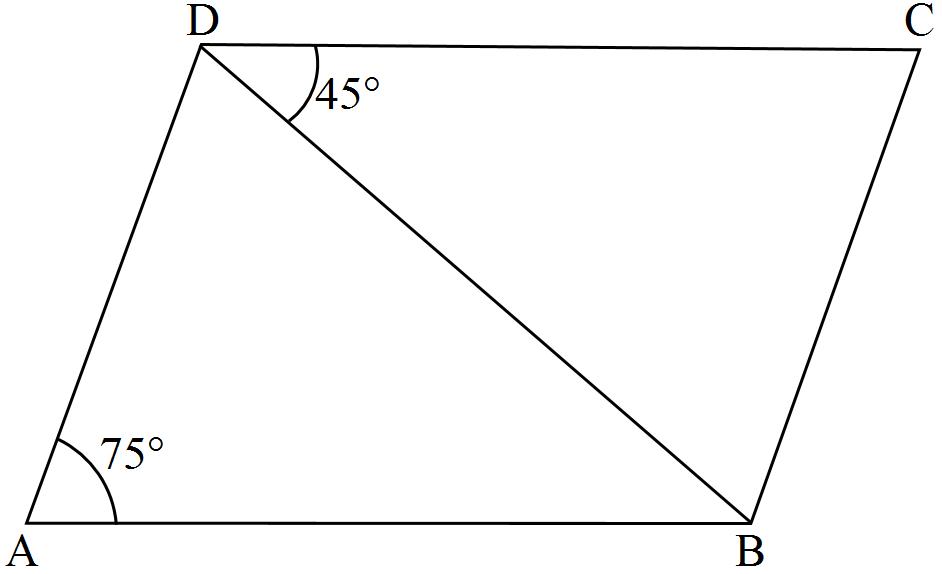
    As per the question
    $\angle\text{BAD} = \angle\text{BCD} = 75^\circ$ (opposite angles of parallelogram)
    Now, in $\triangle\text{BCD},$
    $\angle\text{BCD} + \angle\text{CBD} + \angle\text{BCD} = 180^\circ$
    $45^\circ + \angle\text{CBD} + 75^\circ = 180^\circ$
    $\angle\text{CBD} = 60^\circ$
View full question & answer
MCQ 831 Mark
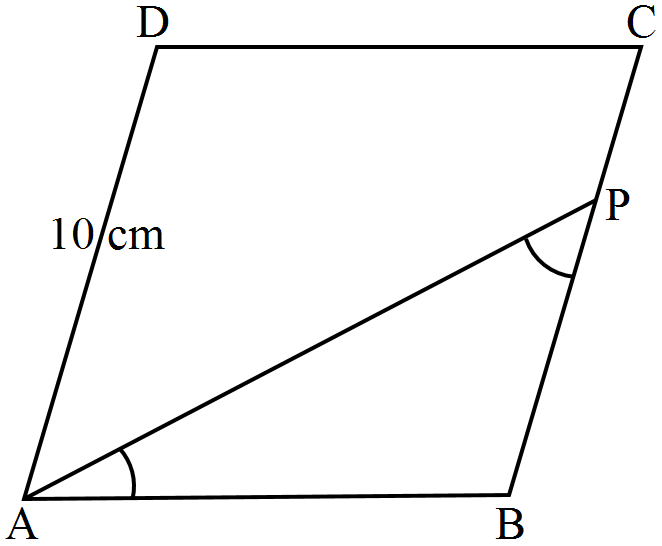
P is the mid-point of side BC of a parallelogram ABCD such that $\angle\text{BAP} = \angle\text{DAP}.$ If AD = 10cm, then CD =
  • A
    5cm
  • B
    6cm
  • C
    8cm
  • D
    10cm
View full question & answer
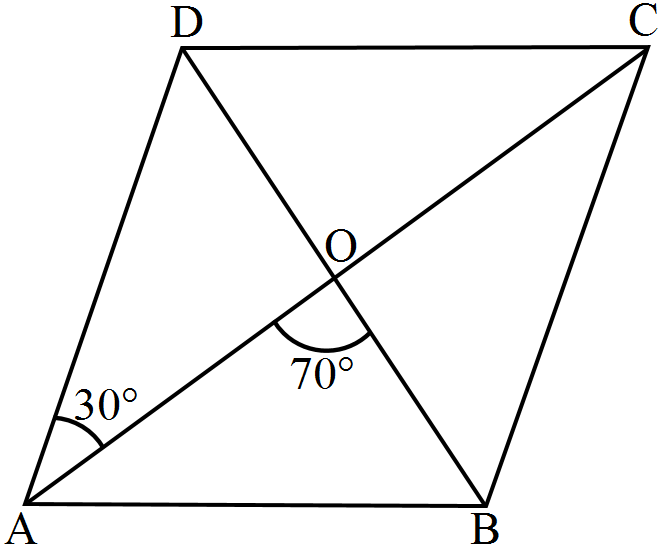
MCQ 841 Mark
  • A
    30º
  • B
    45º
  • C
    35º
  • D
    40º
Answer
  1. 40º
    Solution:
    $\angle\text{DAC} = \angle\text{ACB} = 30^\circ $ (alternate angles)
    $\angle\text{BOA} = \angle\text{BOC} = 180^\circ $ (linear pair)
    $\angle\text{BOC} = 180^\circ - 70^\circ = 110^\circ$
    In $\triangle\text{BOC},\ \angle\text{BOC} + \angle\text{OCB} + \angle\text{CBO} = 180^\circ$ (angle sum property)
    $110^\circ + 30^\circ + \angle\text{CBO} = 180^\circ$
    $\angle\text{CBO} = 180^\circ - 140^\circ = 40^\circ = \angle\text{DBC}$
View full question & answer
MCQ 851 Mark
ABCD is a parallelogram in which diagonal AC bisects $\angle\text{BAD}.$ if $\angle\text{BAC}=35^\circ,$ then $\angle\text{ABC}=$
  • A
    70°
  • B
    110°
  • C
    90°
  • D
    120°
View full question & answer
MCQ 861 Mark
In fig ABCD is a parallelogram. If $\angle\text{DAB}=60^\circ$ and $\angle\text{DBC}=80^\circ$ then $\angle\text{CDB}$ is:
  • A
    80º
  • B
    70º
  • C
    40º
  • D
    60º
Answer
  1. 40º
    Solution:
    $40^\circ\ \angle\text{C} = 60^\circ$ as opposite angles of a parallelogram are equal and $\angle\text{CDB} = 40^\circ$ angle sum property of a triangle. [In $\triangle\text{CDB},\ \angle\text{C} + \angle\text{CDB} + \angle\text{DBC} = 180^\circ$]
View full question & answer
MCQ 871 Mark
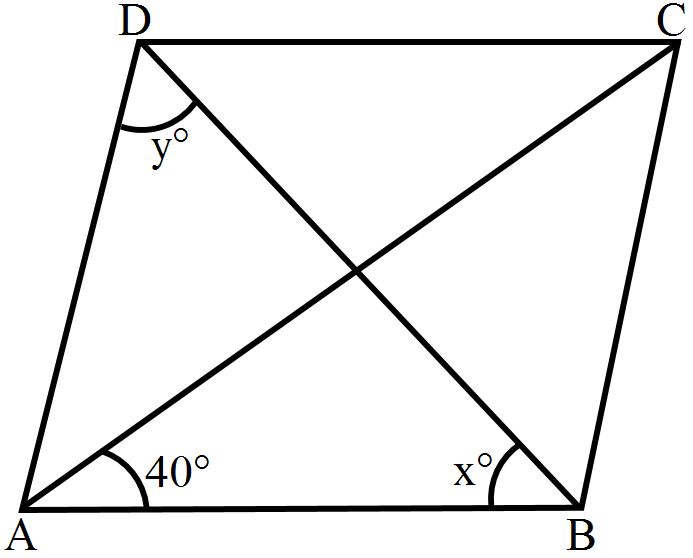
  • A
    x = 55º and y = 65º
  • B
    x = 50º and y = 50º
  • C
    x = 75º and y = 55º
  • D
    x = 80º and y = 80º
Answer
  1. x = 50º and y = 50º
    Solution:
    ABCD is a rhombus and a rhombus is also a parallelogram. A rhombus has four equal sides.
    The diagonals of a rhombus are perpendicular bisector of each other.
    So, in $\triangle\text{AOB}, \ \angle\text{OAB} = 40^\circ, \angle\text{AOB} = 90^\circ $ and $\angle\text{ABO} = 180^\circ- (40^\circ + 90^\circ) = 50^\circ$
    $∴ \text{x} = 50^\circ$
    In $\triangle\text{ABD, AB = AD}$
    So, $\angle\text{ABD} = \angle\text{ADB} = 50^\circ$
    Hence, x = 50° and y = 50°
View full question & answer
MCQ 881 Mark
Write the correct answer in the following:
D and E are the mid-points of the sides AB and AC of $\Delta\text{ABC}$ and O is any point on side BC. O is joined to A. If P and Q are the mid-points of OB and OC respectively, then DEQP is:
  • A
    A square.
  • B
    A rectangle.
  • C
    A rhombus.
  • D
    A parallelogram.
View full question & answer
MCQ 891 Mark
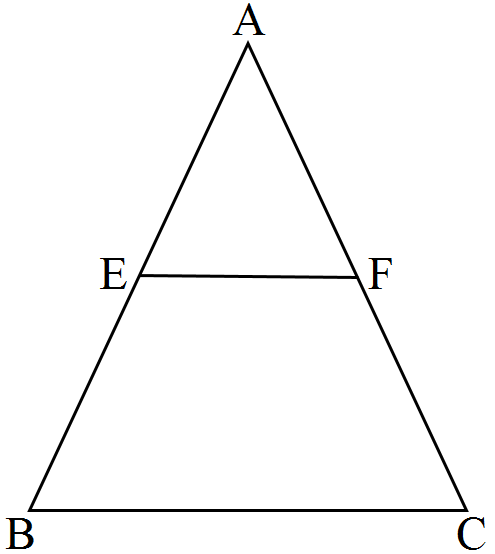
In $\triangle\text{ABC},$ EF is the line segment joining the mid-points of the sides AB and AC. BC = 7.2cm, Find EF = ?
  • A
    3.4cm
  • B
    3.6cm
  • C
    3.5cm
  • D
    2.6cm
Answer
  1. 3.6cm
    Solution:
    E and F are midpoints of sides AB and AC. By midpoint theorem, EF is parallel to BC and EF is $\frac{1}{2}$ of BC.
    So, $\text{EF} = {1}{2}$ of $(7.2) = 3.6\text{cm}.$
View full question & answer
MCQ 901 Mark
The diagonals of a parallelogram ABCD intersect at O. if $\angle\text{BOC}=90^\circ$ and $\angle\text{BDC}=50^\circ,$ then $\angle\text{AOB}=$
  • A
    40°
  • B
    50°
  • C
    10°
  • D
    90°
View full question & answer
MCQ 921 Mark
A diagonal of a Rectangle is inclined to one side of the rectangle at an angle of 25º. The Acute Angle between the diagonals is:
  • A
    50º
  • B
    115º
  • C
    40º
  • D
    25º
Answer
  1. 50º
    Solution:
    Two diagonals of a rectangle divide it into four triangles. Out of these four triangles a pair of opposite triangles are congruent by SSS in which a pair of triangles have two equal angles of 25 each and in another pair of opposite triangles have two equal angles of 65 each. By angle sum property we have two options of angle formed between diagonals. Either it is of 130 or 50. 50 is an acute angle. So, it is a correct option.
View full question & answer
MCQ 931 Mark
The figure formed by joining the mid-points of the sides of a quadrilateral ABCD, taken in order, is a square only if:
  • A
    ABCD is a Rhombus.
  • B
    Diagonals of ABCD are equal and perpendicular.
  • C
    Diagonals of ABCD are perpendicular.
  • D
    Diagonals of ABCD are equal.
Answer
  1. Diagonals of ABCD are equal and perpendicular.
    Solution:
    A quadrilateral formed by joining the mid-points of a square is a square. So, ABCD is a square. In Square, diagonals are equal and perpendicular.
View full question & answer
MCQ 941 Mark
ABCD is a Rhombus such that $\angle\text{ACB}= 40^\circ,$ then $\angle\text{ADB}$ is:
  • A
    50º
  • B
    60º
  • C
    100º
  • D
    40º
Answer
  1. 50º
    Solution:
    In Rhombus, diagonals bisect each other right angle. By using angle sum property in any of the four triangles formed by intersection of diagonals, we get $\angle\text{CBD} = 50$ and $\angle\text{CBD} = \angle\text{ADC}$ (alternate angles).
    So, $\angle\text{ADC} = 50$
View full question & answer
MCQ 951 Mark
  • A
    (AC2 + BD2) = 3AB2
  • B
    AC2 + BD2 = 4AB2
  • C
    AC2 + BD2 = AB2
  • D
    AC2 + BD2 = 2AB2
Answer
  1. AC2 + BD2 = 4AB2
    Solution:
    ABCD is a rhombus. AB = BC = CD = DA
    In Rhombus, diagonals bisect each other at right angles.
    So, AO= CO and BO = DO
    In triangle AOB × AO2 + BO2 = AB2 (Pythagoras theorem)
    $\Big(\frac{1}{2}\text{AC}\Big)^2 + \Big(\frac{1}{2}\text{BD}\Big)^2 = \text{AB}^2$
    $\frac{\text{AC}^2}{4} + \frac{\text{BD}^2}{4} = \text{AB}^2$
    = AC2 + BD2 = 4AB2
View full question & answer
MCQ 961 Mark
In a quadrilateral ABCD, $\angle\text{A} + \angle\text{C}$ is 2 times $\angle\text{B} + \angle\text{D}.$ If $\angle\text{A} = 140^\circ$ and $\angle\text{D} = 60^\circ,$ then ZB = ?
  • A
    60º
  • B
    120º
  • C
    80º
  • D
    None of these
Answer
  1. 60º
    Solution:
    Given,
    ABCD is a parallelogram
    $\angle\text{A} + \angle\text{C} = 2(\angle\text{B} + \angle\text{D})$
    $\angle\text{A} = 40^\circ$
    $∵ \angle\text{A} + \angle\text{B} + \angle\text{C} + \angle\text{D} = 360^\circ$ [angle sum property of quadrilateral]
    $\Rightarrow \angle\text{A} + \angle\text{C} + \angle\text{B} + \angle\text{D} = 360^\circ$
    $⇒ 2(\angle\text{B} + \angle\text{D})+ \angle\text{B} + \angle\text{D} = 360^\circ$
    $⇒ 3(\angle\text{B} + \angle\text{D})= 360^\circ$
    $\Rightarrow\angle\text{B}+\angle\text{D}=\frac{360^\circ}{3}=120^\circ$
    $\because\ \angle\text{B}=60^\circ$ [given]
    $\therefore\ \angle\text{B}=120^\circ-60^\circ=60^\circ$
View full question & answer
MCQ 971 Mark
In Parallelogram ABCD, bisectors of angles A and B intersect each other at O. The measure of $\angle\text{AOB}$ is:
  • A
    40°
  • B
    25°
  • C
    65°
  • D
    130°
View full question & answer
MCQ 991 Mark
A quadrilateral is a _________, if its opposite sides are equal:
  • A
    Parallelogram
  • B
    Kite
  • C
    Cyclic quadrilateral
  • D
    Trapezium
Answer
  1. Parallelogram
    Solution:
    By SSS congruence condition.
    Alternate angles are equal by CPCT, hence opposite sides are parallel.
View full question & answer
M.C.Q - Page 2 - Maths STD 9 Questions - Vidyadip