What special name can be given to a quadrilateral PQRS if $\angle\text{P}+\angle\text{S}=180^{\circ}?$
Since the sum of adjacent angles $\neq180^{\circ},$ PQRS is not a parallelogram.
Hence, PQRS is a trapezium.
50 questions · timed · auto-graded
Solution:
Consider I.
We know that, in a rectangle the diagonals are not bisectors of each other, since the adjacent side.
Thus, I is false.
Consider II.
We know that, in a square the diagonals bisect the opposite angles.
So, in a square ABCD, the diagonals AC bisects $\angle\text{A}$ as well as $\angle\text{C}.$
Thus, II is true.
Consider III.
We know that, in a rhombus the diagonals bisect the opposite angles.
So, in a rhombus ABCD, the diagonals AC bisects $\angle\text{A}$ as well as $\angle\text{C}.$
Thus, III is true.
Solution:
The figure formed by joining the mid points of the adjacent sides of a rhombus is a rectangle.

Solution:
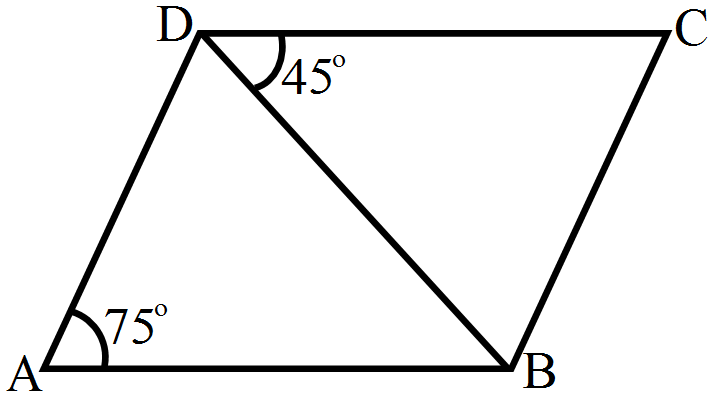
Since ABCD is a parallelogram, AB || CD since opposite angles of a parallelogram are equal.
$\Rightarrow\angle\text{ABD}=\angle\text{BCD}=45^{\circ}$ ...(Alternate angles)
In $\triangle\text{ADB},$
$\angle\text{ABD}+\angle\text{BDA}+\angle\text{DAB}=180^{\circ}$ ...(Angle sum property)
$\Rightarrow45+\angle\text{BDA}+75=180$
$\Rightarrow\angle\text{BDA}+120=180$
$\Rightarrow\angle\text{BDA}=60^{\circ}$
$\Rightarrow\angle\text{CBD}=\angle\text{BDA}=60^{\circ}$ ...(Alternate angles)
$\Rightarrow\angle\text{CBD}=60^{\circ}$
Solution:

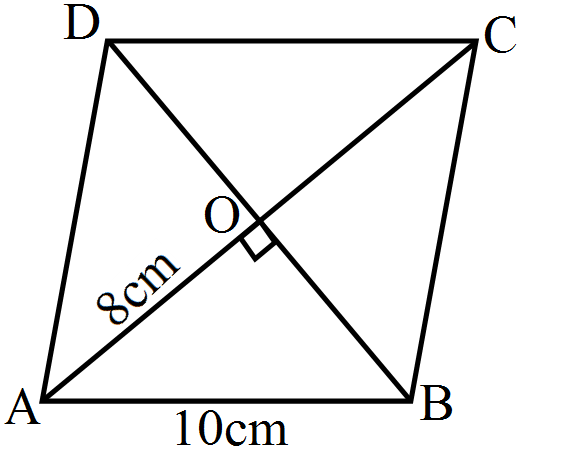
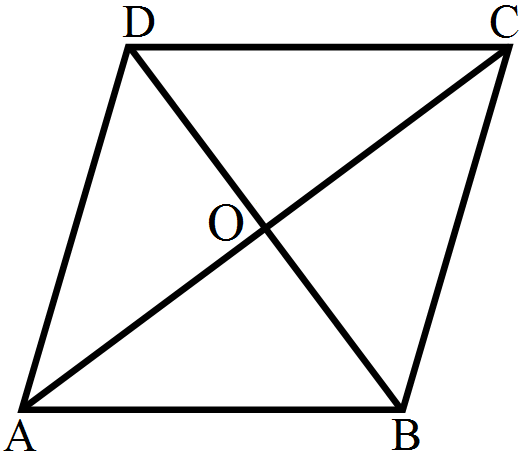
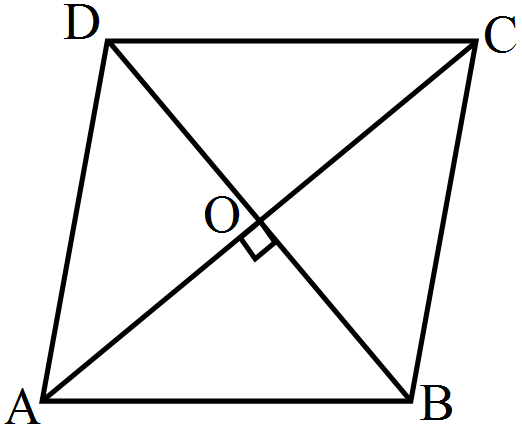
Let ABCD be the rhombus with diagonals AB = 10cm and Ac = 16cm.
Since the diagonals of a rhombus are perpendicular bisectors of each other,
$\Rightarrow\text{OA}=8\text{cm},\text{BD = 2OB}$ and $\angle\text{AOB}=90^{\circ}$
In right $\triangle\text{AOB},$
By Pythagoras theorem,
$\text{AB}^2=\text{OA}^2+\text{OB}^2$
$\Rightarrow(10)^{2}=(8)^2+\text{OB}^2$
$\Rightarrow100=64+\text{OB}^2$
$\Rightarrow\text{OB}^2=36$
$\Rightarrow\text{OB}=\sqrt{36}$
$\Rightarrow\text{OB}=6\text{cm}$
$\Rightarrow\text{BD}=2\times\text{OB}$
$\Rightarrow\text{BD}=2\times6$
$\Rightarrow\text{BD}=12\text{cm}$
Hence, the lenght of the other diagonal is 12cm.
Solution:

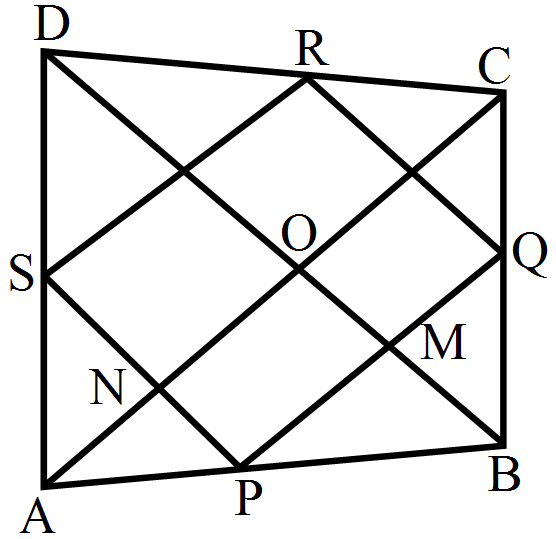
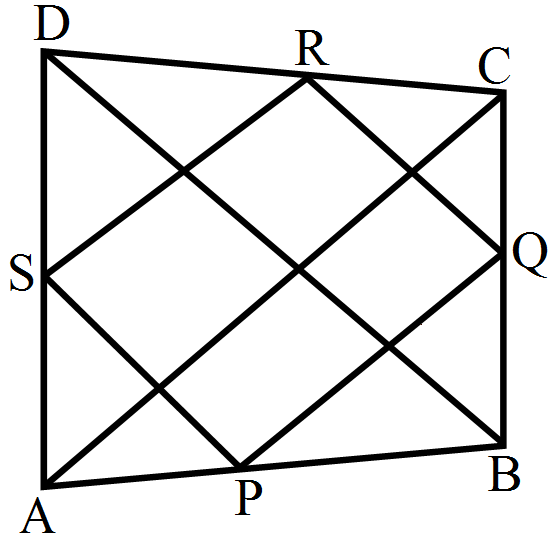
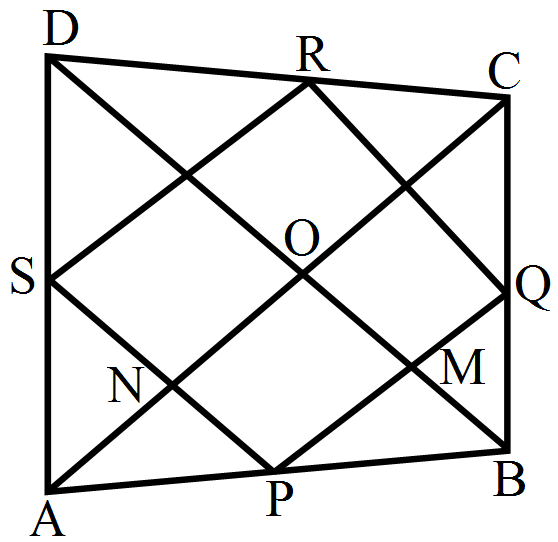
In $\triangle\text{ABC},$ P and Q are the mid-points of sides AB and BC respectively.
$\therefore\text{PQ || AC}$ and $\text{PQ}=\frac{1}{2}\text{AC ...(i)}$
In $\triangle\text{BCD},$ Q and R are the mid-points of sides BC and CD respectively.
$\therefore\text{QR || BD}$ and $\text{QR}=\frac{1}{2}\text{BD ...(ii)}$
In $\triangle\text{ADC},$ S and R are the mid-points of sides AD and CD respectively.
$\therefore\text{RS || AC}$ and $\text{RS}=\frac{1}{2}\text{AC ...(iii)}$
In $\triangle\text{ABD},$ P and S are the mid-points of sides AB and AD respectively.
$\therefore\text{SP || BD}$ and $\text{SP}=\frac{1}{2}\text{BD ...(iv)}$
$\Rightarrow\text{PQ || RS}$ and $\text{QR || SP }$ [From (i), (ii), (iii) and (iv)]
Thus, PQRS is a parallelogram.
Now, $\text{AC = BD}$ (given)
$\Rightarrow\frac{1}{2}\text{AC}=\frac{1}{2}\text{BD}$
$\Rightarrow\text{PQ = QR = RS = SP}$ [From (i), (ii), (iii) and (iv)]
Let the diagonals AC and BD intersect at O.
Now,
$\text{PS || BD}$
$\Rightarrow\text{PN || MO}$
Also, from (i), $\text{PQ || AC}$
$\Rightarrow\text{PM || NO}$
Thus, in quadrilateral PMON, $\text{PM || NO}$ and $\text{PN || MO}$
$\Rightarrow\text{PMON}$ is a parallelogram.
$\Rightarrow\angle\text{MPN}=\angle\text{MON}$ (opposite angles of a parallelogram are equal)
$\Rightarrow\angle\text{MPN}=\angle\text{BOA}$ $(\text{Since }\angle\text{BOA}=\angle\text{MON})$
$\Rightarrow\angle\text{MPN}=90^{\circ}$ $(\text{Since }\text{AC}\perp\text{BD},\angle\text{BOA}=90^{\circ})$
$\Rightarrow\angle\text{QPS}=90^{\circ}$
Thus, PQRS is a parallelogram such that PQ = QR = RS = SP and $\angle\text{QPS}=90^{\circ}.$
Hence, PQRS is a square if diagonals of ABCD are equal and perpendicular.
Solution:
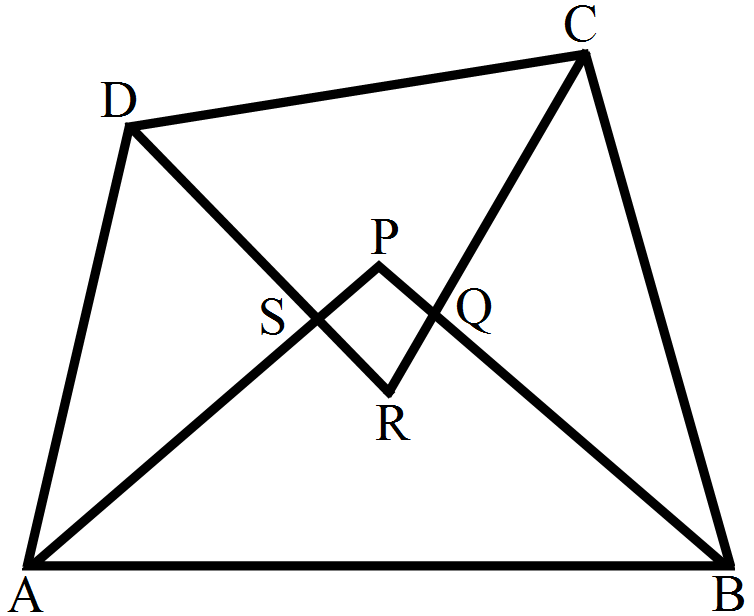
In $\triangle\text{APB},$ by angle sum property,
$\angle\text{APB}+\angle\text{PAB}+\angle\text{PBA}=180^{\circ}$
$\Rightarrow\angle\text{APB}+\frac{1}{2}\angle\text{A}+\frac{1}{2}\angle\text{B}=180^{\circ}$
$\Rightarrow\angle\text{APB}=180^{\circ}-\Big(\frac{1}{2}\angle\text{A}+\frac{1}{2}\angle\text{B}\Big)$
In $\triangle\text{CRD},$ by angle sum property,
$\angle\text{CRD}+\angle\text{RDC}+\angle\text{RCD}=180^{\circ}$
$\Rightarrow\angle\text{CRD}+\frac{1}{2}\angle\text{D}+\frac{1}{2}\angle\text{C}=180^{\circ}$
$\Rightarrow\angle\text{CRD}=180^{\circ}-\Big(\frac{1}{2}\angle\text{D}+\frac{1}{2}\angle\text{C}\Big)$
Now, $\angle\text{SPQ}+\angle\text{SRQ}=\angle\text{APB}+\angle\text{CRD}$
$=360^{\circ}-\Big(\frac{1}{2}\angle\text{A}+\frac{1}{2}\angle\text{B}+\frac{1}{2}\angle\text{C}+\frac{1}{2}\angle\text{D}\Big)$
$=360^{\circ}=\frac{1}{2}(\angle\text{A}+\angle\text{B}+\angle\text{C}+\angle\text{D})$
$=360^{\circ}-\frac{1}{2}\times360^{\circ}$
$=360^{\circ}-180^{\circ}$
$=180^{\circ}$
Now, $\angle\text{PSR}+\angle\text{PQR}=360^{\circ}-(\angle\text{SPQ}+\angle\text{SRQ})$
$=360^{\circ}-180^{\circ}$
$=180^{\circ}$
Hence, PQRS is a quadrilateral whose opposite angles are supplementary.

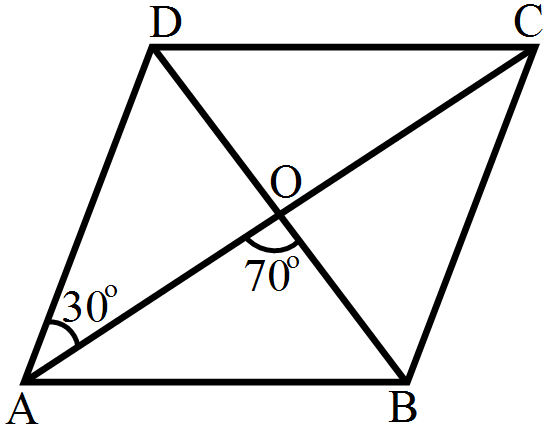
Solution:
$\text{AD || BC},$
$\Rightarrow\angle\text{DAO}=\angle\text{BCO}=30^{\circ}$ ...(Alternate angles)
$\Rightarrow\angle\text{BCO}=30^{\circ}$
$\angle\text{AOB}+\angle\text{BOC}=180^{\circ}$ ...(Linear pair of angles)
$\Rightarrow70+\angle\text{BOC}=180$
$\Rightarrow\angle\text{BOC}=110^{\circ}$
In $\triangle\text{CBO},$
$\angle\text{BOC}+\angle\text{BCO}+\angle\text{OBC}=180^{\circ}$ ...(Angle sum Property)
$\Rightarrow110+30+\angle\text{OBC}=180$
$\Rightarrow\angle\text{OBC}=40^{\circ}$
$\Rightarrow\angle\text{DBC}=40^{\circ}$ ...(D - O - B)
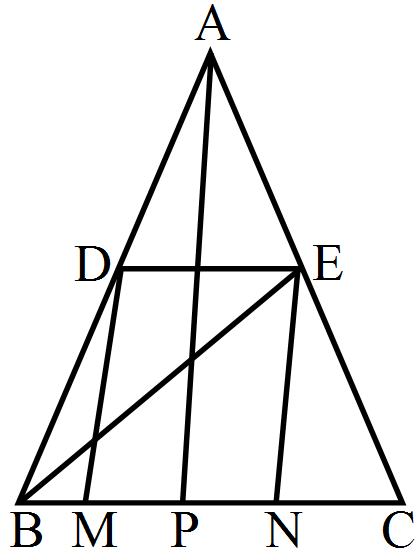
Solution:

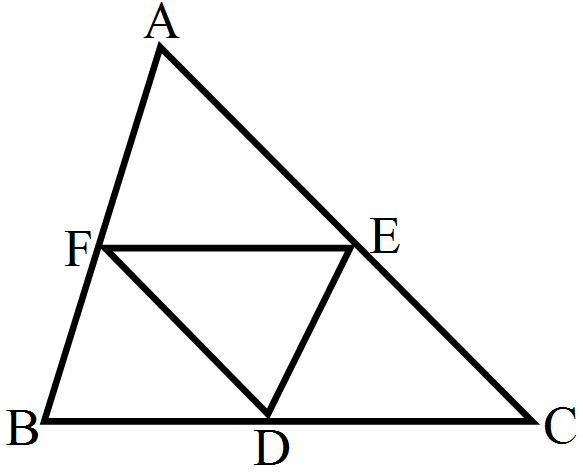
In $\triangle\text{ABC},$ D and E are the mid-points of sides AB and AC respectively.
$\Rightarrow\text{DE || BC}$ and $\text{DE}=\frac{1}{2}\text{BC }...(\text{i})$
Now, $\text{MN = MP + PN}=\frac{1}{2}\text{BP}+\frac{1}{2}\text{CP}=\frac{1}{2}(\text{BP + CP})$
$\therefore\text{MN}=\frac{1}{2}\text{BC ...(ii)}$
From (i) and (ii),
$\text{DE || MN}$ and $\text{DE = MN}$
Hence, DENM is a parallelogram.

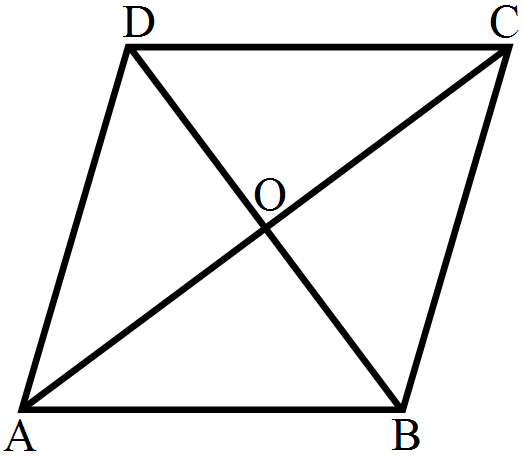
Solution:
The diagonals of a rhombus bisect each other at right angles.
$\Rightarrow\text{OA}=\frac{1}{2}\text{AC}$ and $\text{OB}=\frac{1}{2}\text{BD}$
Also, $\angle\text{AOB}=90^{\circ}$
In right $\triangle\text{AOB},$
$\therefore\text{AB}^2=\text{OA}^2+\text{OB}^2$ ...(By Pythagoras theorem)
$\Rightarrow\text{AB}^2=\frac{1}{4}\text{AC}^2+\frac{1}{4}\text{BD}^2$
$\Rightarrow\text{AC}^2+\text{BD}^2=4\text{AB}^2$
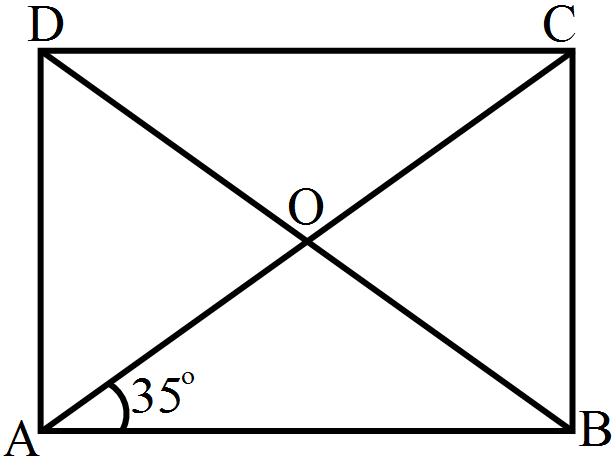
Solution:

$\angle\text{DAO}+\angle\text{OAB}=\angle\text{DAB}$
$\Rightarrow\angle\text{DAO}+35^{\circ}=90^{\circ}$
$\Rightarrow\angle\text{DAO}=55^{\circ}$
ABCD is a rectangle and diagonals of a rectangle are equal and bisect each other.
$\text{OA = OD}$
$\Rightarrow\angle\text{ODA}=\angle\text{DAO}$ (angles opposte to equal sides are equal)
$\Rightarrow\angle\text{ODA}=55^{\circ}$
In DODA, by angle sum property,
$\angle\text{ODA}+\angle\text{DAO}+\angle\text{AOD}=180^{\circ}$
$\Rightarrow55^{\circ}+\angle55^{\circ}+\angle\text{AOD}=180^{\circ}$
$\Rightarrow\angle\text{AOD}=70^{\circ}$
Solution:

In $\triangle\text{ABC},$ P and Q are the mid-point of sides AB and BC respectively.
$\therefore\text{PQ || AC}$ and $\text{PQ}=\frac{1}{2}\text{AC }...(\text{i})$
In $\triangle\text{ADC},$ R and S are the mid-point of sides CD and AD respectively.
$\therefore\text{RS || AC}$ and $\text{RS}=\frac{1}{2}\text{AC }...(\text{ii})$
From (i) and (ii),
$\text{PQ ∥ RS}$ and $\text{PQ = RS}$
Thus, in quadrilateral PQRS, a pair of opposite sides are equal are parallel.
So, PQRS is a parallelogram.
Let the diagonals AC and BD intersect at O.
Now, in $\triangle\text{ABD},$ P and S are the mid-points of sides AB and AD respectively.
$\therefore\text{PS || BD}$
$\Rightarrow\text{PN || MO}$
Also, from (i), $\text{PQ || AC}$
$\Rightarrow\text{PM || NO}$
Thus, in quadrilateral PMON, $\text{PM || NO}$ and $\text{PN || MO},$
⇒ PMON is a parallelogram.
$\Rightarrow\angle\text{MPN}=\angle\text{MON}$ (opposite angles of a parallelogram are equal)
$\Rightarrow\angle\text{MPN}=\angle\text{BOA}$ $(\text{Since }\angle\text{BOA}=\angle\text{MON})$
$\Rightarrow\angle\text{MPN}=90^{\circ}$ $(\text{Since }\text{AC}\perp\text{BD},\angle\text{BOA}=90^{\circ})$
$\Rightarrow\angle\text{QPS}=90^{\circ}$
Thus, PQRS is a parallelogram whose one angle, i.e. $\angle\text{QPS}=90^{\circ}.$
Hence, PQRS is a rectangle if $\text{AC}\perp\text{BD}.$
Solution:
The figure formed by joining the mid points of the adjacent sides of a parallelogram is a parallelogram.
Solution:
If the quad. ABCD is a ‖gm, it could be a rectangle or square or rhombus.
So, statement I is not sufficient to answer the question.
If the diagonals AC and BD are perpendicular to each other, then the ‖gm could be a square or rhombus.
So, statement II is not sufficient to answer the question.
However, if the statements are combined, then the quad. ABCD is a rhombus.
Solution:
We know that, in a || gm opposite sides are equal, opposite angles are equal and also the diagonals bisect each other.
So, opposite angles are bisected by the diagonals is not true.

Solution:
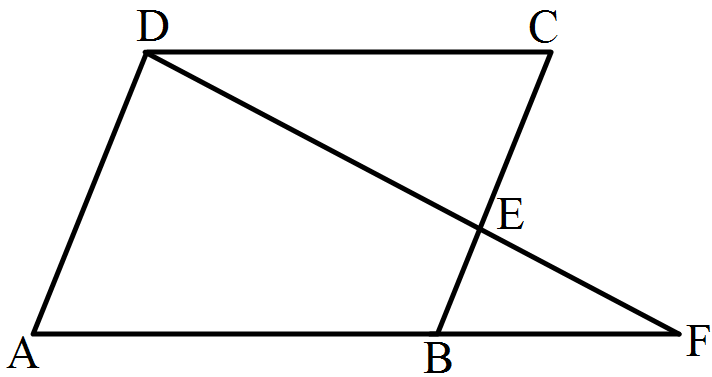
In $\triangle\text{CDE}$ and $\triangle\text{BFE,}$
$\angle\text{DEC}=\angle\text{FEB}$ ...(Vertically opposite angles)
$\angle\text{DCE}=\angle\text{FBE}$ ...(Alternate angles)
and $\text{CE = BE}$ ...(E is the mid-point.)
$\therefore\triangle\text{CDE}\cong\triangle\text{BFE}$ ...(By AA congruence criterion)
$\therefore\text{CD = BF}$ ...(C.P.C.T.)
Now,
$\text{AF = AB + BF}$
$\Rightarrow\text{AF + AB + CD}$ ...(from (i))
$\Rightarrow\text{AF = 2AB}$
Solution:
The bisectors of $\angle\text{APQ},\angle\text{BPQ},\angle\text{CQP}$ and $\angle\text{PQD}$ enclose a rectengle.
Solution:
The figure formed by joining the mid points of the adjacent sides of a square is a square.

Solution:

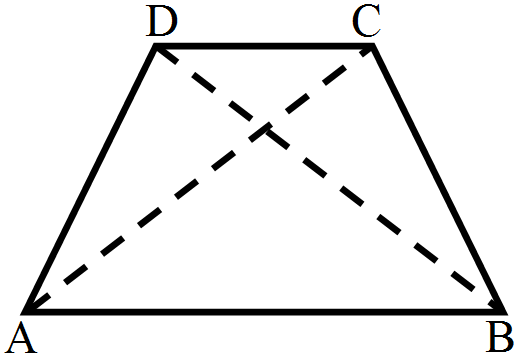
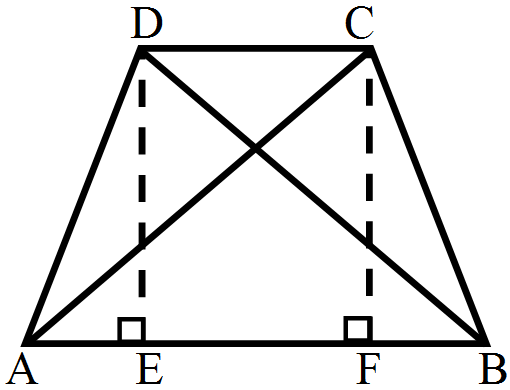
Construction: Draw perpendicular from D and C on AB which meets AB at E and F, respectively.
So, DEFC is a parallelogram, since one pair of opposite sides are parallel and equal.
In $\triangle\text{ABC},$
$\angle\text{B}$ is an acute angle.
$\Rightarrow\text{AC}^2=\text{BC}^2+\text{AB}^2-2\text{AB}\times\text{AE}$
In $\triangle\text{ABD},$
$\angle\text{A}$ is an acute angle.
$\Rightarrow\text{BD}^2=\text{AD}^2+\text{AB}^2-2\text{AB}\times\text{AF}$
$\Rightarrow\text{AC}^2+\text{BD}^2=\text{BC}^2+\text{AD}^2+2\text{AB}(\text{AB}-\text{BE}-\text{AF})$
$=\text{BC}^2+\text{AD}^2+2\text{AB}\times\text{EF}$
$=\text{BC}^2+\text{AD}^2+2\text{AB}\times\text{CD}$
Solution:
Let the common multiple be x.
$\therefore$ The angle measure 3x, 7x, 6x and 4x.
Since the sum of the angles of a quadrilateral is 360°, we have
3x + 7x + 6x + 4x = 360
⇒ 20x = 360
⇒ x = 18°
$\therefore$ The angles of the quadrilateral are
3x = 3(18) = 54°
7x = 7(18) = 126°
6x = 6(18) = 108° and
4x = 4(18) = 72°
Now, 54 + 126 = 180° and 108 + 72 = 180°
So, the angles are interior angles and hence we get one pair of parallel sides of ABCD.
Hence, ABCD is a trapezium.
Solution:
However, the triangle formed by joining the mid-point of the sides of an isosceles triangle is surely an isosceles triangle.
So, III is false
Thus, I and II are true.
Solution:
The diagonals are equal in a rectangle.
The diagonals in a parallelogram, rhombus or trapezium need not be equal.
Solution:
If the opposite sides of a quad. ABCD are equal, the quadrilateral is a parallelogram.
If the opposite angles are equal, then the quad. ABCD is a parallelogram.
Solution:
Area of a parallelogram = base ⨯ height
Since two parallelogram stand on equal bases and between the same parallel lines,
their heights are same.
$\therefore$ Areas are also same.
$\therefore$ The ratio of their area is 1 : 1.
Solution:
Let h be the heigth of the parallelogram.
Then, h < b.
We konw that, area of a parallelogram = base × height
If a is the base of the parallelogram, then area of a parallelogram = a × h
⇒ A = a × h
We know that, area of a rectangle = length × breadth
⇒ A = a × b
So, a × h < a × b
Hence, A < B.
Solution:
If the diagonals of a quadrilateral bisect each other at right angles,
then the figure is a rhombus.
This is because in a rhombus, the diagonals are perpendicular bisectors of each other.
Solution:
Let one of the angle of the || gm be x°.
According to the given condition,
$\therefore$ the adjacent angle $=\frac{2}{3}\text{x}^{\circ}$
Now,
$\text{x}+\frac{2}{3}\text{x}=180^{\circ}$ ...(Sum of the adjacent angles of || gm is 180°.)
$\Rightarrow\frac{3\text{x}+2\text{x}}{3}=180^{\circ}$
$\Rightarrow\frac{5\text{x}}{3}=180^{\circ}$
$\Rightarrow5\text{x}=540^{\circ}$
$\Rightarrow\text{x}=108^{\circ}$
⇒ the adjacent angles $=\frac{2}{3}(108)=36\times2=72^{\circ}$
Hence, the smallest angle is 72°.
Solution:

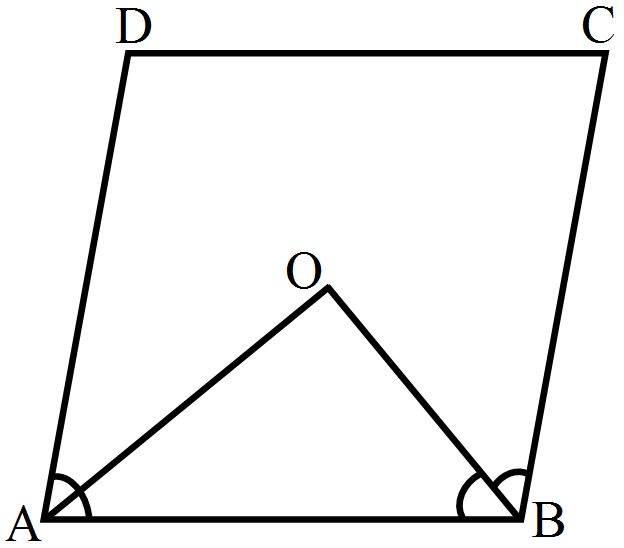
Consider parallelogram ABCD,
We know that, the sum if the adjacent angles of a parallelogram is 180°.
$\Rightarrow\angle\text{DAB}+\angle\text{CBA}=180^{\circ}$
$\Rightarrow\frac{1}{2}\angle\text{DAB}+\frac{1}{2}\angle\text{CBA}=\frac{1}{2}(180^{\circ})$
$\Rightarrow\angle\text{OAB}+\angle\text{OBA}=90^{\circ} ...(\text{i})$
Now,
In $\triangle\text{OAB},$
$\angle\text{OAB}+\angle\text{OBA}+\angle\text{AOB}=180^{\circ}$ ...(Angle sum property)
$\Rightarrow90^{\circ}+\angle\text{AOB}=180^{\circ}$ ...(from (i))
$\Rightarrow\angle\text{AOB}=90^{\circ}$
The bisectore of any adjacent angles of a parallelogram intersects at 90°.
Solution:
The bisectors of the angles of a parallelogram encloses a rectangle.
Solution:

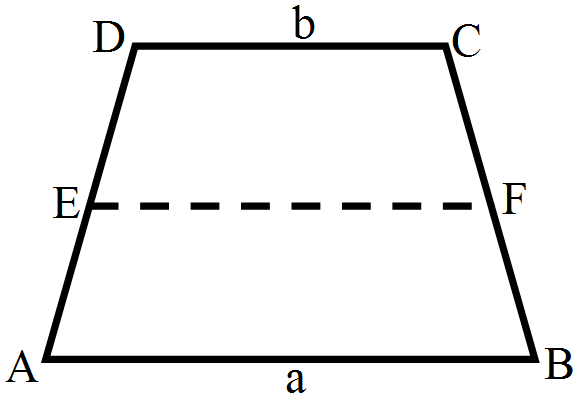
E and F are the given to be the mid-points of AD and BC respectively.
$\therefore\text{EF} = \frac{1}{2}(\text{AB + DC})$
$=\frac{1}{2}(\text{a + b})$
Solution:
The figure formed by joining the mid points of the adjacent sides of a quadrilateral is a parallelogram.
Solution:

In $\triangle\text{ABC},$ P and Q are the mid-points of sides AB and BC respectively.
$\therefore\text{PQ || AC}$ and $\text{PQ}=\frac{1}{2}\text{AC ...(i)}$
In $\triangle\text{BCD},$ Q and R are the mid-points of sides BC and CD respectively.
$\therefore\text{QR || BD}$ and $\text{QR}=\frac{1}{2}\text{BD ...(ii)}$
In $\triangle\text{ADC},$ S and R are the mid-points of sides AD and CD respectively.
$\therefore\text{RS || AC}$ and $\text{RS}=\frac{1}{2}\text{AC ...(iii)}$
In $\triangle\text{ABD},$ P and S are the mid-points of sides AB and AD respectively.
$\therefore\text{SP || BD}$ and $\text{SP}=\frac{1}{2}\text{BD ... (iv)}$
$\Rightarrow\text{PQ ∥ RS}$ and $\text{QR ∥ SP}$ [From (i), (ii), (iii) and (iv)]
Thus, PQRS is a parallelogram.
Now, AC = BD (given)
$\Rightarrow\frac{1}{2}\text{AC}=\frac{1}{2}\text{BD}$
$\Rightarrow\text{PQ = QR = RS = SP }$ [From (i), (ii), (iii) and (iv)]
Hence, PQRS is a rhombus if diagonals of ABCD are equal.

Solution:

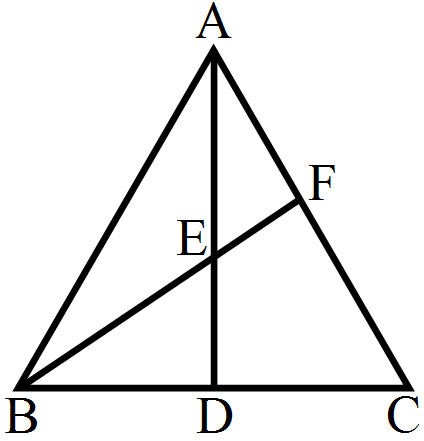
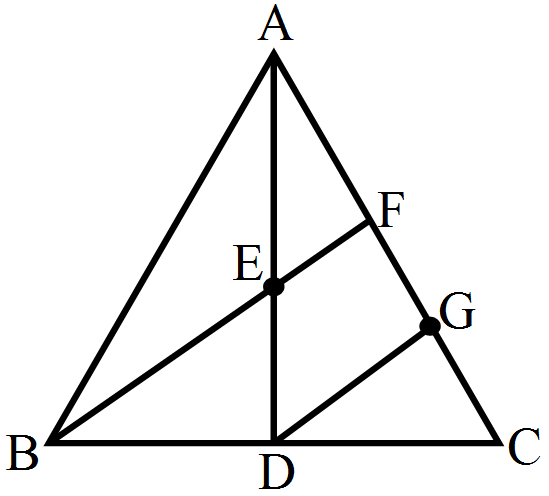
Construction: Join DG and G be the mid-point of FC.
Now,
In $\triangle\text{BCF, D}$ is the mid-point of BC and G is the mid-point of FC and F is the mid-point of AG.
$\Rightarrow\text{DG || BF}$
$\Rightarrow\text{DG || EF}$ ...(B - E - F)
$\Rightarrow\text{AF}=\text{FG}=\text{GC}$ ...(Since G is the mid-point.)
$\Rightarrow\text{AF}=\frac{1}{2}\text{AC}$
Solution:
Let the smallest angle be x°
⇒ its adjacent angle = (2x - 24)
Since sum of the adjacent angles = 180°
⇒ x + 2x - 24 = 180
⇒ 3x = 204
⇒ x = 68°
So, its adjacent angle = 2(68) - 24 = 136 - 24 = 112°.
Hence, the largest angle of the parallelogram is 112°.

Solution:
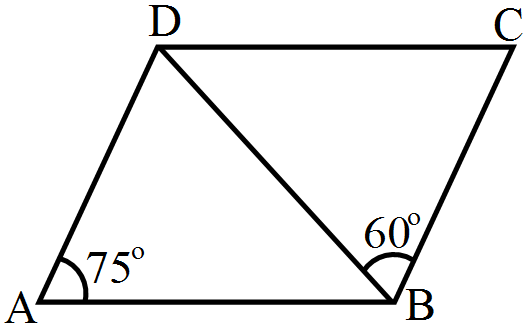
We know that, the opposite angles of a parallelogram are equal.
$\therefore\angle\text{C}=\angle\text{A}=75^{\circ}$
In $\triangle\text{BCD},$
$\angle\text{BCD}+\angle\text{BDC}+\angle\text{CBD}=180^{\circ}$ ...(Angle sum property)
$\Rightarrow75^{\circ}+\angle\text{BDC}+60^{\circ}=180^{\circ}$
$\Rightarrow\angle\text{BDC}=45^{\circ}$
Solution:
If the diagonals of a || gm ABCD are equal, then ‖gm ABCD could either be a rectangle or a square.
If the diagonals of the ‖gm ABCD intersect at right angles, then the ‖gm ABCD could be a square or a rhombus.
However, if both the statements are combined, then ‖gm ABCD will be a square.
Solution:

We konw that, the diagonals of a rhombus bisect each other at right angles.
So, Ac = 16cm and BD = 12cm
⇒ OA = 8cm and OB = 6cm
Also, $\angle\text{OAB}=90^{\circ}$
In right $\triangle\text{OAB},$
By Pythagoras theorem,
$\text{AB}^2=\text{OA}^2+\text{OB}^2$
$\Rightarrow\text{AB}^2=(8)^2+(6)^2$
$\Rightarrow\text{AB}^2=64+36$
$\Rightarrow\text{AB}^2=100$
$\Rightarrow\text{AB}=\sqrt{100}$
$\Rightarrow\text{AB}=10\text{cm}$
Hence, the length of each side of the rhombus is 10cm.
Solution:
Given that ABCD is a parallelogram.
We konw that, opposite sides of a parallelogram are parallel.
$\Rightarrow\angle\text{A}+\angle\text{B}=180^{\circ}$ ...(interior angles)
Also, $\angle\text{A}=\angle\text{B}=90^{\circ}$ ...(Given)
Since opposite angles of a parallelogram are equal,
$\angle\text{A}=\angle\text{C}$ and $\angle\text{B}=\angle\text{D}$
So, $\angle\text{A}=\angle\text{C}=\angle\text{B}=\angle\text{D}=90^{\circ}$
$\therefore$ ABCD is a rectangle.
Solution:

We know that, sum of the angles of a quadrilateral is 360°.
$\Rightarrow\angle\text{A}+\angle\text{B}+\angle\text{C}+\angle\text{D}=360^{\circ}$
$\Rightarrow\angle\text{A}+\angle\text{B}+70^{\circ}+30^{\circ}=360^{\circ}$
$\Rightarrow\angle\text{A}+\angle\text{B}=260^{\circ}$
$\Rightarrow\frac{1}{2}\angle\text{A}+\frac{1}{2}\angle\text{B}=\frac{1}{2}(260)^{\circ}$
$\Rightarrow\angle\text{BAO}+\angle\text{ABO}=130^{\circ}...(\text{i})$
In $\triangle\text{AOB},$
$\angle\text{BAO}+\angle\text{ABO}+\angle\text{AOB}=180^{\circ}$ ...(Angle sum Property)
$\Rightarrow130^{\circ}+\angle\text{AOB}=180^{\circ}$ ...(from (i))
$\Rightarrow\angle\text{AOB}=50^{\circ}$
Solution:
If the diagonals of a quad. ABCD bisect each other, then the quad. ABCD is a parallelogram.
So, I gives the answer.
If the diagonals are equal, then the quad. ABCD is a parallelogram.
So, II gives the answer.