Questions · Page 2 of 2

M.C.Q

Question 511 Mark
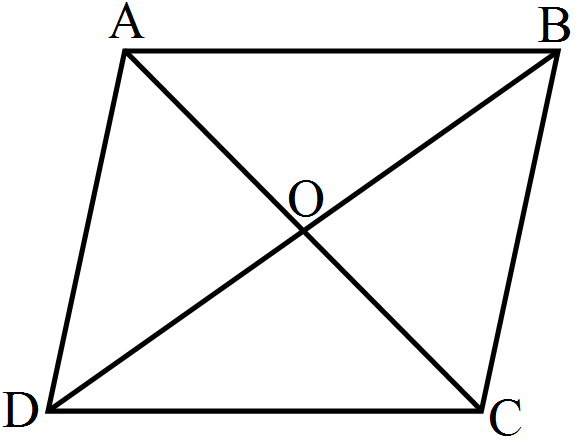
ABCD is a rhombus such that $\angle\text{ACB}=50^{\circ}.$ Then, $\angle\text{ADB}=?$
  1. 40°
  2. 25°
  3. 65°
  4. 130°
Answer
  1. 40°

Solution:

ABCD is a rhombus.

$\Rightarrow\text{AD || BC}$ and $\text{AC}$ is the transversal.

$\Rightarrow\angle\text{DAC}=\angle\text{ACB}$ (alternate angles)

$\Rightarrow\angle\text{DAC}=50^{\circ}$

In $\triangle\text{AOD},$ by angle sum property,

$\angle\text{AOD}+\angle\text{DAO}+\angle\text{ADO}=180^{\circ}$

$\Rightarrow90^{\circ}+\angle\text{50}^{\circ}+\angle\text{ADO}=180^{\circ}$

$\Rightarrow\angle\text{ADO}=40^{\circ}$

$\Rightarrow\angle\text{ADB}=40^{\circ}$
View full question & answer
Question 521 Mark
The angles of a quadrilateral are in the ratio 3 : 4 : 5 : 6. The smallest of these angles is:
  1. 45°
  2. 60°
  3. 36°
  4. 48°
Answer
  1. 60°

Solution:

Let tha common multipal be x.

$\therefore$ The angle measure 3x, 4x, 5x and 6x.

Since the sum of the angles of a quadrilateral being 360°, we have

3x + 4x + 5x + 6x = 360°

⇒18x = 360°

⇒ x = 20°

$\therefore$ The angles of the quadrilateral are

3x = 3(20) = 60°,

4x = 4(20) = 80°,

5x = 5(20)= 100°,

6x = 6(20) = 120°,

$\therefore$ The smallest angle is 60°.

View full question & answer
Question 531 Mark
Three angles of a quadrilateral are 80°, 95° and 112°. Its fourth angle is:
  1. 78°
  2. 73°
  3. 85°
  4. 100°
Answer
  1. 73°

Solution:

Let the measure of the fourth angle be xo.

We know that, the sum of the angles of a quadrilateral is 360o.

So, 80o + 95o + 112o + x = 360o

⇒ 287o + x = 360o ​

⇒ x = 73o

$\therefore$ Its fourth angle is 73o.

View full question & answer
Question 541 Mark
The figure formed by joining the mid-points of the adjacent sides of a rectangle is a:
  1. Rhombus.
  2. Square.
  3. Rectangle.
  4. Parallelogram.
Answer
  1. Rhombus.

Solution:

The figure formed by joining the mid points of the adjacent sides of a rectangle is a rhombus.

View full question & answer
Question 551 Mark
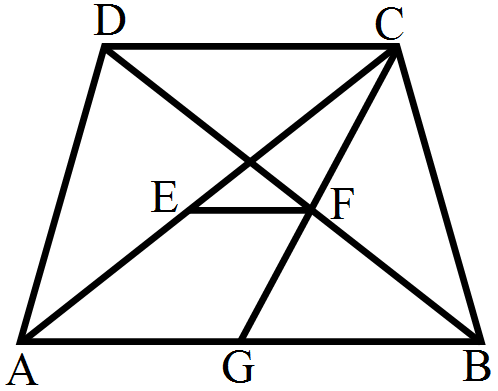
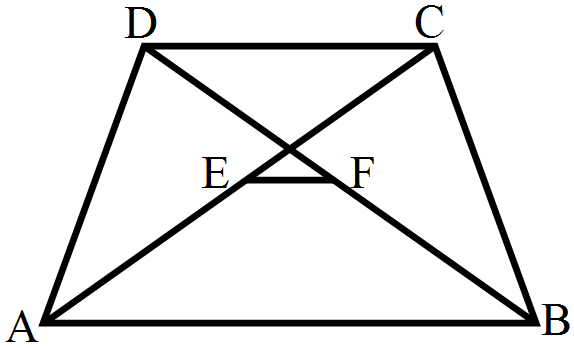
In a trapezium ABCD, if E and F be the mid-point of the diagonals AC and BD respectively. Then, EF = ?

  1. $\frac{1}{2}\text{AB}$

  2. $\frac{1}{2}\text{CD}$

  3. $\frac{1}{2}(\text{AB + CD})$

  4. $\frac{1}{2}(\text{AB}-\text{CD})$

Answer
  1. $\frac{1}{2}(\text{AB}-\text{CD})$

Solution:

Construction: join CF and extend it to meet AB at G.

In $\triangle\text{CDF}$ and $\triangle\text{GFB},$

$\angle\text{CDF}=\angle\text{GFB}$ ...(Vertically opposite angles)

$\text{AB || CD},$

So, $\angle\text{DCF}=\angle\text{GFB,}$ ...(alternate angles)

$\text{DF = FB}$ ...(F is the mid-point of BD)

$\Rightarrow\triangle\text{CDF}\cong\triangle\text{GFB}$ ...(ASA congruence criterion)

So, $\text{CD = GB}$ and $\text{CF = GF}$ ...(C.P.C.T.)

Since E and F are the mid-points of CA and CG respectively,

we have $\text{EF}=\frac{1}{2}\text{AG}$

$=\frac{1}{2}(\text{AB}-\text{GB})$

$=\frac{1}{2}(\text{AB}-\text{CD})$

View full question & answer
Question 561 Mark
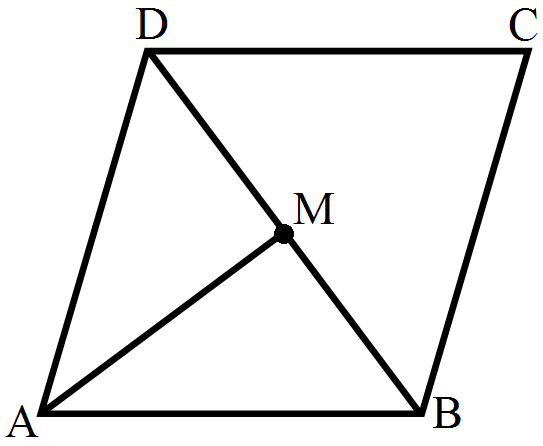
In the given figure, ABCD is a parallelogram, M is the mid-point of BD and BD bisects $\angle\text{B}$ as well as $\angle\text{D}.$ Then, $\angle\text{AMB}= ?$

  1. 45°
  2. 60°
  3. 90°
  4. 30°
Answer
  1. 90°,

Solution:

$\angle\text{ABC}=\angle\text{ADC}$ ...(Opposite angles of a parallelogram are equal)

$\Rightarrow\frac{1}{2}\angle\text{ABC}=\frac{1}{2}\angle\text{ADC}$

$\Rightarrow\angle\text{ABD}=\angle\text{ADB}$

So, $\text{AD = AB}$ ...(Sides opposite equal angles are equal.)

$\therefore\triangle\text{ABD}$ is isosceles

Also, M is the mid-point of BD.

$\therefore\text{AM}\perp\text{BD}$

$\therefore\angle\text{AMB}=90^{\circ}$

View full question & answer
M.C.Q - Page 2 - Maths STD 9 Questions - Vidyadip