Question types

Triangles [NEW] question types

210 questions across 10 question groups — pick any mix to generate a Maths paper with step-by-step answer keys.

210
Questions
10
Question groups
5
Question types
Sample Questions

Triangles [NEW] questions

One sample from each question group in this chapter. Select any group above to see the full set with answer keys.

Q 4M.C.Q1 Mark
The side BC of $\triangle A B C$ is produced to a point D. The bisector of $\angle A$ meets side BC in L. If $\angle A B C=30^{\circ}$ and $\angle A C D=115^{\circ}$, then $\angle A L C=$
  • A
    $85^{\circ}$
  • $72 \frac{1}{2}^{\circ}$
  • C
    $145^{\circ}$
  • D
    none of these

Answer: B.

View full solution
Q 5M.C.Q1 Mark
The side BC of $\triangle\text{ABC}$ is produced to a poin D. The bisector of $\angle\text{A}$ meet side BC in L. If $\angle\text{ABC}=30^\circ$ and $\angle\text{ACD}=115^\circ,$ then $\angle\text{ALC}=$

  1. $85^\circ$

  2. $72\frac{1}{2}^\circ$

  3. $145^\circ$

  4. $\text{None of these}$

View full solution
Statement-1 (A): The sum of any two sides of a triangle is greater than the third side.
Statement-2 (R): It is possible to construct a triangle with lengths of its sides as 4 cm, 3 cm and 7 cm.
  • A
    Statement-1 is true, Statement-2 is true; Statement-2 is a correct explanation for Statement-1.
  • B
    Statement-1 is true, Statement-2 is true; Statement-2 is not a correct explanation for Statement-1.
  • Statement-1 is true, Statement-2 is false.
  • D
    Statement-1 is false, Statement-2 is true.

Answer: C.

View full solution
Statement-1 (A): It is possible to construct a triangle with lengths of its sides as 8 cm, 7 cm and 4 cm .
Statement-2 (R): The sum of any two sides of a triangle is greater than the third side.
  • Statement-1 is true, Statement-2 is true; Statement-2 is a correct explanation for Statement-1.
  • B
    Statement-1 is true, Statement-2 is true; Statement-2 is not a correct explanation for Statement-1.
  • C
    Statement-1 is true, Statement-2 is false.
  • D
    Statement-1 is false, Statement-2 is true.

Answer: A.

View full solution
Statement-1 (A): It is not possible to construct a triangle with lengths of its sides as 9 cm , 7 cm and 17 cm .
Statement-2 (R): The difference of any two sides of a triangles is less than the third side.
  • A
    Statement-1 is true, Statement-2 is true; Statement-2 is a correct explanation for Statement-1.
  • Statement-1 is true, Statement-2 is true; Statement-2 is not a correct explanation for Statement-1.
  • C
    Statement-1 is true, Statement-2 is false.
  • D
    Statement-1 is false, Statement-2 is true.

Answer: B.

View full solution
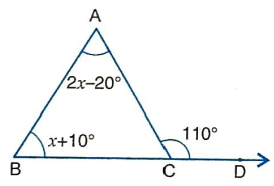
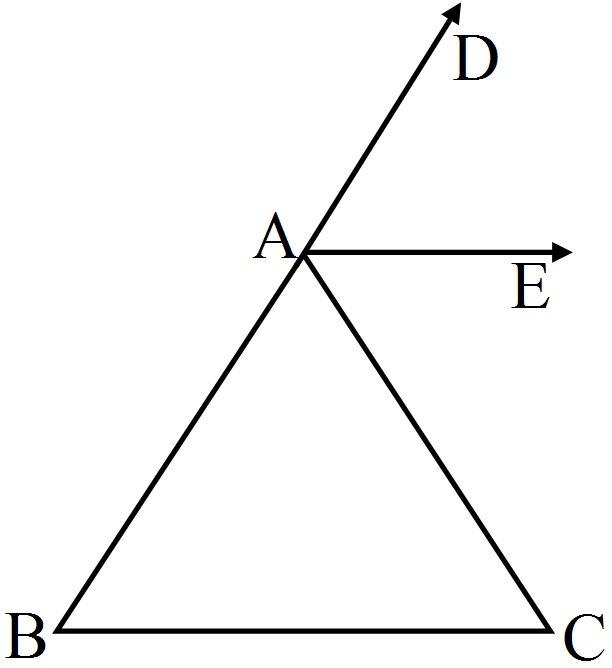
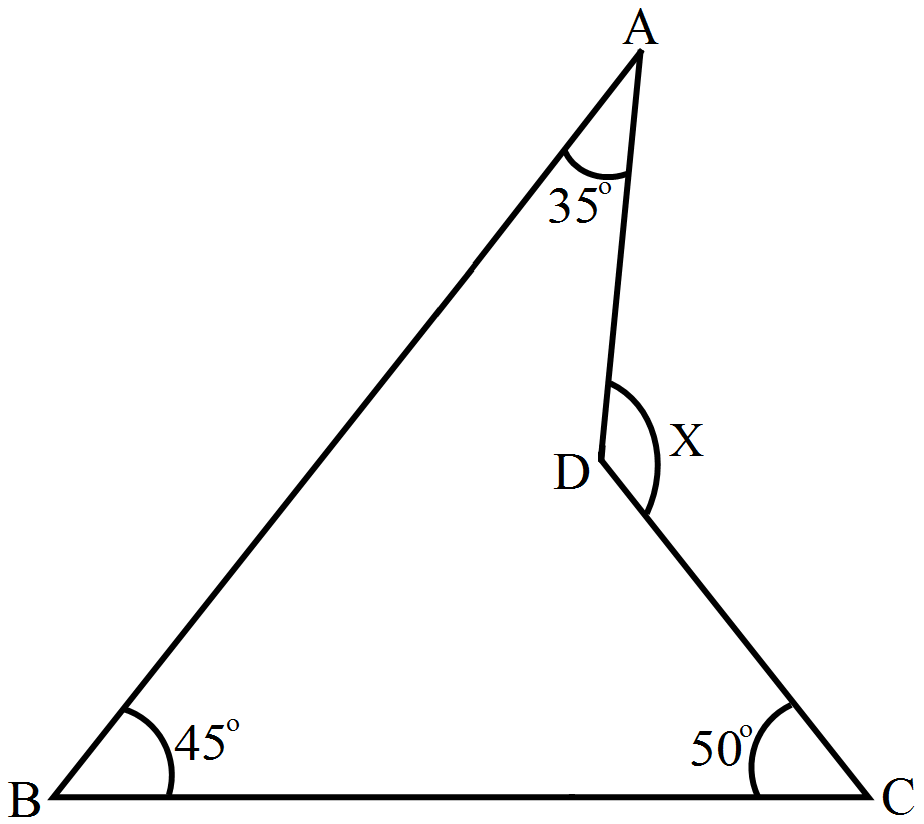
Statement-1 (A): In Fig., side BC of $\triangle A B C$ is produced to D. If $\angle A C D=110^{\circ}$, then $x=40^{\circ}$.
Statement-2 (R): If a side of a triangle is produced, the exterior angle so formed is equal to the sum of the two interior opposite angles.
Image
  • Statement-1 is true, Statement-2 is true; Statement-2 is a correct explanation for Statement-1.
  • B
    Statement-1 is true, Statement-2 is true; Statement-2 is not a correct explanation for Statement-1.
  • C
    Statement-1 is true, Statement-2 is false.
  • D
    Statement-1 is false, Statement-2 is true.

Answer: A.

View full solution
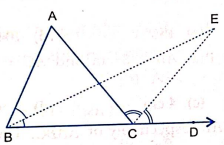
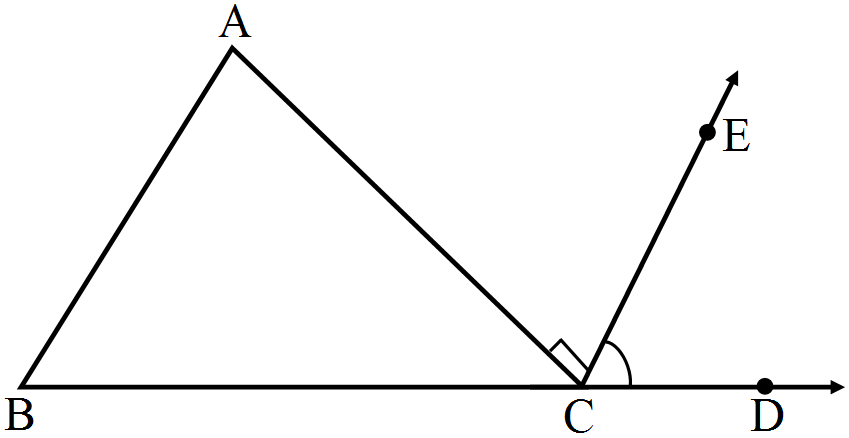
Statement-1 (A): In Fig. side $B C$ of $\triangle A B C$ is produced to a point $D$ such that the bisectors of $\angle A B C$ and $\angle A C D$ meet at a point $E$. If $\angle B A C=80^{\circ}$, then $\angle B E C=50^{\circ}$.
Image
Statement-2 (R): The angle between the internal bisector of one base angle and the external bisector of the other angle of a triangle is equal to one-half of the vertical angle.
  • A
    Statement-1 is true, Statement-2 is true; Statement-2 is a correct explanation for Statement-1.
  • B
    Statement-1 is true, Statement-2 is true; Statement-2 is not a correct explanation for Statement-1.
  • C
    Statement-1 is true, Statement-2 is false.
  • Statement-1 is false, Statement-2 is true.

Answer: D.

View full solution
In two triangles ABC and DEF, it is given that $\angle A = \angle D, \angle B = \angle E$ and $\angle C = \angle F$. Arethe two triangles necessarily congruent?
View full solution
In triangles ABC and CDE, if $AC = CE, BC = CD, \angle A = 60^{\circ}, \angle C = 30^{\circ}$ and $\angle D = 90^{\circ}$. Are two triangles congruent?
View full solution
Q 313 Marks Question3 Marks
Two angles of a triangle are equal and the third angle is greater than each of those angles by 30º. Determine all the angles of the triangle.
View full solution
The angles of a triangle are arranged in ascending order of magnitude. If the difference between two consecutive angles is 10°, find the three angles.
View full solution
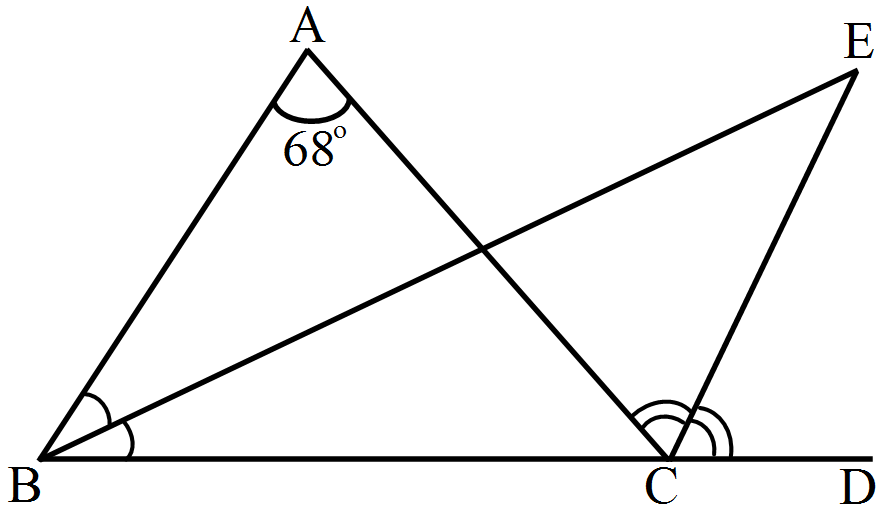
In the given figure, side BC of $\triangle\text{ABC}$ is produced to point D such that bisectors of $\angle\text{ACD}$ meet at a point E. If $\angle\text{BAC}=68^\circ,$ find $\angle\text{BEC}.$

View full solution
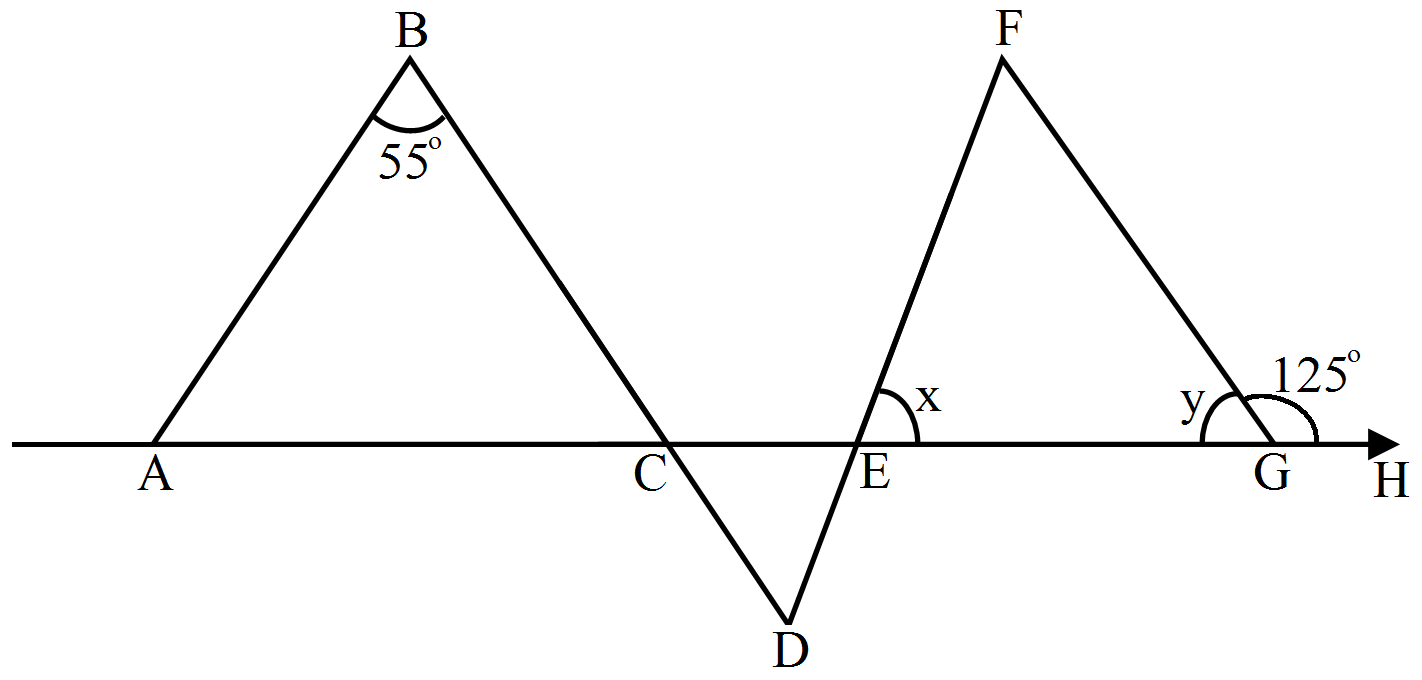
In the given figure, if $\text{AB }||\text{ DE}$ and $\text{BD }||\text{ FG}$ such that $\angle\text{FGH}=125^\circ$ and $\angle\text{B}=55^\circ,$ find x and y.

View full solution
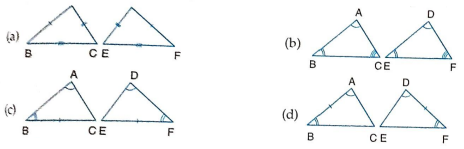
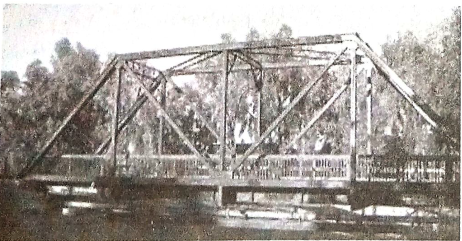
Engineers often use the familiar triangular shape for strength in bridge design. Triangles are effective tools for architecture and are used in the design of bridges, buildings and other structures as they provide strength and stability. The triangle is common in all sorts of building supports and trusses. Following are some questions on triangles:
Image
(i) In triangles ABC and DEF, if AB = DE, AC = EF and $\angle A=\angle E$. Then,
(a) $\triangle A B C \cong \triangle D E F$ by SAS criterion $\quad$(b) $\triangle A B C \cong \triangle E F D$ by SSS criterion
(c) $\triangle A B C \cong \triangle E D F$ by SAS criterion $\quad$(d) $\triangle A B C \cong \triangle E D F$ by ASA criterion
(ii) If $\triangle P R Q \cong \triangle D E F$, then $D E=$
(a) PR $\quad$(b) RQ $\quad$(c) PQ $\quad$(d) DF
(iii) Is it possible to construct a triangle with lengths of sides as 5 cm, 4 cm and 10 cm ?
(iv) In triangles ABC and DEF, AB = FD and $\angle A=\angle D$. Then the two triangles will be congruent by SAS axiom, if
(a) BC = EF $\quad$(b) AC = DE $\quad$(c) AC = EF $\quad$(d) BC = DE
View full solution
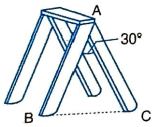
A ladder manufacturing company manufactures foldable step ladders of aluminum as shown in Fig. The lengths of two legs AB and AC are both equal to 110 cm and the angle between the two legs is $30^{\circ}$. On the basis of the above information answer the following questions:
Image
(i) $\angle A B C$ is equal to
(a) $70^{\circ}$ $\quad$(b) $75^{\circ}$(c) $85^{\circ}$ $\quad$(d) $60^{\circ}$
(ii) If $\angle B A C=60^{\circ}$, then $B C=$
(a) 120 cm $\quad$(b) 55 cm $\quad$(c) 110 cm $\quad$(d) 100 cm
(iii) $\triangle A B C$ is
(a) isosceles acute angled $\quad$ (b) right angled isosceles
(c) isosceles obtuse angled$\quad$(d) equilateral
(iv) In two triangles ABC and DEF, if $\angle A=\angle D, A B=D E$ and $A C=D F$, then the criterion by which two triangles are congruent is
(a) SSS $\quad$(b) ASA $\quad$(c) AAS $\quad$(d) SAS
View full solution
In $\triangle\text{ABC},$ if bisectors of $\angle\text{ABC}$ and $\angle\text{ACB}$ intersect at O at angle of 120°, then find the measure of $\angle\text{A}.$
View full solution
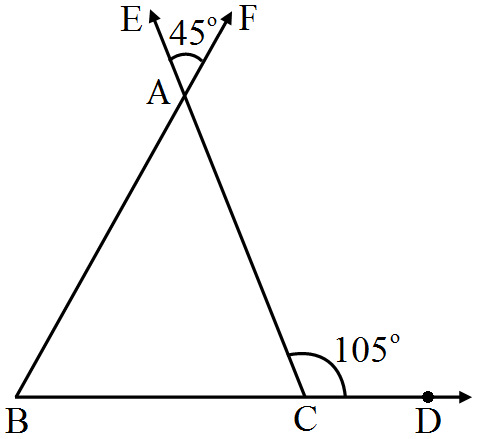
In Fig. the sides BC, CA and AB of a triangle ABC have been produced to D, E and F respectively. If $\angle\text{ACD}=105^\circ$ and $\angle\text{EAF}=45^\circ,$ find all the angles of the triangle ABC.

View full solution
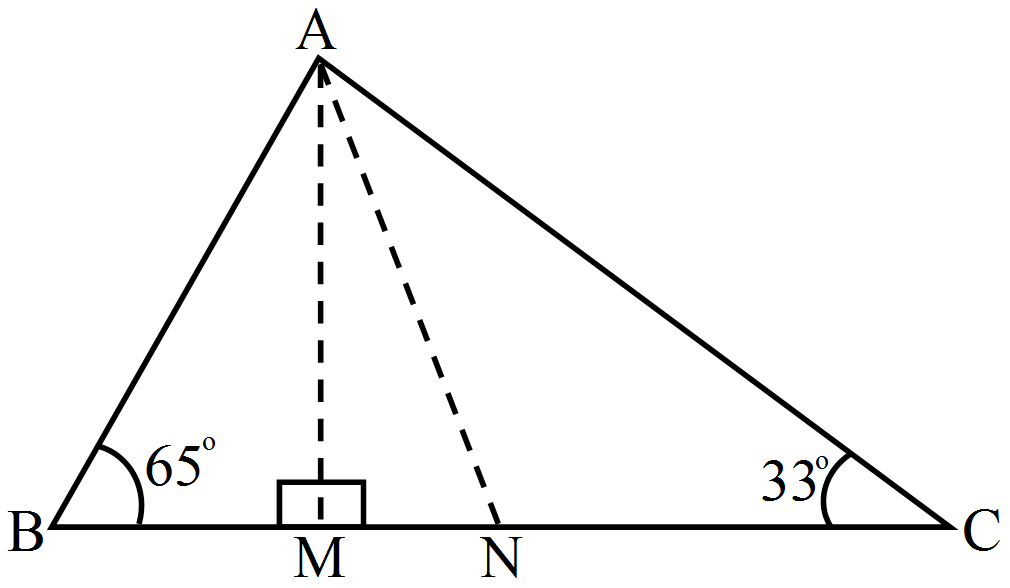
In Fig. $\text{AM}\perp\text{BC}$ and AN is the bisector of $\angle\text{A}.$ If $\angle\text{B}=65^\circ$ and $\angle\text{C}=33^\circ,$ find $\angle\text{MAN}.$

View full solution
In a $\triangle\text{ABC},$ the internal bisectors of $\angle\text{B}$ and $\angle\text{E}$ meet at P and the external bisectors of $\angle\text{B}$ and $\angle\text{C}$ meet at Q. Prove that $\angle\text{BPC}+\angle\text{BQC}=180^\circ.$
View full solution

Generate a Triangles [NEW] paper free

Pick question groups from the list above, set marks and difficulty, and export a branded PDF with step-by-step answer keys. First 3 chapters free — no signup.

Download App