Questions

M.C.Q. [1 M]

Take a timed test

16 questions · auto-graded multiple-choice test.

MCQ 11 Mark
Which of the following is soil borne disease?
  • A
    Leaf spot of rice
  • B
    Red rot of sugarcane
  • Smut of bajra
  • D
    Rust of wheat
Answer
Correct option: C.
Smut of bajra
(c) Smut of bajra
Explanation:
Soil-borne disease are caused by fungal pathogens which persist (survive) in the soil matrix and in residues on the soil surface are defined as soil-borne diseases. Smut of bajra is a soil-borne disease.
View full question & answer
MCQ 21 Mark
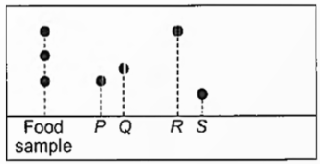
A food sample was tested for the presence of components P, G, R and S and the following chromatogram was obtained.
Image
The components not present in food sample are
  • A
    Q and R
  • B
    P and Q
  • C
    P and R
  • Q and S
Answer
Correct option: D.
Q and S
(d) Q and S
Explanation: Chromatogram of food sample does not match with the chromatograms of components Q and S.
View full question & answer
MCQ 31 Mark
Fermentation of grapes is an example of
  • A
    Redox reaction
  • B
    Reversible change
  • Chemical change
  • D
    Physical change
Answer
Correct option: C.
Chemical change
(c) Chemical change
Explanation:
i. The new substance is formed
ii. It is not reversible
iii. It is permanent
iv. After fermentation, you are not able to obtain grapes again.
So, Fermentation of grapes is an example of chemical change. 
View full question & answer
MCQ 41 Mark
"Viruses are non-cellular organisms" - this statement is a
  • A
    Partially false
  • True statement
  • C
    False statement
  • D
    Partially true
Answer
Correct option: B.
True statement
(b) True statement
Explanation: It is true that viruses are non-cellular organisms. Viruses do not contain cell membranes and other cellular organelles. Viruses are the link between the living and the non-living. They do not show any characteristics of life until they enter the body of a host. They then use the host cell machinery for reproduction.
View full question & answer
MCQ 51 Mark
Which of the following is non-vascular?
  • Epithelial tissue
  • B
    Muscular tissue
  • C
    Connective tissue
  • D
    Nervous tissue
Answer
Correct option: A.
Epithelial tissue
(a) Epithelial tissue
Explanation: Epithelial tissue is composed of cells laid together in sheets with the cells tightly connected to one another. Epithelial layers are non – vascular but innervated.
View full question & answer
MCQ 61 Mark
Statement 1: Isobars have different chemical properties.
Statement 2: The sum of protons and neutrons in isobars is always different.
  • Statement 1 is true and statement 2 is false.
  • B
    Both statements 1 and 2 are true but statement 2 is not the correct explanation of statement 1
  • C
    Both statements 1 and 2 are true and statement 2 is the correct explanation of statement 1.
  • D
    Both statements 1 and 2 are false.
Answer
Correct option: A.
Statement 1 is true and statement 2 is false.
(a) Statement 1 is true and statement 2 is false.
Explanation: Sum of protons and neutrons in isobars is same.
View full question & answer
MCQ 71 Mark
A signal from a space ship reaches the ground in $5$ minutes. What was the distance of the space ship from the ground station? The speed of the signal is $3 \times 10^8\ m / s$.
  • A
    $9 \times 10^7 m$
  • $9 \times 10^{10} m$
  • C
    $9 \times 10^6 m$
  • D
    $3 \times 10^6 m$
Answer
Correct option: B.
$9 \times 10^{10} m$
Time $=5$ minutes $=5 \times 60=300 \sec . $
Distance $=$ speed $\times$ time 
$=3 \times 10^8 m / s \times 300$
$=9 \times 10^{10} m$
View full question & answer
MCQ 81 Mark
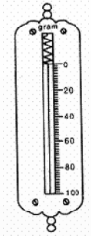
The least count of the spring balance shown in the diagram is:
Image
  • A
    1 g
  • 2 g
  • C
    0.5 g
  • D
    5 g
Answer
Correct option: B.
2 g
(b) 2 g
Explanation: $L . C .=\frac{20-0}{10}=\frac{20}{10}=2 g$
View full question & answer
MCQ 91 Mark
Girth of stem increases due to
  • A
    apical meristem
  • B
    vertical meristem
  • C
    intercalary meristem
  • lateral meristem
Answer
Correct option: D.
lateral meristem
(d) lateral meristem
Explanation: The lateral meristematic tissues are responsible for an increase in the diameter or girth of the plant.
View full question & answer
MCQ 101 Mark
The aumber of molecules in $CuSO _4 5 H _2 O$ bonded by H -bond is
  • A
    5
  • B
    3
  • C
    2
  • 1
Answer
Correct option: D.
1
(d) 1
Explanation: One molecule of water is linked by H-bond because only one molecule of water is present outside the coordination sphere.
View full question & answer
MCQ 111 Mark
Which of the following is absent in plant cells?
  • A
    Cell membrane
  • B
    Vacuole
  • C
    Mitochondria
  • Centriole
Answer
Correct option: D.
Centriole
(d) Centriole
Explanation: A centriole is an organelle that helps cells divide, or make copies of themselves. Centrioles are only found in animal cells. All centrioles are made of protein strands called microtubules.
View full question & answer
MCQ 121 Mark
The smooth muscle consists of ___________ Each fibre contains a single oval nucleus in its thick middle part. The cross-striations are absent so that the fibres look smooth, hence the name unstriated.
  • A
    straight, wide unbranched spindle-shaped fibres
  • long, narrow unbranched spindle-shaped fibres
  • C
    long, wide and spindle-shaped tissues
  • D
    short, wide unbranched spindle-shaped fibres
Answer
Correct option: B.
long, narrow unbranched spindle-shaped fibres
(b) long, narrow unbranched spindle-shaped fibres
Explanation: The smooth muscle consists of long, narrow unbranched spindle-shaped fibres. Each fibre contains a single oval nucleus in its thick middle part. The cross-striations are absent so that the fibres look smooth, hence the name unstriated.
View full question & answer
MCQ 131 Mark
What is the pulse rate of buffalo/minute?
  • 40-60/minute
  • B
    16-18/minute
  • C
    70-72/minute
  • D
    40-45/minute
Answer
Correct option: A.
40-60/minute
(a) 40-60/minute
Explanation: The pulse of cattle is taken at a point on the underside of the base of the tail, the normal rate is 40 - 80 per minute in the adult. In buffalo, the pulse rate is 40 - 60 per minute.
View full question & answer
MCQ 141 Mark
Two racing cars of masses m₁ and m₂ are moving in circles of radii r₁ and r₂ respectively. Their speeds are such that each makes a complete circle in the same length of time T. The ratio of angular speed of the first car to that of the second car is
  • A
    $r _1: r _2$
  • 1:1
  • C
    $m_1 r_2,: m_1 r_2$
  • D
    $m_1: m_2$
Answer
Correct option: B.
1:1
(b) 1:1
Explanation: Both the cars make a complete circle in the same time T, which means that angular speeds of both the cars are same.
$\because \omega=\frac{v}{r}=\frac{2 \pi r}{T r}=\frac{2 r}{T}$
View full question & answer
MCQ 151 Mark
A eukaryotic nucleus has a:
  • A
    non-porous, single membrane
  • B
    porous, single membrane
  • porous, double membrane
  • D
    non-porous, double membrane
Answer
Correct option: C.
porous, double membrane
(c) porous, double membrane
Explanation: The bounding structure of the eukaryotic nucleus. Composed of two phospholipid bilayers with the outer one connected to the endoplasmic reticulum. Double membrane structure riddled with pores that surround deoxyribonucleic acid in eukaryotes. The nuclear pores, like guards at an important government building, are very strict.
View full question & answer
MCQ 161 Mark
The name of A, B, C and D in the following diagram are
Image
  • A
    A - Solidification, B - Vaporisation, C -Fusion, D - Condensation
  • B
    A - Vapourisation, B - Fusion, C- Condensation, D - Solidification
  • A - Fusion, B - Vaporisation, C -Condensation, D - Solidification
  • D
    A - Condensation, B - Vaporisation, C - Solidification, D - Fusion
Answer
Correct option: C.
A - Fusion, B - Vaporisation, C -Condensation, D - Solidification
(c) A-Fusion, B-Vaporisation, C-Condensation, D-Solidification
Explanation:
i. A – Fusion: Change of solid state into liquid state is known as fusion.
ii. B – Vaporization: Change of liquid state into gases state is known as vaporization.
iii. C – Condensation: Change of gases state into liquid state is known as condensation.
iv. D – Solidification: Change of liquid state into solid state is known as solidification. 
View full question & answer