MCQ 11 Mark
If $\text{cosec x}+\cot \text{x}=\frac{11}{2},$ then $\tan\text{x}$ is equal to:
- A
$\frac{21}{22}$
- B
$\frac{15}{16}$
- ✓
$\frac{44}{117}$
- D
$\frac{117}{44}$
AnswerCorrect option: C. $\frac{44}{117}$
We have:
$\text{cosec}\text{ x}+\cot\text{x}=\frac{11}{2}\cdots(1)$
$\Rightarrow\frac{1}{\text{cosec}\text{ x}+\cot\text{x}}=\frac{2}{11}$
$\Rightarrow\frac{\text{cosec}^2\text{x}-\cot\text{x}}{\text{cosec }\text{x}-\cot\text{x}}=\frac{2}{11}$
$\Rightarrow\frac{(\text{cosec}\text{ x}+\cot\text{x})(\text{cosec}\text{ x}-\cot\text{x})}{(\text{cosec}\text{ x}+\cot\text{x})}=\frac{2}{11}$
$\therefore\text{cosec}\text{ x}-\cot\text{x}=\frac{2}{11}\cdots(2)$
subtracting $(2)$ from $(1):$
$\Rightarrow 2\cot\text{x}=\frac{11}{2}-\frac{2}{11}$
$\Rightarrow2\cot\text{x}=\frac{121-4}{22}$
$\Rightarrow2\cot\text{x}=\frac{117}{22}$
$\Rightarrow\cot\text{x}=\frac{117}{44}$
$\Rightarrow\frac{1}{\tan\text{x}}=\frac{117}{44}$
$\Rightarrow\tan\text{x}=\frac{44}{117}$
View full question & answer→MCQ 21 Mark
The smallest value of $x$ satisfying the equation $\sqrt{3}(\cot\text{x}+\tan\text{x})=4$ is:
- A
$\frac{2\pi}{3}$
- B
$\frac{\pi}{3}$
- ✓
$\frac{\pi}{6}$
- D
$\frac{\pi}{12}$
AnswerCorrect option: C. $\frac{\pi}{6}$
Given:
$\sqrt{3}(\cot\text{x}+\tan\text{x})=4$
$\Rightarrow\sqrt{3}\Big(\frac{\cos\text{x}}{\sin\text{x}}+\frac{\sin\text{x}}{\cos\text{x}}\Big)=4$
$\Rightarrow\sqrt{3}(\cos^2\text{x}+\sin^2\text{x})=4\sin\text{x}\cos\text{x}$
$\Rightarrow\sqrt{3}=2\sin2\text{x}$ $\big[\sin2\text{x}=2\sin\text{x}\cos\text{x}\big]$
$\Rightarrow\sin2\text{x}=\frac{\sqrt{3}}{2}$
$\Rightarrow\sin2\text{x}=\sin\frac{\pi}{3}$
$\Rightarrow2\text{x}=\text{n}\pi+(-1)^{\text{n}}\frac{\pi}{3},\text{n}\in\text{Z}$
$\Rightarrow\text{x}=\frac{\text{n}\pi}{2}+(-1)^{\text{n}}\frac{\pi}{6},\text{n}\in\text{Z}$
To obtain the smallest value of $x,$ we will put $n = 0n = 0$ in the above equation.
Thus, we have:
$\text{x}=\frac{\pi}{6}$
Hence, the smallest value of $x$ is $\frac{\pi}{6}.$
View full question & answer→MCQ 31 Mark
$\sec^2\text{x}=\frac{4\text{xy}}{(\text{x}+\text{y})^2}$ is true if and only if
AnswerCorrect option: B. $\text{x=y, x}\neq0$
We have:
$\sec^2\text{x}=\frac{4\text{xy}}{(\text{x}+\text{y})^2}$
$\Rightarrow\frac{4\text{x}\text{y}}{(\text{x}+\text{y})^2}\geq1 $ $[\therefore\sec^2\text{x}\geq1]$
$\Rightarrow4\text{xy}\geq(\text{x}+\text{y})^2$
$\Rightarrow4\text{xy}\geq\text{x}^2+\text{y}^2+2\text{xy}$
$\Rightarrow2\text{xy}\geq\text{x}^2+\text{y}^2$
$\Rightarrow(\text{x}-\text{y})^2\leq0$
$\Rightarrow(\text{x}-\text{y})\leq0$
$\Rightarrow\text{x}=\text{y}$
For $\text{x}=0,\sec^2\text{x}$ will not be defined,
$\Rightarrow\text{x}\neq 0$
$\therefore\text{x}=\text{y}$
View full question & answer→MCQ 41 Mark
The value of $\frac{\sin5\alpha-\sin\beta}{\cos5\alpha+2\cos4\alpha+\cos3\alpha}$ is:
- A
$\cot\frac{\alpha}{2}$
- B
$\cot\alpha$
- ✓
$\tan\frac{\alpha}{2}$
- D
AnswerCorrect option: C. $\tan\frac{\alpha}{2}$
$\frac{\sin5\alpha-\sin3\alpha}{\cos5\alpha+2\cos4\alpha+\cos3\alpha}$
$=\frac{\sin5\alpha-\sin3\alpha}{\cos5\alpha+\cos3\alpha+2\cos4\alpha}$
$=\frac{2\sin\alpha\cos4\alpha}{2\cos4\alpha\cos\alpha+2\cos4\alpha}$
$=\frac{2\sin\alpha\cos4\alpha}{2\cos4\alpha(\cos\alpha+1)}$
$=\frac{\sin\alpha}{\cos\alpha+1}$
$=\frac{2\sin\frac{\alpha}{2}\cos\frac{\alpha}{2}}{\cos^2\frac{\alpha}{2}-\sin^2\frac{\alpha}{2}+\sin^2\frac{\alpha}{2}+\cos^2\frac{\alpha}{2}}$
$=\frac{2\sin\frac{\alpha}{2}\cos\frac{\alpha}{2}}{2\cos^2\frac{\alpha}{2}}$
$=\frac{\sin\frac{\alpha}{2}}{\cos^2\frac{\alpha}{2}}$
$=\tan\frac{\alpha}{2}$
View full question & answer→MCQ 51 Mark
If in $\text{a}\triangle\text{ABC},\tan\text{B}+\tan\text{C}=6,$ then $\cot\text{A}\cot\text{B}\cot\text{C}=$
AnswerCorrect option: C. $\frac16$
In $\triangle\text{ABC},$
$\text{A+B+C}=\pi$
We know that $\tan(\text{A+B+C)}=\frac{\tan\text{A}+\tan\text{B}+\tan\text{C}-\tan\text{A}\tan\text{B}\tan\text{C}}{1-\tan\text{A}\tan\text{B}-\tan\text{B}\tan\text{C}-\tan\text{C}\tan\text{A}}$ and $\tan\pi=0.$
$\therefore\tan\text{A}+\tan\text{B}+\tan\text{C}-\tan\text{A}\tan\text{B}\tan\text{C}=0$
$\tan\text{A}+\tan\text{B}+\tan\text{C}=\tan\text{A}\tan\text{B}\tan\text{C}$
If $\tan\text{A}+\tan\text{B}+\tan\text{C}=6,\tan\text{A}\tan\text{B}\tan\text{C}=6$
$\Rightarrow\frac{1}{\tan\text{A}\tan\text{B}\tan\text{C}}=\frac16$
$\Rightarrow\cot\text{A}\cot\text{B}\cot\text{C}=\frac16$
View full question & answer→MCQ 61 Mark
$\text{If}\ \sin\alpha+\sin\beta=\text{a}\text{ and }\cos\alpha-\cos\beta=\text{b},\ \text{than }\tan\frac{\alpha-\beta}{2}=$
- A
$-\frac{\text{a}}{\text{b}}$
- ✓
$-\frac{\text{b}}{\text{a}}$
- C
$\sqrt{\text{a}^2+\text{b}^2}$
- D
AnswerCorrect option: B. $-\frac{\text{b}}{\text{a}}$
Given:
$\sin\alpha+\sin\beta=\text{a}...(\text{i})$
$\cos\alpha-\cos\beta=\text{b}...(\text{ii})$
Dividing $(i)$ by $(ii):$
$\Rightarrow\ \frac{\sin\alpha+\sin\beta}{\cos\alpha-\cos\beta}=\frac{\text{a}}{\text{b}}$
$\Rightarrow\ \frac{2\sin\big(\frac{\alpha+\beta}{2}\big)\cos\big(\frac{\alpha-\beta}{2}\big)}{-2\sin\big(\frac{\alpha+\beta}{2}\big)\sin\big(\frac{\alpha-\beta}{2}\big)}=\frac{\text{a}}{\text{b}}$ $\Big[\because\ \sin\text{A}+\sin\text{B}=2\sin\Big(\frac{\text{A+B}}{2}\Big)\cos\Big(\frac{\text{A}-\text{B}}{2}\Big)\text{ and }\cos\text{A}+\cos\text{B}$
$\Rightarrow\ \frac{\sin\Big(\frac{\alpha+\beta}{2}\Big)\cos\Big(\frac{\alpha-\beta}{2}\Big)}{-\sin\Big(\frac{\alpha+\beta}{2}\Big)\cos\Big(\frac{\alpha-\beta}{2}\Big)}=\frac{\text{a}}{\text{b}}$
$\Rightarrow\ \cot\Big(\frac{\alpha-\beta}{2}\Big)=-\frac{\text{a}}{\text{b}}$
$\Rightarrow\ \frac{1}{\cot\Big(\frac{\alpha-\beta}{2}\Big)}=\frac{1}{-\frac{\text{a}}{\text{b}}}$
$\Rightarrow\ \tan\Big(\frac{\alpha-\beta}{2}\Big)=-\frac{\text{b}}{\text{a}}$
View full question & answer→MCQ 71 Mark
If $A$ lies in second quadrant $3\tan\text{A}+4=0,$ then the value of $2\cot\text{A}-5\cot\text{A}+\sin\text{A}$ is:
- A
$-\frac{53}{10}$
- ✓
$\frac{23}{10}$
- C
$\frac{37}{10}$
- D
$\frac{7}{10}$
AnswerCorrect option: B. $\frac{23}{10}$
It is given that $\frac{\pi}{2}<\text{A}<\pi$
$3\tan\text{A}+4=0$
$\Rightarrow\tan\text{A}=-\frac{4}{3}$
$\Rightarrow\cot\text{A}=-\frac{3}{4}$
Now,
$\sec\text{A}=\pm\sqrt{1+\tan^2\text{A}}$
$=\pm\sqrt{1+\frac{16}{9}}$
$=\pm\sqrt{\frac{25}{9}}=\pm\frac{5}{3}$
Also,
$\sin\text{A}=\pm\sqrt{1-\cos^2\text{A}}$
$=\pm\sqrt{1-\frac{9}{25}}$
$=\pm\sqrt{\frac{16}{25}}=\pm\frac{4}{5}$
$\therefore\sin\text{A}=\frac{4}{5} (A$ lines in $2^{nd}$ quadrant$)$
so,
$2\cot\text{A}-5\cos\text{A}+\sin\text{A}$
$=2\times\Big(-\frac{3}{5}\Big)-5\times\Big(-\frac{3}{5}\Big)+\frac{4}{5}$
$=-\frac{3}{2}+3+\frac{4}{5}$
$=-\frac{15+30+8}{10} $
$=\frac{23}{10}$
Hence,the correct answer is option $B.$
View full question & answer→MCQ 81 Mark
If $\tan\theta_1\tan\theta_2=\text{k},$ then $\frac{\cos(\theta_1-\theta_2)}{\cos(\theta_1+\theta_2)}=$
- ✓
$\frac{1+\text{k}}{1-\text{k}}$
- B
$\frac{1-\text{k}}{1+\text{k}}$
- C
$\frac{\text{k}+1}{\text{k}-1}$
- D
$\frac{\text{k}-1}{\text{k}+1}$
AnswerCorrect option: A. $\frac{1+\text{k}}{1-\text{k}}$
$\frac{\cos(\theta_1-\theta_2)}{\cos(\theta_1+\theta_2)}$
$=\frac{\cos\theta_1\cos\theta_2+\sin\theta_1\sin\theta_2}{\cos\theta_1\cos\theta_2-0\sin\theta_1\sin\theta_2}$
Dividing numerator and denominator by $\cos\theta_1\cos\theta_2,$ we get:
$\frac{1+\tan\theta_1\tan\theta_2}{1-\tan\theta_1\tan\theta_2}$
$=\frac{1+\text{k}}{1-\text{k}}$
View full question & answer→MCQ 91 Mark
If $\text{cosec x}+\cot\text{x}=\frac{11}{2},$ then $\tan\text{x}=$
- A
$\frac{21}{22}$
- B
$\frac{15}{16}$
- ✓
$\frac{44}{117}$
- D
$\frac{117}{43}$
AnswerCorrect option: C. $\frac{44}{117}$
We have:
$\text{cosec}\text{ x}+\cot\text{x}=\frac{11}{2}\cdots(1)$
$\Rightarrow\frac{1}{\text{cosec}\text{ x}+\cot\text{x}}=\frac{2}{11}$
$\Rightarrow\frac{\text{cosec}^2\text{x}-\cot\text{x}}{\text{cosec}\text{ x}-\cot\text{x}}=\frac{2}{11}$
$\Rightarrow\frac{(\text{cosec}\text{ x}+\cot\text{x})(\text{cosec}\text{ x}-\cot\text{x})}{(\text{cosec}\text{ x}+\cot\text{x})}=\frac{2}{11}$
$\therefore\text{cosec}\text{ x}-\cot\text{x}=\frac{2}{11}\cdots(2)$
subtracting $(2)$ from $(1):$
$\Rightarrow 2\cot\text{x}=\frac{11}{2}-\frac{2}{11}$
$\Rightarrow2\cot\text{x}=\frac{121-4}{22}$
$\Rightarrow2\cot\text{x}=\frac{117}{22}$
$\Rightarrow\cot\text{x}=\frac{117}{44}$
$\Rightarrow\frac{1}{\tan\text{x}}=\frac{117}{44}$
$\Rightarrow\tan\text{x}=\frac{44}{117}$
View full question & answer→MCQ 101 Mark
General solution of $\tan5\text{x}=\cot2\text{x}$ is:
- A
$\frac{\text{n}\pi}{7}+\frac{\pi}{2},\ \text{n}\in\text{Z}$
- B
$\text{x}=\frac{\text{n}\pi}{7}+\frac{\pi}{3},\ \text{n}\in\text{Z}$
- ✓
$\text{x}=\frac{\text{n}\pi}{7}+\frac{\pi}{14},\ \text{n}\in\text{Z}$
- D
$\text{x}=\frac{\text{n}\pi}{7}=\frac{\pi}{14},\ \text{n}\in\text{Z}$
AnswerCorrect option: C. $\text{x}=\frac{\text{n}\pi}{7}+\frac{\pi}{14},\ \text{n}\in\text{Z}$
Given:
$\tan5\text{x}=\cot2\text{x}$
$\Rightarrow\tan5\text{x}=\tan\Big(\frac{\pi}{2}-2\text{x}\Big)$
$\Rightarrow5\text{x}=\text{n}\pi+\frac{\pi}{2}-2\text{x}$
$\Rightarrow7\text{x}=\text{n}\pi+\frac{\pi}{2}$
$\Rightarrow\text{x}=\frac{\text{n}\pi}{7}+\frac{\pi}{14},\ \text{n}\in\text{Z}$
View full question & answer→MCQ 111 Mark
Choose the correct answer. The value of $\sin50^\circ-\sin70^\circ+\sin10^\circ$ is equal to:
- A
$1$
- ✓
$0$
- C
$\frac{1}{2}$
- D
$2$
Answer$\sin50^\circ-\sin70^\circ+\sin10^\circ$
$=2\cos\Big(\frac{50^\circ+70^\circ}{2}\Big)\sin\Big(\frac{50^\circ-70^\circ}{2}\Big)+\sin10^\circ$
$=-2\cos60^\circ\sin10^\circ+\sin10^\circ$
$=-2\cdot\frac{1}{2}\sin10^\circ+\sin10^\circ$
$=0$
View full question & answer→MCQ 121 Mark
In a triangle $\text{ABC}, a = 4, b = 3, \angle\text{A}=60^{\circ}$ then $c$ is a root of the equation:
- ✓
$\text{c}^2-3\text{c}-7=0$
- B
$\text{c}^2+3\text{c}+7=0$
- C
$\text{c}^2-3\text{c}+7=0$
- D
$\text{c}^2+3\text{c}-7=0$
AnswerCorrect option: A. $\text{c}^2-3\text{c}-7=0$
It is given that $a = 4, b = 3$ and $\angle\text{A}=60^{\circ}$
Using cosine rule, we have
$\cos\text{A}=\frac{\text{b}^2+\text{c}^2-\text{a}^2}{2\text{bc}}$
$\Rightarrow\cos60^{\circ}=\frac{9+\text{c}^2-16}{2\times3\times\text{c}}$
$\Rightarrow\frac{1}{2}=\frac{\text{c}^2-7}{6\text{c}}$
$\Rightarrow\text{c}^2-7=3\text{c}$
$\Rightarrow\text{c}^2-3\text{c}-7=0$
Thus, $c$ is the root of $\text{c}^2-3\text{c}-7=0.$
Hence, the correct answer is option $(a).$
View full question & answer→MCQ 131 Mark
What is the value of $\Big(\sin\frac{22.1}{2}+\cos\frac{22.1}{2}\Big)4?$
- ✓
$3+\frac{2\sqrt{2}}{2}$
- B
$1+\frac{2\sqrt{2}}{2}$
- C
$3\sqrt{2}+2$
- D
$1$
AnswerCorrect option: A. $3+\frac{2\sqrt{2}}{2}$
View full question & answer→MCQ 141 Mark
The value of $\Big(\cot\frac{\text{x}}{2}-\tan\frac{\text{x}}{2}\Big)^2(1-2\tan\text{x}\cot2\text{x})$ is:
AnswerWe have,
$\big(\cot\frac{\text{x}}{2}-\tan\frac{\text{x}}{2}\big)(1-2\tan\text{x}\cot2\text{x})$
$\big(\cot^2\frac{\text{x}}{2}-2\cot\frac{\text{x}}{2}+\tan^2\frac{\text{x}}{2}\big)\Big\{1-2\tan\text{x}\Big(\frac{\cot^2\text{x}-1}{2\cot\text{x}}\Big)\Big\}$
$\big(\cot^2\frac{\text{x}}{2}-2+\tan^2\frac{\text{x}}{2}\big)\Big\{1-\tan\text{x}\Big(\frac{\cot^2\text{x}-1}{\cot\text{x}}\Big)\Big\}$
$\big(\cot^2\frac{\text{x}}{2}+\tan^2\frac{\text{x}}{2}-2\big)\Big(1-\frac{\cot^2\text{x}-\tan\text{x}}{\cot\text{x}}\Big)$
$\big(\cot^2\frac{\text{x}}{2}+\tan^2\frac{\text{x}}{2}-2\big)\big(\tan^2\text{x}\big)$
$\big(\cot^2\frac{\text{x}}{2}+\tan\frac{\text{x}}{2}-2\big)\Bigg(\frac{2\tan\frac{\text{x}}{2}}{1-\tan^2\frac{\text{x}}{2}}\Bigg)^2$
$=\frac{1}{\big(1-\tan^2\frac{\text{x}}{2}\big)^2}\big(4+4\tan^4\frac{\text{x}}{2}-8\tan^2\frac{\text{x}}{2}\big)$
$=\frac{1}{\big(1-\tan^2\frac{\text{x}}{2}\big)^2}\big(4-8\tan^2\frac{\text{x}}{2}+4\tan^4\frac{\text{x}}{2}\big)$
$=\frac{1}{\big(1-\tan^2\frac{\text{x}}{2}\big)^2}\Big\{\big(\tan^2\frac{\text{x}}{2}\big)^2-2\big(\tan^2\frac{\text{x}}{2}+1\big)\Big\}$
$=\frac{4\big(\tan^2\frac{\text{x}}{2}-1\big)^2}{\big(1-\tan^2\frac{\text{x}}{2}\big)^2}$
$=4$
View full question & answer→MCQ 151 Mark
Choose the correct answer.If $\tan\theta=3$ and $\theta$ lies in third quadrant, then the value of $\sin\theta$ is:
- A
$\frac{1}{\sqrt{10}}$
- B
$-\frac{1}{\sqrt{10}}$
- C
$\frac{-3}{\sqrt{10}}$
- ✓
$\frac{3}{\sqrt{10}}$
AnswerCorrect option: D. $\frac{3}{\sqrt{10}}$
$\tan\theta=3,\theta$ lies in third quadrant, it is positive.
$\tan\theta=\frac{\text{P}}{\text{B}}=\frac{3}{1}$
Then, Hypotenuse $=\sqrt{(3)^2+(1)^2}=\sqrt{9+1}=\sqrt10$
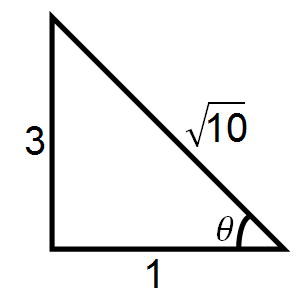
$\therefore\sin\theta=\frac{3}{\sqrt{10}}$ where $\theta$ lies in third quadrant
Hence the correct option is $(D).$ View full question & answer→MCQ 161 Mark
The value of $\cos52^\circ+\cos68^\circ+\cos172^\circ\text{ is }$
- ✓
$0$
- B
$1$
- C
$2$
- D
$\frac{3}{2}$
Answer$\cos52^\circ+\cos68^\circ+\cos172^\circ$
$=\ 2\cos\Big(\frac{52^\circ+68^\circ}{2}\Big)\cos\Big(\frac{52^\circ-68^\circ}{2}\Big)+\cos172^\circ$ $\Big[\because\ \cos\text{A}+\cos\text{B}=2\cos\Big(\frac{\text{A+B}}{2}\Big)\cos\Big(\frac{\text{A}-\text{B}}{2}\Big)\Big]$
$=\ 2\cos60^\circ\cos(-8^\circ)+\cos172^\circ$
$=\ 2\times\frac{1}{2}\cos8^\circ+\cos172^\circ$
$=\ \cos8^\circ+\cos172^\circ$
$=\ 2\cos\Big(\frac{8^\circ+172^\circ}{2}\Big)\cos\Big(\frac{8^\circ-172^\circ}{2}\Big)$
$=\ 2\cos90^\circ\cos82^\circ$
$=\ 0$
View full question & answer→MCQ 171 Mark
The value of $\sin78^\circ-\sin66^\circ-\sin42^\circ+\sin6^\circ\text{ is }$
- A
$\frac{1}{2}$
- ✓
$-\frac{1}{2}$
- C
$-1$
- D
AnswerCorrect option: B. $-\frac{1}{2}$
$\sin(60^\circ+18^\circ)-\sin(60^\circ-18^\circ)-(\sin66^\circ-\sin6^\circ)$
$=\ \sin60^\circ\cos18^\circ+\cos60^\circ\sin18^\circ-\sin60^\circ\cos18^\circ\\ \ \ \ +\cos60^\circ\sin18^\circ-(2\cos36^\circ\frac{1}{2})$
$=\ 2\times\frac{1}{2}\cos18^\circ-\cos36^\circ$
$=\ \frac{\sqrt5-1}{4}-\frac{\sqrt5+1}{4}$
$=\ \frac{-2}{4}$
$=\ \frac{-1}{2}$
View full question & answer→MCQ 181 Mark
If $\tan\text{X}=\frac{\text{a}}{\text{b}},$ then $\text{b}\cos2\text{x}+\text{a}\sin2\text{x}$ is equal to:
AnswerCorrect option: B. $\text{b}$
Givan: $\tan\text{x}=\frac{\text{a}}{\text{b}}$
Now,
$=\cos2\text{x}+\alpha\sin2\text{x}$
$=\text{b}\Big(\frac{1-\tan^2\text{x}}{1+\tan^2\text{x}}\Big)+\text{a}\Big(\frac{2\tan\text{x}}{1+\tan^2\text{x}}\Big)$
$=\text{b}\Bigg(\frac{1-\frac{\text{a}^2}{\text{b}^2}}{1+\frac{\text{a}^2}{\text{b}^2}}\Bigg)+\text{a}\Bigg(\frac{1\times\frac{\text{a}}{\text{b}}}{1+\frac{\text{a}^2}{\text{b}^2}}\Bigg)$
$=\frac{\text{b}(\text{b}^2-\text{a}^2)}{\text{a}^2+\text{b}^2}+\frac{2\text{a}^2\text{b}^2}{\text{a}^2+\text{b}^2}$
$=\frac{\text{b}^3-\text{a}^2\text{b}+2\text{a}^2\text{b}}{\text{a}^2+\text{b}^2}$
$=\frac{\text{b}^3+\text{a}^2\text{b}}{\text{a}^2+\text{b}^2}$
$=\frac{\text{b}(\text{b}^2+\text{a}^2)}{\text{a}^2+\text{b}^2}$
$=\text{b}$
View full question & answer→MCQ 191 Mark
In any $\triangle\text{ABC},2(\text{bc}\cos\text{A + ca}\cos\text{B + ab}\cos\text{C})=$
AnswerCorrect option: C. $\text{a}^2+\text{b}^2+\text{c}^2$
Using cosine rule, we have
$2(\text{bc}\cos\text{A}+\text{ca}\cos\text{B}+\text{ab}\cos\text{C})$
$=2\text{bc}\Big(\frac{\text{b}^2+\text{c}^2-\text{a}^2}{2\text{bc}}\Big)+2\text{ca}\Big(\frac{\text{c}^2+\text{a}^2-\text{b}^2}{2\text{ca}}\Big)+2\text{ab}\Big(\frac{\text{a}^2+\text{b}^2-\text{c}^2}{2\text{ab}}\Big)$
$=\text{b}^2+\text{c}^2-\text{a}^2+\text{c}^2+\text{a}^2-\text{b}^2+\text{a}^2+\text{b}^2-\text{c}^2$
$=\text{a}^2+\text{b}^2+\text{c}^2$
Hence, the correct answer is option $(c).$
View full question & answer→MCQ 201 Mark
If $\sin2\text{A}\frac{4}{5},=$ then what is the value of $\tan\text{A}\Big(0\leq\text{A}\leq\frac{\pi}{4}\Big).$
- A
$1$
- B
$-1$
- ✓
$\frac{1}{2}$
- D
$2$
AnswerCorrect option: C. $\frac{1}{2}$
View full question & answer→MCQ 211 Mark
In a $\text{DABC,}$ if angle $C$ is obtuse, then:
- ✓
$\tan\text{A}\tan\text{B}<1$
- B
$\tan\text{A}\tan\text{B}\in1$
- C
$\tan\text{A}\tan\text{B}>1$
- D
$\text{None of these }$
AnswerCorrect option: A. $\tan\text{A}\tan\text{B}<1$
View full question & answer→MCQ 221 Mark
If $\text{A}-\text{B}=\frac\pi4,$ then $(1+\tan\text{A})(1-\tan\text{B})$ is equal to:
Answer$\tan(\text{A - B})=\tan\frac\pi4$
$\Rightarrow\frac{\tan\text{A}-\tan\text{B}}{1+\tan\text{A}\tan\text{B}}=1$
$\Rightarrow\tan\text{A}-\tan\text{B}=1+\tan\text{A}\tan\text{B}\cdots(1)$
Now,
$(1+\tan\text{A})(1-\tan\text{B})$
$=1+\tan\text{A}-\tan\text{B}-\tan\text{A}\tan\text{B}$
$=1+1+\tan\text{A}\tan\text{B}-\tan\text{A}\tan\text{B}$
$=2$
View full question & answer→MCQ 231 Mark
The value of $\sin^25^\circ+\sin^210^\circ+\sin^215^\circ+\ ...\ +\sin^285^\circ+\sin^290^\circ$ is:
AnswerWe have:
$\sin^25^\circ+\sin^210^\circ+\sin^215^\circ+...+\sin^285^\circ+\sin^290^\circ$
$=\sin^25^\circ+\sin^210^\circ+\sin^215^\circ+...+\sin^2(90^\circ-10^\circ)+\sin^2(90^\circ-5^\circ)+\sin^290^\circ$
$=\sin^25^\circ+\sin^210^\circ+\sin^215^\circ+...+\cos^210^\circ+\cos^25^\circ+\sin^290^\circ$
$=(\sin^25^\circ+\cos^25^\circ)+(\sin^210^\circ+\cos^210^\circ)+(\sin^215^\circ+\cos^215^\circ)$
$+(\sin^220^\circ+\cos^220^\circ)+(\sin^225^\circ+\cos^225^\circ)+(\sin^230^\circ+\cos^230^\circ)$
$+(\sin^235^\circ+\cos^235^\circ)+(\sin^240^\circ+\cos^240^\circ)+\sin^245^\circ+\sin^290^\circ$
$=1+1+1+1+1+1+1+1+\Big(\frac{1}{\sqrt2}\Big)+(1)^2$ $[\because \sin^2\theta+\cos^2\theta=1]$
$=8+\frac{1}{2}+1$
$=9.5$
View full question & answer→MCQ 241 Mark
In any $\triangle\text{ABC},\sum\text{a}^2(\sin\text{B}-\sin\text{C})=$
AnswerUsing sine rule, we have
$\sum\text{a}^2(\sin\text{B}-\sin\text{C})$
$\text{a}^2\Big(\frac{\text{b}}{\text{k}}-\frac{\text{c}}{\text{k}}\Big)+\text{b}^2\Big(\frac{\text{c}}{\text{k}}-\frac{\text{a}}{\text{k}}\Big)+\text{c}^2\Big(\frac{\text{a}}{\text{k}}-\frac{\text{b}}{\text{k}}\Big)$
$=\frac{1}{\text{k}}(\text{a}^2\text{b}-\text{a}^2\text{c}+\text{b}^2\text{c}-\text{b}^2\text{a}+\text{c}^2\text{a}-\text{c}^2\text{b})$
This expression cannot be simplified to match with any of the given options.
However, if the quesion is "In any $\triangle\text{ABC},\sum\text{a}^2(\sin\text{B}-\sin\text{C})=",$ then the solution is as follows.
Using sine rule, we have
$\sum\text{a}^2(\sin^2\text{B}-\sin^2\text{C})$
$\text{a}^2\Big(\frac{\text{b}^2}{\text{k}^2}-\frac{\text{c}^2}{\text{k}^2}\Big)+\text{b}^2\Big(\frac{\text{c}^2}{\text{k}^2}-\frac{\text{a}^2}{\text{k}^2}\Big)+\text{c}^2\Big(\frac{\text{a}^2}{\text{k}^2}-\frac{\text{b}^2}{\text{k}^2}\Big)$
$\frac{1}{\text{k}^2}(\text{a}^2\text{b}^2-\text{a}^2\text{c}^2+\text{b}^2\text{c}^2-\text{b}^2\text{a}^2+\text{c}^2\text{a}^2-\text{c}^2\text{b}^2)$
$=\frac{1}{\text{k}^2}\times0$
$=0$
Hence, the correct answer is option $(d).$
View full question & answer→MCQ 251 Mark
The value of $\sin^2\Big(\frac{\pi}{18}\Big)+\sin^2\Big(\frac{\pi}{9}\Big)+\sin^2\Big(\frac{7\pi}{18}\Big)+\sin^2\Big(\frac{4\pi}{9}\Big)$ is:
AnswerWe have,
$\sin^2\Big(\frac{\pi}{18}\Big)+\sin^2\Big(\frac{7\pi}{18}\Big)+\sin^2\Big(\frac{4\pi}{9}\Big)$
$=\frac{1}{2}\Big[1-\cos\big(\frac{\pi}{9}\big)+1-\cos\big(\frac{2\pi}{9}\big)+1-\cos\frac{7\pi}{9}+1-\cos\frac{8\pi}{9}\Big]$ $\Big(\therefore\sin^2\theta=\frac{1-\cos2\theta}{2}\Big)$
$=\frac{1}{2}\Big[4-\cos\big(\frac{\pi}{9}\big)-\cos\big(\frac{2\pi}{9}\big)-\Big\{-\cos\Big(\pi-\frac{7\pi}{9}\Big)\Big\}-\big\{-\cos(\pi-\frac{8\pi}{9})\big\}\Big]$
$=\frac{1}{2}\Big[4-\cos\big(\frac{\pi}{9}\big)-\cos\big(\frac{2\pi}{9}\big)+\cos\big(\frac{2\pi}{9}\big)+\cos\big(\frac{\pi}{9}\big)\Big]$
$=\frac{4}{2}$
$=2$
View full question & answer→MCQ 261 Mark
If $\cos2\text{x}+2\cos\text{x}=1$ then, $(2-\cos^2\text{x})\sin^2\text{x}$ is equal to:
- ✓
$1$
- B
$-1$
- C
$-\sqrt{5}$
- D
$\sqrt{5}$
AnswerWe have,
$\Rightarrow2\cos^2\text{x}-1+2\cos\text{x}=1$
$\Rightarrow\cos^2\text{x}+\cos\text{x}-1=0$
$\Rightarrow\cos\text{x}=\frac{-1\pm\sqrt{1^2+4}}{2}$
$\Rightarrow\cos\text{x}=\frac{-1\pm\sqrt{5}}{2}$
$\Rightarrow\cos\text{x}=\frac{-1+\sqrt{5}}{2}$
Now,
$(2-\cos^2\text{x})\sin^2\text{x}=\bigg[2-\Big(\frac{-1+\sqrt{5}}{2}\Big)^2\bigg](1-\cos^2\text{x})$
$=\bigg[2-\frac{1}{4}\Big(1-2\sqrt{5}+5\Big)\bigg]\Big(1-\frac{1}{4}\Big(1-2\sqrt{5}+5\Big)\Big)$
$=\frac{1}{4}\Big(1+\sqrt{5}\Big)\Big(\sqrt{5}-1\Big)$
$=\frac{4}{4}$
$=1$
View full question & answer→MCQ 271 Mark
If $0<\text{x}<\frac{\pi}{2},$ and if $\frac{\text{y+1}}{1-\text{y}}=\sqrt{\frac{1+\sin\text{x}}{1-\sin\text{x}}},$ then $y$ is equal to:
AnswerCorrect option: B. $\tan\frac{\text{x}}{2}$
We have:
$\frac{\text{y}+1}{1-\text{y}}=\sqrt{\frac{1+\sin\text{x}}{1-\sin\text{x}}}$
$\Rightarrow\frac{\text{y}+1}{1-\text{y}}=\sqrt{\frac{\cos^2\frac{\text{x}}{2}+\sin^2\frac{\text{x}}{2} +2\sin\frac{\text{x}}{2}-\cos\frac{\text{x}}{2}}{\cos^2\frac{\text{x}}{2}+\sin^2\frac{\text{x}}{2}-2\sin\frac{\text{x}}{2}\cos\frac{\text{x}}{2}}}$
$\Rightarrow\frac{\text{y}+1}{1-\text{y}}=\sqrt{\frac{\Big(cos\frac{\text{x}}{2}+\sin\frac{\text{x}}{2}\Big)^2}{\Big(\cos\frac{\text{x}}{2}-\sin\frac{\text{x}}{2}\Big)^2}}$
$\Rightarrow\frac{\text{y}+1}{1-\text{y}}=\frac{\Big(\cos\frac{\text{x}}{2}+\sin\frac{\text{x}}{2}\Big)}{\Big(\cos\frac{\text{x}}{2}-\sin\frac{\text{x}}{2}\Big)}$ $[\because 0< \text{x }<\frac{\pi}{2}\Rightarrow0< \frac{\pi}{2}<\frac{\pi}{4}, 0 \text{ to } \frac{\pi}{4}\cos\text{x}>\sin\text{x}]$
$\Rightarrow\frac{\frac{\cos\frac{\text{x}}{2}}{\cos\frac{\text{x}}{2}} +\frac{\sin\frac{\text{x}}{2}}{\cos\frac{\text{x}}{2}}}{\frac{\cos\frac{\text{x}}{2}}{\cos\frac{\text{x}}{2}}-\frac{\sin\frac{\text{x}}{2}}{\cos\frac{\text{x}}{2}}}$
$\Rightarrow\frac{\text{y}+1}{1-\text{y}}=\frac{1+\tan\frac{\text{x}}{2}}{1-\tan\frac{\text{x}}{2}}$
comparing both the sides:
$\text{y}=\tan\frac{\text{x}}{2}$
View full question & answer→MCQ 281 Mark
The value of $\cos^2\Big(\frac{\pi}{6}+\text{x}\Big)-\sin^2\Big(\frac\pi6-\text{x}\Big)$ is:
AnswerCorrect option: A. $\frac{1}{2}\cos2\text{x}$
$\cos^2\Big(\frac\pi6+\text{x}\Big)-\sin^2\Big(\frac{\pi}{6}-\text{x}\Big)$
$=\cos\Big(\frac{\pi}{6}+\text{x}+\frac{\pi}{6})-\text{x}\Big)\cos\Big(\frac{\pi}{6}+\text{x}-\frac{\pi}{6}+\text{x}\Big)$
$\Big[\text{Using}\cos(\text{A+B})\cos(\text{A-B})=\cos^2\text{A}-\sin^2\text{B}\Big]$
$=\cos\frac{2\pi}{6}\cos2\text{x}$
$=\frac12\cos2\text{x}$
$\Big[\text{As}\cos\frac\pi3=\frac12\Big]$
View full question & answer→MCQ 291 Mark
The value of $\cos1^\circ\cos2^\circ\cos3^\circ\dots\ \cos179^\circ$ is:
- A
$\frac{1}{\sqrt{2}}$
- ✓
$0$
- C
$1$
- D
$-1$
Answer$\cos1^\circ \cos2^\circ \cos3^\circ...\ \cos179^\circ$
$=\cos1^\circ\cos2^\circ\cos3^\circ...\ \cos90^\circ...\ \cos179^\circ$
$=0$
$(\cos90^\circ = 0)$
Hence, the correct answer is option $B.$
View full question & answer→MCQ 301 Mark
Choose the correct answer.
If $A$ lies in the second quadrant and $3\tan\text{A}+4=0,$ then the value of $2\cot\text{A}-5\cos\text{A}+\sin\text{A}$ is equal to:
- A
$\frac{-53}{10}$
- ✓
$\frac{23}{10}$
- C
$\frac{37}{10}$
- D
$\frac{7}{10}$
AnswerCorrect option: B. $\frac{23}{10}$
Given that, $3\tan\text{A}+4=0,$
$A$ lies in second quadrant
$\therefore\tan\text{A}=\frac{-4}{3}$
$\cos\text{A}=\frac{-3}{5} [A$ lies in second quadrant$]$
and $\sin\text{A}=\frac{4}{5}$ and $\cot\text{A}=\frac{-3}{4}$
$\therefore2\cot\text{A}-5\cos\text{A}+\sin\text{A}=2\Big(\frac{-3}{4}\Big)-5\Big(\frac{-3}{5}\Big)+\frac{4}{5}\\=\frac{-3}{2}+3+\frac{4}{5}=\frac{-15+30+8}{10}=\frac{23}{10}$
Hence, the correct option is $(b).$
View full question & answer→MCQ 311 Mark
Choose the correct answer. The value of $\tan1^\circ\tan2^\circ\tan3^\circ...\tan89^\circ$ is:
Answer$\tan1^\circ\tan2^\circ\tan^\circ\dots\tan89^\circ$
$=[\tan1^\circ\tan2^\circ\dots\tan44^\circ]\\\tan45^\circ[\tan(90^\circ-44^\circ)\tan(90^\circ-43^\circ)\dots\tan(90^\circ-1^\circ)]$
$=[\tan1^\circ\tan2^\circ\dots\tan44^\circ][\cot44^\circ\cot43^\circ\dots\cot1^\circ]$
$=1-1\dots1-1$
$=1$
View full question & answer→MCQ 321 Mark
The general value of $x$ satisfying the equation $\sqrt{3}\sin\text{x}+\cos\text{x}=\sqrt{3}$ is given by:
- A
$\text{x}=\text{n}\pi+(-1)^\text{n}\frac{\pi}{4}+\frac{\pi}{3},\ \text{n}\in\text{Z}$
- ✓
$\text{x}=\text{n}\pi+(-1)^\text{n}\frac{\pi}{3}-\frac{\pi}{6},\text{n}\in\text{Z}$
- C
$\text{x}=\text{n}\pi\pm\frac{\pi}{6},\ \text{n}\in\text{Z}$
- D
$\text{x}=\text{n}\pi\pm\frac{\pi}{3},\ \text{n}\in\text{Z}$
AnswerCorrect option: B. $\text{x}=\text{n}\pi+(-1)^\text{n}\frac{\pi}{3}-\frac{\pi}{6},\text{n}\in\text{Z}$
Given:
$\sqrt{3}\sin\text{x}+\cos\text{x}=\sqrt{3}\ .....(1)$
This equation is of the form $\text{a}\sin\theta+\text{b}\cos\theta=\text{c},$ where $\text{a}=\sqrt{3},\ \text{b}=1$ and $\text{c}=\sqrt{3}$
Let:
$\text{a}=\text{r}\cos\alpha$ and $\text{b}=\text{r}\sin\alpha$
Now
$\text{r}=\sqrt{\text{a}^2+\text{b}^2}=\sqrt{\Big(\sqrt{3}\Big)^2+1^1}=2$ and $\tan\alpha=\frac{\text{b}}{\text{a}}\Rightarrow\tan\alpha=\frac{1}{\sqrt{3}}$
$\Rightarrow\alpha=\frac{\pi}{6}$
On putting $\text{a}=\sqrt{3}=\text{r}\cos\alpha$ and $\text{b}=1=\text{r}\sin\alpha$ in equation $(1),$ we get:
$\text{r}\cos\alpha\sin\text{x}+\text{r}\sin\alpha\cos\text{}x=\sqrt{3}$
$\Rightarrow\text{r}\sin\big(\text{x}+\alpha\big)=\sqrt{3}$
$\Rightarrow\text{2}\sin\big(\text{x}+\alpha\big)=\sqrt{3}$
$\Rightarrow\text{}\sin\big(\text{x}+\alpha\big)=\frac{\sqrt{3}}{2}$
$\Rightarrow\text{}\sin\big(\text{x}+\alpha\big)=\sin\frac{\pi}{3}$
$\Rightarrow\text{}\sin\big(\text{x}+\frac{\pi}{6}\big)=\sin\frac{\pi}{3}$
$\Rightarrow\text{x}=\text{n}\pi+(-1)^\text{n}\frac{\pi}{3}-\frac{\pi}{6},\ \text{n}\in\text{Z}$
View full question & answer→MCQ 331 Mark
If $\tan\alpha=\frac{\text{x}}{\text{x}+1}\text{ and }\tan\beta=\frac{1}{2\text{x}+1},$ than $\alpha+\beta$ is equal to
- A
$\frac{\pi}{2}$
- B
$\frac{\pi}{3}$
- C
$\frac{\pi}{6}$
- ✓
$\frac{\pi}{4}$
AnswerCorrect option: D. $\frac{\pi}{4}$
It is given that $\tan\alpha=\frac{\text{x}}{\text{x}+1}\text{ and }\tan\beta=\frac{1}{2\text{x}+1}.$
Now,
$\tan(\alpha+\beta)=\frac{\tan\alpha+\tan\beta}{1-\tan\alpha\tan\beta}$
$=\ \frac{\frac{\text{x}}{\text{x}+1}+\frac{1}{2\text{x}+1}}{1-\frac{\text{x}}{\text{x}+1}\times\frac{1}{2\text{x}+1}}$
$=\ \frac{\frac{\text{x}(2\text{x}+1)+\text{x}+1}{(\text{x}+1)(2\text{x}+1)}}{\frac{(\text{x+1})(2\text{x}+1)-\text{x}}{(\text{x}+1)(2\text{x}+1)}}$
$=\ \frac{2\text{x}^2+\text{x}+\text{x}+1}{2\text{x}^2+3\text{x}+1-1}$
$=\ \frac{2\text{x}^2+2\text{x}+1}{2\text{x}^2+2\text{x}+1}$
$=\ 1$
$\therefore\ \tan(\alpha+\beta)=1=\tan\frac{\pi}{4}$
$\ \Rightarrow\ \alpha+\beta=\frac{\pi}{4}$
View full question & answer→MCQ 341 Mark
The angle between the minute and hour hands of a clock at $8 : 30$ is:
- A
$80^\circ$
- ✓
$75^\circ$
- C
$60^\circ$
- D
$105^\circ$
AnswerCorrect option: B. $75^\circ$
We know that the hour of a clock completes one rotation in $12$ hours.
Angle traced by the hour hand in $12$ hours $= 360^\circ$
Now,
Angle traced by the hour hand in $8$ hours $30$ minutes, i.e.
We also know that the minute hand of a clock completes one rotation in $60$ minutes.
Angle traced by the minute hade in $30$ minutes $=\Big(\frac{360}{60}\times30^{\circ}\Big)=180^{\circ}$
Required angle between the two hands of the clock $= 255^\circ - 180^\circ = 75^\circ$
View full question & answer→MCQ 351 Mark
If $\frac{\pi}{2}<\text{x}<{\pi},$ and if $=\sqrt{\frac{1-\sin\text{x}}{1+\sin\text{x}}}+\sqrt{\frac{1+\sin\text{x}}{1-\sin\text{x}}},$ is equal to:
- A
$2\sec\text{x}$
- ✓
$-2\sec\text{x}$
- C
$\sec\text{x}$
- D
$-\sec\text{x}$
AnswerCorrect option: B. $-2\sec\text{x}$
$\sqrt{\frac{1-\sin\text{x}}{1+\sin\text{x}}}+\sqrt{\frac{1+\sin\text{x}}{1-\sin\text{x}}}$
$=\sqrt{\frac{(1-\sin\text{x})(1-\sin\text{x})}{(1+\sin\text{x})(1-\sin\text{x})}}+\sqrt{\frac{(1+\sin\text{x})(1+\sin\text{x})}{(1-\sin\text{x})(1+\sin\text{x})}}$
$=\sqrt{\frac{(1-\sin\text{x})^2}{1-\sin^2\text{x}}}+\sqrt{\frac{(1+\sin\text{x})^2}{1-\sin^2\text{x}}}$
$=\sqrt{\frac{(1-\sin\text{x})^2}{\cos^2\text{x}}}+\sqrt{\frac{(1+\sin\text{x})^2}{\cos^2\text{x}}}$
$=\frac{(1-\sin\text{x})}{-\cos\text{x}}+\frac{(1+\sin\text{x})}{-\cos\text{x}}$
$[\frac{\pi}{2}<\text{x}<\pi,\text{so}\cos\text{x}\text{ will }\text{be }\text{negative}.]$
$-(\sec\text{x}-\tan\text{x})-(\sec\text{x}+\tan\text{x})$
$=-2\sec\text{x}$
View full question & answer→MCQ 361 Mark
Choose the correct answer. The value of $\sin(45^\circ+\theta)-\cos(45^\circ-\theta)$ is:
- A
$2\cos\theta$
- B
$2\sin\theta$
- C
$1$
- ✓
$0$
AnswerGiven expression is $(\sin45^\circ+\theta)-\cos(45^\circ-\theta)$
$\sin(45^\circ+\theta)=\sin45^\circ\cos\theta+\cos45^\circ\sin\theta$
$=\frac{1}{\sqrt2}\cos\theta+\frac{1}{\sqrt2}\sin\theta$
$\cos(45^\circ-\theta)=\cos45^\circ\cos\theta+\sin45^\circ\sin\theta$
$=\frac{1}{\sqrt2}\cos\theta+\frac{1}{\sqrt2}\sin\theta$
$\sin(45^\circ+\theta)-\cos(45^\circ-\theta)$
$=\frac{1}{\sqrt2}\cos\theta+\frac{1}{\sqrt2}\sin\theta-\frac{1}{\sqrt2}\cos\theta-\frac{1}{\sqrt2}\sin\theta$
$= 0.$
Hence, the correct option is $(d).$
View full question & answer→MCQ 371 Mark
If $\frac{3\pi}{4}<\text{a}<\pi,$ then $\sqrt{2\cot\text{a}+\frac{1}{\sin^\text{a}}}$ is equal to:
- A
$1-\cot\text{a}$
- B
$1+\cot\text{a}$
- C
$-1+\cot\text{a}$
- ✓
$-1-\cot\text{a}$
AnswerCorrect option: D. $-1-\cot\text{a}$
We have:
$\sqrt{2\cot\alpha+\frac{1}{\sin\alpha}}$
$=\sqrt{\frac{2\cos\alpha}{\sin\alpha}+\frac{1}{\sin^2\alpha}}$
$=\sqrt{\frac{2\sin\alpha\cos\alpha+1}{\sin\alpha}}$
$=\sqrt{\frac{2\sin\alpha\cos\alpha+\sin^2\alpha+\cos^2\alpha}{\sin\alpha}}$
$=\sqrt{\frac{(\sin\alpha+\cos\alpha)^2}{\sin^2\alpha}}$
$=\sqrt{(1+\cot\alpha)^2}$
$=|1+\cot\alpha|$
$=-(1+\cot\alpha) $
$[\text{ when}\frac{3\pi}{4}<\alpha<\pi,\cot\alpha<-1\Rightarrow\cot\alpha+1<0\big]$
$=-1-\cot\alpha$
View full question & answer→MCQ 381 Mark
If $2\tan\alpha=3\tan\beta$ then $\tan(\alpha-\beta)=$
- ✓
$\frac{\sin2\beta}{5-\cos2\beta}$
- B
$\frac{\cos2\beta}{5-\cos2\beta}$
- C
$\frac{\sin2\beta}{5+\cos2\beta}$
- D
AnswerCorrect option: A. $\frac{\sin2\beta}{5-\cos2\beta}$
Given:
$2\tan\alpha=3\tan\beta$
Now,
$\tan(\alpha+\beta)=\frac{\tan\alpha-\tan\beta}{1+\tan\alpha\tan\beta}$
$=\frac{\frac{3}{2}\tan\beta-\tan\beta}{1+\Big(\frac{3}{2}\tan\beta\Big)\tan\beta}$
$=\frac{3\tan\beta-2\tan\beta}{2+3\tan^2\beta}$
$=\frac{\tan\beta}{2+3\tan^2\beta}$
$=\frac{\frac{\sin\beta}{\cos\beta}}{2+3\frac{\sin^2\beta}{\cos^2\beta}}$
$=\frac{\sin\beta\cos\beta}{2\cos\beta+3\sin\beta}$
$=\frac{\sin\beta\cos\beta}{2+\sin^2\beta}$
$=\frac{2\sin\beta\cos\beta}{4+2-\cos2\beta}$
$=\frac{\sin2\beta}{4+1-cos2\beta}$
$\therefore\tan(\alpha+\beta)=\frac{\sin2\beta}{5-\cos2\beta}$
View full question & answer→MCQ 391 Mark
If $\tan\alpha=\frac{1}{7},\tan\beta=-\frac{1}{3},$ then $\cos2\alpha$ is equal to:
- A
$\sin2\beta$
- ✓
$\sin4\beta$
- C
$\sin3\beta$
- D
$\cos^2\beta$
AnswerCorrect option: B. $\sin4\beta$
it is given thet $\tan\alpha=\frac{1}{7}$ and $\tan\beta=\frac{1}{3}.$
Now,
$\tan\beta=\frac{2\tan\beta}{1-\tan^2\beta}$
$=\frac{2\times\frac{1}{3}}{1-\frac{1}{9}}$
$=\frac{\frac{2}{3}}{\frac{8}{9}}$
$=\frac{3}{4}$
$\therefore\tan(\alpha+2\beta)=\frac{\tan\alpha+\tan\beta}{1-\tan\alpha\tan\beta}$
$=\frac{\frac{1}{7}+\frac{3}{4}}{1-\frac{1}{7}\times\frac{3}{4}}$
$=\frac{\frac{25}{28}}{\frac{25}{28}}$
$=1$
$\tan(\alpha+2\beta)=1=\tan\frac{\pi}{4}$
$\Rightarrow\alpha+2\beta=\frac{\pi}{4}$
$\Rightarrow\alpha=\frac{\pi}{4}-2\beta$
$\Rightarrow2\alpha=\frac{\pi}{2}-4\beta$
$\Rightarrow\cos2\alpha=\cos\big(\frac{\pi}{2}-4\beta\big)=\sin4\beta$
$\therefore\cos2\alpha=\sin4\beta$
Hence, the correct answer is option $B.$
View full question & answer→MCQ 401 Mark
If $\tan69^\circ+\tan66^\circ-\tan69^\circ\tan66^\circ=2\text{k},$ then $k =$
- A
$-1$
- B
$\frac12$
- ✓
$\frac{-1}{2}$
- D
AnswerCorrect option: C. $\frac{-1}{2}$
$\tan135^\circ=\tan(90^\circ+45^\circ)$
$=-\tan45^\circ$
$=-1$
Or, $\tan(69^\circ+66^\circ)=\frac{\tan69^\circ+\tan66^\circ}{1-\tan69^\circ\tan66^\circ}$
$\Rightarrow-1=\frac{\tan69^\circ+\tan66^\circ}{1-\tan69^\circ\tan66^\circ}$
$\Rightarrow\tan69^\circ+\tan66^\circ-\tan69^\circ+\tan66^\circ=-1$
$\therefore2\text{k}=-1$
$\Rightarrow\text{k}=\frac{-1}{2}$
View full question & answer→MCQ 411 Mark
If $\tan\frac{\text{x}}{2}=\sqrt{\frac{1-\text{e}}{1+\text{e}}}\tan\frac{\alpha}{2}$ then $\cos\alpha=$
- A
$1-\text{e}\cos(\cos\text{x}+\text{e})$
- B
$\frac{1+\text{e}\cos\text{x}}{\cos\text{x}-\text{e}}$
- C
$\frac{1-\text{e}\cos\text{x}}{\cos\text{x}-\text{e}}$
- ✓
$\frac{\cos\text{x}-\text{e}}{1-\text{e}\cos\text{x}}$
AnswerCorrect option: D. $\frac{\cos\text{x}-\text{e}}{1-\text{e}\cos\text{x}}$
Given:
$\tan\frac{\text{x}}{2}=\sqrt{\frac{1-\text{e}}{1+\text{e}}}\tan\frac{\alpha}{2}$
$\Rightarrow\frac{\tan\frac{\text{x}}{2}}{\tan\frac{\alpha}{2}}=\sqrt{\frac{1-\text{e}}{1+\text{e}}}$
Squaring both sides, we get,
$\frac{\tan^2\frac{\text{x}}{2}}{\tan^2\frac{\alpha}{2}}=\frac{1-\text{e}}{1+\text{e}}$
$\Rightarrow\tan^2\frac{\alpha}{2}(1-\text{e})=\tan^2\frac{\text{x}}{2}(1+\text{e})$
$\Rightarrow\frac{\sin^2\frac{\alpha}{2}}{\cos^2\frac{\alpha}{2}}(1-\text{e})=\frac{\sin^2\frac{\text{x}}{2}}{\cos^2\frac{\text{x}}{2}}(1+\text{e})$
$\Rightarrow\frac{\frac{1}{2}(1-\cos\alpha)}{\frac{1}{2}(1+\cos\alpha)}(1-\text{e})=\frac{\frac{1}{2}(1-\cos\text{x})}{\frac{1}{2}(1+\cos\text{x})}(1+\text{e})$
$\Rightarrow(1-\cos\alpha)(1+\cos\text{x})(1-\text{e})=(1+\cos\alpha)(1-\cos\text{x})(1+\text{x})$
$\Rightarrow(1+\cos\text{x})(1-\text{e})-\cos\alpha(1+\cos\text{x})(1-\text{e})\\=(1-\cos\text{x})(1+\text{e})+\cos\alpha(1-\cos\text{x})(1+\text{e})$
$\Rightarrow\cos\alpha\big\{(1+\cos\text{x})(1-\text{e})+(1-\cos\text{x})(1+\text{e})\big\}\\=(1+\cos\text{x})(1-\text{e})-(1-\cos\text{x})(1+\text{e})$
$\Rightarrow\cos\alpha=\frac{2\cos\text{x}-2\text{e}}{2-2\text{e}\cos\text{x}}=\frac{\cos\text{x}-\text{e}}{1-\text{e}\cos\text{x}}$
View full question & answer→MCQ 421 Mark
If the angles of a triangle are in $A.P.$ then the measures of one of the angles in radians is:
- A
$\frac{\pi}{6}$
- ✓
$\frac{\pi}{3}$
- C
$\frac{\pi}{2}$
- D
$\frac{2\pi}{3}$
AnswerCorrect option: B. $\frac{\pi}{3}$
Let the angles of the triangle be $(a - d), (a)$ and $(a + d).$
Thus, we have:
$a - d + a + a + d = 180$
$\Rightarrow 3a = 180$
$\Rightarrow a = 60$
View full question & answer→MCQ 431 Mark
If $\tan\theta+\sec\theta=\text{e}^\text{x},$ then $\cos\theta=$
- A
$\frac{\text{e}^\text{x}+\text{e}^{-\text{x}}}{2}$
- ✓
$\frac{2}{\text{e}^\text{x}+\text{e}^{-\text{x}}}$
- C
$\frac{\text{e}^\text{x}-\text{e}^{-\text{x}}}{2}$
- D
$\frac{\text{e}^\text{x}-\text{e}^{-\text{x}}}{\text{e}^\text{x}+\text{e}^{-\text{x}}}$
AnswerCorrect option: B. $\frac{2}{\text{e}^\text{x}+\text{e}^{-\text{x}}}$
We have:
$\tan\theta + \sec\theta=\text{e}^\text{x}$
$\sec\theta + \tan\theta = \text{e}^\text{x}\cdots(1)$
$\Rightarrow\frac{1}{\sec\theta+\tan\theta}=\frac{1}{\text{e}^\text{x}}$
$\Rightarrow\frac{\sec^2\theta-\tan^2\theta}{\sec\theta + \tan\theta}=\frac{1}{\text{e}^\text{x}}$
$\Rightarrow\frac{(\sec\theta+\tan\theta)(\sec\theta-\tan\theta)}{(\sec\theta + \tan\theta)}=\frac{1}{\text{e}^\text{x}}$
$\therefore \sec\theta - \tan\theta=\frac{1}{\text{e}^\text{x}}\cdots(2)$
Adding $(1)$ and $(2):$
$2\sec\theta = \text{e}^\text{x}+ \frac{1}{\text{e}^\text{x}}$
$\Rightarrow 2\sec\theta = \frac{(\text{e}^\text{x})^2+1}{\text{e}^\text{x}}$
$\Rightarrow \sec\theta = \frac{\text{e}^{2\text{x}}+1}{2\text{e}^\text{x}}$
$\Rightarrow\sec\theta=\frac{1}{2}\times\frac{\text{e}^{2\text{x}}+1}{2\text{e}^\text{x}}$
$\Rightarrow\sec\theta = \frac{1}{2}\times(\text{e}^\text{x}+\text{e}^\text{-x})$
$\Rightarrow\frac{1}{\cos\theta}=\frac{\text{e}^\text{x}+\text{e}^\text{x}}{2}$
$\Rightarrow\cos\theta= \frac{2}{\text{e}^\text{x}+\text{e}^\text{-x}}$
View full question & answer→MCQ 441 Mark
If $\cos\text{x}=\frac{1}{2}\Big(\text{a}+\frac{1}{\text{a}}\Big),$ and $3\text{x}=\lambda\Big(\text{a}^3+\frac{1}{\text{a}^3}\Big),$ then $\lambda=$
- A
$\frac{1}{4}$
- ✓
$\frac{1}{2}$
- C
$1$
- D
AnswerCorrect option: B. $\frac{1}{2}$
Given:
$\cos\text{x}=\frac{1}{2}(\text{a}+\frac{1}{\text{a}})$
$\cos3\text{x}=\lambda\Big(\text{a}^2+\frac{1}{a^3}\Big)$
Now,
$\cos^3\text{x}=\frac{1}{8}\Big[\text{a}^3+\frac{1}{\text{a}^2}+3\text{a}\frac{1}{\text{a}^3}+\text{a}\frac{1}{\text{a}}\Big]$
$\cos^3\text{x}=\frac{1}{8}\Big(a^3+\frac{1}{a^3}+32\cos\text{x}\Big)$
$[\because\cos\text{x}=\frac{1}{2}(\text{a}+\frac{1}{\text{a}})]$
$\Rightarrow\cos^3\text{x}=\frac{1}{8}\Big(\frac{\cos^3\text{x}}{\lambda}+6\cos\text{x}\Big)$
$\Rightarrow\cos^3\text{x}=\frac{1}{8}\Big(\frac{4\cos^3\text{x}-3\cos\text{x}}{\lambda}+6\cos\text{x}\Big)$
$\Rightarrow\cos^3\text{x}=\frac{4\cos^3\text{x}}{8\lambda}\frac{3\cos^3\text{x}}{8\lambda}+\frac{6\cos\text{x}}{8}$
On comparing the powers of $\cos3x$ on both sides, we get
$1=\frac{4}{8\lambda}$
$1=\frac{4}{8\lambda}$
$\Rightarrow\lambda=\frac{1}{2}$
View full question & answer→MCQ 451 Mark
If $\tan\text{x}+\sec\text{x}=\sqrt{3},0<\text{x}<\pi,$ then $x$ is equal to:
- A
$\frac{5\pi}{6}$
- B
$\frac{2\pi}{3}$
- ✓
$\frac{\pi}{6}$
- D
$\frac{\pi}{3}$
AnswerCorrect option: C. $\frac{\pi}{6}$
We have:
$\tan\text{x}+\sec\text{x}=\sqrt{3}$ $[0,<\text{x}<\pi]$
$\Rightarrow\sec\text{x}+\tan\text{x}=\sqrt{3}$
$\Rightarrow\frac{1}{\cos\text{x}}+\frac{\sin\text{x}}{\cos\text{x}}=\sqrt{3}$
$\Rightarrow1+\sin\text{x}=\sqrt{3}\cos\text{x}$
$\Rightarrow(1+\sin\text{x})^2=(\sqrt{3}\cos\text{x})^2$
$\Rightarrow1+\sin^2\text{x}+2\sin\text{x}=3\cos^2\text{x}$
$\Rightarrow1+\sin^2\text{x}+2\sin\text{x}=3(1-\sin^2\text{x})$
$\Rightarrow4\sin^2\text{x}+2\sin\text{x}=2$
$\Rightarrow2\sin^2\text{x}+\sin\text{x}-1=0$
$\Rightarrow\sin\text{x}=-1,\frac{1}{2}$
since $0<\text{x}<\pi,\ \sin\text{x}$ cannot be negative.
$\therefore\sin\text{x}=\frac{1}{2}$
$\therefore\text{x}=\frac{\pi}{6}$
View full question & answer→MCQ 461 Mark
Choose the correct answer. The value of $\cot\Big(\frac{\pi}{4}+\theta\Big)\cot\Big(\frac{\pi}{4}-\theta\Big)$ is:
Answer$\cot\Big(\frac{\pi}{4}+\theta\Big)\cdot\cot\Big(\frac{\pi}{4}-\theta\Big)=\frac{\cot\frac{\pi}{4}\cot\theta-1}{\cot\theta+\cot\frac{\pi}{4}}\times\frac{\cot\frac{\pi}{4}\cot\theta+1}{\cot\theta-\cot\frac{\pi}{4}}$
$=\frac{1.\cot\theta-1}{\cot\theta+1}\times\frac{1.\cot\theta+1}{\cot-1}$
$=\frac{\cot\theta-1}{\cot\theta+1}\times\frac{\cot\theta+1}{\cot\theta-1}$
$=1$
Hence, the correct option is $(c).$
View full question & answer→MCQ 471 Mark
The value of $2\sin^2\text{B}+4\cos(\text{A+B})\sin\text{A}\sin\text{B}+\cos^2(\text{A+B})$ is:
- A
$0$
- B
$\cos3\text{A}$
- ✓
$\cos2\text{A}$
- D
AnswerCorrect option: C. $\cos2\text{A}$
We have,
$2\sin^2\text{B}+4\cos(\text{A+B})\sin\text{A}\sin\text{B}+\cos2\text{A+B}$
$=1-\cos2\text{B}+\cos^2(\text{A+B})+4\cos(\text{A+B})\sin\text{A}\sin\text{B}$
$=1+(\cos2(\text{A+B})-\cos2\text{B})+4\cos(\text{A+B})\sin\text{A}\sin\text{B}$
$=1-2\sin\text{A}\sin(\text{A+2B})+4\cos(\text{A+B})\sin\text{A}\sin\text{B}\\ \ \ \ \ \ \ \ \ \Big[\because\cos\text{C}\cos\text{D}=-2\sin\frac{\text{C+D}}{2}\sin\frac{\text{C}-\text{D}}{2}\Big]$
$=1-2\sin\text{A}[\sin(\text{A}+2\text{B})-2\sin\text{B}-2\cos(\text{A+B})]$
$=1-2\sin\text{A}[\sin(\text{A}+2\text{B})-\big\{\sin(\text{B+A+B})+\sin(\text{B}-\text{(A+B)})\big\}\\ \ \ \ \ \ [\because2\sin\text{C}\cos\text{D}=\sin(\text{C+D})+\sin(\text{C}-\text{D})]$
$=1-2\sin\text{A}\big[\sin(\text{A+2B})-\big\{\sin(\text{A+2B})+\sin(-\text{A})\big\}\big]$
$=1-2\sin\text{A}[\sin\text{A}]$
$=1-2\sin2\text{A}$
$=\cos2\text{A}$
View full question & answer→MCQ 481 Mark
If $\alpha+\beta+\text{y}=2\text{p},$ then:
- ✓
$\frac{\tan\alpha}{2}+\frac{\tan\beta}{2}+\frac{\tan\text{y}}{2}=\frac{\tan\alpha}{2}.\frac{\tan\beta}{2}.\frac{\tan{\text{y}}}{2}$
- B
$\frac{\tan\alpha}{2}.\frac{\tan{\beta}}{2}+\frac{\tan{\beta}}{2}.\frac{\tan{\text{y}}}{2}=\frac{\tan\text{y}}{2}.\frac{\tan{\alpha}}2=1{}$
- C
$\frac{\tan\alpha}{2}+\frac{\tan\beta}{2}+\frac{\tan\text{y}}{2}=\frac{\tan\alpha}{2}.\frac{\tan\beta}{2}.\frac{\tan\text{y}}{2}$
- D
$\text{None of these}$
AnswerCorrect option: A. $\frac{\tan\alpha}{2}+\frac{\tan\beta}{2}+\frac{\tan\text{y}}{2}=\frac{\tan\alpha}{2}.\frac{\tan\beta}{2}.\frac{\tan{\text{y}}}{2}$
View full question & answer→MCQ 491 Mark
If $\cos\text{x}+\sqrt{3}\sin\text{x}=2,\text{then}\ \text{x}=$
- ✓
$\frac{\pi}{3}$
- B
$\frac{2\pi}{3}$
- C
$\frac{4\pi}{3}$
- D
$\frac{5\pi}{3}$
AnswerCorrect option: A. $\frac{\pi}{3}$
Given: $\cos\text{x}+\sqrt{3}\sin\text{x}=2\ ......(1)$
This equation is of the form $\text{a}\cos\text{x}+\text{b}\sin\text{x}=\text{c},$ where $\text{a}=1,\ \text{b}=\sqrt{3}$ and $\text{c}=2.$
Let:
$\text{a}=\text{r}\ \cos\alpha$ and $\text{b}=\sin\alpha$
Now,
$1=\text{r}\ \cos\alpha,\sqrt{3}=\text{r}\sin\alpha$
$\Rightarrow\text{r}=\sqrt{\text{a}^2+\text{b}^2}=\sqrt{1+3}=\sqrt{4}=2$
And,
$\tan\alpha=\frac{\text{b}}{\text{a}}$
$\Rightarrow\tan\alpha=\frac{\sqrt{3}}{1}$
$\Rightarrow\tan\alpha\sqrt{3}$
$\Rightarrow\alpha=\frac{\pi}{3}$
On putting $\text{a}=1=\text{r}\ \cos\alpha$ and $\text{b}=\sqrt{3}=r\ \sin\alpha$ in equation $(1),$ we get:
$\Rightarrow\text{r}\cos(\text{x}-\alpha)=2$
$\Rightarrow2\cos(\text{x}-\frac{\pi}{3})=2$
$\Rightarrow\cos(\text{x}-\frac{\pi}{3})=1$
$\Rightarrow\cos(\text{x}-\frac{\pi}{3})=\cos0$
$\Rightarrow\text{x}=\frac{\pi}{3}=2\text{n}\pi\pm0$
$\Rightarrow\text{x}=2\text{n}\pi\pm\frac{\pi}{3}$
For $\text{n}=0,\text{x}=\frac{\pi}{3}.$
$\therefore\text{x}=\frac{\pi}{3}$
View full question & answer→MCQ 501 Mark
If $\cot\text{x}-\tan\text{x}=\sec\text{x},$ then, $x$ is equal to:
- ✓
$2\text{n}\pi+\frac{3\pi}{2},\text{n}\in\text{Z}$
- B
$\text{n}\pi+(-1)^\text{n}\frac{\pi}{6},\text{n}\in\text{Z}$
- C
$\text{n}\pi+\frac{\pi}{2},\text{n}\in\text{Z}$
- D
AnswerCorrect option: A. $2\text{n}\pi+\frac{3\pi}{2},\text{n}\in\text{Z}$
Given equation:
$\cot\text{x}-\tan\text{x}=\sec\text{x}$
$\Rightarrow\frac{\cos\text{x}}{\sin\text{x}}-\frac{\sin\text{x}}{\cos\text{x}}=\frac{1}{\cos\text{x}}$
$\Rightarrow\frac{\cos^2\text{x}-\sin^2}{\sin\text{x}\cosx}=\frac{1}{\cos\text{x}}$
$\Rightarrow\cos^2\text{x}\sin^2=\sin\text{x}$
$\Rightarrow(1-\sin^2\text{x})-\sin^2\text{x}=\sin\text{x}$
$\Rightarrow1-2\sin^2=\sin\text{x}$
$\Rightarrow2\sin^2\text{x}+\sin\text{x}-1=0$
$\Rightarrow2\sin^2\text{x}+2\sin\text{x}-\sin\text{x}-1=0$
$\Rightarrow2\sin\text{x}(\sin\text{x}+1)-1(\sin\text{x}+1)=0$
$\Rightarrow(\sin\text{x}+1)(2\sin\text{x}-1)=0$
$\Rightarrow\sin\text{x}+1=0$ or $2\sin\text{x}-1=0$
$\Rightarrow\sin\text{x}=-1$ or $\sin\text{x}=\frac{1}{2}$
Now,
$\sin\text{x}=\frac{1}{2}$
$\Rightarrow\sin\text{x}=\sin\frac{3\pi}{2}$
$\Rightarrow\text{x}=\text{m}\pi+(-1)^\text{m}\frac{3\pi}{2},\ \text{m}\in\text{Z}$
And
$\sin\text{x}=\frac{1}{2}$
$\Rightarrow\sin\text{x}=\sin\frac{\pi}{6}$
$\Rightarrow\text{x}=\text{n}\pi+(-1)^\text{n}\frac{\pi}{6},\text{n}\in\text{Z}$
$\therefore\text{x}=\text{n}\pi+(-1)^\text{n}\frac{\pi}{6},\text{n}\in\text{Z}$
View full question & answer→