Questions

1 Marks Question

🎯

Test yourself on this topic

5 questions · timed · auto-graded

Question 11 Mark
Motion in two dimensions, in a plane can be studied by expressing position, velocity and acceleration as vectors in Cartesian co-ordinates $\text{A}=\text{A}_\text{x}\hat{\text{i}}+\text{A}_\text{y}\hat{\text{j}}$ where $\hat{\text{i}}$ and $\hat{\text{j}}$ are unit vector along x and y directions, respectively and $A_x$ and $A_y$ are corresponding components of A Fig. Motion can also be studied by expressing vectors in circular polar co-ordinates as $\text{A}=\text{A}_\text{r}\hat{\text{r}}+\text{A}_\theta\hat{\theta}$ where $\hat{\text{r}}=\frac{\text{r}}{\text{r}}=\cos\theta\hat{\text{i}}+\sin\theta\hat{\text{j}}$ and $\hat{\theta}=-\sin\theta\hat{\text{i}}+\cos\theta\hat{\text{j}}$ are unit vectors along direction in which ‘r’ and ‘$\theta$’ are increasing.
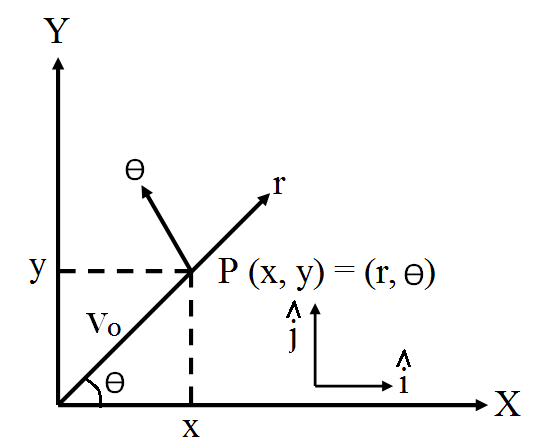
  1. Express $\hat{\text{i}}$ and $\hat{\text{j}}$ in terms of $\hat{\text{r}}$ and $\hat{\theta}$.
  2. Show that both $\hat{\text{r}}$ and $\hat{\theta}$ are unit vectors and are perpendicular to each other.
  3. Show that $\frac{\text{d}}{\text{dt}}(\hat{\text{r}})=\omega\hat{\theta}$ where $\omega=\frac{\text{d}\theta}{\text{dt}}$ and $\frac{\text{d}}{\text{dt}}(\hat{\text{r}})=-\omega\hat{\text{r}}$
  4. For a particle moving along a spiral given by $\text{r}=\text{a}\theta\hat{\text{r}}$ , where a = 1 (unit), find dimensions of ‘a’.
  5. Find velocity and acceleration in polar vector represention for particle moving along spiral described in (d) above.
Answer
 
  1. According to the problem, unit vector
$\hat{\text{r}}=\cos\theta\hat{\text{i}}+\sin\theta\hat{\text{j}}\cdots(\text{i})$
$\hat{\theta}=-\sin\theta\hat{\text{i}}+\cos\theta\hat{\text{j}}\cdots(\text{ii})$
Multiplying Eq.(i) by $\sin\theta$ and Eq. (ii) with $\cos\theta$ and adding
$\Rightarrow\hat{\text{r}}\sin\theta+\hat{\theta}\cos\theta$$=\sin\theta\cdot\cos\theta\hat{\text{i}}+\sin^2\theta\hat{\text{j}}+\cos^2\theta\hat{\text{j}}-\sin\theta\cdot\cos\theta\hat{\text{i}}$
$=\hat{\text{j}}(\cos^2\theta+\sin^2\theta)=\hat{\text{j}}$
$\hat{\text{r}}\sin\theta+\hat{\theta}\cos\theta=\hat{\text{j}}$
By Eq.(i) $\text{x}\cos\theta-$Eq. (ii) $\text{x}\sin\theta$
$\text{n}(\hat{\text{r}}\cos\theta-\hat{\theta}\sin\theta)=\hat{\text{i}}$
  1. $\hat{\text{r}}\cdot\hat{\theta}=(\cos\theta\hat{\text{i}}+\sin\theta\hat{\text{j}})\cdot(-\sin\theta\hat{\text{i}}+\cos\theta\hat{\text{j}})$
$=-\cos\theta\cdot\sin\theta+\sin\theta\cdot\cos\theta=0$
$\Rightarrow\theta=90^\circ,$ angle between $\hat{\text{r}}$ and $\hat{\theta}$.
  1. Given, $\hat{\text{r}}=\cos\theta\hat{\text{i}}+\sin\theta\hat{\text{j}}$
$\frac{\text{d}\hat{\text{r}}}{\text{dt}}=\frac{\text{d}}{\text{dt}}(\cos\theta\hat{\text{i}}+\sin\theta\hat{\text{j}})$
$=-\sin\theta\cdot\frac{\text{d}\theta}{\text{dt}}\hat{\text{i}}+\cos\theta\cdot\frac{\text{d}\theta}{\text{dt}}\hat{\text{j}}$
$=\omega[-\sin\theta\hat{\text{i}}+\cos\theta\hat{\text{j}}$ $\Big[\because\theta=\frac{\text{d}\theta}{\text{dt}}\Big]$
  1. Given,$\text{r}=\text{a}\theta\hat{\text{r}},$ here writing dimension.
$[\text{r}]=[\text{a}][\theta][\hat{\text{r}}]\Rightarrow\text{L}=\frac{[\text{a}]}{1}$
$\Rightarrow[\text{a}]=\text{L}=[\text{M}^0\text{L}^1\text{T}^0]$
  1. Given, $\text{a}=1$ unit, $\text{r}=\theta\hat{\text{r}}=\theta[\cos\theta\hat{\text{i}}+\sin\theta\hat{\text{j}}]$
By differentiating this equation,we get
Velocity $\text{v}=\frac{\text{dr}}{\text{dt}}=\frac{\text{d}\theta}{\text{dt}}\hat{\text{r}}+\theta\frac{\text{d}}{\text{dt}}\hat{\text{r}}$
$=\frac{\text{d}\theta}{\text{dt}}\hat{\text{r}}+\theta\frac{\text{d}}{\text{dt}}[(\cos\theta\hat{ \text{i}}+\sin\theta\hat{\text{j}})]$
$=\frac{\text{d}\theta}{\text{dt}}\hat{\text{r}}+\theta\Big[(-\sin\theta\hat{\text{i}}+\cos\theta\hat{\text{j}})\frac{\text{d}\theta}{\text{dt}}\Big]$
$=\frac{\text{d}\theta}{\text{dt}}\hat{\text{r}}+\theta\hat{\theta}\omega=\omega\hat{\text{r}}+\omega\theta\hat{\theta}$
By differentiating this equation, we get
Acceleration,
$\text{a}=\frac{\text{d}\theta}{\text{dt}}[\omega\hat{\text{r}}+\omega\theta\hat{\theta}]$
$=\frac{\text{d}}{\text{dt}}\Big[\frac{\text{d}\theta}{\text{dt}}\hat{\text{r}}+\frac{\text{d}\theta}{\text{dt}}(\theta\hat{\theta})\Big]$
$=\frac{\text{d}^2\theta}{\text{dt}^2}\hat{\text{r}}+\frac{\text{d}\theta}{\text{dt}}\cdot\frac{\text{d}\hat{\text{r}}}{\text{dt}}+\frac{\text{d}^2\theta}{\text{dt}^2}\theta\hat{\theta}+\frac{\text{d}\theta}{\text{dt}}\frac{\text{d}}{\text{dt}}(\theta\hat{\theta})\frac{\text{d}^2\theta}{\text{dt}^2}\hat{\text{r}}$
$+\omega[-\sin\theta\hat{\text{i}}+\sin\theta\hat{\text{j}}]+\frac{\text{d}^2\theta}{\text{dt}^2}\theta\hat{\theta}+\frac{\omega\text{d}}{\text{dt}}(\theta\hat{\theta})$
$=\frac{\text{d}^2\theta}{\text{dt}^2}\hat{\text{r}}+\omega^2\hat{\theta}+\frac{\text{d}^2\theta}{\text{dt}^2}\times\theta\hat{\theta}+\omega^2\hat{\theta}+\omega^2\theta(-\hat{\text{r}})$
$\Big(\frac{\text{d}^2\theta}{\text{dtv}^2}-\omega^2\Big)\hat{\text{r}}+\Big(2\omega^2+\frac{\text{d}^2\theta}{\text{dt}^2}\theta\Big)\theta$
View full question & answer
Question 21 Mark
A cricket fielder can throw the cricket ball with a speed $V_0$. If he throws the ball while running with speed u at an angle $\theta$ to the horizontal, find
  1. The effective angle to the horizontal at which the ball is projected in air as seen by a spectator.
  2. What will be time of flight?
  3. What is the distance (horizontal range) from the point of projection at which the ball will land?
  4. Find $\theta$ at which he should throw the ball that would maximise the horizontal range as found in (iii).
  5. how does $\theta$ for maximum range change if $\text{u}>\upsilon_\text{o},\text{u}=\upsilon_\text{o},\text{ u}<\upsilon_\text{o}$?
  6. How does $\theta$ in (v) compare with that for u = 0 (i.e.45° )?
Answer
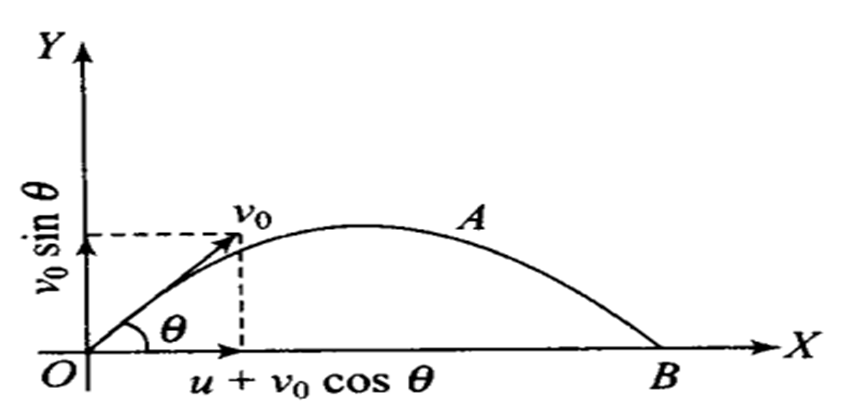
The observer on ground (spectator) observes that the x-component of ball is more because of the speed of fielder. As shown in the adjacent diagram,
So, initial velocity in x-direction,

$\text{u}_\text{x}=\text{u}+\text{v}_0\cos\theta$
Initial velocity in y-direction,
$\text{u}_\text{y}=\text{v}_0\sin\theta$
Where angle of projection is $\theta$.
  1. Now, the angle of projection with horizontal seen by spectator will be
$\tan\theta=\frac{\text{u}_\text{y}}{\text{u}_\text{x}}=\frac{\text{u}_0\sin\theta}{\text{u}+\text{u}_0\cos\theta}$
$\Rightarrow\theta=\tan^{-1}\Big(\frac{\text{v}_0\sin\theta}{\text{u}+\text{v}_0\cos\theta}\Big)$
  1. As net displacement along y-axis is zero over time period T(time of flight).
$\text{y}=0,\text{u}_\text{y}=\text{v}_0\sin\theta,\text{a}_\text{y}=-\text{g},\text{t}=\text{T}$
We know that $\text{y}=\text{u}_\text{y}\text{t}+\frac{1}{2}\text{a}_\text{y}\text{t}^2$
$\Rightarrow0=\text{v}_0\sin\theta\text{T}+\frac{1}{2}(-\text{g})\text{T}^2$
$\Rightarrow\text{T}\Big[\text{v}_0\sin\theta-\frac{\text{g}}{2}\text{T}\Big]=0$
$\Rightarrow\text{T}=0,\frac{2\text{v}_0\sin\theta}{\text{g}}$
$\text{T}=0,$ corresponds to point O.
Hence, $\text{T}=\frac{2\text{u}_0\sin\theta}{\text{g}}$
  1. Horizontal range,
$\text{R}=(\text{u+v}_0\cos\theta)\text{T}$
$=(\text{u}+\text{v}_0\cos\theta)\frac{2\text{v}_0\sin\theta}{\text{g}}$
$=\frac{\text{v}_0}{\text{g}}[2\text{u}\sin\theta+\text{v}_0\sin2\theta]$
  1. For horizontal range to be maximum,$\frac{\text{dR}}{\text{d}\theta}=0$
$\Rightarrow\frac{\text{v}_0}{\text{g}}[2\text{u}\cos\theta+\text{v}_0\cos2\theta\times2]=0$
$\Rightarrow2\text{u}\cos\theta+2\text{v}_0[2\cos^2\theta-1]=0$
$\Rightarrow4\text{v}_0\cos^2\theta+2\text{u}\cos\theta-2\text{v}_0=0$
$\Rightarrow2\text{v}_0\cos^2\theta+\text{u}\cos\theta-\text{v}_0=0$
$\Rightarrow\cos\theta=\frac{-\text{u}\pm\sqrt{\text{u}^2+{8\text{v}_\text{0}}^2}}{4\text{v}_0}$
$\Rightarrow\theta_\text{max}=\cos^{-1}\Bigg[\frac{-\text{u}\pm\sqrt{\text{u}^2+{8\text{v}_0}^2}}{4\text{v}_0}\Bigg]$
$=\cos^{-1}\Bigg[\frac{-\text{u}\pm\sqrt{\text{u}^2+{8\text{v}_0}^2}}{4\text{v}_0}\Bigg]$
  1. If $\text{u}=\text{v}_0,$
$\cos\theta=\frac{-\text{v}_0\pm\sqrt{\text{v}^2_0+8\text{v}^2_0}}{4\text{v}^2_0}=\frac{-1+3}{4}=\frac{1}{2}$
$\Rightarrow\theta=60^\circ$
If $\text{u}<<\text{v}_0,$ then $8\text{v}^2_0+\text{u}^2\approx8\text{v}^2_0$
$\theta_\text{max}=\cos^{-1}\Bigg[\frac{-\text{u}\pm2\sqrt{2}\text{v}_0}{4\text{v}_0}\Bigg]$$=\cos^{-1}\Big[\frac{1}{\sqrt{2}}-\frac{\text{u}}{4\text{v}_0}\Big]$
If $\text{u}<<\text{v}_0$ then $\theta_\text{max}=\cos^{-1}\Big(\frac{1}{\sqrt{2}}\Big)=\frac{\pi}{4}$
If $\text{u}>\text{u}_0$ and $\text{u}>>\text{v}_0$
$\theta_\text{max}=\cos^{-1}\Big[\frac{-\text{u}\pm\text{u}}{4\text{v}_0}\Big]=0$
$\Rightarrow\theta_\text{max}=\frac{\pi}{2}$
  1. If $\text{u}=0,\theta_\text{max}=\cos^{-1}\Bigg[\frac{0\pm\sqrt{8\text{v}^2_0}}{4\text{v}_0}\Bigg]$
$=\cos^{-1}\Big(\frac{1}{\sqrt{2}}\Big)=45^\circ$
Hence, when $\text{u}=0,\theta\geq45^\circ$
View full question & answer
Question 31 Mark
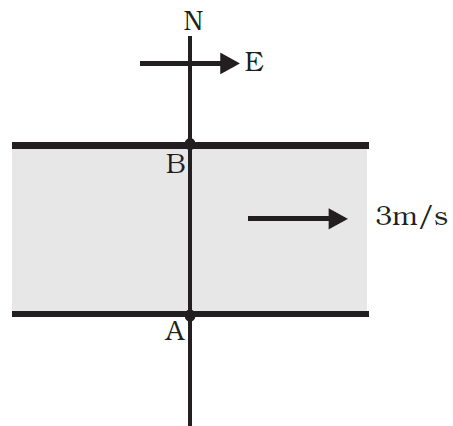
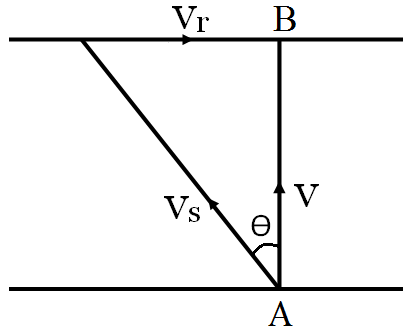
A river is flowing due east with a speed $3 m/ s$. A swimmer can swim in still water at a speed of $4 m/ s$ Fig.
  1. If swimmer starts swimming due north, what will be his resultant velocity (magnitude and direction)?
  2. If he wants to start from point A on south bank and reach opposite point B on north bank,
  • which direction should he swim?
  • what will be his resultant speed?
  1. From two different cases as mentioned in (a) and (b) above, in which case will he reach opposite bank in shorter time?
Answer
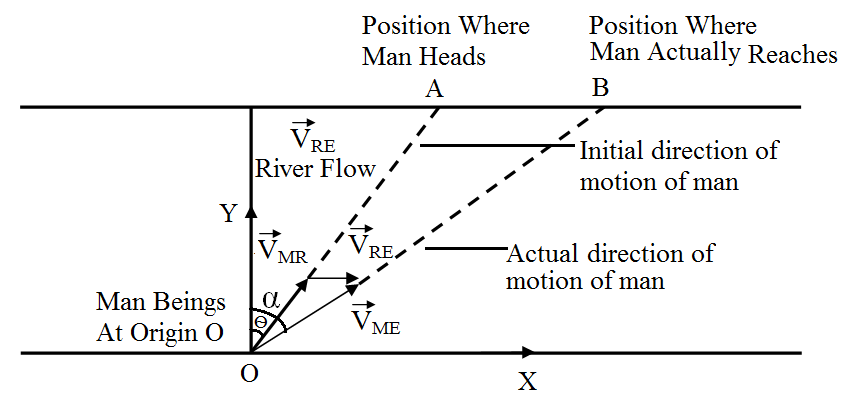
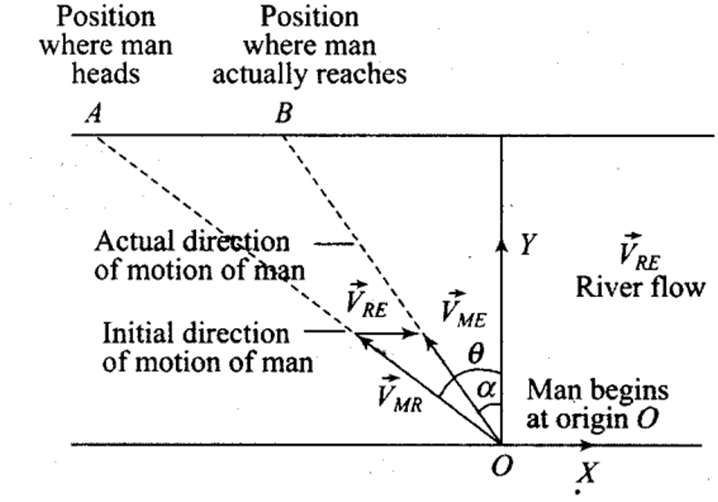
Key concept: Analysis of Relative Velocity in Different Situations: The motion of a boat (or a swimmer) in running water, say, a river.$\vec{\text{V}}_\text{MR}=$ Velocity of man relative to river flow
$\vec{\text{V}}_\text{RE}=$ Velocity of river flow relative to earth
$\vec{\text{V}}_\text{ME}=$ Velocity of man relative to earth
Denoting $|\vec{\text{V}}_\text{MR}|=\text{v},|\vec{\text{V}}_\text{RE}|=\text{u},|\vec{\text{V}}_\text{ME}|=\text{v}_\text{R}$
Case (i): Man swims towards flow
In unit vector notiation.$\vec{\text{V}}_\text{MR}=\text{v}\sin\theta\hat{\text{i}}+\text{v}\cos\theta\hat{\text{j}};\vec{\text{V}}_\text{ME}=\text{u}\hat{\text{i}}$ as $\vec{\text{V}}_\text{ME}=\vec{\text{V}}_\text{MR}+\vec{\text{V}}_\text{RE}$
$\vec{\text{V}}_\text{R}=(\text{v}\sin\theta\hat{\text{i}}+\cos\theta\hat{\text{j}})+\text{u}\hat{\text{i}}$
$=(\text{v}\sin\theta+\text{u})\hat{\text{i}}+\text{v}\cos\theta\hat{\text{j}}$
Suppose the man reaches the point B(x, y)and time of motion is t. We have
$\text{x}=\text{v}_{\text{RX}}\text{t}=(\text{v}\sin\theta+\text{u})\text{t}\ \cdots(\text{i})$
$\text{y}=\text{v}_{\text{RY}}\text{t}=\text{v}\cos\theta\text{t}\ \cdots(\text{ii})$
We have used the fact that the motion along the x- and y axes takes place with the respective to x- and y- components of resultant velocity.
Case (ii): Man swims against flow
$\vec{\text{v}}_\text{R}=(-\text{v}\sin\theta+\text{u})\hat{\text{i}}+\text{v}\cos\theta\hat{\text{j}}$
$\text{x}=\text{v}_\text{RX}\text{t}=(\text{u}-\text{v}\sin\theta)\text{t}\ \ \cdots(\text{iii})$
$\text{y}=\text{v}_\text{RX}\text{t}=\text{v}\cos\theta\text{ t}\cdots(\text{iv})$
  • If width of the river is d, then time taken to cross the river is
$\text{t}=\frac{\text{y}}{\text{v}_{\text{RY}}}=\frac{\text{d}}{\text{v}\cos\theta}$
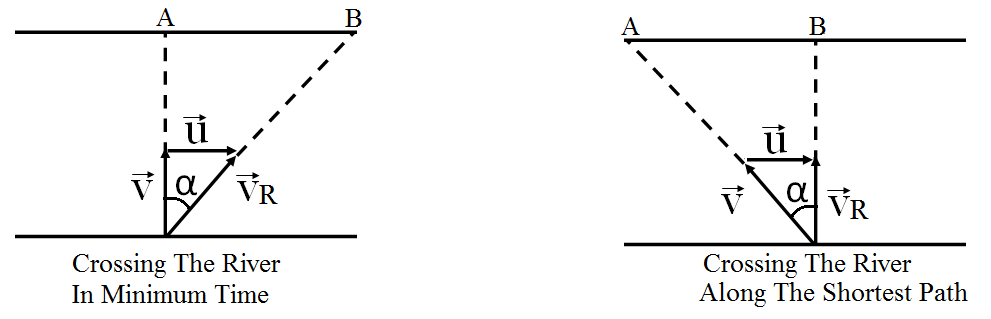
  • Time of crossing is minimum if $\cos\theta=1$, i.e. the swimmer begins to swim at right angle to flow $\text{t}_{\text{min}}=\frac{\text{d}}{\text{v}}\cdot$
  • Actual velocity of the swimmer is $|\vec{\text{v}}_\text{R}|=\sqrt{\text{v}^2+\text{u}^2}$ at an angle
$\tan\alpha=\frac{|\vec{\text{u}|}}{|\vec{\text{v}}|}$.
  • If the man wishes to swim straight (perpendicular to flow), his resultant velocity must be zero. $\text{v}_{\text{RX}}=\text{u - v}\sin\theta=0$

$|\vec{\text{v}}_{\text{R}}|=\sqrt{\text{v}^2+\text{u}^2}$
$\tan\alpha=\frac{|\vec{\text{u}}|}{|\vec{\text{v}}|}$
$|\vec{\text{v}}_{\text{R}}|=\sqrt{\text{v}^2-\text{u}^2}$
$\sin\alpha=\frac{|\vec{\text{u}}|}{|\vec{\text{v}}|}$
According to the problem,
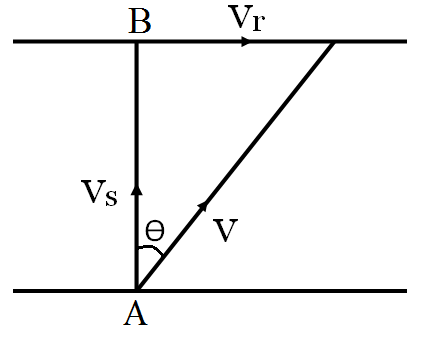
Speed of the river $(v_r) = 3 m/ s (east)$
Velocity of swimmer (with respect to the river), $(v_s) = 4 m/ s (north)$
  1. As the swimmer starts swimming due north, then y-component of his resultant velocity is 4 m/ s (north) and x-component (produced by river flow) is 3 m/ s (east). Then his resultant velocity will be
$\text{v}=\sqrt{\text{v}^2_\text{r}+\text{v}^2_\text{s}}=\sqrt{(3)^2+(4)^2}$
$=\sqrt{9+16}=\sqrt{25}=5\text{m/ s}$
$\tan\theta=\frac{\text{v}_\text{r}}{\text{v}_\text{s}}=\frac{3}{4}=0.75=\tan36^\circ54'$
Hence, $\theta=36^\circ54'\text{ N or }\theta=37^\circ\text{N}$
  1. If he wants to reach on the point directly opposite to him (points B), the swimmer should swim at an angle θ of north.
Resultant speed of the swimmer

$\text{v}=\sqrt{\text{v}^2_\text{s}-\text{v}^2_\text{r}}=\sqrt{(4)^2-(3)^2}$
$=\sqrt{16-9}=\sqrt{7}\text{m/ s}$
$\tan\theta=\frac{\text{v}_\text{r}}{\text{v}}=\frac{3}{\sqrt{7}}$
$\theta=\tan^{-1}\Big(\frac{3}{\sqrt{7}}\Big)\text{of north}$
  1. In case (a)
Time taken by the swimmer to cross the river, $\text{t}_1=\frac{\text{d}}{\text{v}_\text{s}}=\frac{\text{d}}{4}\text{s}$
In case (b),
Time taken by the swimmer to cross the river,
$\text{t}_1=\frac{\text{d}}{\text{v}}=\frac{\text{d}}{\sqrt{7}}$
As $\frac{\text{d}}{\text{v}}<\frac{\text{d}}{\sqrt{7}},$ therefore $\text{t}_1<\text{t}_2.$
Hence, the swimmer will cross the river in shorter time in case (a).
View full question & answer
Question 41 Mark
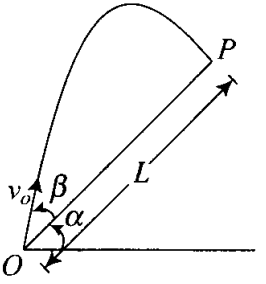
A particle is projected in air at an angle $\beta$ to a surface which itself is inclined at an angle $\alpha$ to the horizontal (Fig.).
  1. Find an expression of range on the plane surface (distance on the plane from the point of projection at which particle will hit the surface).
(Hint: This problem can be solved in two different ways:
  1. Point P at which particle hits the plane can be seen as intersection of its trajectory (parobola) and straight line. Remember particle is projected at an angle $(\alpha+\beta)$ w.r.t. horizontal.
  2. We can take x-direction along the plane and y-direction perpendicular to the plane. In that case resolve g (acceleration due to gravity) in two differrent components, $g_x$ along the plane and $g_y$ perpendicular to the plane. Now the problem can be solved as two independent motions in x and y directions respectively with time as a common parameter.)
Answer
Consider new cartesian coordinates in which X-axis is along inclined plane OP and OY axis perpendicular to it as shown in the figure. Consider the motion of the projectile from OAP.$\text{a}_\text{y}=-\text{g}\cos\alpha$
$\text{a}_\text{x}=\text{g}\sin\alpha$
Consider motion along OX axis.$\text{x}=\text{L}, \text{u}_{\text{x}}=\text{v}_{0}\cos\beta, \text{a}_\text{x}=-\text{g}\sin\alpha$
$\text{t} = \text{T}=\frac{2\text{v}_0\sin\beta}{\text{g}\cos\alpha}$
$\text{s} = \text{u}_\text{x}\text{t}+\frac{1}{2}\text{a}_\text{x}\text{t}^{2}$
$\text{L}=\text{v}_0\cos\beta(\text{T})+\frac{1}{2}(-\text{g}\sin\alpha)\text{T}^2=\text{T}\big[\text{v}_0\cos\beta-\frac{1}{2}\text{g}\sin\alpha.\text{T}\big]$
$=\frac{2\text{v}_0\sin\beta}{\text{g}\cos\alpha}\Big[\text{v}_0\cos\beta-\frac{1}{2}\text{g}\sin\alpha.\frac{2\text{v}_0\sin\beta}{\text{g}\cos\alpha}\Big]$
$=\frac{2\text{v}^{2}_{0}\sin\beta}{\text{g}\cos^2\alpha}[\cos\beta.\cos\alpha-\sin\beta\sin\alpha]$
$\text{L}=\frac{2\text{v}^{2}_{0}\sin\beta}{\text{g}\cos^2\alpha}\cos(\alpha+\beta)$ [Range on the plane surface]
View full question & answer
Question 51 Mark
A gun can fire shells with maximum speed $v_0$ and the maximum horizontal range that can be achieved is $\text{R}=\frac{\text{v}^2_0}{\text{g}}.$

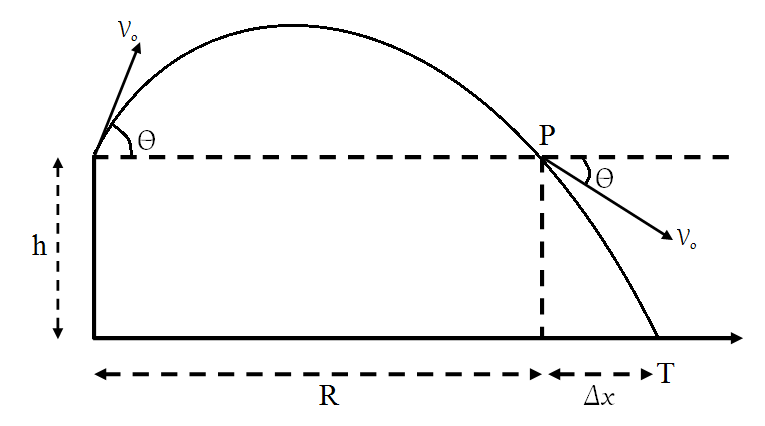
If a target farther away by distance $\Delta\text{x}$ (beyond R) has to be hit with the same gun (Fig), show that it could be achieved by raising the gun to a height at least $\text{h}=\Delta\text{x}\Big[1+\frac{\Delta\text{x}}{\text{R}}\Big]$ (Hint: This problem can be approached in two different ways:
  1. Refer to the diagram: target T is at horizontal distance $\text{x}=\text{R}+\Delta\text{x}$ and below point of projection y = – h.
  2. From point P in the diagram: Projection at speed $v_0$ at an angle $\theta$ below horizontal with height h and horizontal range $\Delta\text{x}$.)
Answer
The main concept used: This problem can be solved in two different ways:
  1. The target is at horizontal distance $(\text{R}+\Delta\text{x})$ and below the point of projection h metre below i.e., y = -h.
  2. The motion of projectile after point P to T: projection speed is at an angle$(-\theta)$ i.e., $\theta^\circ$ below horizontal and vertical height covered it is (-h) and horizontal range $\Delta\text{x}.$
Solution:
$\text{R}=\frac{\text{v}^2_0}{\text{g}}\ \dots(\text{i})$ that it is maximum range of projectile
$\therefore$ The angle of projection $\theta=45^\circ$
Let the gun is raised to a heighth from the horizontal level of target T. So that the projectile can hit the target T.
Total range of projectile must be $=(\text{R}+\Delta\text{x})$
Horizontal component of velocity at $\text{A}=\text{v}_0\cos\theta$
The motion of the projectile from P to T: As A and P are on the same level. So the magnitude of velocity will be same at A and P.
$\therefore$ But the direction of velocity will be below horizontal,
so horizontal velocity at $\text{P}=\text{v}_\text{x}=-\text{v}_0\cos\theta$
So vertical velocity at $\text{P}=\text{v}_\text{y}=\text{v}_0\sin\theta$
$\text{h}=\text{ut}+\frac{1}2\text{at}^2$
$\text{h}=-\text{v}_0\sin\theta(\text{t})+\frac{1}2\text{gt}^2\ \dots(\text{ii})$
Consider horizontal motion from A to T = distance $(\text{R}+\Delta\text{x})=\text{v}_0\cos\theta.\text{t}$
$\text{t}=\frac{\text{R}+\Delta\text{x}}{\text{v}_0\cos\theta}$
Substitue t in (ii) $\text{h}=-\text{v}_02\sin\theta\Big[\frac{\text{R}+\Delta\text{x}}{\text{v}_0\cos\theta}\Big]+\frac{1}2\text{g}\frac{(\text{R}+\Delta\text{x})^2}{\text{v}^2_0\cos^2\theta}$
$\text{h}=-\tan\theta(\text{R}+\Delta\text{x})+\frac{1}2\Big(\frac{\text{g}}{\text{v}^2_0}\Big)\frac{(\text{R}+\Delta\text{x})^2}{\frac{1}2}\theta=45^\circ$
$\text{h}=-(\text{R}+\Delta\text{x})+\frac{1}{\text{R}}(\text{R}^2+\Delta\text{x}^2+2\text{R}\Delta\text{x})$ $\Big[\because\frac{\text{g}}{\text{v}^2_0}=\frac{1}{\text{R}}\Big]$
$=-\text{R}-\Delta\text{x}+\text{R}+\frac{\Delta\text{x}^2}{\text{R}}+2\Delta\text{x}=\Delta\text{x}+\frac{\Delta\text{x}^2}{\text{R}}$
$\text{h}=\Delta\text{x}\Big[1+\frac{\Delta\text{x}}{\text{R}}\Big]$ Hence proved.
View full question & answer
1 Marks Question - Physics STD 11 Science Questions - Vidyadip