Question types

Motion in a Plane question types

36 questions across 5 question groups — pick any mix to generate a Physics paper with step-by-step answer keys.

36
Questions
5
Question groups
5
Question types
Sample Questions

Motion in a Plane questions

One sample from each question group in this chapter. Select any group above to see the full set with answer keys.

Figure shows the orientation of two vectors $u$ and $v$ in the $XY$ plane.
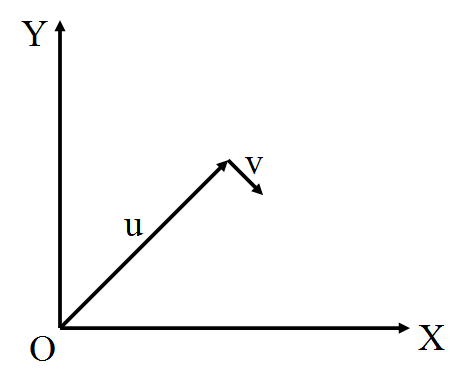
If $\text{u}=\text{a}\hat{\text{i}}+\text{b}\hat{\text{j}}$ and $\text{v}=\text{p}\hat{\text{i}}+\text{q}\hat{\text{j}}$ which of the following is correct?
  • A
    $a$ and $p$ are positive while $b$ and $q$ are negative.
  • $a, p$ and $b$ are positive while $q$ is negative.
  • C
    $a, q$ and $b$ are positive while $p$ is negative.
  • D
    $a, b, p$ and $q$ are all positive.

Answer: B.

View full solution
For a particle performing uniform circular motion, choose the correct statement$(s)$ from the following:
  1. Magnitude of particle velocity $($speed$)$ remains constant.
  2. Particle velocity remains directed perpendicular to radius vector.
  3. Direction of acceleration keeps changing as particle moves.
  4. Angular momentum is constant in magnitude but direction keeps changing.
  • $1 , 2$ and $3$
  • B
    $1 , 2$ and $4$
  • C
    $2 , 3$ and $4$
  • D
    $ 2$ and $3$

Answer: A.

View full solution
In a two dimensional motion, instantaneous speed $v_0$ is a positive constant. Then which of the following are necessarily true?
  • A
    The average velocity is not zero at any time.
  • B
    Average acceleration must always vanish.
  • C
    Displacements in equal time intervals are equal.
  • Equal path lengths are traversed in equal intervals.

Answer: D.

View full solution
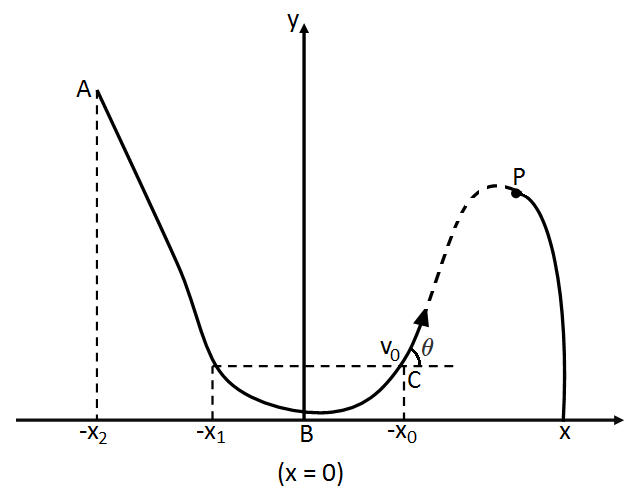
A particle slides down a frictionless parabolic $\left(y=x^2\right)$ track $(A-B-C)$ starting from rest at point $A$. Point $B$ is at the vertex of parabola and point $C$ is at a height less than that of point $A$. After $C$, the particle moves freely in air as a projectile. If the particle reaches highest point at $P$, then
  • A
    KE at $P = KE$ at$ B.$
  • B
    height at $P =$ height at $A$.
  • total energy at $P =$ total energy at $A.$
  • D
    time of travel from $A$ to $B =$ time of travel from $B$ to $P.$

Answer: C.

View full solution
The angle between $\vec{\text{A}}=\hat{\text{i}}+\hat{\text{j}}$ and $\vec{\text{B}}=\hat{\text{i}}-\hat{\text{j}}$ is
  • A
    $45^\circ$
  • $90^\circ$
  • C
    $–45^\circ$
  • D
    $180^\circ$

Answer: B.

View full solution
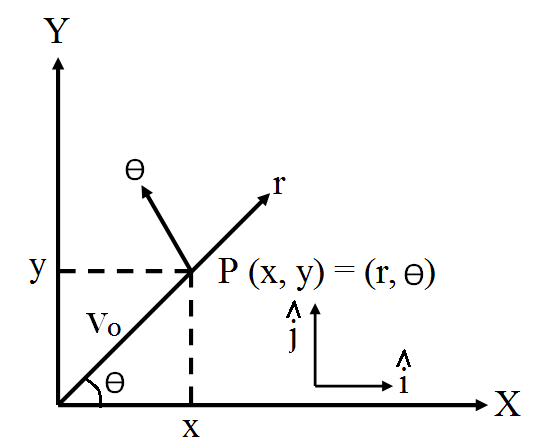
Motion in two dimensions, in a plane can be studied by expressing position, velocity and acceleration as vectors in Cartesian co-ordinates $\text{A}=\text{A}_\text{x}\hat{\text{i}}+\text{A}_\text{y}\hat{\text{j}}$ where $\hat{\text{i}}$ and $\hat{\text{j}}$ are unit vector along x and y directions, respectively and $A_x$ and $A_y$ are corresponding components of A Fig. Motion can also be studied by expressing vectors in circular polar co-ordinates as $\text{A}=\text{A}_\text{r}\hat{\text{r}}+\text{A}_\theta\hat{\theta}$ where $\hat{\text{r}}=\frac{\text{r}}{\text{r}}=\cos\theta\hat{\text{i}}+\sin\theta\hat{\text{j}}$ and $\hat{\theta}=-\sin\theta\hat{\text{i}}+\cos\theta\hat{\text{j}}$ are unit vectors along direction in which ‘r’ and ‘$\theta$’ are increasing.
  1. Express $\hat{\text{i}}$ and $\hat{\text{j}}$ in terms of $\hat{\text{r}}$ and $\hat{\theta}$.
  2. Show that both $\hat{\text{r}}$ and $\hat{\theta}$ are unit vectors and are perpendicular to each other.
  3. Show that $\frac{\text{d}}{\text{dt}}(\hat{\text{r}})=\omega\hat{\theta}$ where $\omega=\frac{\text{d}\theta}{\text{dt}}$ and $\frac{\text{d}}{\text{dt}}(\hat{\text{r}})=-\omega\hat{\text{r}}$
  4. For a particle moving along a spiral given by $\text{r}=\text{a}\theta\hat{\text{r}}$ , where a = 1 (unit), find dimensions of ‘a’.
  5. Find velocity and acceleration in polar vector represention for particle moving along spiral described in (d) above.
View full solution
A cricket fielder can throw the cricket ball with a speed $V_0$. If he throws the ball while running with speed u at an angle $\theta$ to the horizontal, find
  1. The effective angle to the horizontal at which the ball is projected in air as seen by a spectator.
  2. What will be time of flight?
  3. What is the distance (horizontal range) from the point of projection at which the ball will land?
  4. Find $\theta$ at which he should throw the ball that would maximise the horizontal range as found in (iii).
  5. how does $\theta$ for maximum range change if $\text{u}>\upsilon_\text{o},\text{u}=\upsilon_\text{o},\text{ u}<\upsilon_\text{o}$?
  6. How does $\theta$ in (v) compare with that for u = 0 (i.e.45° )?
View full solution
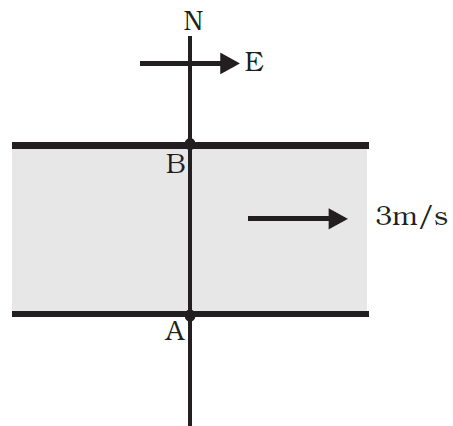
A river is flowing due east with a speed $3 m/ s$. A swimmer can swim in still water at a speed of $4 m/ s$ Fig.
  1. If swimmer starts swimming due north, what will be his resultant velocity (magnitude and direction)?
  2. If he wants to start from point A on south bank and reach opposite point B on north bank,
  • which direction should he swim?
  • what will be his resultant speed?
  1. From two different cases as mentioned in (a) and (b) above, in which case will he reach opposite bank in shorter time?
View full solution
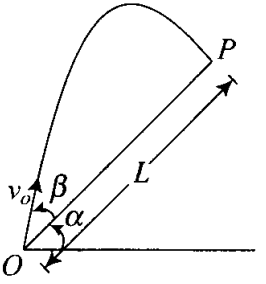
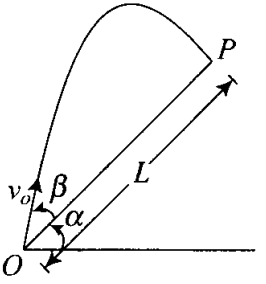
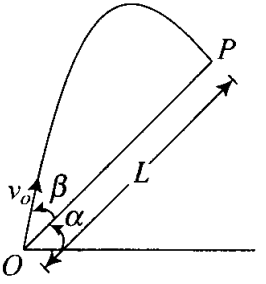
A particle is projected in air at an angle $\beta$ to a surface which itself is inclined at an angle $\alpha$ to the horizontal (Fig.).
  1. Find an expression of range on the plane surface (distance on the plane from the point of projection at which particle will hit the surface).
(Hint: This problem can be solved in two different ways:
  1. Point P at which particle hits the plane can be seen as intersection of its trajectory (parobola) and straight line. Remember particle is projected at an angle $(\alpha+\beta)$ w.r.t. horizontal.
  2. We can take x-direction along the plane and y-direction perpendicular to the plane. In that case resolve g (acceleration due to gravity) in two differrent components, $g_x$ along the plane and $g_y$ perpendicular to the plane. Now the problem can be solved as two independent motions in x and y directions respectively with time as a common parameter.)
View full solution
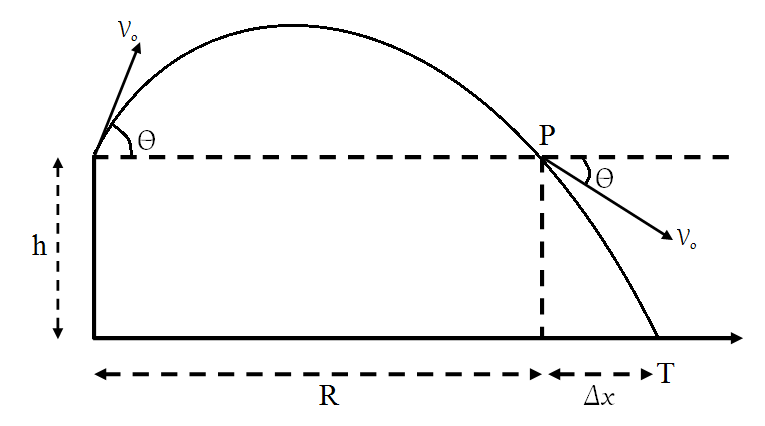
A gun can fire shells with maximum speed $v_0$ and the maximum horizontal range that can be achieved is $\text{R}=\frac{\text{v}^2_0}{\text{g}}.$

If a target farther away by distance $\Delta\text{x}$ (beyond R) has to be hit with the same gun (Fig), show that it could be achieved by raising the gun to a height at least $\text{h}=\Delta\text{x}\Big[1+\frac{\Delta\text{x}}{\text{R}}\Big]$ (Hint: This problem can be approached in two different ways:
  1. Refer to the diagram: target T is at horizontal distance $\text{x}=\text{R}+\Delta\text{x}$ and below point of projection y = – h.
  2. From point P in the diagram: Projection at speed $v_0$ at an angle $\theta$ below horizontal with height h and horizontal range $\Delta\text{x}$.)
View full solution
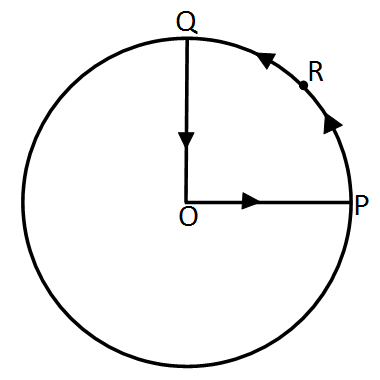
A cyclist starts from centre O of a circular park of radius 1km and moves along the path OPRQO as shown Fig. If he maintains constant speed of $10ms^{–1}$, what is his acceleration at point R in magnitude and direction?

 
View full solution
Q 133 Marks Question3 Marks
A ball is thrown from a roof top at an angle of $45^\circ$ above the horizontal. It hits the ground a few seconds later. At what point during its motion, does the ball have. Explain?
  1. greatest speed.
  2. smallest speed.
  3. greatest acceleration?
View full solution
Q 143 Marks Question3 Marks
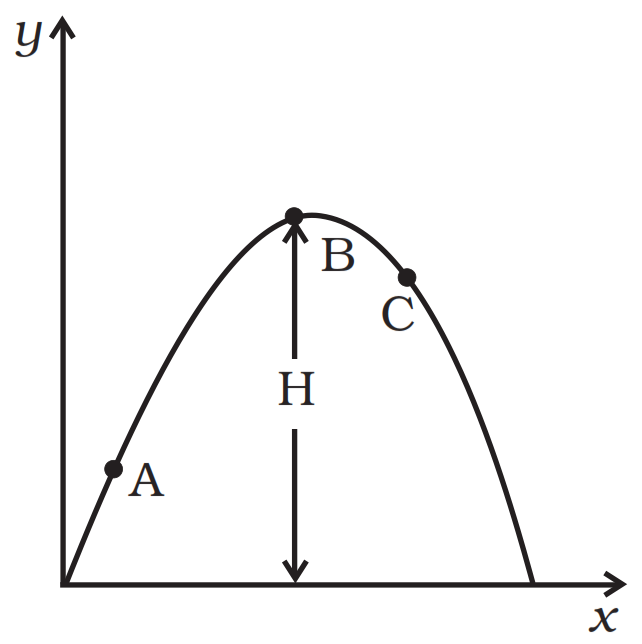
A particle is projected in air at some angle to the horizontal, moves along parabola as shown in Fig., where x and y indicate horizontal and vertical directions, respectively. Show in the diagram, direction of velocity and acceleration at points A, B and C.
View full solution
Q 153 Marks Question3 Marks
Earth can be thought of as a sphere of radius 6400km. Any object (or a person) is performing circular motion around the axis of earth due to earth’s rotation (period 1 day). What is acceleration of object on the surface of the earth (at equator) towards its centre? what is it at latitude $\theta?$ How does these accelerations compare with $g = 9.8m/ s^2?$
View full solution
Q 163 Marks Question3 Marks
A boy travelling in an open car moving on a levelled road with constant speed tosses a ball vertically up in the air and catches it back. Sketch the motion of the ball as observed by a boy standing on the footpath. Give explanation to support your diagram.
View full solution
A fighter plane is flying horizontally at an altitude of 1.5km with speed 720km/ h. At what angle of sight (w.r.t. horizontal) when the target is seen, should the pilot drop the bomb in order to attack the target?
View full solution
A particle is projected in air at an angle $\beta$ to a surface which itself is inclined at an angle $\alpha$ to the horizontal (Fig.).
  1. Time of flight.
(Hint: This problem can be solved in two different ways:
  1. Point P at which particle hits the plane can be seen as intersection of its trajectory (parobola) and straight line. Remember particle is projected at an angle $(\alpha+\beta)$ w.r.t. horizontal.
  2. We can take x-direction along the plane and y-direction perpendicular to the plane. In that case resolve g (acceleration due to gravity) in two differrent components, $g_x$ along the plane and $g_y$ perpendicular to the plane. Now the problem can be solved as two independent motions in x and y directions respectively with time as a common parameter.)
View full solution
A particle is projected in air at an angle $\beta$ to a surface which itself is inclined at an angle $\alpha$ to the horizontal (Fig.).
  1. β at which range will be maximum.
(Hint: This problem can be solved in two different ways:
  1. Point P at which particle hits the plane can be seen as intersection of its trajectory (parobola) and straight line. Remember particle is projected at an angle $(\alpha+\beta)$ w.r.t. horizontal.
  2. We can take x-direction along the plane and y-direction perpendicular to the plane. In that case resolve g (acceleration due to gravity) in two differrent components, $g_x$ along the plane and $g_y$ perpendicular to the plane. Now the problem can be solved as two independent motions in x and y directions respectively with time as a common parameter.)
View full solution
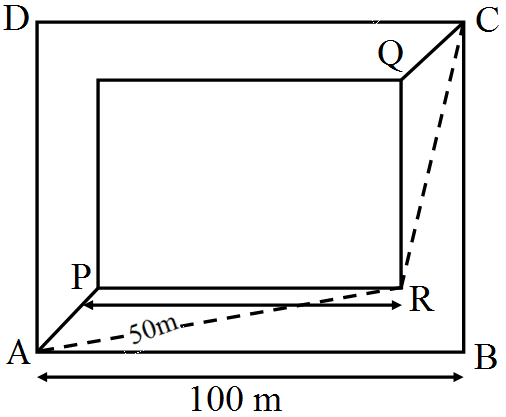
A man wants to reach from A to the opposite corner of the square C Fig. The sides of the square are 100m. A central square of 50m × 50m is filled with sand. Outside this square, he can walk at a speed 1m/ s. In the central square, he can walk only at a speed of $\upsilon\text{m/ s}(\upsilon<1)$. What is smallest value of v for which he can reach faster via a straight path through the sand than any path in the square outside the sand?
View full solution
A girl riding a bicycle with a speed of $5m/ s$ towards north direction, observes rain falling vertically down. If she increases her speed to $10m/ s$, rain appears to meet her at $45°$ to the vertical. What is the speed of the rain? In what direction does rain fall as observed by a ground based observer?
(Hint: Assume north to be $\hat{\text{i}}$ direction and vertically downward to be $-\hat{\text{j}}$. Let the rain velocity $\text{v}_\text{r}$ be $\text{a}\hat{\text{i}}+\text{b}\hat{\text{j}}.$ The velocity of rain as observed by the girl is always $V_r-V_{girl}$. Draw the vector diagram/s for the information given and find a and b. You may draw all vectors in the reference frame of ground based observer)
View full solution

Generate a Motion in a Plane paper free

Pick question groups from the list above, set marks and difficulty, and export a branded PDF with step-by-step answer keys. First 3 chapters free — no signup.

Download App