Questions

True False[1 Marks ]

🎯

Test yourself on this topic

7 questions · timed · auto-graded

Question 11 Mark
The boundaries of the solids are curves.
Answer
False.Solution:
The given statement is false because boundaries of solids are surfaces.
View full question & answer
Question 21 Mark
The coordinates of points in the table.
$x$ $0$ $1$ $2$ $3$ $4$
$y$ $2$ $3$ $4$ $-5$ $6$
represent some of the solutions of the equation $x – y + 2 = 0.$
Answer
The coordinates of p0oints are $(0, 2), (1, 3), (2, 4), (3, –5)$ and $(4, 6).$
Given equation is $x0 - y + 2 = 0$
At point $(0, 2), 0 – 2 + 2 = 0 \Rightarrow 0=0,$ it satisfies.
At point $(1, 3), 1 - 3 + 2 = 3-3 = 0 \Rightarrow 0 = 0,$ it satisfies.
At point $(2, 4), 2 - 4 + 2 = 4 - 4 = 0 \Rightarrow 0 = 0,$ it satisfies.
At point $(3, -5), 3 – (- 5) + 2 = 3 + 5 + 2 = 10 \neq 0,$ it does not satisfy.
At point $(4, 6), 4 - 6 + 2 - 6 - 6 = 0 \Rightarrow 0 = 0,$ it satisfies.
 Hence, point $(3, – 5)$ does not satisfy the equation.
View full question & answer
Question 31 Mark
Every point on the graph of a linear equation in two variables does not represent a solution of the linear equation.
Answer
False Solution: Since, every point on the graph of the linear equation represents a solution.
View full question & answer
Question 41 Mark
The graph of every linear equation in two variables need not be a line.
Answer
False Solution: Since, the graph of a linear equation in two variables always represent a line.
View full question & answer
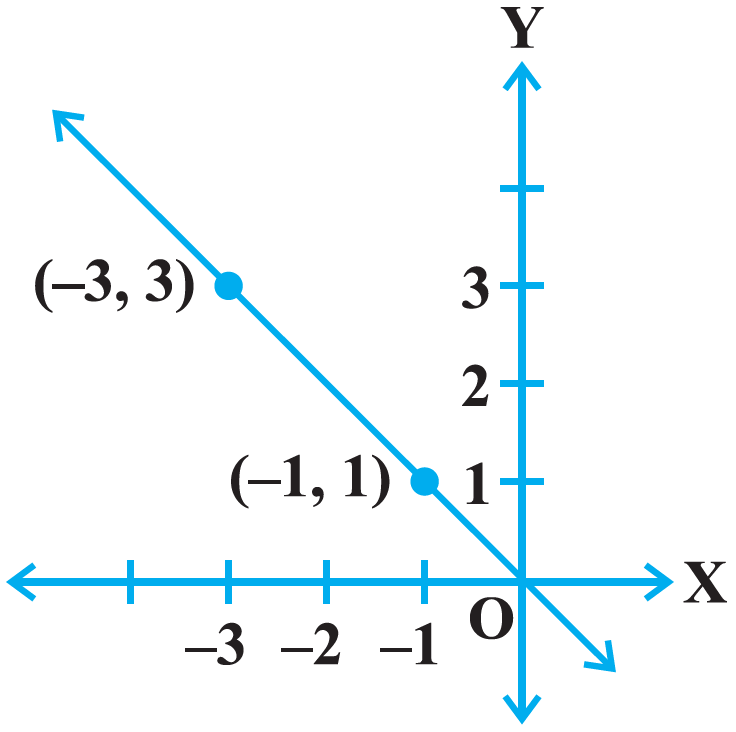
Question 51 Mark
The graph given below represents the linear equation $x + y = 0.$
Answer
If the given points $(-1, 1)$ and $(- 3, 3)$ lie on the linear equation $x + y = 0,$
then both points will satisfy the equation. So, at point $(-1, 1),$
we put $x = -1,$ and $y = 1$ in $LHS$ of the given equation,
we get $LHS = x + y = -1 + 1 = 0 = RHS$ Again,
at point $(-3, 3)$ put $x = -3$ and $y = 3$ in $LHS$ of the given equation,
we get, $LHS = x + y= -3 + 3 = 0 = RHS$
Hence, $(-1, 1)$ and $(-3, 3)$ both satisfy the given linear equation $x + y = 0.$
View full question & answer
Question 61 Mark
The graph of the linear equation $x + 2y = 7$ passes through the point $(0, 7).$
Answer
If we put $x = 0$ and $y = 7$ in $LHS$ of the given equation, we get, $LHS = (0) + 2 (7)= 0 + 14 = 14 ≠ 7 = RHS$ Hence, $(0, 7)$ does not lie on the line $x + 2y = 7.$
View full question & answer
Question 71 Mark
The point $(0, 3)$ lies on the graph of the linear equation $3x + 4y = 12.$
Answer
If we put $x = 0$ and $y = 3$ in $LHS$ of the given equation, we find, $LHS = 3 × 0 + 4 × 3 = 0 + 12 = 12 = RHS$ Hence, $(0, 3)$ lies on the linear equation $3x + 4y = 12.$
View full question & answer
True False[1 Marks ] - Maths STD 9 Questions - Vidyadip