Question 11 Mark
Without actual division, find the following rational numbers are terminating decimals. $\frac{16}{125}$
Answer$\frac{16}{125}$ Denominator of $\frac{16}{125}$ is $125 $. And, $125=5^3$ Therefore, $125$ has no other factors than $2$ and $5 . $Thus, $\frac{16}{125}$ is a terminating decimal.
View full question & answer→Question 21 Mark
What can you say about the sum of a rational number and an irrational number?
Answer The sum of a rational number and an irrational number is irrational.
Example: $5+\sqrt{3}$ is irrational.
View full question & answer→Question 31 Mark
The number $\frac{665}{625}$ will terminate after how many decimal places?
Answer
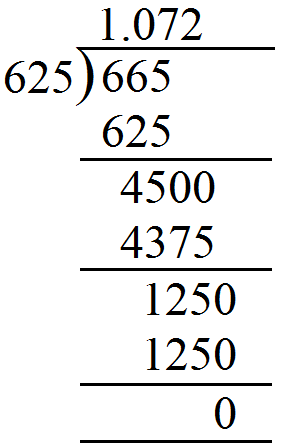
Thus, the given number will terminate after $3$ decimal places. View full question & answer→Question 41 Mark
Classify the following number as rational or irrational. give reasons to support your answer. $4.1276$
Answer$4.1276$ It is a terminating decimal. Hence, it is rational.
View full question & answer→Question 51 Mark
Classify the following number as rational or irrational. give reasons to support your answer. $6.834837...$
Answer$6.834837...$ It is neither terminating, nor repeating hence it is irrational number.
View full question & answer→Question 61 Mark
Without actual division, find the following rational numbers are terminating decimals. $\frac{31}{375}$
Answer$\frac{31}{375}$ Denominator of $\frac{31}{375}$ is $375.375=5^3 \times 3$ So, the prime factor $375$ are $5$ and $3 .$ Thus, $\frac{31}{375}$ is not a terminating decimal.
View full question & answer→Question 71 Mark
Evaluate: $\big(125\big)^{\frac{1}{3}}$
Answer$\big(125\big)^{\frac{1}{3}}=(5^3)^{\frac{1}{3}}=5^{3\times\frac{1}{3}}=5^1=5$
View full question & answer→Question 81 Mark
Classify the following number as rational or irrational. give reasons to support your answer. $3.040040004...$
Answer$3.040040004...$ is an irrational number because it is a non-terminating, non-repeating decimal.
View full question & answer→Question 91 Mark
Rationalise the denominator of the following: $\frac{1}{\sqrt{7}}$
AnswerOn multiplying the numerator and denominator of the given number by $\sqrt{7},$ we get $\frac{1}{\sqrt{7}}=\frac{1}{\sqrt{7}}\times\frac{\sqrt{7}}{\sqrt{7}}=\frac{\sqrt{7}}{7}.$
View full question & answer→Question 101 Mark
Without actual division, find the following rational numbers are terminating decimals. $\frac{5}{12}$
Answer$\frac{5}{12}$ Denominator of $\frac{5}{12}$ is $12 $. And, $12=2^2 \times 3$ So, $12$ has a prime factor $3 ,$ which is other than $2$ and $5$ . Thus, $\frac{5}{12}$ is not a terminating decimal.
View full question & answer→Question 111 Mark
Rationalise $\frac{1}{\sqrt{3}+\sqrt{2}}.$
Answer$\frac{1}{\sqrt{3}+\sqrt{2}}=\frac{1}{\sqrt{3}+\sqrt{2}}\times\frac{\sqrt{3}-\sqrt{2}}{\sqrt{3}-\sqrt{2}}$ $=\frac{\sqrt{3}-\sqrt{2}}{\big(\sqrt{3}\big)^2-\big(\sqrt{2}\big)^2}$ $=\frac{\sqrt{3}-\sqrt{2}}{3-2}$ $=\sqrt{3}-\sqrt{2}$
View full question & answer→Question 121 Mark
Represent the following rational numbers on the number line: $-2.4$
Answer$-2.4=\frac{-24}{10}=\frac{-12}{5}=-2\frac{2}{5}$
View full question & answer→Question 131 Mark
Find two irrational numbers between $0.16$ and $0.17.$
AnswerTwo irrational numbers between $0.16$ and $0.17$ are as follows: $0.1611161111611111611111...$ and $0.169669666...$
View full question & answer→Question 141 Mark
Evaluate: $\big(64\big)^{\frac{1}{6}}$
Answer$\big(64\big)^{\frac{1}{6}}=(2^6)^{\frac{1}{6}}=2^{\big(6\times\frac{1}{6}\big)}=2^1=2$
View full question & answer→Question 151 Mark
Solve: $\big(3-\sqrt{11}\big)\big(3+\sqrt{11}\big).$
Answer$\big(3-\sqrt{11}\big)\big(3+\sqrt{11}\big)$ $=3^2-\big(\sqrt{11}\big)^2$ $=9-11$ $=-2$
View full question & answer→Question 161 Mark
Without actual division, find the following rational numbers are terminating decimals. $\frac{7}{24}$
Answer$\frac{7}{24}$ Denominator of $\frac{7}{24}$ is $24$ . And, $24=2^3 \times 3$ So, $24$ has a prime factor $3 ,$ which is other than $2$ and $5$ . Thus, $\frac{7}{24}$ is not a terminating decimal.
View full question & answer→Question 171 Mark
Simplify: $\frac{6^{\frac{1}{4}}}{6^{\frac{1}{5}}}$
Answer$\frac{6^{\frac{1}{4}}}{6^{\frac{1}{5}}}=6^{\big(\frac{1}{4}-\frac{1}{5}\big)}$ $=6^{\big(\frac{5-4}{20}\big)}=6^{\frac{1}{20}}$
View full question & answer→Question 181 Mark
Classify the following number as rational or irrational. give reasons to support your answer. $\frac{22}{7}$
Answer$\frac{22}{7}$ is a rational number because it can be expressed in the $\frac{\text{p}}{\text{q}}$ form.
View full question & answer→Question 191 Mark
Classify the following number as rational or irrational. give reasons to support your answer. $\sqrt{1.44}$
Answer$\sqrt{1.44}=1.2$ So, it is rational.
View full question & answer→Question 201 Mark
Simplify: $(14641)^{0.25}$
Answer$(14641)^{0.25}$ $=(14641)^{\frac{1}{4}}$ $=(11^4)^{\frac{1}{4}}$ $=11^{4\times\frac{1}{4}}$ $=11$
View full question & answer→Question 211 Mark
Evaluate: $\big(64\big)^{-\frac{1}{2}}$
Answer$\big(64\big)^{-\frac{1}{2}}=\frac{1}{\big(64\big)^{\frac{1}{2}}}=\frac{1}{\big(8^2\big)^{\frac{1}{2}}}=\frac{1}{\big(8\big)^{2\times\frac{1}{2}}}$ $=\frac{1}{8^1}=\frac{1}{8}$
View full question & answer→Question 221 Mark
Classify the following number as rational or irrational. give reasons to support your answer. $\frac{2}{3}\sqrt{6}$
Answer$\frac{2}{3}\sqrt{6}$ It is an irrational number.
View full question & answer→Question 231 Mark
Give an example of two irrational numbers whose: Quotient is an irrational number.
Answer$2$ irrational numbers with quotient an irrational number will be $\sqrt{15}$ and $\sqrt{5}$
View full question & answer→Question 241 Mark
Find an irrational number between $5$ and $6.$
AnswerAn irrational number between $5$ and $6 =\sqrt{5\times6}=\sqrt{30}$
View full question & answer→Question 251 Mark
Give an example of two irrational numbers whose: Product is an irrational number.
Answer$2$ irrational numbers with product an irrational number will be $6+\sqrt{3}$ and $7-\sqrt{3}$
View full question & answer→Question 261 Mark
Give an example of two irrational numbers whose: Sum is an irrational number.
Answer$2$ irrational numbers with sum an irrational number $7+\sqrt{5}$ and $\sqrt{6}-8$
View full question & answer→Question 271 Mark
Rationalise the denominator of the following: $\frac{\sqrt{5}}{2\sqrt{3}}$
AnswerOn multiplying the numerator and denominator of the given number by $\sqrt{3},$ we get $\frac{\sqrt{5}}{2\sqrt{3}}=\frac{\sqrt{5}}{2\sqrt{3}}\times\frac{\sqrt{3}}{\sqrt{3}}=\frac{\sqrt{15}}{2\times3}=\frac{\sqrt{15}}{6}$
View full question & answer→Question 281 Mark
Simplify: $6^\frac{1}{2}\times7^\frac{1}{2}$
Answer$6^\frac{1}{2}\times7^\frac{1}{2}=(6\times7)^{\frac{1}{2}}=(42)^{\frac{1}{2}}$
View full question & answer→Question 291 Mark
Represent the following rational numbers on the number line: $\frac{5}{7}$
Answer$\frac{5}{7}$ 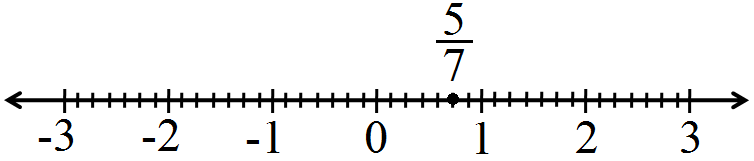
View full question & answer→Question 301 Mark
Simplify $\Big(\frac{3125}{243}\Big)^{\frac{4}{5}}.$
Answer$\Big(\frac{3125}{243}\Big)^{\frac{4}{5}}$ $=\Big(\frac{5^5}{3^5}\Big)^{\frac{4}{5}}$ $=\Big(\frac{5}{3}\Big)^{5\times\frac{4}{5}}$ $=\Big(\frac{5}{3}\Big)^4$ $=\frac{625}{81}$
View full question & answer→Question 311 Mark
Classify the following number as rational or irrational. give reasons to support your answer. $2.356565656...$
Answer$2.356565656...$ is a rational number because it is repeating.
View full question & answer→Question 321 Mark
Simplify: $3^\frac{1}{4}\times5^\frac{1}{4}$
Answer$3^\frac{1}{4}\times5^\frac{1}{4}=(3\times5)^{\frac{1}{4}}=(15)^{\frac{1}{4}}$
View full question & answer→Question 331 Mark
Represent the following rational numbers on the number line: $1.3$
Answer$1.3=\frac{13}{10}=1\frac{3}{10}$
View full question & answer→Question 341 Mark
Is zero a rational number? Justify.
AnswerYes, $0$ is a rational number. $0$ can be expressed in the form of the fraction $\frac{\text{p}}{\text{q}},$ where $p = 0$ and $q$ can be any integer except $0.$
View full question & answer→Question 351 Mark
Without actual division, find the following rational numbers are terminating decimals.
$\frac{13}{80}$
Answer$\frac{13}{80}$
Denominator of $\frac{13}{80}$ is $80.$
And,
$80=2^4 \times 5$
Therefore, $80$ has no other factors than $2$ and $5.$
Thus, $\frac{13}{80}$ is a terminating decimal.
View full question & answer→Question 361 Mark
Simplify: $\frac{5^{\frac{6}{7}}}{5^{\frac{2}{3}}}$
Answer$\frac{5^{\frac{6}{7}}}{5^{\frac{2}{3}}}=5^{\big(\frac{6}{7}-\frac{2}{3}\big)}$ $=5^{\big(\frac{18-14}{21}\big)}=5^{\frac{4}{21}}$
View full question & answer→Question 371 Mark
Simplify: $2^\frac{2}{3}\times2^\frac{1}{5}$
Answer$2^\frac{2}{3}\times2^\frac{1}{5}$ $=2^{\frac{2}{3}+\frac{1}{5}}$ $=2^{\frac{10+3}{15}}$ $=2^{\frac{13}{15}}$
View full question & answer→Question 381 Mark
Represent the following rational numbers on the number line: $\frac{8}{3}$
Answer$\frac{8}{3}=2\frac{2}{3}$
View full question & answer→Question 391 Mark
Give an example of two irrational numbers whose: Sum is a rational number.
Answer$2$ irrational numbers with sum a rational number $3-\sqrt{2}$ and $3+\sqrt{2}$
View full question & answer→Question 401 Mark
Simplify: $\frac{8^{\frac{1}{2}}}{8^{\frac{2}{3}}}$
Answer$\frac{8^{\frac{1}{2}}}{8^{\frac{2}{3}}}=8^{\big(\frac{1}{2}-\frac{2}{3}\big)}$ $=8^{\big(\frac{3-4}{6}\big)}=8^{\frac{-1}{6}}$
View full question & answer→Question 411 Mark
Classify the following number as rational or irrational. give reasons to support your answer. $1.23232333...$
Answer$1.23232333...$ is an irrational number because it is a non−terminating, non−repeating decimal.
View full question & answer→Question 421 Mark
Simplify: $(3^4)^{\frac{1}{4}}$
Answer$(3^4)^{\frac{1}{4}}=3^{\big(4\times\frac{1}{4}\big)}=(3)^1=3$
View full question & answer→Question 431 Mark
Simplify $\sqrt[4]{81\text{x}^8\text{y}^4\text{z}^{16}}.$
Answer$\sqrt[4]{81\text{x}^8\text{y}^4\text{z}^{16}}$ $=\sqrt[4]{3^4(\text{x}^2)^4\text{y}^4(\text{z}^4)^4}$ $=\sqrt[4]{(3\text{x}^2\text{y}\text{z}^4)^4}$ $=(3\text{x}^2\text{y}\text{z}^4)^{4\times\frac{1}{4}}$ $=3\text{x}^2\text{y}\text{z}^4$
View full question & answer→Question 441 Mark
Give an example of two irrational numbers whose: Difference is an irrational number.
Answer$2$ irrational numbers with difference an irrational number will be $3-\sqrt{5}$ and $3+\sqrt{5}.$
View full question & answer→Question 451 Mark
Represent the following rational numbers on the number line: $-\frac{23}{6}$
Answer$-\frac{23}{6}=-3\frac{5}{6}$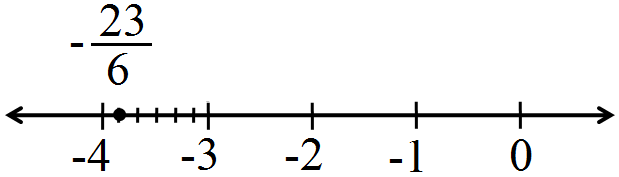
View full question & answer→Question 461 Mark
Write the rationalising factor of the denominator in $\frac{1}{\sqrt{2}+\sqrt{3}}.$
AnswerThe rationalising factor of the denominator in $\frac{1}{\sqrt{2}+\sqrt{3}}$ is $\big(\sqrt{2}-\sqrt{3}\big).$
View full question & answer→Question 471 Mark
Add: $\Big(\frac{2}{3}\sqrt{7}-\frac{1}{2}\sqrt{2}+6\sqrt{11}\Big)$ and $\Big(\frac{1}{3}\sqrt{7}+\frac{3}{2}\sqrt{2}-\sqrt{11}\Big)$
AnswerWe have: $\Big(\frac{2}{3}\sqrt{7}-\frac{1}{2}\sqrt{2}+6\sqrt{11}\Big)+\Big(\frac{1}{3}\sqrt{7}+\frac{3}{2}\sqrt{2}-\sqrt{11}\Big)$ $=\Big(\frac{2}{3}\sqrt{7}+\frac{1}{3}\sqrt{7}\Big)+\Big(-\frac{1}{2}\sqrt{2}+\frac{3}{2}\sqrt{2}\Big)+\big(6\sqrt{11}-\sqrt{11}\big)$ $=\Big(\frac{2}{3}+\frac{1}{3}\Big)\sqrt{7}+\Big(-\frac{1}{2}+\frac{3}{2}\Big)\sqrt{2}+(6-1)\sqrt{11}$ $=\sqrt{7}+\sqrt{2}+5\sqrt{11}$
View full question & answer→Question 481 Mark
Evaluate $\Big(\frac{81}{49}\Big)^{\frac{-3}{2}}.$
Answer$\Big(\frac{81}{49}\Big)^{\frac{-3}{2}}$ $=\Big(\frac{49}{81}\Big)^{\frac{3}{2}}$ $=\Big(\frac{7^2}{9^2}\Big)^{\frac{3}{2}}$ $=\Big(\frac{7}{9}\Big)^{2\times\frac{3}{2}}$ $=\Big(\frac{7}{9}\Big)^3$ $=\frac{343}{729}$
View full question & answer→Question 491 Mark
Simplify $\sqrt[4]{\sqrt[3]{\text{x}^2}}$ and express the result in the exponential form of $x.$
Answer$\sqrt[4]{\sqrt[3]{\text{x}^2}}$ $=\Big(\sqrt[3]{\text{x}^2}\Big)^\frac{1}{4}$ $=\big(\text{x}^2\big)^{\frac{1}{3}\times\frac{1}{4}}$ $=\text{x}^{2\times\frac{1}{12}}$ $=\text{x}^\frac{1}{6}$
View full question & answer→Question 501 Mark
Simplify $(32)^\frac{1}{5}+(-7)^0+(64)^{\frac{1}{2}}.$
Answer $(32)^\frac{1}{5}+(-7)^0+(64)^{\frac{1}{2}}$
$=(2^5)^{\frac{1}{5}}+1+(8^2)^{\frac{1}{2}}$
$=2^{5\times\frac{1}{5}}+1+8^{2\times\frac{1}{2}}$
$=2+1+8$
$=11$
View full question & answer→