MCQ 11 Mark
Directions: In the following questions, the Assertions $(A)$ and Reason(s) $(R)$ have been put forward. Read both the statements carefully and choose the correct alternative from the following:
Assertion: All quadrilateral are not parallelogram.
Reason: Quadrilateral that don’t have parallel side.
- ✓
Both Assertion and Reason are correct and Reason is the correct explanation for Assertion.
- B
Both Assertion and Reason are correct and Reason is not the correct explanation for Assertion.
- C
Assertion is true but the reason is false.
- D
Both assertion and reason are false.
AnswerCorrect option: A. Both Assertion and Reason are correct and Reason is the correct explanation for Assertion.
Both Assertion and Reason are correct and Reason is the correct explanation for Assertion.
View full question & answer→MCQ 21 Mark
Directions: In the following questions, the Assertions $(A)$ and Reason(s) $(R)$ have been put forward. Read both the statements carefully and choose the correct alternative from the following:
Assertion: The interior angle of a rectangle at each vertex is $90^\circ $.
Reason: The sum of all interior angles is $360^\circ$ .
- ✓
Both Assertion and Reason are correct and Reason is the correct explanation for Assertion.
- B
Both Assertion and Reason are correct and Reason is not the correct explanation for Assertion.
- C
Assertion is true but the reason is false.
- D
Both assertion and reason are false.
AnswerCorrect option: A. Both Assertion and Reason are correct and Reason is the correct explanation for Assertion.
Both Assertion and Reason are correct and Reason is the correct explanation for Assertion.
View full question & answer→MCQ 31 Mark
Directions: In the following questions, the Assertions $(A)$ and Reason(s) $(R)$ have been put forward. Read both the statements carefully and choose the correct alternative from the following:
Assertion: Every trapazoid is a parallelogram.
Reason: A trapazoid is a quadrilateral whose opposite side are parallel.
- A
Both Assertion and Reason are correct and Reason is the correct explanation for Assertion.
- B
Both Assertion and Reason are correct and Reason is not the correct explanation for Assertion.
- C
Assertion is true but the reason is false.
- ✓
Both assertion and reason are false.
AnswerCorrect option: D. Both assertion and reason are false.
Both assertion and reason are false.
View full question & answer→MCQ 41 Mark
Directions: In the following questions, the Assertions $(A)$ and Reason(s) $(R)$ have been put forward. Read both the statements carefully and choose the correct alternative from the following:
Assertion: Kite is not rhombus.
Reason: Because only one adjacent pair of side are equal and only one pair of opposite angle are equal.
- ✓
Both Assertion and Reason are correct and Reason is the correct explanation for Assertion.
- B
Both Assertion and Reason are correct and Reason is not the correct explanation for Assertion.
- C
Assertion is true but the reason is false.
- D
Both assertion and reason are false.
AnswerCorrect option: A. Both Assertion and Reason are correct and Reason is the correct explanation for Assertion.
Both Assertion and Reason are correct and Reason is the correct explanation for Assertion.
View full question & answer→MCQ 51 Mark
Directions: In the following questions, the Assertions $(A)$ and Reason(s) $(R)$ have been put forward. Read both the statements carefully and choose the correct alternative from the following:
Assertion: A rectangle is $12\ cm$ wide, and $5\ cm$ tall, $13\ cm$ is the length of a diagonal.
Reason: A rectangle is $12\ cm$ wide, and $5\ cm$ tall, $13\ cm$ is the length of a diagonal.
- ✓
Both Assertion and Reason are correct and Reason is the correct explanation for Assertion.
- B
Both Assertion and Reason are correct and Reason is not the correct explanation for Assertion.
- C
Assertion is true but the reason is false.
- D
Both assertion and reason are false.
AnswerCorrect option: A. Both Assertion and Reason are correct and Reason is the correct explanation for Assertion.
Both Assertion and Reason are correct and Reason is the correct explanation for Assertion.
View full question & answer→MCQ 61 Mark
Directions: In the following questions, the Assertions $(A)$ and Reason(s) $(R)$ have been put forward. Read both the statements carefully and choose the correct alternative from the following:
Assertion: All quadrilateral are not rectangle.
Reason: All quadrilateral are parallogram.
- A
Both Assertion and Reason are correct and Reason is the correct explanation for Assertion.
- B
Both Assertion and Reason are correct and Reason is not the correct explanation for Assertion.
- C
Assertion is true but the reason is false.
- ✓
Both assertion and reason are false.
AnswerCorrect option: D. Both assertion and reason are false.
Both assertion and reason are false.
View full question & answer→MCQ 71 Mark
Assertion and Reason Type $\text{MCQ}$
Assertion: In a rhombus $\text{ABCD,}$ the diagonal $\text{AC}$ bisects $\angle\text{A}$ as well as $\angle\text{C}.$
Reason: The diagonals of a rhombus bisect each other at right angles.
- A
Both Assertion $(A)$ and Reason $(R)$ are true and Reason is a correct explanation of Assertion $(A)$.
- ✓
Both Assertion $(A)$ and Reason $(R)$ are true but Reason is not a correct explanation of Assertio $(A)$.
- C
Assertion $(A)$ is true and Reason $(R)$ is false.
- D
Assertion $(A)$ is false and Reason $(R)$ is true.
AnswerCorrect option: B. Both Assertion $(A)$ and Reason $(R)$ are true but Reason is not a correct explanation of Assertio $(A)$.
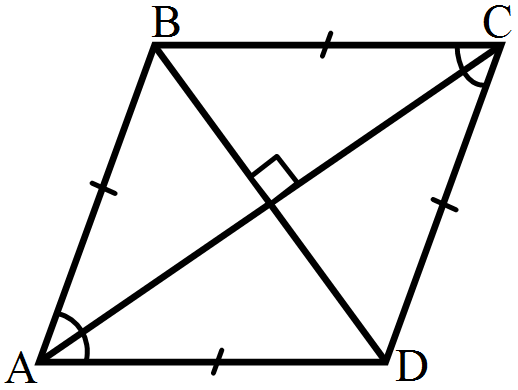
In a rhombus $\text{ABCD,}$ the diagonal $\text{AC}$ bisects $\angle\text{A}$ as well as $\angle\text{C}.$
So, the Assertion $(A)$ is true.
The diagonal of a rhombus bisect each other at right angles.
So, the Reason $(R)$ is true, and is not the correct explanation for the Assertion $(A).$ View full question & answer→MCQ 81 Mark
Directions: In the following questions, the Assertions $(A)$ and Reason(s) $(R)$ have been put forward. Read both the statements carefully and choose the correct alternative from the following:
Assertion: A rectangle is $12\ cm$ long and $5\ cm$ tall, $34\ cm$ is its Perimeter$?$
Reason: Perimeter of rectangle $= 2\ × ($leangth $×$ breadth$).$
- ✓
Both Assertion and Reason are correct and Reason is the correct explanation for Assertion.
- B
Both Assertion and Reason are correct and Reason is not the correct explanation for Assertion.
- C
Assertion is true but the reason is false.
- D
Both assertion and reason are false.
AnswerCorrect option: A. Both Assertion and Reason are correct and Reason is the correct explanation for Assertion.
Both Assertion and Reason are correct and Reason is the correct explanation for Assertion.
View full question & answer→MCQ 91 Mark
Assertion and Reason Type $\text{MCQ}$
Assertion: $\text{BCD}$ is a quadrilateral in which $\text{P, Q, R}$ and $S$ are the mid$-$points of $\text{AB, BC, CD}$ and $\text{DA}$ respectively. Then, $\text{PQRS}$ is a parallelogram.
Reason: The line segment joining the mid$-$points of any two sides of a triangle is parallel to the third side and equal to half of it.
- ✓
Both Assertion $(A)$ and Reason $(R)$ are true and Reason is a correct explanation of Assertion $(A).$
- B
Both Assertion $(A)$ and Reason $(R)$ are true but Reason is not a correct explanation of Assertio $(A).$
- C
Assertion $(A)$ is true and Reason $(R)$ is false.
- D
Assertion $(A)$ is false and Reason $(R)$ is true.
AnswerCorrect option: A. Both Assertion $(A)$ and Reason $(R)$ are true and Reason is a correct explanation of Assertion $(A).$
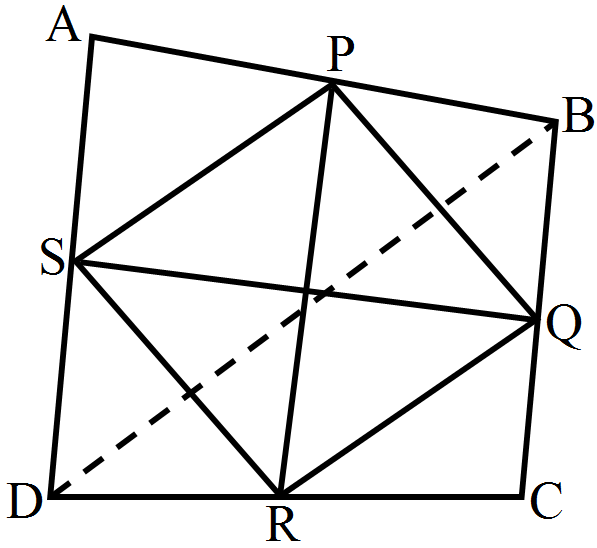
$\text{ABCD}$ is a quadrilateral in which $\text{P, Q, R}$ and $S$ are the mid$-$points of $\text{AB, BC, CD}$ and $\text{DA}$ respectively.
Then, $\text{PQRS}$ is a parallelogram.
The Assertion $(A) $ is true.
The line segment joining the mid$-$points of any two sides of a triangle is parallel to the third side and equal to half of it.
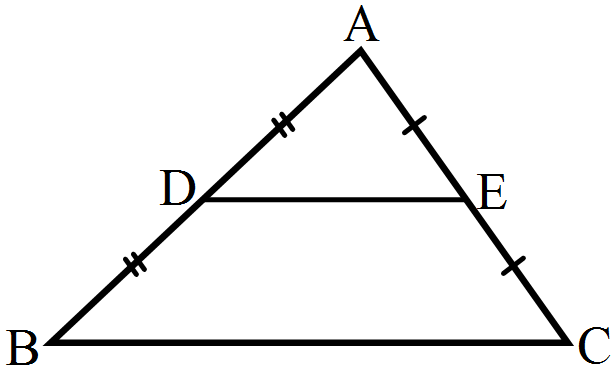
The Reason $(R)$ is true and is the correct explanation for the Assertion $(A).$ View full question & answer→MCQ 101 Mark
Directions: In the following questions, the Assertions $(A)$ and Reason(s) $(R)$ have been put forward. Read both the statements carefully and choose the correct alternative from the following:
Assertion: $ABCD$ is a square. $AC$ and $BD$ intersect at $O$. The measure of $\angle\text{ABC}=900.$
Reason: Diagonals of a square bisect each other at right angles.
- ✓
Both Assertion and Reason are correct and Reason is the correct explanation for Assertion.
- B
Both Assertion and Reason are correct and Reason is not the correct explanation for Assertion.
- C
Assertion is true but the reason is false.
- D
Both assertion and reason are false.
AnswerCorrect option: A. Both Assertion and Reason are correct and Reason is the correct explanation for Assertion.
Both Assertion and Reason are correct and Reason is the correct explanation for Assertion.
View full question & answer→MCQ 111 Mark
Directions: In the following questions, the Assertions $(A)$ and Reason(s) $(R)$ have been put forward. Read both the statements carefully and choose the correct alternative from the following:
Assertion: Two opposite angles of a parallelogram are $(3x - 2^\circ )$ and $(50 - x)^\circ .$ The measure of one of the angle is $37^\circ .$
Reason: Opposite angles of a parallelogram are equal.
- ✓
Both assertion and reason are true and reason is the correct explanation of assertion.
- B
Both assertion and reason are true but reason is not the correct explanation of assertion.
- C
Assertion is true but reason is false.
- D
Assertion is false but reason is true.
AnswerCorrect option: A. Both assertion and reason are true and reason is the correct explanation of assertion.
Since, opposite angles of a parallelogram are equal.
Therefore,
$3x - 2 = 50 - x$
$x = 13$
One angle is $37^\circ .$
View full question & answer→MCQ 121 Mark
Assertion and Reason Type MCQ
Assertion: The diagonals of $a \|\ gm$ bisect each other.
Reason: If the diagonals of $a \|\ gm$ are equal and intersect at right angles, then the parallelogram is a square.
- ✓
Both Assertion $(A)$ and Reason $(R)$ are true and Reason is a correct explanation of Assertion $(A)$.
- B
Both Assertion $(A)$ and Reason $(R)$ are true but Reason is not a correct explanation of Assertio $(A)$.
- C
Assertion $(A)$ is true and Reason $(R)$ is false.
- D
Assertion $(A)$ is false and Reason $(R)$ is true.
AnswerCorrect option: A. Both Assertion $(A)$ and Reason $(R)$ are true and Reason is a correct explanation of Assertion $(A)$.
The diagonals of all gm bisect each other.
So, the Assertion $(A)$ is true.
If the diagonals of $a \| gm$ are equal and intersect at right angles,
then the parallelogram is a square.
So, the Reason $(R)$ is true, but is not the correct explanation for the Assertion $(A).$
Note: The answer in the textbook is incorrect.
View full question & answer→MCQ 131 Mark
Directions: In the following questions, the Assertions $(A)$ and Reason(s) $(R)$ have been put forward. Read both the statements carefully and choose the correct alternative from the following:
Assertion: The area of a rhombus is $24\ cm^2$ having diagonals equal to $6\ cm$ and $8\ cm.$
Reason: Area of rhombus $=\frac{(\text{d}_1\times\text{d}_2)}{2}$
- ✓
Both Assertion and Reason are correct and Reason is the correct explanation for Assertion.
- B
Both Assertion and Reason are correct and Reason is not the correct explanation for Assertion.
- C
Assertion is true but the reason is false.
- D
Both assertion and reason are false.
AnswerCorrect option: A. Both Assertion and Reason are correct and Reason is the correct explanation for Assertion.
Both Assertion and Reason are correct and Reason is the correct explanation for Assertion.
View full question & answer→MCQ 141 Mark
Directions: In the following questions, the Assertions $(A)$ and Reason(s) $(R)$ have been put forward. Read both the statements carefully and choose the correct alternative from the following:
Assertion: Diagonal of trapezium are equal.
Reason: Diagonal of trapezium are perpendicular.
- A
Both Assertion and Reason are correct and Reason is the correct explanation for Assertion.
- B
Both Assertion and Reason are correct and Reason is not the correct explanation for Assertion.
- C
Assertion is true but the reason is false.
- ✓
Both assertion and reason are false.
AnswerCorrect option: D. Both assertion and reason are false.
Both assertion and reason are false.
View full question & answer→MCQ 151 Mark
Directions: In the following questions, the Assertions $(A)$ and Reason(s) $(R)$ have been put forward. Read both the statements carefully and choose the correct alternative from the following:
Assertion: Every square is a rectangle.
Reason: Every rectangle is a square
- A
Both Assertion and Reason are correct and Reason is the correct explanation for Assertion.
- B
Both Assertion and Reason are correct and Reason is not the correct explanation for Assertion.
- ✓
Assertion is true but the reason is false.
- D
Both assertion and reason are false.
AnswerCorrect option: C. Assertion is true but the reason is false.
Assertion is true but the reason is false.
View full question & answer→MCQ 161 Mark
Directions: In the following questions, the Assertions $(A)$ and Reason(s) $(R)$ have been put forward. Read both the statements carefully and choose the correct alternative from the following:
Assertion: The angles of a quadrilateral are $x^\circ , (x - 10)^\circ , (x + 30)^\circ ,$ and $(2x)^\circ ,$ the smallest angle is equal to $58^\circ .$
Reason: Sum of the angles of a quadrilateral is $360^\circ .$
- ✓
Both assertion and reason are true and reason is the correct explanation of assertion.
- B
Both assertion and reason are true but reason is not the correct explanation of assertion.
- C
Assertion is true but reason is false.
- D
Assertion is false but reason is true.
AnswerCorrect option: A. Both assertion and reason are true and reason is the correct explanation of assertion.
Both assertion and reason are true and reason is the correct explanation of assertion.
View full question & answer→MCQ 171 Mark
Directions: In the following questions, the Assertions $(A)$ and Reason(s) $(R)$ have been put forward. Read both the statements carefully and choose the correct alternative from the following:
Assertion: A geometric shape whose four side four angle and four vertices is known as quadrilateral.
Reason: Rhombus is a qudrilateral.
- ✓
Both Assertion and Reason are correct and Reason is the correct explanation for Assertion.
- B
Both Assertion and Reason are correct and Reason is not the correct explanation for Assertion.
- C
Assertion is true but the reason is false.
- D
Both assertion and reason are false.
AnswerCorrect option: A. Both Assertion and Reason are correct and Reason is the correct explanation for Assertion.
Both Assertion and Reason are correct and Reason is the correct explanation for Assertion.
View full question & answer→MCQ 181 Mark
Directions: In the following questions, the Assertions $(A)$ and Reason(s) $(R)$ have been put forward. Read both the statements carefully and choose the correct alternative from the following:
Assertion: The diagonals in a square bisect each other at $90^\circ .$
Reason: The diagonals in a square divide the square into four congruent equilateral right - angles triangles.
- A
Both Assertion and Reason are correct and Reason is the correct explanation for Assertion.
- B
Both Assertion and Reason are correct and Reason is not the correct explanation for Assertion.
- ✓
Assertion is true but the reason is false.
- D
Both assertion and reason are false.
AnswerCorrect option: C. Assertion is true but the reason is false.
Assertion is true but the reason is false.
View full question & answer→MCQ 191 Mark
Directions: In the following questions, the Assertions $(A)$ and Reason(s) $(R)$ have been put forward. Read both the statements carefully and choose the correct alternative from the following:
Assertion: All parallogram are quadrilateral.
Reason: All parallogram are rectangle.
- A
Both Assertion and Reason are correct and Reason is the correct explanation for Assertion.
- B
Both Assertion and Reason are correct and Reason is not the correct explanation for Assertion.
- ✓
Assertion is true but the reason is false.
- D
Both assertion and reason are false.
AnswerCorrect option: C. Assertion is true but the reason is false.
Assertion is true but the reason is false.
View full question & answer→MCQ 201 Mark
Directions: In the following questions, the Assertions $(A)$ and Reason(s) $(R)$ have been put forward. Read both the statements carefully and choose the correct alternative from the following:
Assertion: If the angles of a quadrilateral are in the ratio $2 : 3 : 7 : 6,$ then the measure of angles are $40^\circ , 60^\circ , 140^\circ , 120^\circ ,$ respectively.
Reason: The sum of the angles of a quadrilateral is $360^\circ .$
- A
Both Assertion and Reason are correct and Reason is the correct explanation for Assertion.
- B
Both Assertion and Reason are correct and Reason is not the correct explanation for Assertion.
- ✓
Assertion is true but the reason is false.
- D
Both assertion and reason are false.
AnswerCorrect option: C. Assertion is true but the reason is false.
Assertion is true but the reason is false.
View full question & answer→MCQ 211 Mark
Directions: In the following questions, the Assertions $(A)$ and Reason(s) $(R)$ have been put forward. Read both the statements carefully and choose the correct alternative from the following:
Assertion: Two opposite angles of a parallelogram are $(3x - 2)^\circ $ and $(50 - x)^\circ $ The measure of one of the angle is $37^\circ .$
Reason: Opposite angles of a parallelogram are equal.
- A
Both Assertion and Reason are correct and Reason is the correct explanation for Assertion.
- B
Both Assertion and Reason are correct and Reason is not the correct explanation for Assertion.
- ✓
Assertion is true but the reason is false.
- D
Both assertion and reason are false.
AnswerCorrect option: C. Assertion is true but the reason is false.
Assertion is true but the reason is false.
View full question & answer→MCQ 221 Mark
Directions: In the following questions, the Assertions $(A)$ and Reason(s) $(R)$ have been put forward. Read both the statements carefully and choose the correct alternative from the following:
Assertion: The consecutive sides of a quadrilateral have one common point.
Reason: The opposite sides of a quadrilateral have two common point.
- A
Both Assertion and Reason are correct and Reason is the correct explanation for Assertion.
- B
Both Assertion and Reason are correct and Reason is not the correct explanation for Assertion.
- ✓
Assertion is true but the reason is false.
- D
Both assertion and reason are false.
AnswerCorrect option: C. Assertion is true but the reason is false.
Assertion is true but the reason is false.
View full question & answer→MCQ 231 Mark
Directions: In the following questions, the Assertions $(A)$ and Reason(s) $(R)$ have been put forward. Read both the statements carefully and choose the correct alternative from the following:
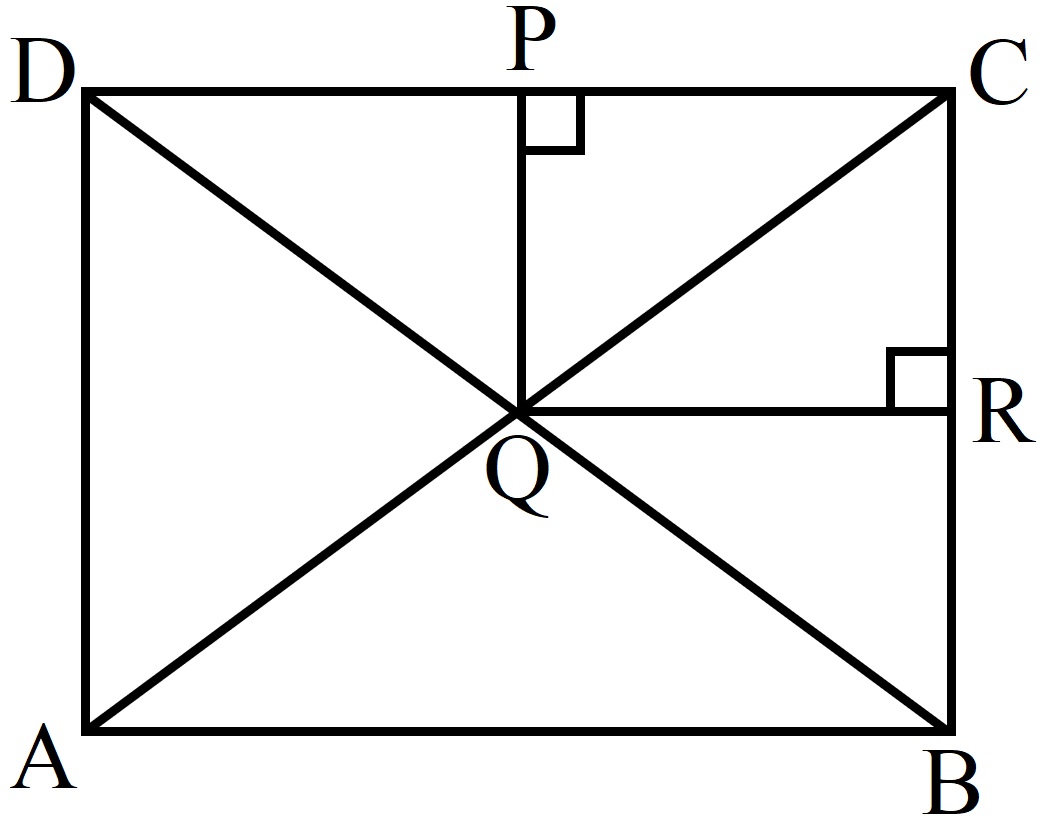
Assertion: $\text{ABCD}$ and $\text{PQRC}$ are rectangles and $Q$ is a midpoint of $\text{AC.}$ Then $\text{DP = PC.}$
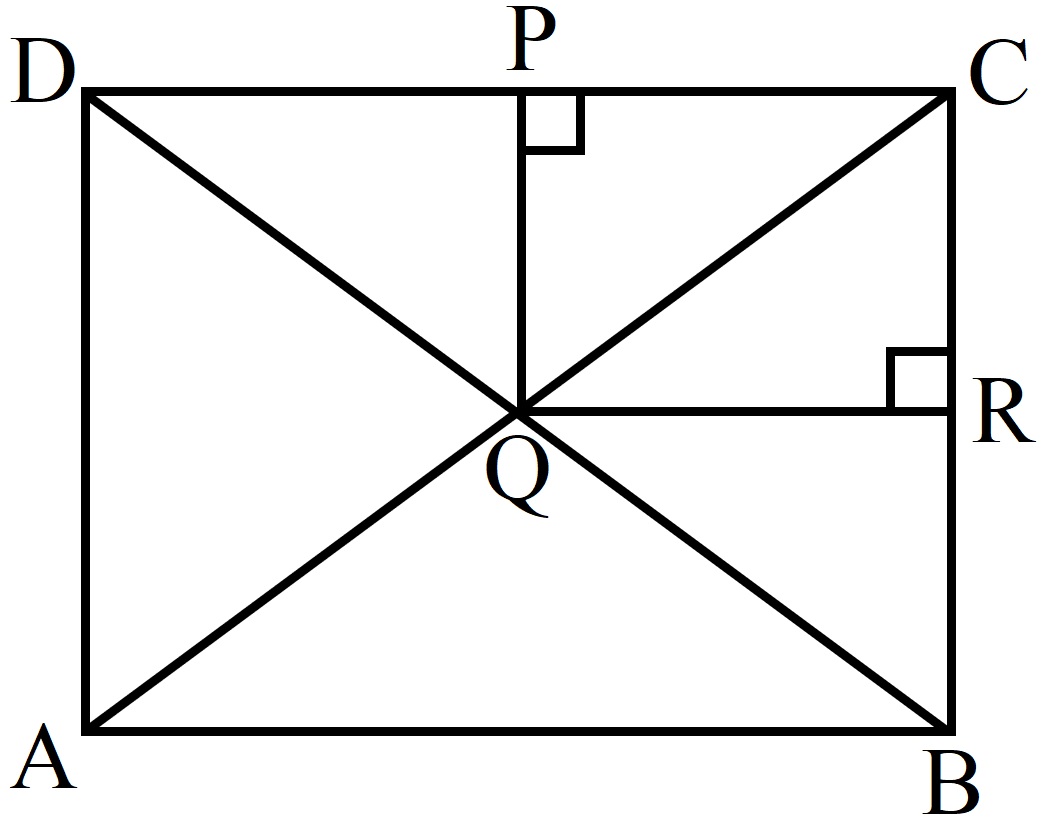
Reason: The line segment joining the midpoint of any two sides of a triangle is parallel to the third side and equal to half of it. - A
Both assertion and reason are true and reason is the correct enatixplaon of assertion.
- B
Both assertion and reason are true but reason is not the correct explanation of assertion.
- C
Assertion is true but reason is false.
- ✓
Assertion is false but reason is true.
AnswerCorrect option: D. Assertion is false but reason is true.
In $\triangle\text{ADC,Q}$ is the midpoint of $\text{AC}$ such that $\text{PQ}\parallel\text{AD}.$
$P$ is the mid $-$ point of $\text{DC}$
$\text{DP = PC} [$Using converse of midpoint theorem$]$
View full question & answer→MCQ 241 Mark
Directions: In the following questions, the Assertions $(A)$ and Reason(s) $(R)$ have been put forward. Read both the statements carefully and choose the correct alternative from the following:
Assertion: Every square is a rhombus.
Reason: It has four equal - length sides and goes above and beyond that to also have four right angle.
- ✓
Both Assertion and Reason are correct and Reason is the correct explanation for Assertion.
- B
Both Assertion and Reason are correct and Reason is not the correct explanation for Assertion.
- C
Assertion is true but the reason is false.
- D
Both assertion and reason are false.
AnswerCorrect option: A. Both Assertion and Reason are correct and Reason is the correct explanation for Assertion.
Both Assertion and Reason are correct and Reason is the correct explanation for Assertion.
View full question & answer→MCQ 251 Mark
Directions: In the following questions, the Assertions $(A)$ and Reason(s) $(R)$ have been put forward. Read both the statements carefully and choose the correct alternative from the following:
Assertion: A parallogram whose adjacent are equal is known as rhombus.
Reason: The diagonas of parallogram are not bisect each other.
- A
Both Assertion and Reason are correct and Reason is the correct explanation for Assertion.
- B
Both Assertion and Reason are correct and Reason is not the correct explanation for Assertion.
- ✓
Assertion is true but the reason is false.
- D
Both assertion and reason are false.
AnswerCorrect option: C. Assertion is true but the reason is false.
Assertion is true but the reason is false.
View full question & answer→MCQ 261 Mark
Directions: In the following questions, the Assertions $(A)$ and Reason(s) $(R)$ have been put forward. Read both the statements carefully and choose the correct alternative from the following:
Assertion: Rectangle is equiangular.
Reason: All angles of rectangle are equal.
- ✓
Both Assertion and Reason are correct and Reason is the correct explanation for Assertion.
- B
Both Assertion and Reason are correct and Reason is not the correct explanation for Assertion.
- C
Assertion is true but the reason is false.
- D
Both assertion and reason are false.
AnswerCorrect option: A. Both Assertion and Reason are correct and Reason is the correct explanation for Assertion.
Both Assertion and Reason are correct and Reason is the correct explanation for Assertion.
View full question & answer→MCQ 271 Mark
Directions: In the following questions, the Assertions $(A)$ and Reason(s) $(R)$ have been put forward. Read both the statements carefully and choose the correct alternative from the following:
Assertion: If the diagonals of a parallelogram $ABCD$ are equal, then $\angle\text{ABC}=90^\circ.$
Reason: If the diagonals of a parallelogram are equal, it becomes a rectangle.
- ✓
Both Assertion and Reason are correct and Reason is the correct explanation for Assertion.
- B
Both Assertion and Reason are correct and Reason is not the correct explanation for Assertion.
- C
Assertion is true but the reason is false.
- D
Both assertion and reason are false.
AnswerCorrect option: A. Both Assertion and Reason are correct and Reason is the correct explanation for Assertion.
Both Assertion and Reason are correct and Reason is the correct explanation for Assertion.
View full question & answer→MCQ 281 Mark
Directions: In the following questions, the Assertions $(A)$ and Reason(s) $(R)$ have been put forward. Read both the statements carefully and choose the correct alternative from the following:
Assertion: $\text{ABCD}$ is a quadrilateral in which $P, Q, R$ and $S$ are the mid $-$ points of $AB, BC, CD$ and $DA$ respectively. Then, $\text{PQRS}$ is a parallelogram.
Reason : The line segment joining the mid $-$ points of any two sides of a triangle is parallel to the third side and equal to half of it.
- ✓
Both assertion $(A)$ and reason $(R)$ are true and reason $(R)$ is a correct explanation of assertion $(A).$
- B
Both assertion $(A)$ and reason $(R)$ are true but reason $(R)$ is not a correct explanation of assertion $(A).$
- C
Assertion $(A)$ is true and reason $(R)$ is false.
- D
Assertion $(A)$ is false and reason $(R)$ is true.
AnswerCorrect option: A. Both assertion $(A)$ and reason $(R)$ are true and reason $(R)$ is a correct explanation of assertion $(A).$
Both assertion $(A)$ and reason $(R)$ are true and reason $(R)$ is a correct explanation of assertion $(A)$.
View full question & answer→MCQ 291 Mark
Directions: In the following questions, the Assertions $(A)$ and Reason(s) $(R)$ have been put forward. Read both the statements carefully and choose the correct alternative from the following:
Assertion: $1.44\ sq.m$ the area of a square clipboard whose side measures $120\ cm.$
Reason: Area of square = $side^2$.
- ✓
Both Assertion and Reason are correct and Reason is the correct explanation for Assertion.
- B
Both Assertion and Reason are correct and Reason is not the correct explanation for Assertion.
- C
Assertion is true but the reason is false.
- D
Both assertion and reason are false.
AnswerCorrect option: A. Both Assertion and Reason are correct and Reason is the correct explanation for Assertion.
Both Assertion and Reason are correct and Reason is the correct explanation for Assertion.
View full question & answer→MCQ 301 Mark
Directions: In the following questions, the Assertions $(A)$ and Reason(s) $(R)$ have been put forward. Read both the statements carefully and choose the correct alternative from the following:
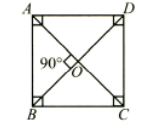
Assertion: $ABCD$ is a square. $AC$ and $BD$ intersect at $O$. The measure of $\angle\text{AOB}=90^\circ$.
Reason: Diagonals of a square bisect each other at right angles.
- ✓
Both assertion and reason are true and reason is the correct enatixplaon of assertion.
- B
Both assertion and reason are true but reason is not the correct explanation of assertion.
- C
Assertion is true but reason is false.
- D
Assertion is false but reason is true.
AnswerCorrect option: A. Both assertion and reason are true and reason is the correct enatixplaon of assertion.
Since, diagonals of a square bisect each other at right angles.
$\angle\text{AOB}=90^\circ$
View full question & answer→MCQ 311 Mark
Directions: In the following questions, the Assertions $(A)$ and Reason(s) $(R)$ have been put forward. Read both the statements carefully and choose the correct alternative from the following:
Assertion: Adjacent side of rhombus are equal.
Reason: The opposite side of rhombus are equal.
- A
Both Assertion and Reason are correct and Reason is the correct explanation for Assertion.
- ✓
Both Assertion and Reason are correct and Reason is not the correct explanation for Assertion.
- C
Assertion is true but the reason is false.
- D
Both assertion and reason are false.
AnswerCorrect option: B. Both Assertion and Reason are correct and Reason is not the correct explanation for Assertion.
Both Assertion and Reason are correct and Reason is not the correct explanation for Assertion.
View full question & answer→MCQ 321 Mark
Directions: In the following questions, the Assertions $(A)$ and Reason(s) $(R)$ have been put forward. Read both the statements carefully and choose the correct alternative from the following:
Assertion: The angles of a quadrilateral are $x^\circ , (x – 10)^\circ , (x + 30)^\circ $ and $(2x)^\circ ,$ the smallest angle is equal to $58^\circ .$
Reason: Sum of the angles of a quadrilateral is $360^\circ .$
- ✓
Both Assertion and Reason are correct and Reason is the correct explanation for Assertion.
- B
Both Assertion and Reason are correct and Reason is not the correct explanation for Assertion.
- C
Assertion is true but the reason is false.
- D
Both assertion and reason are false.
AnswerCorrect option: A. Both Assertion and Reason are correct and Reason is the correct explanation for Assertion.
Both Assertion and Reason are correct and Reason is the correct explanation for Assertion.
View full question & answer→MCQ 331 Mark
Directions: In the following questions, the Assertions $(A)$ and Reason(s) $(R)$ have been put forward. Read both the statements carefully and choose the correct alternative from the following:
Assertion: Triangle is not quadrilateral.
Reason: Quadrilateral is a polygon it has four side.
- ✓
Both Assertion and Reason are correct and Reason is the correct explanation for Assertion.
- B
Both Assertion and Reason are correct and Reason is not the correct explanation for Assertion.
- C
Assertion is true but the reason is false.
- D
Both assertion and reason are false.
AnswerCorrect option: A. Both Assertion and Reason are correct and Reason is the correct explanation for Assertion.
Both Assertion and Reason are correct and Reason is the correct explanation for Assertion.
View full question & answer→MCQ 341 Mark
Directions: In the following questions, the Assertions $(A)$ and Reason(s) $(R)$ have been put forward. Read both the statements carefully and choose the correct alternative from the following:
Assertion: A parallelogram consists of two congruent triangles.
Reason: Diagonal of a parallelogram divides it into two congruent triangles.
- ✓
Both Assertion and Reason are correct and Reason is the correct explanation for Assertion.
- B
Both Assertion and Reason are correct and Reason is not the correct explanation for Assertion.
- C
Assertion is true but the reason is false.
- D
Both assertion and reason are false.
AnswerCorrect option: A. Both Assertion and Reason are correct and Reason is the correct explanation for Assertion.
Both Assertion and Reason are correct and Reason is the correct explanation for Assertion.
View full question & answer→MCQ 351 Mark
Directions: In the following questions, the Assertions $(A)$ and Reason(s) $(R)$ have been put forward. Read both the statements carefully and choose the correct alternative from the following:
Assertion: All the four angles of a quadrilateral cannot be obtuse.
Reason: Because obtuse angle is grater than $90^\circ .$
- ✓
Both Assertion and Reason are correct and Reason is the correct explanation for Assertion.
- B
Both Assertion and Reason are correct and Reason is not the correct explanation for Assertion.
- C
Assertion is true but the reason is false.
- D
Both assertion and reason are false.
AnswerCorrect option: A. Both Assertion and Reason are correct and Reason is the correct explanation for Assertion.
Both Assertion and Reason are correct and Reason is the correct explanation for Assertion.
View full question & answer→MCQ 361 Mark
Directions: In the following questions, the Assertions $(A)$ and Reason(s) $(R)$ have been put forward. Read both the statements carefully and choose the correct alternative from the following:
Assertion: The consecutive sides of a quadrilateral have one common point..
Reason: The opposite sides of a quadrilateral have two common point.
- A
Both assertion and reason are true and reason is the correct enatixplaon of assertion.
- B
Both assertion and reason are true but reason is not the correct explanation of assertion.
- ✓
Assertion is true but reason is false.
- D
Assertion is false but reason is true.
AnswerCorrect option: C. Assertion is true but reason is false.
Assertion is true but reason is false.
View full question & answer→MCQ 371 Mark
Directions: In the following questions, the Assertions $(A)$ and Reason(s) $(R)$ have been put forward. Read both the statements carefully and choose the correct alternative from the following:
Assertion: In $\text{ABC,}$ median $\text{AD}$ is produced to $X$ such that $\text{AD = DX.}$ Then $\text{ABXC}$ is a parallelogram.
Reason: Diagonals $\text{AX}$ and $\text{BC}$ bisect each other at right angles.
- A
Both assertion and reason are true and reason is the correct enatixplaon of assertion.
- B
Both assertion and reason are true but reason is not the correct explanation of assertion.
- ✓
Assertion is true but reason is false.
- D
Assertion is false but reason is true.
AnswerCorrect option: C. Assertion is true but reason is false.
In quadrilateral $\text{ABXC,}$ we have
$\text{AD = DX} [$Given$]$
$\text{BD = DC} [$Given$]$
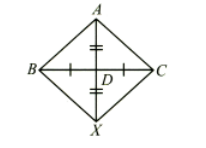
So, diagonals $\text{AX}$ and $\text{BC}$ bisect each other but not at right angles.
Therefore, $\text{ABXC}$ is a parallelogram. View full question & answer→MCQ 381 Mark
Directions: In the following questions, the Assertions $(A)$ and Reason(s) $(R)$ have been put forward. Read both the statements carefully and choose the correct alternative from the following:
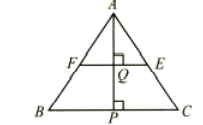
Assertion: In $\text{ABC, E}$ and $F$ are the midpoints of $\text{AC}$ and $\text{AB}$ respectively. The altitude $\text{AP}$ at $\text{BC}$ intersects $\text{FE}$ at $Q$. Then, $\text{AQ = QP.}$
Reason: $Q$ is the midpoint of $\text{AP.}$
- ✓
Both assertion and reason are true and reason is the correct enatixplaon of assertion.
- B
Both assertion and reason are true but reason is not the correct explanation of assertion.
- C
Assertion is true but reason is false.
- D
Assertion is false but reason is true.
AnswerCorrect option: A. Both assertion and reason are true and reason is the correct enatixplaon of assertion.
In $\triangle\text{ABC}, E$ and $F$ are midpoint of the sides $\text{AC}$ and $\text{AB}$ respectively.
$\text{FE}\parallel\text{BC} [$By mid $-$ point theorem$]$
$Q$ is mid $-$ point of $\text{AP}$
$\text{AQ = QP.}$
View full question & answer→MCQ 391 Mark
Directions: In the following questions, the Assertions $(A)$ and Reason(s) $(R)$ have been put forward. Read both the statements carefully and choose the correct alternative from the following:
Assertion: $ABCD$ and $PQRC$ are rectangles and $Q$ is a midpoint of $AC $. Then $DP = PC.$
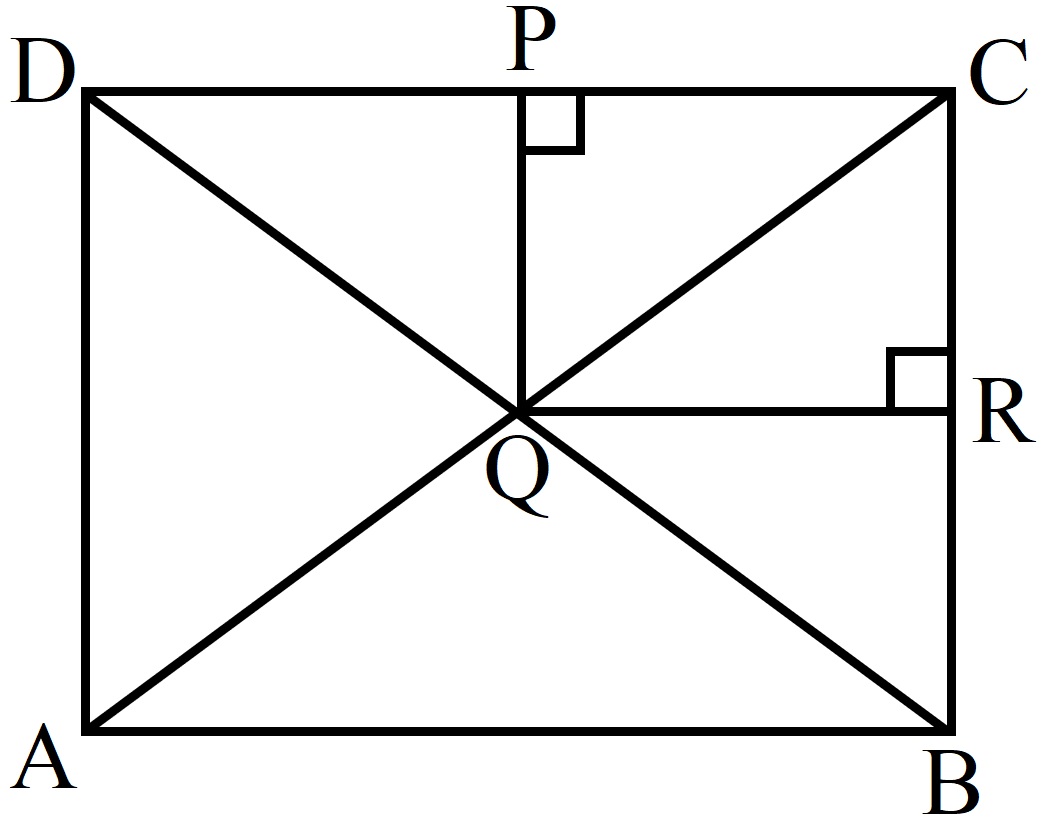
Reason: The line segment joining the midpoint of any two sides of a triangle is parallel to the third side and equal to half of it. - A
Both Assertion and Reason are correct and Reason is the correct explanation for Assertion.
- ✓
Both Assertion and Reason are correct and Reason is not the correct explanation for Assertion.
- C
Assertion is true but the reason is false.
- D
Both assertion and reason are false.
AnswerCorrect option: B. Both Assertion and Reason are correct and Reason is not the correct explanation for Assertion.
Both Assertion and Reason are correct and Reason is not the correct explanation for Assertion.
View full question & answer→MCQ 401 Mark
Directions: In the following questions, the Assertions $(A)$ and Reason$(s) (R)$ have been put forward. Read both the statements carefully and choose the correct alternative from the following:
Assertion: A rectangle is $6\ m$ wide and $3\ m$ high, $18\ m^2$ is its Area.
Reason: Area of rectangle $=$ leangth $\times$ breadth.
- ✓
Both Assertion and Reason are correct and Reason is the correct explanation for Assertion.
- B
Both Assertion and Reason are correct and Reason is not the correct explanation for Assertion.
- C
Assertion is true but the reason is false.
- D
Both assertion and reason are false.
AnswerCorrect option: A. Both Assertion and Reason are correct and Reason is the correct explanation for Assertion.
Both Assertion and Reason are correct and Reason is the correct explanation for Assertion.
View full question & answer→MCQ 411 Mark
Directions: In the following questions, the Assertions $(A)$ and Reason(s) $(R)$ have been put forward. Read both the statements carefully and choose the correct alternative from the following:
Assertion: $ABCD$ is a rhombus such that $\angle\text{ABC}=40^\circ$ then $\angle\text{ADC}$ is equal to $40^\circ .$
Reason: In rhombus opposite angles are equal.
- ✓
Both Assertion and Reason are correct and Reason is the correct explanation for Assertion.
- B
Both Assertion and Reason are correct and Reason is not the correct explanation for Assertion.
- C
Assertion is true but the reason is false.
- D
Both assertion and reason are false.
AnswerCorrect option: A. Both Assertion and Reason are correct and Reason is the correct explanation for Assertion.
Both Assertion and Reason are correct and Reason is the correct explanation for Assertion.
View full question & answer→MCQ 421 Mark
Directions: In the following questions, the Assertions $(A)$ and Reason(s) $(R)$ have been put forward. Read both the statements carefully and choose the correct alternative from the following:
Assertion: If the diagonals of a parallelogram $ABCD$ are equal, then $\angle\text{ABC}=90^\circ$.
Reason: If the diagonals of a parallelogram are equal, it becomes a rectangle.
- ✓
Both assertion and reason are true and reason is the correct enatixplaon of assertion.
- B
Both assertion and reason are true but reason is not the correct explanation of assertion.
- C
Assertion is true but reason is false.
- D
Assertion is false but reason is true.
AnswerCorrect option: A. Both assertion and reason are true and reason is the correct enatixplaon of assertion.
Both assertion and reason are true and reason is the correct enatixplaon of assertion.
View full question & answer→MCQ 431 Mark
Directions: In the following questions, the Assertions $(A)$ and Reason(s) $(R) $ have been put forward. Read both the statements carefully and choose the correct alternative from the following:
Assertion: The interior angle of a rectangle at each vertex is $90^\circ .$
Reason: The sum of all interior angles is $360^\circ .$
- ✓
Both Assertion and Reason are correct and Reason is the correct explanation for Assertion.
- B
Both Assertion and Reason are correct and Reason is not the correct explanation for Assertion.
- C
Assertion is true but the reason is false.
- D
Both assertion and reason are false.
AnswerCorrect option: A. Both Assertion and Reason are correct and Reason is the correct explanation for Assertion.
Both Assertion and Reason are correct and Reason is the correct explanation for Assertion.
View full question & answer→MCQ 441 Mark
Directions: In the following questions, the Assertions $(A)$ and Reason(s) $(R)$ have been put forward. Read both the statements carefully and choose the correct alternative from the following:
Assertion: If the angles of a quadrilateral are in the ratio $2 : 3 : 7 : 6,$ then the measure of angles are $40^\circ , 60^\circ , 140^\circ , 120^\circ $ respectively.
Reason: The sum of the angles of a quadrilateral is $360^\circ .$
- ✓
Both assertion and reason are true and reason is the correct enatixplaon of assertion.
- B
Both assertion and reason are true but reason is not the correct explanation of assertion.
- C
Assertion is true but reason is false.
- D
Assertion is false but reason is true.
AnswerCorrect option: A. Both assertion and reason are true and reason is the correct enatixplaon of assertion.
Both assertion and reason are true and reason is the correct enatixplaon of assertion.
View full question & answer→MCQ 451 Mark
Assertion and Reason Type $\text{MCQ}$
Assertion : Every parallelogram is a rectangle.
Reason : The angle bisectors of a parallelogram form a rectangle.
- A
Both Assertion $(A)$ and Reason $(R)$ are true and Reason is a correct explanation of Assertion $(A).$
- B
Both Assertion $(A)$ and Reason $(R)$ are true but Reason is not a correct explanation of Assertio $(A).$
- C
Assertion $(A)$ is true and Reason $(R)$ is false.
- ✓
Assertion $(A)$ is false and Reason $(R)$ is true.
AnswerCorrect option: D. Assertion $(A)$ is false and Reason $(R)$ is true.
Every parallelogram need not be rectangle, since a parallelogram could be a square, or a rhombus too.
So, the Assertion $(A)$ is false.
The angle bi sectors of a parallelogram form a rectangle.
So, the Reason $(R)$ is true.
View full question & answer→MCQ 461 Mark
Directions: In the following questions, the Assertions $(A)$ and Reason(s) $(R)$ have been put forward. Read both the statements carefully and choose the correct alternative from the following:
Assertion: Every square is a rectangle.
Reason: Because it is a quadrilateral with all four angles right angles.
- ✓
Both Assertion and Reason are correct and Reason is the correct explanation for Assertion.
- B
Both Assertion and Reason are correct and Reason is not the correct explanation for Assertion.
- C
Assertion is true but the reason is false.
- D
Both assertion and reason are false.
AnswerCorrect option: A. Both Assertion and Reason are correct and Reason is the correct explanation for Assertion.
Both Assertion and Reason are correct and Reason is the correct explanation for Assertion.
View full question & answer→MCQ 471 Mark
Directions: In the following questions, the Assertions $(A)$ and Reason(s) $(R)$ have been put forward. Read both the statements carefully and choose the correct alternative from the following:
Assertion: A rectangle is $12\ cm$ wide, and $5\ cm$ tall, $13\ cm$ is the length of a diagonal.
Reason: Leangth of diagonal of rectangle $\text{I}=\sqrt{(\text{a}^2+\text{b}^2)}.$
- ✓
Both Assertion and Reason are correct and Reason is the correct explanation for Assertion.
- B
Both Assertion and Reason are correct and Reason is not the correct explanation for Assertion.
- C
Assertion is true but the reason is false.
- D
Both assertion and reason are false.
AnswerCorrect option: A. Both Assertion and Reason are correct and Reason is the correct explanation for Assertion.
Both Assertion and Reason are correct and Reason is the correct explanation for Assertion.
View full question & answer→MCQ 481 Mark
Directions: In the following questions, the Assertions $(A)$ and Reason(s) $(R)$ have been put forward. Read both the statements carefully and choose the correct alternative from the following:
Assertion: The value of xin given figure is $140^\circ .$
Reason: Sum of angles of quadrilateral is $360^\circ .$
- ✓
Both Assertion and Reason are correct and Reason is the correct explanation for Assertion.
- B
Both Assertion and Reason are correct and Reason is not the correct explanation for Assertion.
- C
Assertion is true but the reason is false.
- D
Both assertion and reason are false.
AnswerCorrect option: A. Both Assertion and Reason are correct and Reason is the correct explanation for Assertion.
Both Assertion and Reason are correct and Reason is the correct explanation for Assertion.
View full question & answer→MCQ 491 Mark
Directions: In the following questions, the Assertions $(A)$ and Reason(s) $(R)$ have been put forward. Read both the statements carefully and choose the correct alternative from the following:
Assertion: Rectangle have leangth and breadth.
Reason: The largest side of rectangle is breadth.
- A
Both Assertion and Reason are correct and Reason is the correct explanation for Assertion.
- B
Both Assertion and Reason are correct and Reason is not the correct explanation for Assertion.
- ✓
Assertion is true but the reason is false.
- D
Both assertion and reason are false.
AnswerCorrect option: C. Assertion is true but the reason is false.
Assertion is true but the reason is false.
View full question & answer→MCQ 501 Mark
Directions: In the following questions, the Assertions $(A)$ and Reason(s) $(R)$ have been put forward. Read both the statements carefully and choose the correct alternative from the following:
Assertion: In $\triangle\text{ABC}, E$ and $F$ are the midpoints of $AC$ and $AB$ respectively. The altitude $AP$ at $BC$ intersects $FE$ at $Q.$ Then, $AQ = QP.$
Reason: $Q$ is the midpoint of $AP.$
- A
Both Assertion and Reason are correct and Reason is the correct explanation for Assertion.
- ✓
Both Assertion and Reason are correct and Reason is not the correct explanation for Assertion.
- C
Assertion is true but the reason is false.
- D
Both assertion and reason are false.
AnswerCorrect option: B. Both Assertion and Reason are correct and Reason is not the correct explanation for Assertion.
Both Assertion and Reason are correct and Reason is not the correct explanation for Assertion.
View full question & answer→